Project Management UL: Courses, Options and Alternatives
Does a project management certificate prove you can manage a project?
Many candidates searching for project management UL start with the course and never ask that question. They compare titles, fees and durations, pick the one that fits the calendar, and assume the certificate settles the matter. Then they sit in an interview and discover that the panel wants to hear about a schedule they recovered, not a module they passed.
The gap sits in the assumption. A course title doesn't tell you what an award is worth, and in Ireland the same phrase covers at least four different routes with different lengths, different awards and different standing with employers. The letters UL point to one of those routes, not to all of them.
This guide untangles them. It treats UL as the University of Limerick, sets that route beside micro-credentials and private online certificates, and is direct about the distinction that catches people out: a certificate documents study, while a degree is a recognised academic award. Those aren't the same claim, and a hiring manager reading a CV knows the difference.
Table of Contents
- Project Management Study Routes at a Glance
- What a Project Management Course Actually Teaches
- Core Subjects and the Tools You Practise
- Why Irish Employers Want Project Managers
- Alternatives to a University of Limerick Route
- Choosing Between a Degree and a Short Certificate
- Build Project Evidence and Confirm Your Next Step
Project Management Study Routes at a Glance
In most searches, UL means the University of Limerick. A learner typing project management UL is usually weighing a university place against something quicker, and the four realistic options are an undergraduate degree with project management modules, a postgraduate taught master's, a short micro-credential, or a private online certificate such as a Mini-MBA.
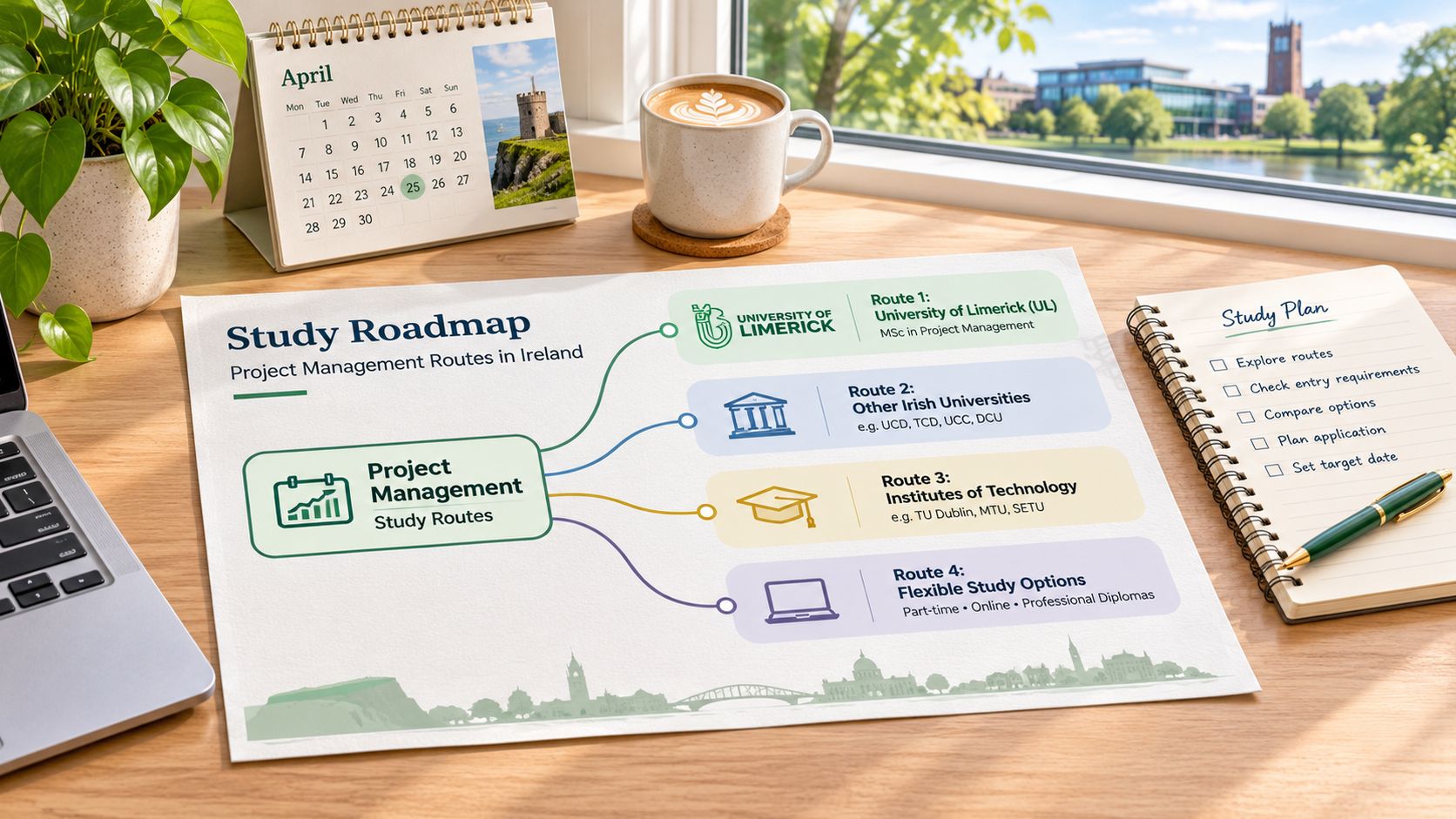
Read the table below as a map of what each route delivers, not a ranking. A degree builds long-term recognition and a transcript an employer can interpret without help. A micro-credential suits someone adding one focused skill to an existing career. A private certificate documents self-paced study, and it is a provider's record of completion rather than a university award.
| Route | Typical length | Award | Best for |
|---|---|---|---|
| Undergraduate degree with project management modules | Three to four years, set by the institution | Honours degree | School leavers and career starters |
| Postgraduate taught master's | One to two years, full-time or part-time | Master's degree | Graduates and experienced managers wanting a formal credential |
| Micro-credential from an Irish university | Roughly 25 to 900 hours | Standalone or stackable award (1 to 30 ECTS) | Professionals adding one focused skill |
| Private online Mini-MBA or certificate | Self-paced | Provider certificate, not a degree | Working professionals who need skills and a documented record |
The lengths in the first two rows are the standard shape of an Irish honours degree and a taught master's rather than confirmed UL programme facts. Current UL programme titles, fees and entry requirements change, so confirm them on the university's own pages before you build a plan around one.
Practical rule: match the route to the decision you're trying to unlock, not to the number of modules on offer. A promotion panel, a visa application and a first job interview ask for three different kinds of proof.
What follows starts with the subject itself, because every route on that table teaches some version of the same lifecycle.
What a Project Management Course Actually Teaches
Project management is taught as a lifecycle, and the clearest way to see it is to borrow a film set. Long before the cameras roll, someone has signed off the script, the budget and the shooting schedule. The shoot is short compared with the preparation, and the job doesn't end when filming wraps, because the finished film has to be handed over and the lessons written down.
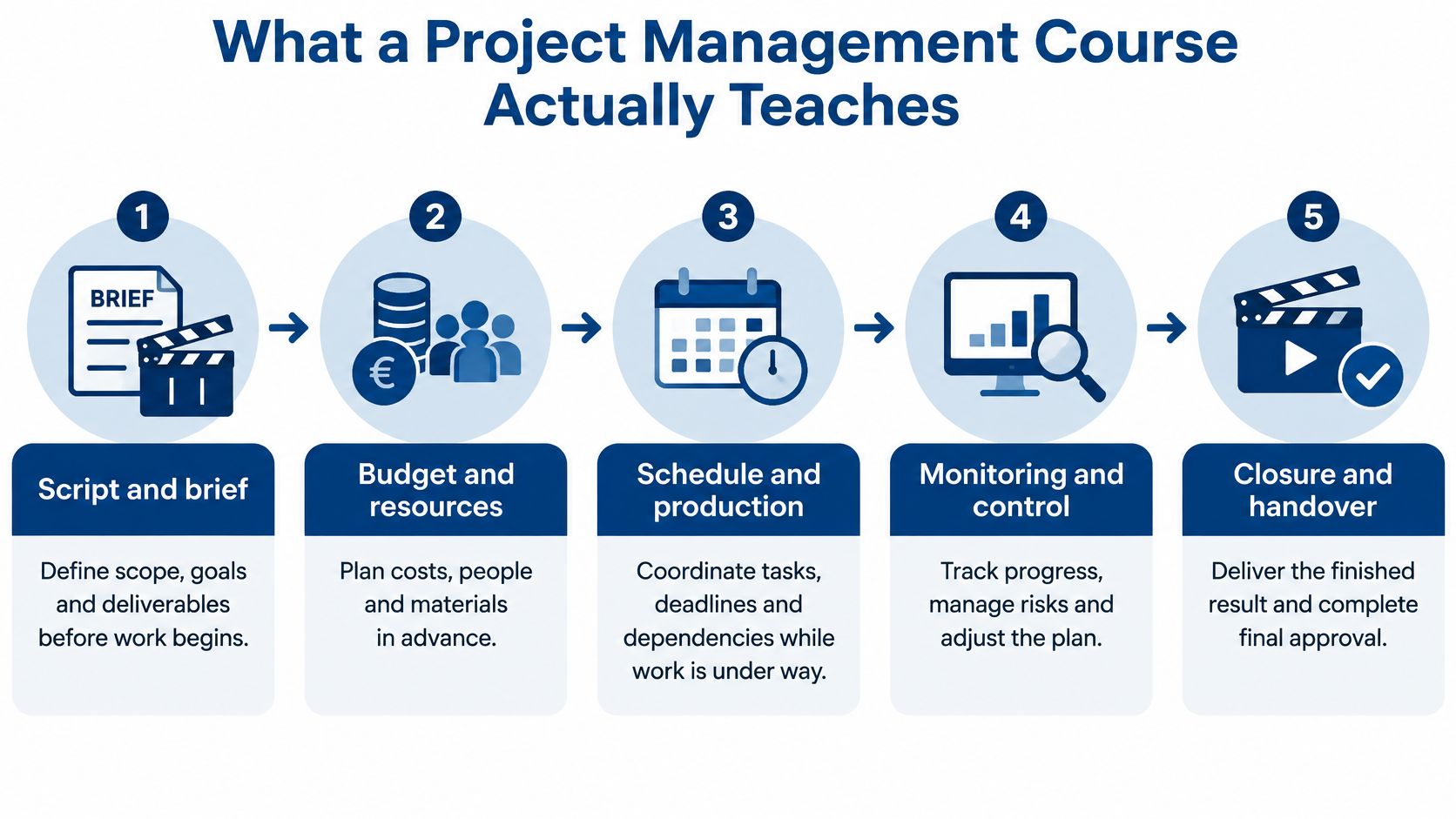
A course maps that arc onto five stages, and each one produces a specific decision.
- Initiation. The business case and the scope. What problem the project solves, what falls inside it, what falls outside, and who pays. A weak business case lets a badly defined project through the gate, and everything downstream inherits the flaw.
- Planning. Schedule, budget and risks. Task sequence, duration estimates, a cost baseline and a risk register with owners attached.
- Execution. Leading the team and the suppliers. Clearing blockers, running the interfaces between trades or departments, keeping decisions with the people authorised to make them.
- Monitoring and control. Tracking progress against the baseline, explaining variance, and controlling change instead of absorbing it.
- Closure. Handover, acceptance, the post-project review and the benefits the sponsor was promised.
The order matters more than the labels. The Project Ireland 2040 capital plan records that 64% of major projects sat at appraisal or planning and design, while 31% were at implementation or construction. Most of what decides an outcome is settled before anyone breaks ground.
Picture a housing scheme where the scope was left loose at initiation. Say the specification for groundworks was never fixed, so the tender went out with an allowance instead of a design. Weather delays the excavation, the allowance is spent by month three, and the construction team starts value-engineering the finishes to protect the budget. That is an illustration, not a case study, and it's the standard shape of an overrun: the cost shows up in construction, the cause sits in planning.
The national portfolio explains why this is taught so heavily in Ireland. Project Ireland 2040 spans transport, housing, water, health and education, which means prioritisation, appraisal, procurement and delivery assurance run across many projects at once rather than one at a time.
By the end of a first course, a learner should be able to name each stage and state the decision it produces. That's a modest test, and it separates a course that teaches vocabulary from one that teaches control.
Core Subjects and the Tools You Practise
The syllabus looks similar across most providers, and the differences usually lie in whether each subject is practised or only described. Every row below is a working tool, not a chapter to be memorised.
| Subject | What you learn to do | Practice tool |
|---|---|---|
| Initiation and business case | Justify a project and define its scope | Project charter |
| Scheduling | Sequence tasks and identify the critical path | Work breakdown structure and Gantt chart |
| Cost control | Build a budget, forecast and explain variances | Budget versus forecast tracker |
| Risk management | Identify, score and respond to risks | Risk register |
| Stakeholders and communication | Map influence and plan updates | Stakeholder map |
| Procurement and contracts | Compare suppliers and manage contract changes | Supplier evaluation matrix and change log |
| Quality and closure | Confirm acceptance and record lessons learned | Post-project review |
Knowing a subject and practising it are different things
Knowing what a critical path is takes a paragraph. Finding it in a schedule of forty tasks, with two shared resources and a supplier lead time that moved last week, takes an afternoon and a spreadsheet. That's the gap employers test for, and it's the reason a course is only as good as the exercises attached to it.
Irish recruitment evidence points the same way. The 2024 National Skills Bulletin reports that employment among civil engineers and construction project managers grew by approximately 2,400 people since 2022, above the national average, with rising employment-permit issuance. Employers reported persistent difficulty filling vacancies, and the skills named for those roles were project management, problem solving and critical thinking, not framework recall.
Three exercises build the same muscles at home, and none of them requires a workplace.
- Draft a work breakdown structure for a kitchen renovation. Break it to the level where each task has one owner, one duration and one dependency. You'll find the ordering problem in minutes.
- Build a five-line risk register for something you're planning. Score each risk on likelihood and impact, name an owner, and write the response. Five honest lines beat fifty copied ones.
- Track a small household budget against a forecast for three months. Record the forecast, then the actual, then the variance and the reason. Cost control is variance explanation, and the habit transfers straight into a project.
Tools like these are also where automation is starting to appear, mostly in drafting and early warning rather than in approval. The changes artificial intelligence is bringing to project management sit alongside the register, not above it.
If time is short, prioritise two subjects. Take scheduling first, because the critical path is the argument you'll make most often when a date slips. Take risk management second, because it's the subject that turns a status report into a forecast, and it's the one hiring managers probe when they ask what went wrong on your last piece of work.
Why Irish Employers Want Project Managers
A graduate applies for a site role and the interview turns on one question: the planning approval for your package is running eight weeks late, so what do you do next? The answer separates candidates who have run delivery from candidates who have read about it, and the Irish labour market is short of the first group. The key traits of successful project managers show up in that answer far more than in any qualification.
The scale of that shortage is documented. The Expert Group's third report on future skills needs forecast that approximately 5,100 managers and supervisors would be needed over the National Development Plan period, while only about 1,650 students were expected to graduate with the relevant skills. That's an estimated shortfall of roughly 3,450 people, and the same report recommended raising the low level of training provision in project management and supervisory skills.
Three applications show what the work looks like day to day.
A housing scheme where the schedule hangs on planning permissions and serviced-land sequencing: the project manager's value is an integrated programme that shows which units can start before which approvals land. A public water project where cost forecasting and stakeholder reporting dominate, because the spend is public and every variance gets explained to a committee. An IT rollout where the project manager coordinates technical staff with business units and owns the dependency map between them.
Where the demand sits beyond construction
Construction and engineering are the loudest, not the only, source of demand. The SOLAS National Skills Bulletin 2025 records 139,000 people employed in ICT occupations, 5.0% of the workforce, and identifies difficult-to-fill demand for project managers alongside site managers and sector-specific engineers. The ESRI's assessment of labour and skills shortages classifies ICT specialists and project managers as a high-shortage occupation group of an estimated 16,000 people.
For a learner, that has a practical consequence: check the sector focus of a course against the employer you want. A route with an IT and business coordination emphasis matches technology employers, while a construction-heavy syllabus matches contractors and design consultancies.
Read three job adverts for project roles this week and count how often risk, scheduling or stakeholder management appears. The count tells you more about the local market than any prospectus.
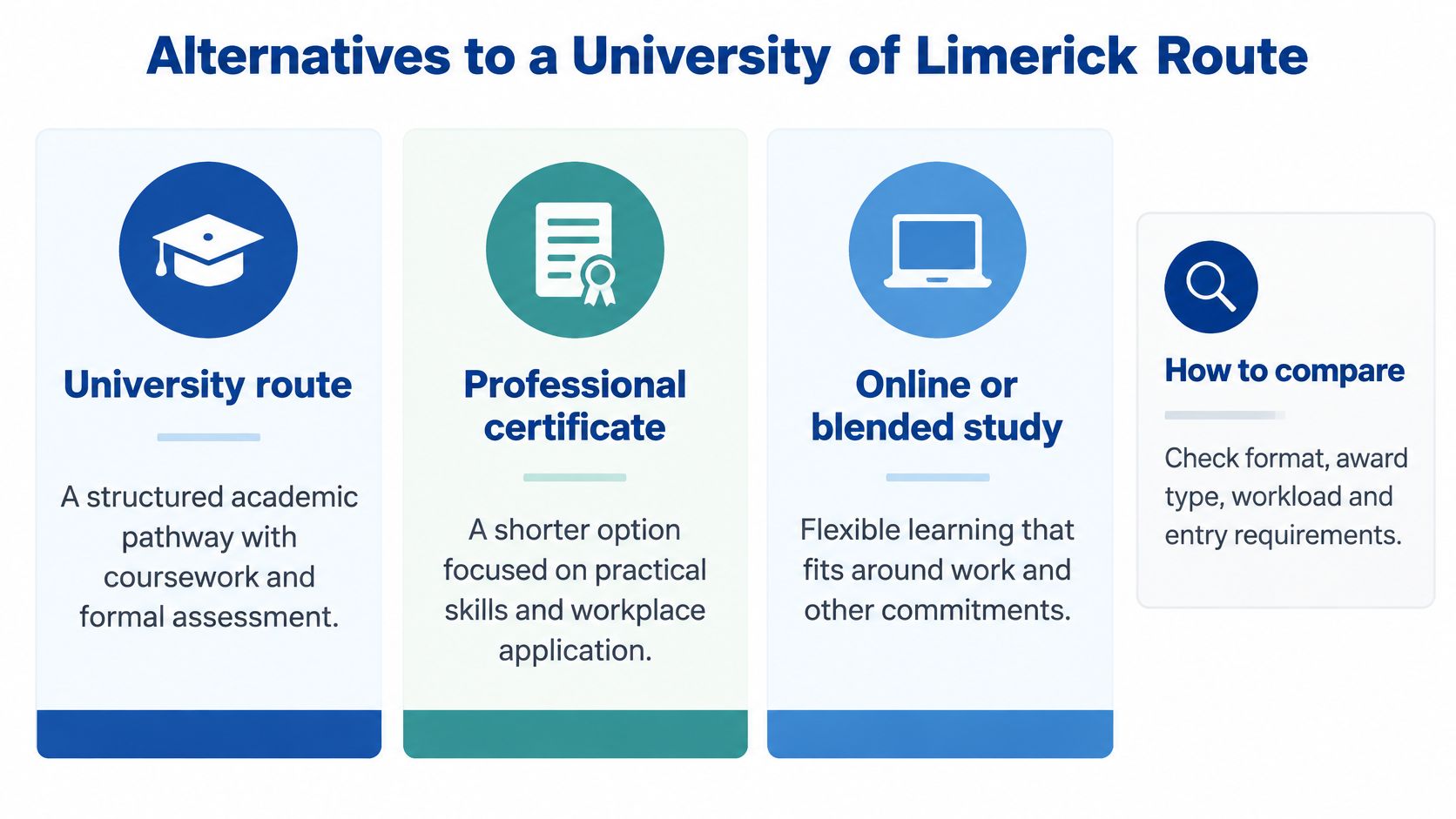
Alternatives to a University of Limerick Route
A University of Limerick route is one of several ways to study project management in Ireland, and the format and award comparison sits in the first section. What matters here is the rulebook that shapes the alternatives, because it explains what a short award can and can't claim.
What the micro-credential rules actually allow
Ireland has built a framework for short professional learning, and its limits are set out clearly by the University of Limerick's own micro-credential guidance. Awards run from 1 to 30 ECTS credits and are designed as standalone qualifications that can be transferred or stacked into larger ones. The OECD work reported there places Irish higher-education micro-credentials generally at levels 6 to 9 of the National Framework of Qualifications, representing approximately 25 to 900 hours of learning, with quality assurance overseen by Quality and Qualifications Ireland.
That's a useful structure for a working adult. It's also narrower than a degree: a micro-credential is a defined chunk of assessed learning, not a full academic programme.
The European Institute of Leadership and Management offers two project management options in this space. The Mini-MBA in Project Management covers the full lifecycle from initiation to closure. The Programme Certificate in Project Management is aimed at current project managers, team leaders and people moving into a project role. Both are fully online and self-paced.
Two claims about these programmes are the provider's own and worth confirming before enrolling: that the Mini-MBA programme certificate is earned by completing six courses within the programme, and that the institute is a certified member of the CPD Certification Service. Neither option is a university degree unless that status is separately established.
| Option | Format | Award | Main limit |
|---|---|---|---|
| University of Limerick degree or master's | Timetabled, full-time or part-time | Degree or master's | Longer commitment; confirm current entry requirements and fees |
| Irish micro-credential | Short and flexible, 1 to 30 ECTS | Standalone or stackable award | Not automatically a degree; check level and hours |
| EILM Mini-MBA in Project Management | Fully online, self-paced | Programme certificate after completing six courses | Not a university degree unless separately established |
| EILM Programme Certificate in Project Management | Fully online, self-paced | Programme certificate | Aimed at current and aspiring project managers; not a degree |
| Standalone online course | Self-paced | Course certificate | Covers one skill, such as risk management or change management |
The trade-off is straightforward. A non-degree certificate is faster and fits around a job, and it gives you a documented record of study in weeks rather than years. A UL degree or master's carries the recognition of a formal university award, which is what some employers, regulators and postgraduate admissions processes require.
Choosing Between a Degree and a Short Certificate
The assumption worth challenging is that a certificate always equals a qualification. It doesn't, and the fastest way through the decision is to start from your situation rather than from a course page.
- School leaver with no work history. The undergraduate degree route carries the most weight here, because the award does the work your CV can't yet do.
- Graduate from another discipline. Compare a taught master's with a Mini-MBA on cost and time, not on prestige. The master's buys recognition; the Mini-MBA buys skills sooner.
- Working team leader who needs structure quickly. A programme certificate or a micro-credential fits, and a certificate aimed at current project managers and team leaders is built for exactly that position.
- IT professional managing technology teams. An IT-focused Mini-MBA covers human resources management, innovation management, project management, marketing essentials and IT management in one programme, which matches organisations where the project manager also coordinates technical staff.
Weigh five criteria before you commit: the recognition your target employer asks for, the cost per hour of study, the hours you can protect each week, whether your employer will fund any of it, and whether the award can be verified or displayed on a professional profile. That last point is practical rather than cosmetic. Learners consistently say the self-paced format is what made study fit around work, and a flexible format that gets finished beats a prestigious one that gets abandoned.
Ask an employer this before you enrol: would this award meet the requirement for the role, or is a degree-level qualification the entry bar?
Here's the verdict. If a public-sector competition, a professional register or a promotion panel specifies a degree, choose a recognised degree route and treat everything shorter as preparation for it. If you need skills and a documented credential while staying in work, a short certificate is a sound choice, provided you're clear about which of the two things you're buying.
Build Project Evidence and Confirm Your Next Step
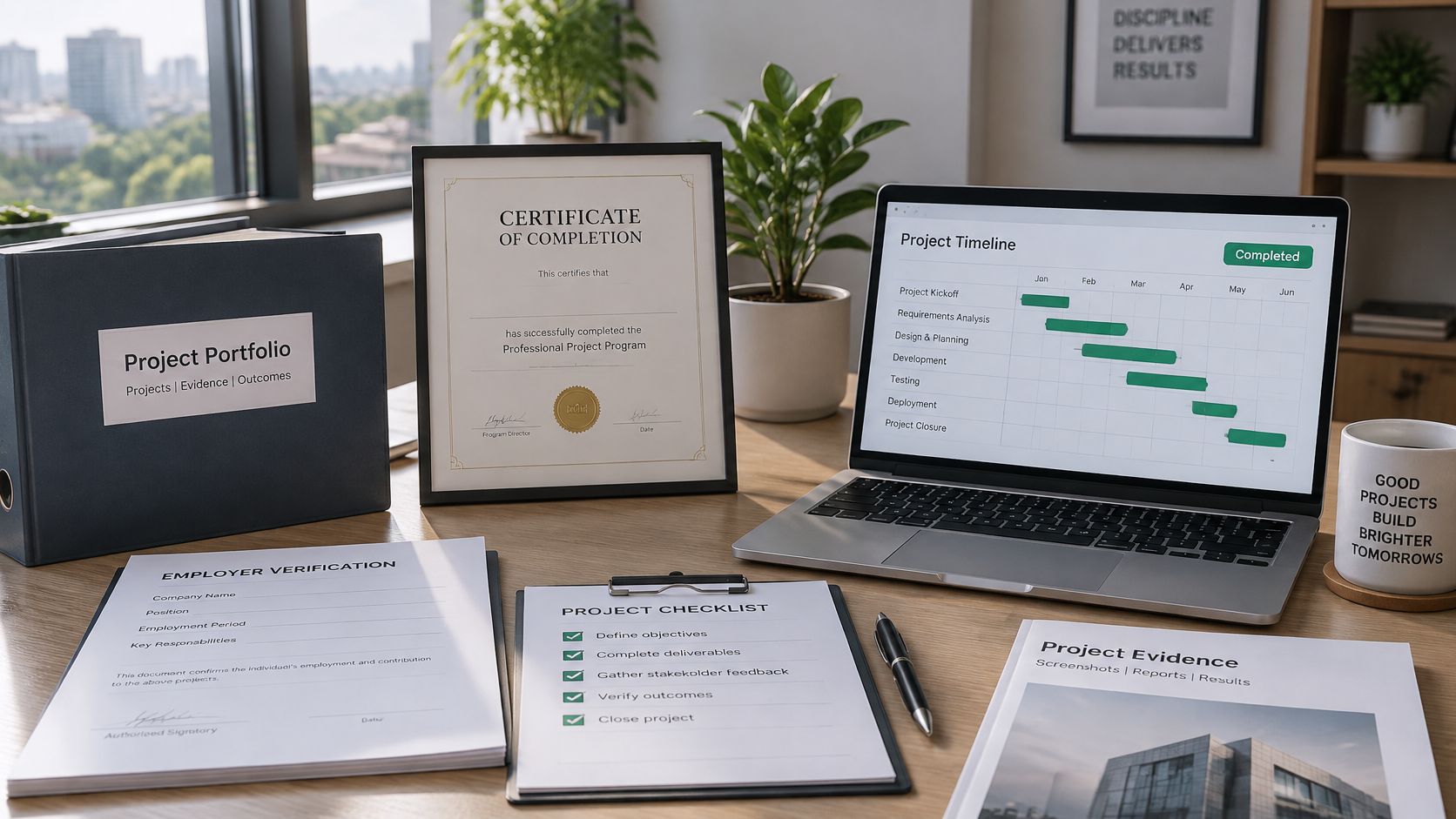
A certificate alone doesn't prove delivery, and employers say so directly. In a survey of employers in renewable energy and infrastructure, 74% identified insufficient practical experience as a recruitment barrier, compared with 60% citing general skills shortages, as Solar Ireland's experience gap report sets out. The candidates employers wanted had handled planning, grid processes, construction, commissioning and the problems that surface during execution.
The Irish construction market is large enough to absorb people who can show that evidence. Investment in total construction represented 11.2% of Ireland's modified gross national income (GNI*) in 2024, according to the Central Statistics Office.
Turning existing work into project evidence
Build one simulated portfolio around a small Irish infrastructure project and carry it to the end: a risk register with owners, a stakeholder map, a procurement decision with the comparison behind it, a change log with one rejected change, a commissioning plan and a post-project review. Then translate what you've already done. Volunteer work has scope and deadlines. Academic group work has a schedule and a dependency chain. Operations experience has cost control and variance. Running a small business has all three plus suppliers.
The portfolio question a hiring manager is really asking is whether you can hold scope, cost, risk and people in your head at the same time and explain a decision you made.
Five steps close the loop.
- Confirm the programme title and award on the official UL or provider website, in writing.
- Check entry requirements and whether the award is a degree, a micro-credential or a provider certificate.
- Compare total study hours with the hours you can realistically protect each week.
- Check fees and funding options, including whether an employer will contribute.
- Enrol and start with the lifecycle course, because every later subject depends on it.
One more detail to verify rather than assume: the Mini-MBA programme certificate is earned by completing the courses included in the programme, and the provider states it can be verified and added to a professional profile. Treat that verification route as a claim to confirm before you pay.
The single decision to make before applying is this. Confirm the award and the entry requirements first, and choose the course second.
The European Institute of Leadership and Management teaches project management through a Mini-MBA that follows the full lifecycle from initiation to closure, and through a Programme Certificate built for current project managers, team leaders and people stepping into a project role. Both are delivered fully online and self-paced, so the study fits around a working week rather than replacing it, and both are built around the tools this article describes: charters, schedules, risk registers and post-project reviews. Visit European Institute of Leadership and Management to compare the two routes and confirm which award matches the job you're aiming for.