
Value and Value Chain: How Activities Build Advantage
Orders are coming in, staff are busy, and sales look healthy. Yet after ingredients, wages, packaging, delivery and refunds are paid, the business owner sees less profit than expected. Raising prices might help, but it won't explain where the money is going.
Understanding value and value chain starts with a more useful question: which activities make the offer worth buying, and which consume resources without improving it? The answer helps managers distinguish necessary costs from avoidable waste, and useful improvements from investments that merely look impressive.
Table of Contents
- What Value and the Value Chain Actually Mean
- The Primary and Support Activities at a Glance
- How Activities Build Margin and Competitive Advantage
- Value Chains Beyond the Factory Floor
- Measuring Value When Data Is Incomplete
- Map Your Chain and Choose Where to Invest
What Value and the Value Chain Actually Mean
Consider a bakery selling a loaf for €4 in a hypothetical example. The baker buys flour, mixes dough, bakes, packages and delivers the bread, then sells it at the shop counter. Each stage either contributes something the customer values or incurs a cost that needs justification.
Freshness might persuade the customer to buy. Protective packaging might prevent damage. Repacking the same loaf because the first bag was unsuitable adds work without improving the final offer.

Value is not the same as activity
Value means the amount buyers are willing to pay for what a firm provides. Margin, in value-chain analysis, is the gap between the value created and the collective cost of performing the activities. Actual financial margin depends on the revenue the firm captures, so willingness to pay shouldn't be mistaken for money already earned.
Michael Porter's value chain describes the activities a firm performs to design, produce, market, deliver and support its offer. It's an analytical lens, not a flowchart showing what happens next.
Practical rule: An activity deserves attention when it changes what buyers will pay, what delivery costs, or the risk of failing to deliver.
Some necessary activities don't attract a direct customer payment. Food-safety checks, for example, protect the bakery's ability to provide an acceptable product. Their contribution becomes clearer when managers consider the consequences of getting them wrong.
The business sits within a wider system
The value system connects the firm's activities with suppliers upstream and distributors and customers downstream. A bakery's performance can depend on flour consistency, delivery arrangements and how a retailer stores its bread.
A coffee roaster offers another useful distinction. Sourcing suitable green beans supports flavour, consistent roasting makes the product dependable, and subscription delivery saves the customer effort. These activities create different benefits, even though they contribute to the same purchase.
A useful starting exercise is to list five stages of the business's offer, from supplier selection through to after-sales support. Beside each stage, the manager can record the customer benefit and the cost required to provide it.
The Primary and Support Activities at a Glance
Primary and support activities with examples of value added
| Activity | Covers | Example of value added |
|---|---|---|
| Inbound logistics | Receiving, storing and handling inputs | Fewer stockouts from reliable goods-in checks |
| Operations | Converting inputs into finished products or services | Lower unit cost through standard work |
| Outbound logistics | Storing and delivering finished goods | Faster delivery to the customer |
| Marketing and sales | Promotion, pricing and channel choice | Clear reasons to choose the brand |
| Service | Installation, support and after-sales care | Repeat purchases from reliable aftercare |
| Firm infrastructure | Finance, planning, legal and management | Cost control and governance across the chain |
| Human resource management | Recruiting, training and rewarding staff | Skills that differentiate delivery |
| Technology development | Product design, process improvement and IT | Features or processes competitors cannot easily copy |
| Procurement | Sourcing inputs, suppliers and contracts | Better input prices and supplier quality |
Porter's model separates five primary activities from four support activities. The middle column identifies the work involved; the final column shows a possible contribution, not a guaranteed outcome. Managers still need evidence that the activity produces that benefit.
Primary activities deliver the offer
Inbound logistics concerns what happens when inputs arrive. A bakery checking flour deliveries for damage and suitability can prevent disruption before production begins.
Operations turns those inputs into an offer customers can use. Consistent mixing instructions, for instance, can reduce spoiled batches without changing the recipe customers enjoy.
Outbound logistics gets the finished offer to its destination. Delivery scheduling matters when bread must arrive before a café opens, not merely before the delivery driver finishes work.
Marketing and sales helps buyers understand and choose the offer, while service supports them after purchase. Clear allergen information can influence a buying decision; dependable complaint handling can preserve a customer relationship.
Support activities enable reliable delivery
Firm infrastructure gives managers budgets, controls and decision-making responsibilities. Human resource management equips employees to perform the work, while technology development improves products, methods and information systems.
Procurement is distinct from inbound logistics. Procurement selects and contracts with the flour supplier; inbound logistics receives and stores the flour when it arrives.
The same operational task can contribute differently across businesses. Software development might support internal administration in a retailer but form part of operations in a software business. Marketing remains a primary category in Porter's model, although customer research can also inform technology development.
- Assign a label: Tag each function with the activity it principally serves.
- Check ownership: Identify activities with no accountable owner or overlapping responsibilities.
- Follow the work: Classify what employees do, rather than relying on department names.
The table is a checklist for gaps, not a requirement to establish separate departments. In a small organisation, the same person may negotiate supplier terms, manage deliveries and handle customer enquiries.
How Activities Build Margin and Competitive Advantage
A business can improve its position through cost leadership or differentiation. Cost leadership means performing activities at a lower cost than rivals while maintaining an offer buyers accept. A hypothetical budget airline might shorten aircraft turnaround times through coordinated cleaning, boarding and ground handling, reducing time spent on the ground.
Differentiation means offering something buyers recognise as distinctive and are willing to reward. A furniture maker might provide dependable repairs and replacement components, giving customers a reason to choose its products rather than a cheaper alternative.
Neither route means improving every activity indiscriminately. The discipline of choosing a competitive strategy involves deciding which customer expectations to meet especially well and which costly extras to leave out.
Linkages matter more than isolated savings
Activities influence one another. A retailer's inbound quality checks can prevent defective goods reaching customers, reducing returns, replacement deliveries and customer-service work.
A narrow departmental target could undermine that benefit. If the warehouse removes inspections to reduce receiving costs, the business might spend more handling complaints and collecting damaged products.
A saving in one department isn't a business saving if another department must spend more to repair the consequences.
Competitive advantage requires more than competent performance. Rivals must find the activity, or the way activities fit together, difficult to reproduce. Purchasing the same equipment is easier than recreating experienced judgement, reliable supplier relationships and well-integrated working routines.
Four tests for judging whether an activity is an advantage
The following questions form a practical scoring grid. The time periods are suggested assessment criteria, not statistical benchmarks.
| Test | Question to ask | Strong sign of advantage |
|---|---|---|
| Cost position | Is this activity cheaper to perform than rivals' equivalent? | Lower unit cost sustained over three years |
| Differentiation | Does the customer notice it and pay for it? | Price premium or higher repeat purchase rate |
| Linkage | Does it reinforce another activity? | Shared systems cut cost in two places |
| Imitability | Can a competitor copy it within a year? | Copying requires years of data or specialist skill |
Consider a furniture maker assessing its finishing process. Standardised preparation and careful material control make the process strong on cost position. However, if competitors can readily adopt the same method, it scores weakly on resistance to imitation.
That improvement is still worthwhile. It shouldn't be described as a durable competitive advantage without further evidence.
A stronger position might combine the finishing method with distinctive colour development, trained craftspeople and repair records that help staff match older products. The benefit comes from the combination, rather than from a single procedure.
Before committing investment, a manager should select two activities and rate each against all four tests as strong, uncertain or weak. A short written reason, supported by cost records or customer evidence, makes the assessment more useful than an unexplained score.
Value Chains Beyond the Factory Floor
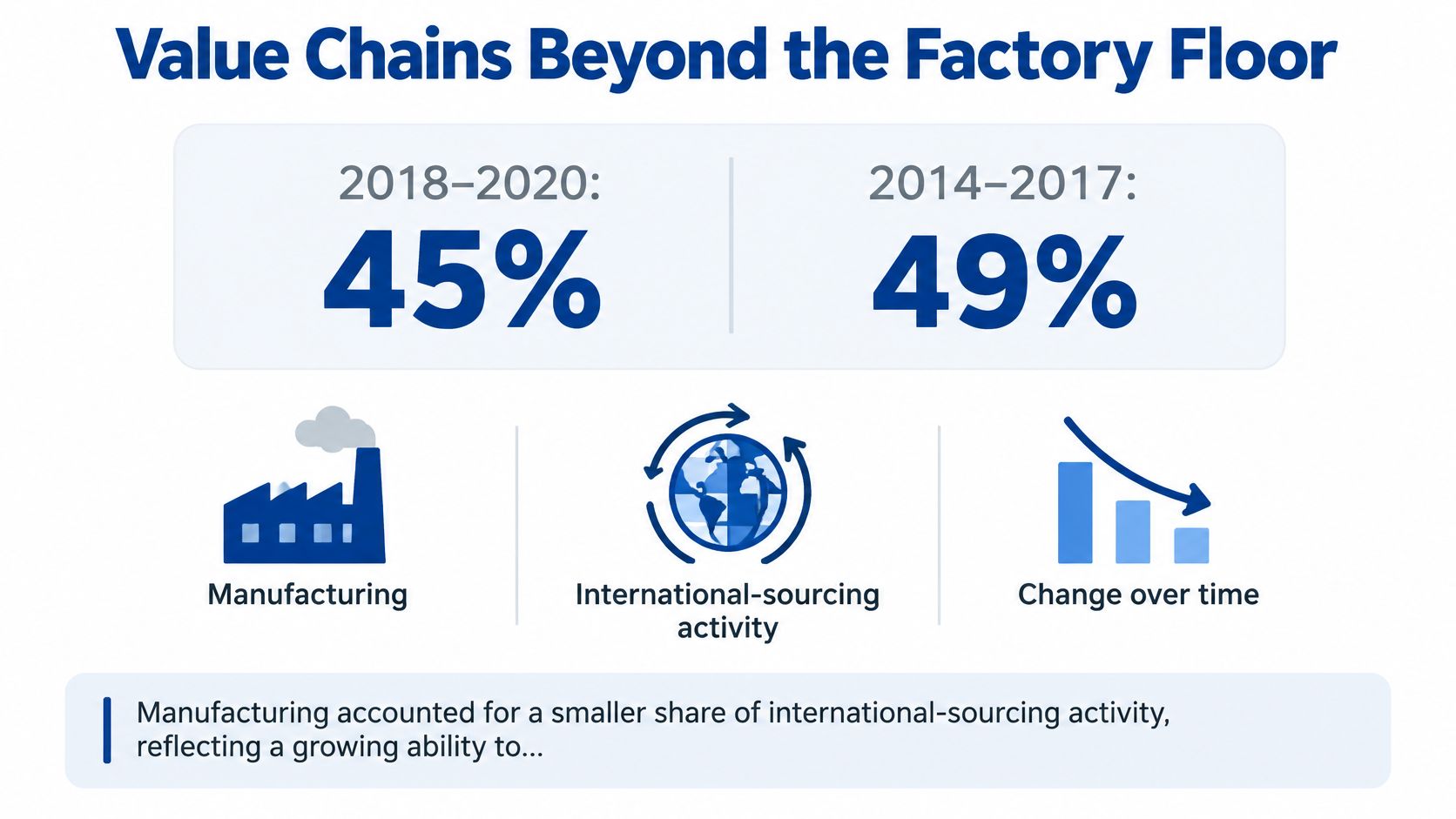
Manufacturing accounted for 45% of international-sourcing activity in 2018–2020, down from 49% in 2014–2017, according to Eurostat's international sourcing analysis. That change challenges the assumption that international value chains concern only factories and physical production.
Digitalisation and the ability to codify service work allow firms to distribute IT, administration, engineering, logistics, research and customer support across borders. A value-chain map limited to the assembly line would miss these functions and their costs.
Follow the earnings, not just the product
Consider a hypothetical European hardware company. Its employees design a connected device in one country, contract software development elsewhere and arrange assembly in another location.
Customers purchase the device, then pay for an ongoing monitoring subscription. In this scenario, most margin is earned after the initial sale through software and service delivery, rather than through assembly.
The physical supply chain remains important, but it doesn't explain the whole business model. An introduction to supply chain management and its importance helps distinguish the coordination of supply from the broader question of where the firm earns and protects margin.
- Before assembly: Product design and software development shape functionality and customer usefulness.
- After assembly: Branding, distribution, finance and support influence access, confidence and continuing revenue.
- Across the business: Data, skills, organisational know-how and digital infrastructure enable coordination.
Cross-border demand creates exposure as well as opportunity
Ireland illustrates the scale of international dependence: foreign final demand drove 68.9% of domestic value added in 2020, compared with 46.0% in 2008 and an OECD average of 29.8%, according to the OECD's Ireland Trade in Value Added country note. Overseas demand shocks can therefore transmit into domestic output and employment.
For an individual business, that makes customer location as important to examine as supplier location. A locally performed service may still rely heavily on buyers abroad, while an overseas contractor may operate a function central to customer retention.
The practical question is precise: which functions does the business offshore, and which of those carry its margin? Answering it requires recording ownership of capabilities, customer relationships and knowledge, not merely the address of the factory.
Measuring Value When Data Is Incomplete
A useful value-chain map doesn't require pretending that every supplier's operations are fully visible. Managers need to distinguish confirmed evidence, reasonable estimates and unresolved gaps.
Ireland's Corporate Sustainability Reporting Regulations guidance describes double-materiality reporting, including value-chain information, and provides that companies may explain unavailable value-chain information during the first three reporting years. Double materiality considers both the organisation's impacts and how sustainability matters affect the organisation financially.
Build a defensible evidence trail
An unavailable figure shouldn't become an invented precise estimate. A supplier's invoice can establish purchasing expenditure, but it doesn't automatically establish that supplier's emissions or working conditions.
Evidence check: Every estimate should identify its basis, reference period, limitations and responsible owner.
Managers should begin with suppliers and activities carrying substantial cost or potentially serious impacts. Procurement records, contracts, supplier questionnaires and supporting environmental or human-rights evidence can then be assembled in a consistent register.
- Use purchasing records carefully: Spend and contract descriptions can indicate supplier activity, but they remain proxies where operational evidence is absent.
- Label estimates: Record the reference year and distinguish reported figures from assumptions.
- Track concentration: Show reliance on particular customers, suppliers and countries, not just total purchasing volumes.
- Schedule updates: Give each material gap an owner and a review date.
Separate structural evidence from current conditions
The Central Statistics Office's Global Value Chains survey covers 2018–2023 and around 4,200 enterprises, examining international sourcing, relocated functions, destinations, motivations and barriers. Official structural statistics can nevertheless describe an earlier operating environment because supply-and-use information takes time to compile.
Managers can supplement that historical view with current lead times, inventory coverage, customs exposure and supplier performance. These operational indicators shouldn't be presented as replacements for national statistics; they answer different questions.
Within the firm, activity-based costing can connect expenditure to the work consuming resources. A transparent, regularly refreshed map is more useful than an elaborate diagram built on undocumented assumptions.
Map Your Chain and Choose Where to Invest
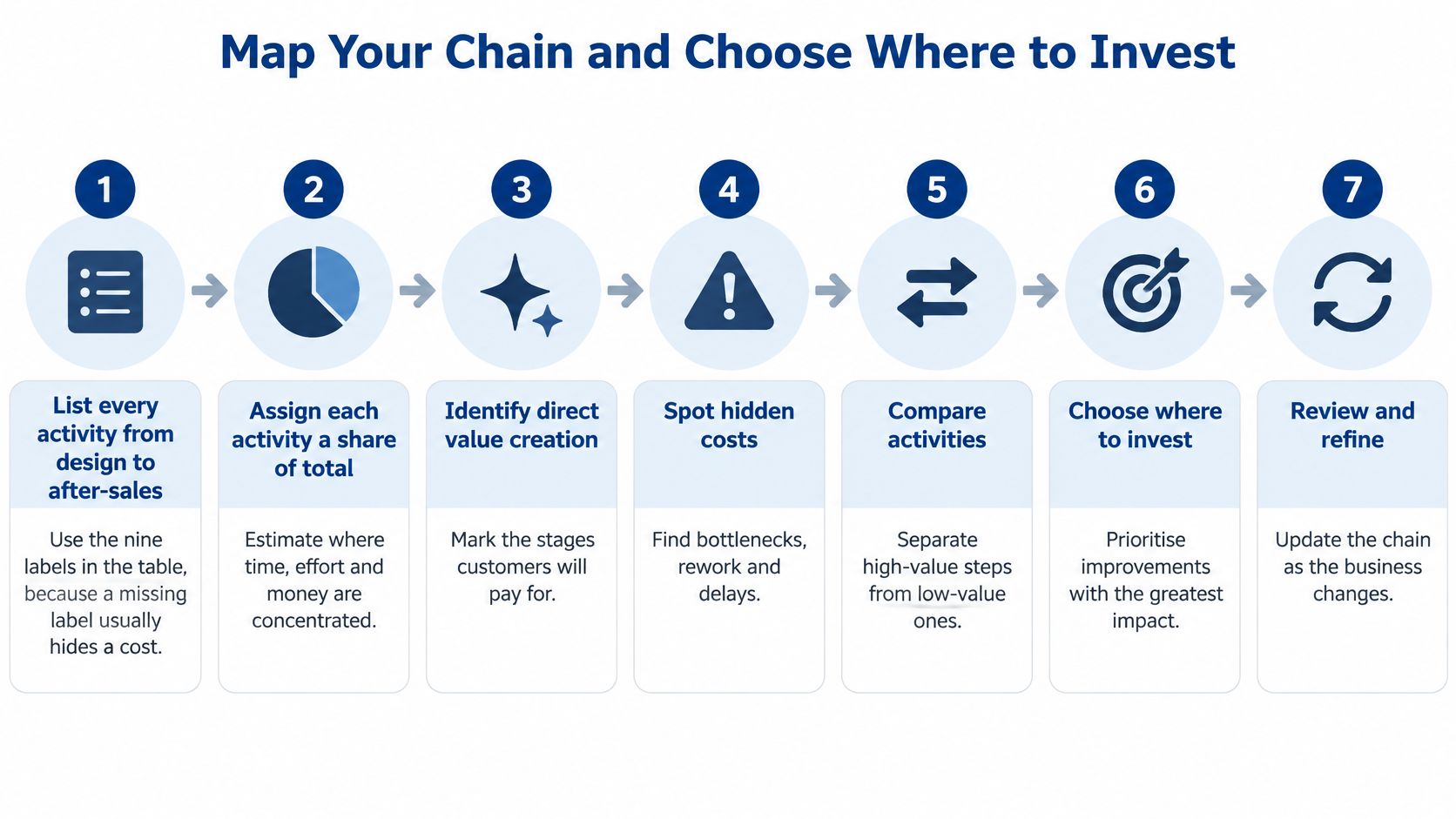
A workable analysis needs named activities, accountable owners and evidence that connects proposed changes to business results. A spreadsheet is sufficient to begin, provided each entry identifies its cost basis, customer contribution and main dependencies.
Build the map from operating records
List every activity from design to after-sales. Use the nine activity labels to check completeness, then describe the actual work beneath each. An unlabelled task can conceal costs, such as repeated corrections to customer orders.
Assign each activity a share of total cost. Use payroll, materials and overhead records, allocating expenditure through sensible drivers such as staff time, orders processed or machine use. Spreading overhead evenly can hide a stage that consumes disproportionate effort.
Ask five customers which stage they would miss most. Treat this as an exploratory exercise, not a representative survey. Questions about recent purchases and problems produce more useful answers than a general request to name what matters.
Mark who performs the work. Identify in-house teams, suppliers and partners, then flag single dependencies. A critical process operated by a sole contractor needs different scrutiny from an easily replaceable purchase.
Score each activity against the advantage tests. Add a written reason for every judgement and name the evidence supporting it. Where rival cost information is unavailable, mark cost position uncertain rather than claiming superiority.
Find one or two useful linkages. For example, clearer product specifications may reduce both procurement disputes and production rework. Record the expected effect in each activity so that managers can check the total outcome.
Rank activities by margin contribution and risk. Distinguish measured contribution from estimated influence on revenue or retention. Include the consequences of failure, because a low-cost activity can still protect an important customer promise.
Choose an investment that can be tested
The decision rule is to invest first in an activity that scores strongly on at least two tests and carries a meaningful share of margin. That's a practical prioritisation rule, not proof that the investment will succeed.
Activities customers value and competitors struggle to copy deserve protection. Activities offering neither benefit may be candidates for simplification, removal or outsourcing, provided quality, compliance and continuity remain secure. Uncertain activities need a bounded experiment rather than an immediate long-term commitment.
A short business case should state the problem, proposed change, expected benefit, implementation cost and principal risk. It should also identify a balancing measure: faster order processing, for example, shouldn't come at the expense of order accuracy.
For structured grounding, European Institute of Leadership and Management offers online certificate courses including Introduction to Logistics and Supply Chain Management, Introduction to IT Management, Leadership and Organisations, Investment Fundamentals, and Problem Solving Skills.
The next action is concrete: the responsible manager records one chosen activity, its performance measure and a review date, then runs a 90-day test. The review should compare results with the starting position, check effects elsewhere in the business and decide whether to expand, revise or stop the change.
European Institute of Leadership and Management offers self-paced online education in business management, leadership and related professional disciplines. Its logistics and supply chain learning can help managers develop the knowledge needed to examine activities, dependencies and operational choices more systematically. Visit European Institute of Leadership and Management to explore study options relevant to the next value-chain improvement.