
What Is a Business Case? Sections and Purpose

A business case is a structured decision document that tests whether a proposed investment is justified before money, people or time are committed. A manager faces that test whenever a hire, a software purchase, a new site or a training programme looks attractive but hasn't yet earned the spend. Enthusiasm isn't evidence, and a good idea isn't automatically a good use of a limited budget. The case forces a pause, puts the options side by side, and asks whether the preferred one still holds up once cost, risk and timing are written down.
Table of Contents
- What a Business Case Is For
- The Sections Every Case Should Contain
- How Leaders Use the Case to Decide
- Examples from Products Training and Technology
- Why the Case Must Survive a Bad Year
- Building a Case When the Return Is Unclear
- Draft the Recommendation Before You Spend
What a Business Case Is For
Say a department head wants two extra staff, a new system and the training to use it. Each request sounds reasonable on its own, but together they compete for the same money and the same management time. The question that stops the spend is simple. Is this justified compared with doing nothing or doing something smaller?
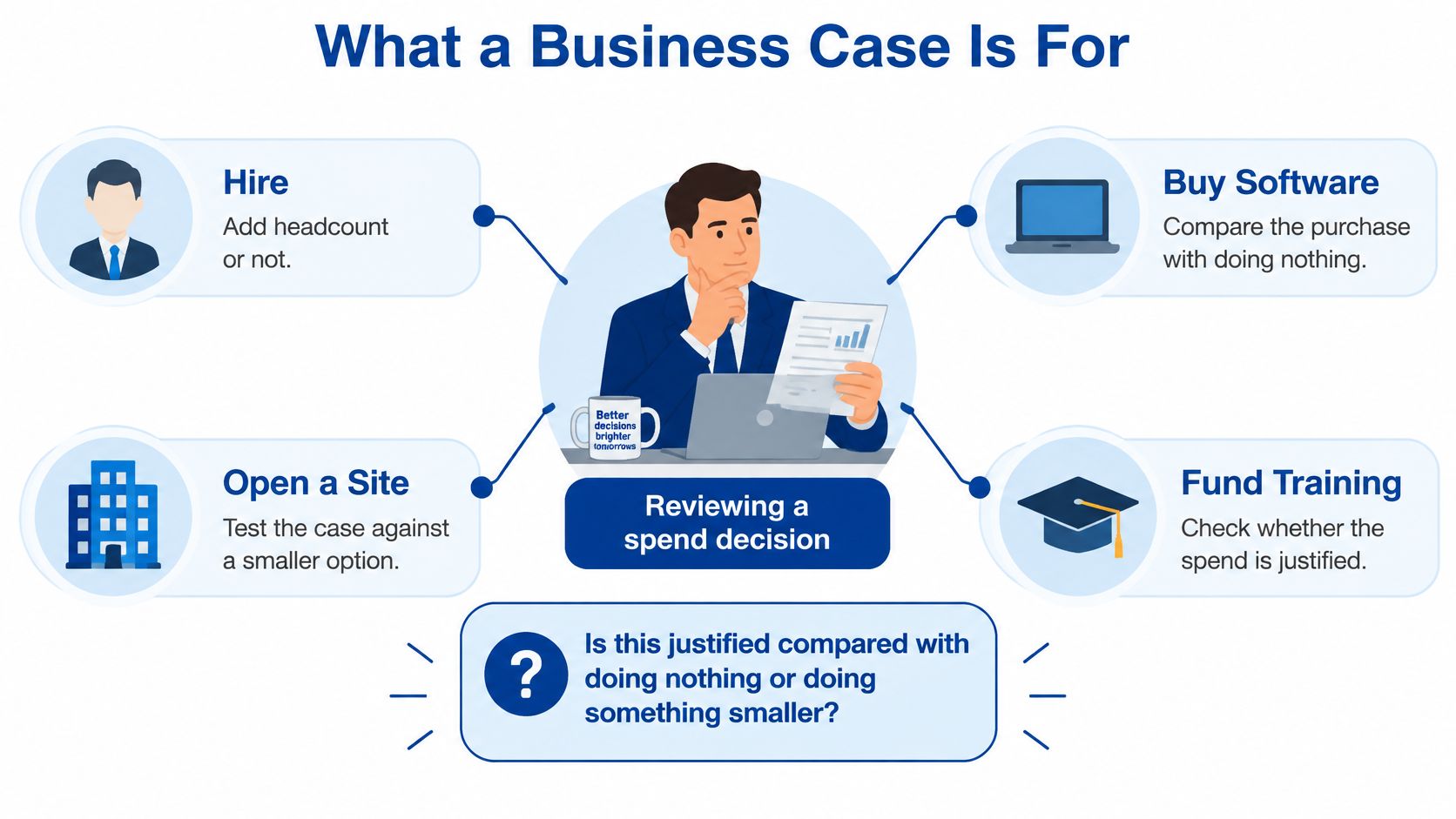
That comparison is the heart of what is a business case in practice. It's a disciplined argument for choosing one course of action over alternatives, recorded in a form that other people can challenge. A manager who can't show why the larger option beats the smaller one hasn't finished the work, however polished the presentation looks.
How It Differs From a Plan and a Pitch
A business plan describes how an organisation will operate over a period, covering markets, operations and finances at a broad level. A business case is narrower and sharper. It isolates one proposed investment and tests whether that single decision deserves approval.
A pitch tries to persuade, so it leads with the upside. A case must do the opposite job as well, exposing weak assumptions, delivery problems and costs that a pitch would soften. The reader should finish the document able to disagree with the recommendation for stated reasons, using evidence the writer supplied.
Irish public guidance gives private teams a useful discipline to borrow. The Irish Government's Public Spending Code guide requires every project, regardless of size or cost, to undergo financial appraisal, while cost-benefit analysis should form part of the economic appraisal for projects with estimated costs above the applicable threshold. Financial appraisal examines affordability and financial impact, and economic appraisal considers wider social and economic costs and benefits.
Additionality rule: Only costs and benefits directly attributable to the proposal should influence the decision, so gains that would happen anyway stay out.
That principle of additionality stops a common fudge. If sales would grow without the new hire, that growth can't be claimed as the hire's benefit. If a licence fee disappears only because the new system replaces the old one, that saving does belong in the case.
Translating Public Logic to Private Decisions
The same record adapts cleanly to a product launch, a technology change, an expansion, a training programme or a process change. Each version defines the problem, quantifies the investment, estimates the benefit, tests the assumptions and compares alternatives. Planning, design issues and an evaluation plan belong in the document too, not as later surprises.
The result gives decision makers a common record for judging affordability, value for money, feasibility, risk and expected outcomes. Without that record, the loudest sponsor often wins. With it, a quieter option with stronger numbers can win instead.
A finished case should let a manager say one line with confidence. The case recommends whether to proceed, on what terms, and what will be checked to confirm the choice was right.
The Sections Every Case Should Contain
A decision maker reads a case in a particular order, and each section should answer one question before the next begins. Drafting the headings first, in that order, prevents the usual problem of a document that describes a product in detail but never states the problem it solves. Length can shrink for a small internal spend, but the questions don't change.
Starting With the Problem
The opening work covers the problem statement and the objectives. What's wrong or missing, who feels it, and why does it need attention now rather than next year? Objectives need to be specific, with a timescale, so success is recognisable rather than arguable.
Scope and constraints come next. What's in, what's out, and which systems, sites, licences or suppliers does the proposal depend on? Vague scope is where cases fail, because a cost excluded at approval stage still arrives during delivery.
| Section | Question it answers | Evidence to include |
|---|---|---|
| Executive summary and recommendation | What do we propose, and what do we ask for? | One-paragraph recommendation, decision requested, headline costs and benefits |
| Problem and objectives | What outcome are we trying to change, and by when? | Current baseline, affected users, measurable objectives |
| Scope and constraints | What is included, excluded and dependent on others? | Boundaries, assumptions, interfaces, regulatory limits |
| Options | What else could we do, including doing nothing? | Do nothing, do minimum, and one or more full options on equal terms |
| Financial appraisal | Can we afford it and what is the cash effect? | Costs, funding source, timing, payback or return where relevant |
| Benefits and wider effects | What value is caused by this option? | Revenue, savings, time, quality, and only attributable benefits |
| Risk and feasibility | What could stop delivery or wipe out the benefit? | Capacity, technical risk, sensitivity, mitigations |
| Evaluation plan | How will we know the decision was right? | Owner, milestones, measures, review date |
Comparing Options on Equal Terms
The options section is where weak cases get exposed. Do nothing sets the baseline and shows what happens if the problem is left alone. A do minimum version tests whether a small fix solves most of the problem at a fraction of the cost. At least one full alternative then has to earn its extra spend.
Each option gets costed and benefit tested on the same basis, over the same period, using the same rules. Comparing one option over three years against another over five isn't analysis. It's presentation dressed up as analysis.
- Equal periods: Every option uses the same appraisal window so longer horizons can't inflate benefits.
- Equal benefit rules: Savings count for all options or none, never only for the favourite.
- Equal cost depth: Training, support and internal time appear in every option that needs them.
Money, Benefits and Risk
Financial appraisal follows, covering total cost, the funding source, cash timing and whether the organisation can afford the spend in each year it falls. A project that pays back over five years can still break this year's budget. The cash profile matters as much as the final total.
Benefits come next, and only outcomes the option itself causes belong here. Revenue, cost savings, time recovered or quality gains all count when they're attributable and measurable. A benefit that can't be observed after delivery shouldn't carry weight at approval.
Risk and feasibility then ask what could stop delivery, which assumptions carry the case and what would make it fail. A missing skill, a single supplier or an untested interface can matter more than the financial total. Naming the mitigation, and its cost, keeps the risk section honest rather than decorative.
The document closes with the recommendation, implementation milestones, a named owner and a review date. A short case can run to a few pages if every row in the table is answered. A large capital case needs more evidence, not different questions, and the recommendation must match what that evidence supports.
How Leaders Use the Case to Decide
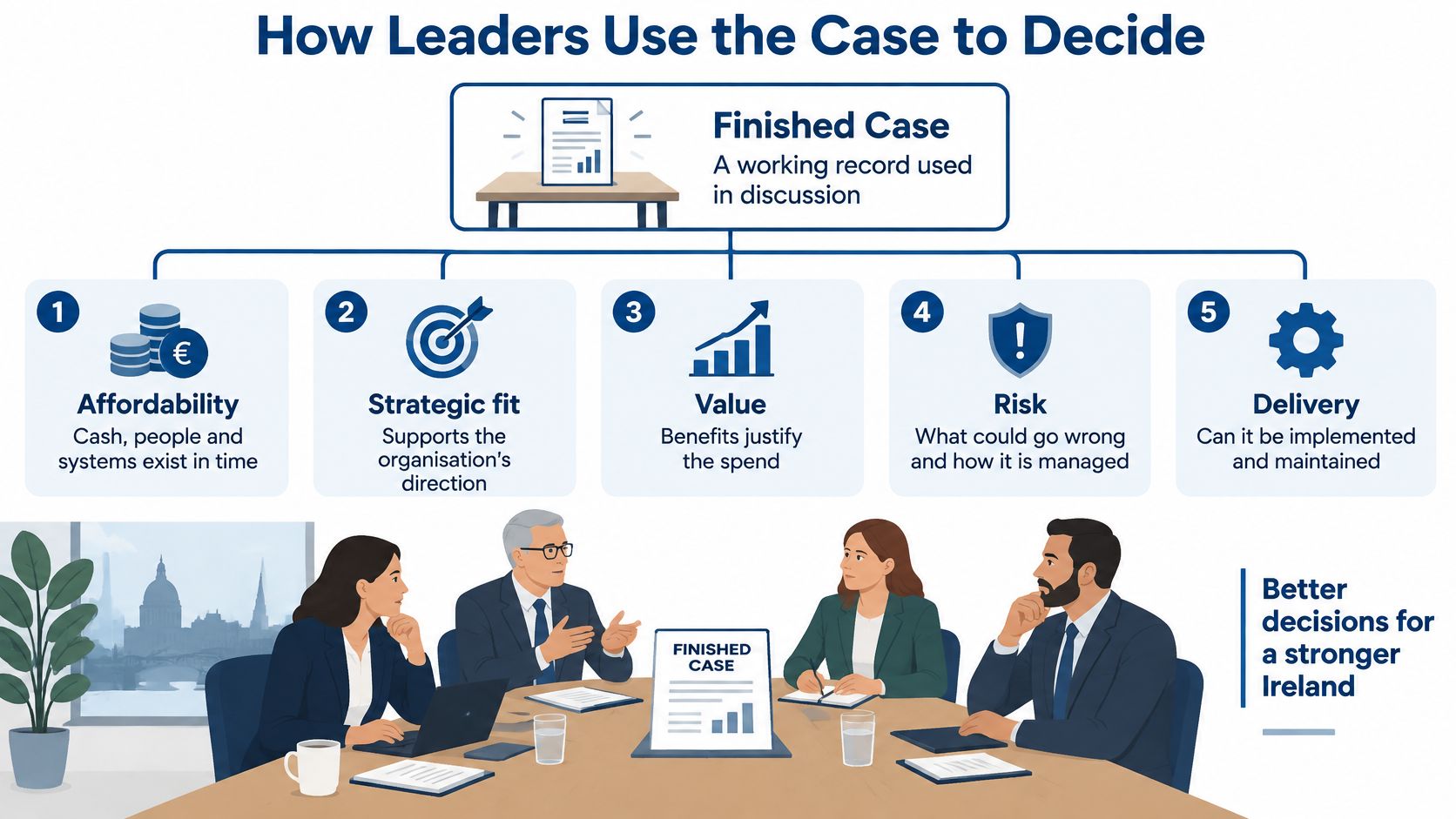
Leaders read a finished case the way a buyer reads a survey on a house, looking for the faults the seller hoped nobody would check. The finance director usually asks the first question: can the organisation fund this when the spend lands? Approval meetings then test the document in roughly the order it was written, and writers who understand that order prepare answers before the challenge arrives.
The Order of Challenge
Affordability and value for money take the opening questions, because the comparison rules set during appraisal decide what counts as a fair answer. Once the money holds up, the room moves to delivery, and the questions get pointed:
- What stops this at the end of stage one if results disappoint?
- Who carries the cost if adoption runs slower than assumed?
- Which current work pauses while this is funded?
- When will the change be visible, and who measures it?
Feasibility, risk and outcomes each get pressed the same way. A benefit that only exists on a slide gets cut in the room. A named owner, a defined stop point and a date when the outcome should be visible all survive challenge, which is why cases that answer these questions on paper shorten the meeting rather than lengthen it.
Weighting the Tests
A private firm may weight affordability and return more heavily than a public body would. That is a legitimate choice, though the case should still name any wider effects it chooses not to count. Hidden exclusions look like errors when they surface later, while declared exclusions read as judgement.
Strategic fit gets tested in the room as well. An affordable project that pulls the organisation away from its direction competes with work that supports that direction. Agreeing the criteria before a sponsor starts defending a proposal keeps the debate on evidence, which is the discipline behind structured decision making for leaders.
The strength of a case shows when the questions get harder, not when the room stays quiet.
The Four Possible Decisions
Every meeting ends in one of four outcomes. Leaders can approve the preferred option, approve a smaller option, defer until a pilot produces evidence, or reject the proposal. Each outcome is respectable when the record supports it.
Deferral deserves more respect than it usually gets. Sending a case back for one missing piece of evidence costs weeks, while approving an untested assumption can cost the full budget. Rejecting a weak case also protects resources for stronger proposals later in the year.
The most useful output is the recorded reason for the decision. A later review can see what was believed at the time, which assumptions were accepted and which risks were knowingly taken. That record turns hindsight into learning rather than blame.
Examples from Products Training and Technology
Abstract headings become clearer when the structure has to handle real choices. Three short scenarios show the same questions producing different answers, because the evidence differs. Each one names a winner and a rejected option, which is what separates a case from a description.
A New Product Decision
Say a food producer spots a gap in its range. The options are staying with the current range, launching one limited product or funding a full range extension. The case compares development cost, expected margin and the risk that the new line steals sales from existing products, a problem called cannibalisation.
The writer tests a twelve month sales assumption, then a downside at half that volume. The full launch only works at high volume and pulls cash from other work, so it fails on affordability. The limited launch wins because it proves demand before the bigger commitment, and existing sales growth already in the forecast is left out of its benefits.
A Training Programme Decision
Now consider new team leads making inconsistent decisions that create rework for everyone else. The options are informal coaching, an external course or an internal academy. Coaching costs little but depends on whichever manager has spare time, so quality varies and nothing gets measured.
The case counts time recovered and fewer repeated errors as the benefits, rather than inventing a revenue line the training can't claim. The external course wins because it gives every team lead the same baseline quickly. The internal academy loses for now, since building it would take longer than the problem allows, even though it might suit a larger organisation later.
A Technology Decision in a Small Firm
A small distributor still processes orders by hand, and errors creep in at busy times. Options are the status quo, automating one workflow or buying a broad platform covering everything. The honest benefits are faster processing and fewer mistakes, not a precise five year return nobody can yet calculate.
The broad platform loses because staff couldn't run it without support the firm doesn't have. Automating one workflow wins as a first step that produces evidence. That pattern matches the approach set out in developing a business case for digital transformation, where scale follows proof instead of preceding it.
Writer's check: Benefits that would have happened anyway, such as growth already sitting in the baseline forecast, must be removed before any option is scored.
Notice what each scenario shares. The losing option fails for a stated reason, such as cash timing, delivery capacity or timing, rather than because the writer preferred something else. Readers can disagree with the scoring, but they can't claim the trade off was hidden.
Labelling a proposal as one of these three patterns helps before any numbers get estimated. A product case lives or dies on volume and cannibalisation. A training case rests on time and error reduction, while a technology case often rests on capability. Starting with the right pattern stops a writer forcing every idea into a sales forecast.
Why the Case Must Survive a Bad Year
A typical weak case has one optimistic revenue line that rises smoothly and never meets a bad month. That line is a hope dressed up as analysis. Approval should depend on whether the organisation can absorb slower adoption, higher costs, delayed cash and weaker demand without the whole plan collapsing.
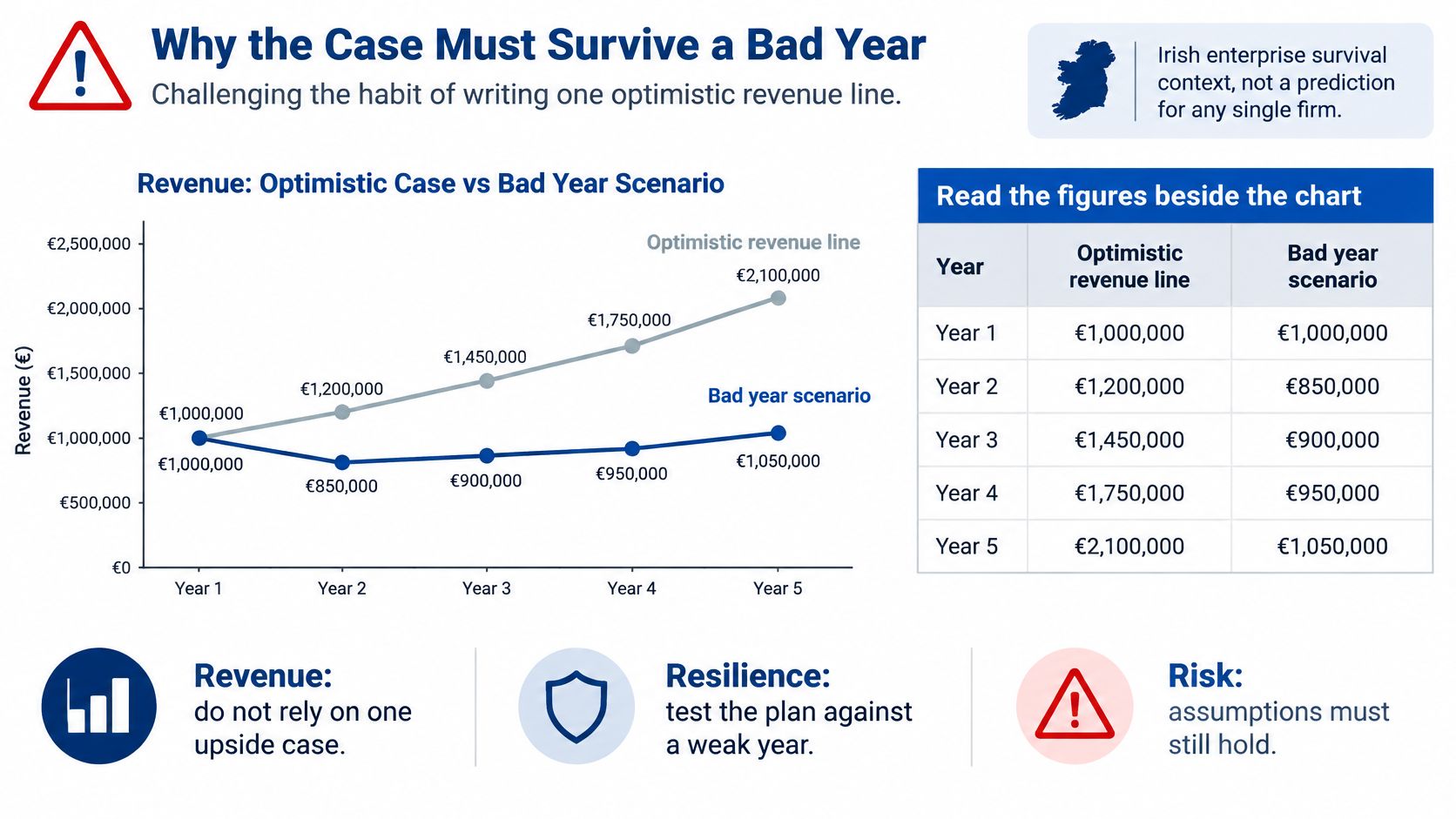
Irish enterprise survival figures give that caution a concrete backdrop. The Central Statistics Office business lifecycle release tracks how many enterprises born in a given year remain active later on, across both older and younger cohorts:
| Cohort and period | Enterprises born | Still active | Survival rate |
|---|---|---|---|
| Born 2018, active in 2023 (five years) | 25,794 | 12,267 | 47.6% |
| Born 2019, active in 2024 (five years) | 26,910 | 13,633 | 50.7% |
| Born 2023, active in 2024 (one year) | 47,542 | 37,392 | 78.7% |
Read down the five-year rows and roughly half of each cohort is gone by the end of the period. Those figures don't predict the fate of any single firm, and they don't prove a particular proposal will fail. What they establish is the level of commercial uncertainty a case is designed to examine. A writer who ignores that context asks decision makers to bet against the base rate without saying so.
Writing the Downside Case
A sound case therefore includes realistic revenue and cost assumptions, sensitivity analysis, milestones, financing requirements, operational capacity, competitive conditions and identifiable exit or corrective actions. Each element answers a practical worry. Sensitivity analysis shows which assumption matters most. Milestones stop money flowing automatically to a failing project.
The break-even illustration shows how this works in practice. Say a base case needs 100 customers to break even. The writer should show the cash position at 70 customers and at 50, then state which costs can stop at each level, such as paused hiring or deferred software licences. A downside without named cost actions is just a smaller number on the same page.
- Tranche the spend: Release each stage of funding only when a milestone is met.
- Name the correction: State in advance what gets cut, paused or sold if a threshold is missed.
- Watch cash timing: A survivable loss on paper can still fail if cash arrives later than bills.
That discipline connects naturally with practical risk management, because the downside case is really a risk decision made before the money leaves. Competitive pressure belongs in the same test, since a rival response can flatten demand faster than any internal problem.
The decision rule is blunt. Proceed only if the downside is survivable, or the spend can be staged so a weak result stops further commitment. A proposal that needs everything to go right has passed nothing at all.
Building a Case When the Return Is Unclear
Digital spend in a small firm breaks the usual template, because the return often can't be calculated precisely at the start. Irish government reporting on an European Investment Bank study on SME digitalisation identifies limited appetite among traditional SMEs for digital investment because businesses struggle to decide when to invest, how much to invest, and which technology to choose. Many firms use a budgeting mindset rather than an investment mindset, treat digitalisation as a cost, and cannot translate technology use into economic impact.
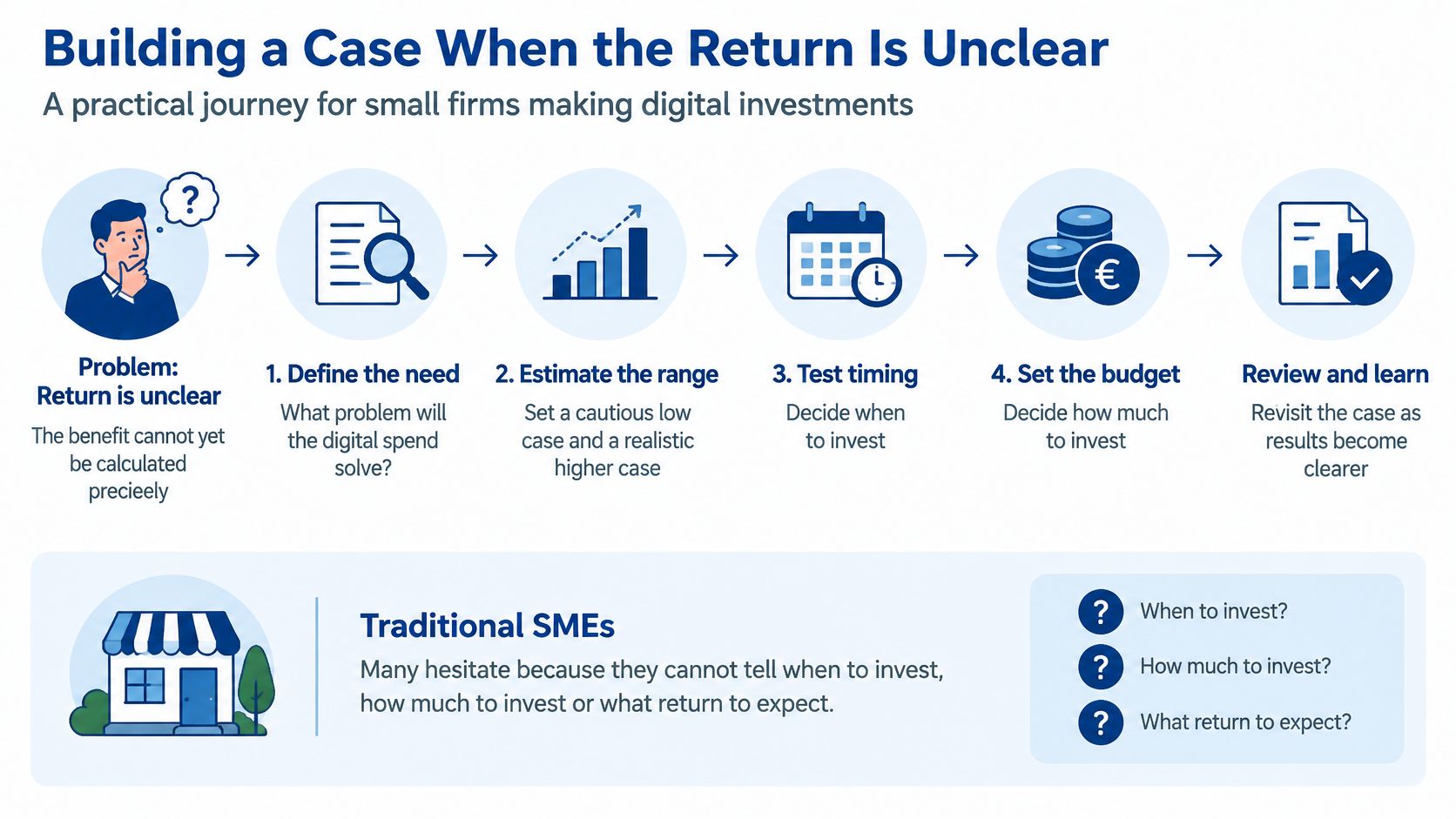
Financing constraints and banks' difficulty assessing digital projects add further barriers. A vague case makes that worse, because a lender can't see what would trigger a stop. Pretending to know a five year return doesn't solve the problem either, since invented precision collapses at the first serious question.
A Staged Case in Five Steps
- Define the operational problem: Measure it first, in terms such as hours per order or errors per batch of invoices, so improvement is visible.
- Choose the smallest pilot: Pick the narrowest test that could move that measure without committing the full budget.
- Pick leading indicators: Track signals such as processing time or conversion rate before chasing a full profit figure.
- Set stop and go thresholds: Write them down before the pilot starts, while judgement is still neutral.
- Update the case with evidence: Scale only if the thresholds are met, and record what the pilot changed.
This staged approach treats the first spend as option value. The pilot buys information and capability, revealing integration risk and whether staff can use the tool. That knowledge has worth even when the answer turns out to be no, because it prevents a larger mistaken commitment.
Budgeting Mindset Versus Investment Mindset
A budgeting mindset asks only what the invoice costs. An investment mindset asks what decision the spend enables and what evidence it produces. The difference sounds subtle, but it changes the whole document, including the financial literacy behind it, which is why financial management guidance for non-financial managers pairs well with staged digital cases.
Irish enterprises are continuing to increase adoption of cloud computing, data analytics, and artificial intelligence, while larger firms remain stronger adopters than smaller firms. A small firm shouldn't copy a large firm's case, with its dedicated teams and support structures. The smaller case wins by being staged, measurable and honest about capability gaps.
Draft the Recommendation Before You Spend
A useful draft can be started this week, before anything is circulated or fully costed. The first move is writing the problem in one sentence, then naming the do nothing option and one realistic alternative beside the preferred idea. Costs that are already visible get listed next, and benefits that can't yet be proved get marked as unproved rather than upgraded. The draft then states the decision being requested in plain terms, proceed, pilot or stop.
Three failure points deserve checking before the draft reaches anyone who disagrees with the project. A forecast with no downside case tests nothing. The person named against the review date should be able to say which metric will show the case worked, and a request that offers only full spend or nothing leaves the room no real choice.
One standard settles whether the draft works. A colleague who opposes the project should still see the options, the money, the risk and the recommended action without needing a private explanation.
If that exercise exposes a gap in financial or strategic judgement, structured study beats another template. Where the weak spot is reading costs, benefits and trade-offs across the whole business, the Mini-MBA in Business Administration at the European Institute of Leadership and Management is an intensive, fast-paced online course built around exactly that general management ground.
Where the draft falls down on choosing between options and defending one course of action, the Mini-MBA in Strategic Management develops the skills to build and carry out strategic plans. Completing a course adds a certificate you can use to showcase the new skills on LinkedIn, and the Mini-MBA programme certificate is earned by completing the courses within that programme.
Managers who want to write cases that survive hard questioning can build the underlying financial, strategic and leadership judgement through the online programmes at European Institute of Leadership and Management. Its self-paced Mini-MBA and certificate options cover the management disciplines behind sound investment decisions, from framing options to testing risk. Exploring the catalogue there is a practical next step before the next spending proposal lands on the table.