
Risk Management in Organisations Explained
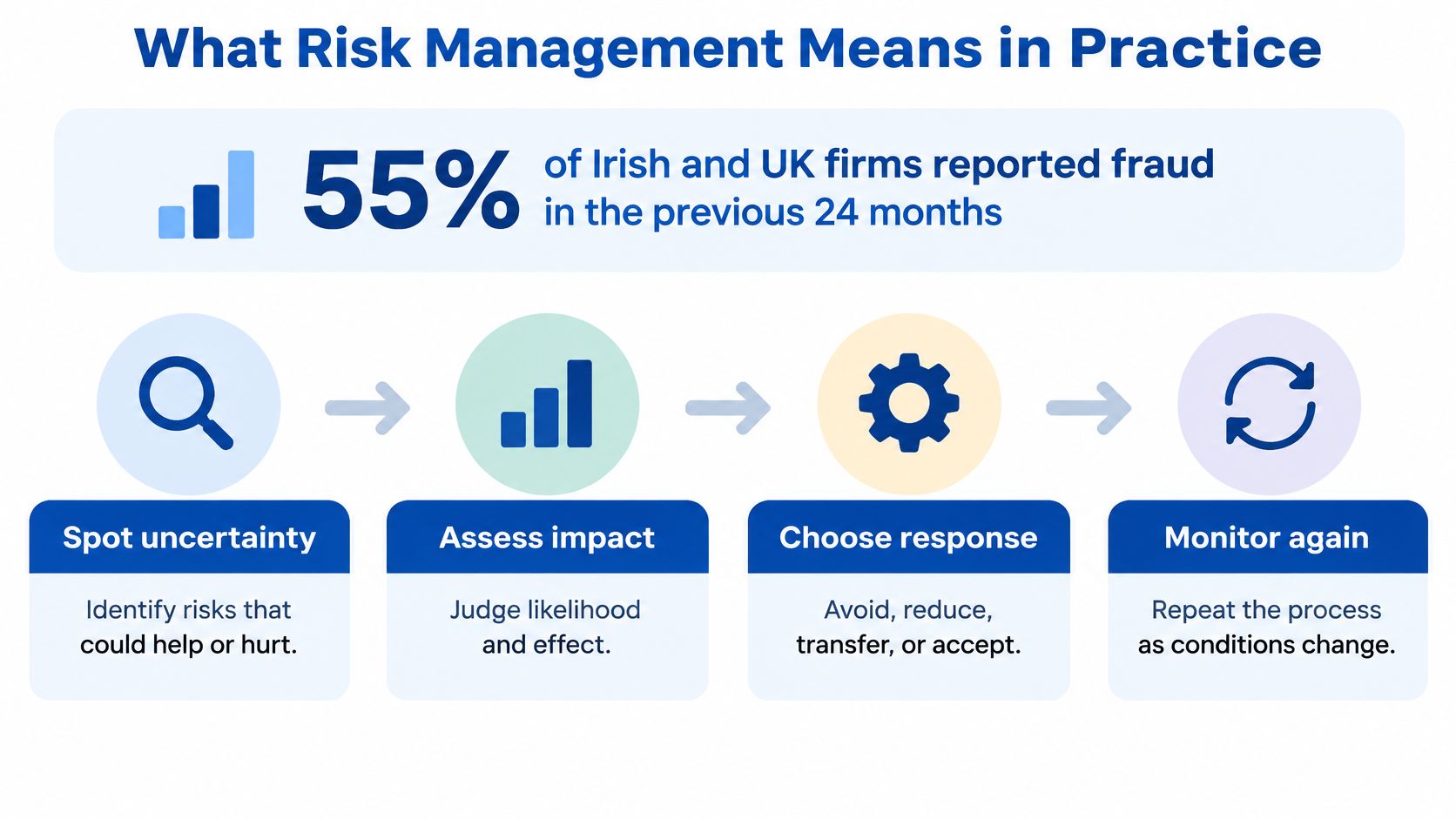
55% of Irish and UK firms reported experiencing fraud in the preceding 24 months, according to PwC Ireland's Global Economic Crime Survey 2024. The finding illustrates why risk management cannot be confined to low-frequency disasters or compliance documentation. Organisations must examine how routine decisions, payment processes and operational dependencies could compromise their objectives.
A risk register provides value only when it informs decisions and prompts action. In particular, managers should test whether a low risk score reflects effective controls or incomplete visibility, especially where suppliers and climate hazards extend beyond their direct oversight.
Table of Contents
- What Risk Management Means in Practice
- How to Identify Risks Before They Hit
- Where Registers Miss Vendor and Cyber Risk
- How to Score Likelihood and Impact
- How to Choose a Treatment That Holds
- How Monitoring Shows Controls Still Work
- Start a Register You Will Reopen
What Risk Management Means in Practice
Risk management is a continuous process of identifying uncertainty, evaluating its significance, selecting a response and verifying that the response remains effective. The starting point should be a defined objective, such as making accurate payments to legitimate suppliers, rather than a broad category such as financial risk.
Consider an email requesting a change to a supplier's bank details. The relevant uncertainty is whether the request is genuine and whether the payment process would detect an impersonation attempt before funds are transferred.
The four stages of organisational risk management
| Stage | Question | Output | Owner |
|---|---|---|---|
| Identify | What could affect our objectives? | Risk list with causes and consequences | Process or function owner |
| Assess | How serious is each risk? | Scored risk register with priority | Named risk owner |
| Treat | What will we do about it? | Treatment plan with budget and date | Control owner |
| Monitor | Is the response still working? | Review pack and updated register | Senior team or board |
The finance manager identifies payment diversion as the risk. The risk owner evaluates how impersonation might succeed and the potential consequences. The control owner then implements independent verification through an established supplier contact.
Monitoring requires evidence that verification occurred for completed bank-detail changes. A policy instructing employees to telephone suppliers does not, by itself, demonstrate compliance.
The stages form a decision and assurance cycle, not a document-production exercise.
Ownership matters more than the template
A risk owner is accountable for understanding an exposure and deciding how it should be managed. A control owner operates a specific safeguard. One person may hold both roles in a small organisation, but the distinction makes responsibility for implementation and oversight explicit.
For example, a ferry operator must identify a hull defect, assess its significance, repair it or adjust operations, and then verify that the repair remains effective. Insurance may address some financial consequences, but it does not repair the hull. An inspection record is useful only if it accurately reflects the vessel's condition.
Practical rule: Assign each material risk to a person with the authority to make or escalate a decision, not simply to a department.
Risk management also informs decisions about opportunity. A proposed service may create growth potential alongside uncertainty about demand, staffing and delivery quality. Management should assess both the expected benefit and the exposure required to pursue it.
Use the four-stage table as a quarterly check. If an output is absent, such as approved treatment funding or evidence of a control review, the process has not been completed.
How to Identify Risks Before They Hit
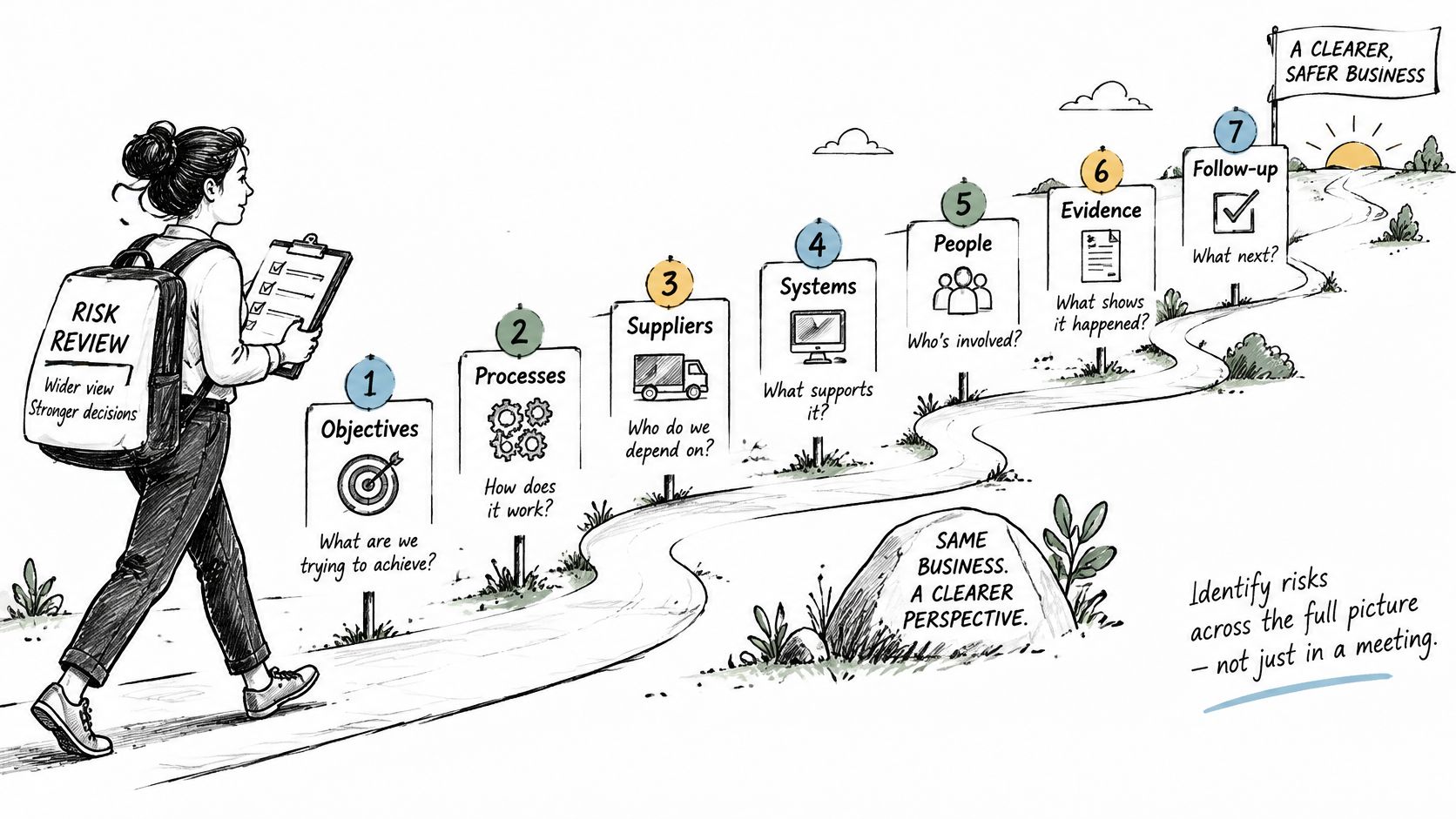
Risk identification should be a structured review of objectives, processes and dependencies, rather than an unprompted list of management concerns. Examine how work is actually performed, including informal workarounds and dependencies that may not appear on an organisation chart.
A consistent review sequence helps teams identify exposures that would otherwise be overlooked.
A practical identification sweep
- Define the objectives. Include revenue, safety, service quality and reputation. State each objective in terms that can be tested: fulfilling customer orders is more useful than business success.
- Map the processes. Examine what must work at each stage, from accepting an order to receiving payment. Identify handovers, manual overrides and activities dependent on a single employee.
- Examine external conditions. Consider social, economic, environmental and technological changes. Determine how an external event could interrupt operations even when internal procedures are followed.
- Consult employees closest to the activity. Drivers, customer-service staff, maintenance technicians and accounts assistants may know about workarounds or near misses not visible to senior managers. Ask what nearly failed as well as what caused a recorded loss.
- Describe cause, event and consequence. For example: a sole supplier becomes unavailable, a component cannot be obtained, and the organisation misses a customer commitment. Supplier problems is too broad to support ownership or treatment.
- Distinguish immediate hazards from emerging risks. A damaged loading area requires prompt intervention. Dependence on unfamiliar technology may require investigation, monitoring and longer-term planning.
- Record the basis for inclusion. Note who identified the risk, when it was raised and what evidence supports it. Subsequent reviewers can then distinguish a current assessment from an outdated assumption.
Use the Irish national approach at business scale
The OECD's Ireland case study reports that the Taoiseach's Office has produced a National Risk Assessment almost annually since 2014, drawing on horizon scanning across social, economic, environmental and technological domains. The case study also describes defence-related assessment of pandemics, cyber-attacks, antimicrobial-resistant infection and disruption to critical supply chains.
Organisations do not need to replicate a national assessment. The transferable practice is to scan across domains, translate broad threats into operational scenarios and assign responsibility for investigating material exposures.
These techniques for identifying risks can support a process walkthrough. Generic checklists should supplement, not replace, an assessment of sector-specific safety and continuity exposures.
Conclude by confirming that every material objective has been considered. Each risk entry should state what could happen, why it could happen, the consequence and who can influence the outcome.
Where Registers Miss Vendor and Cyber Risk
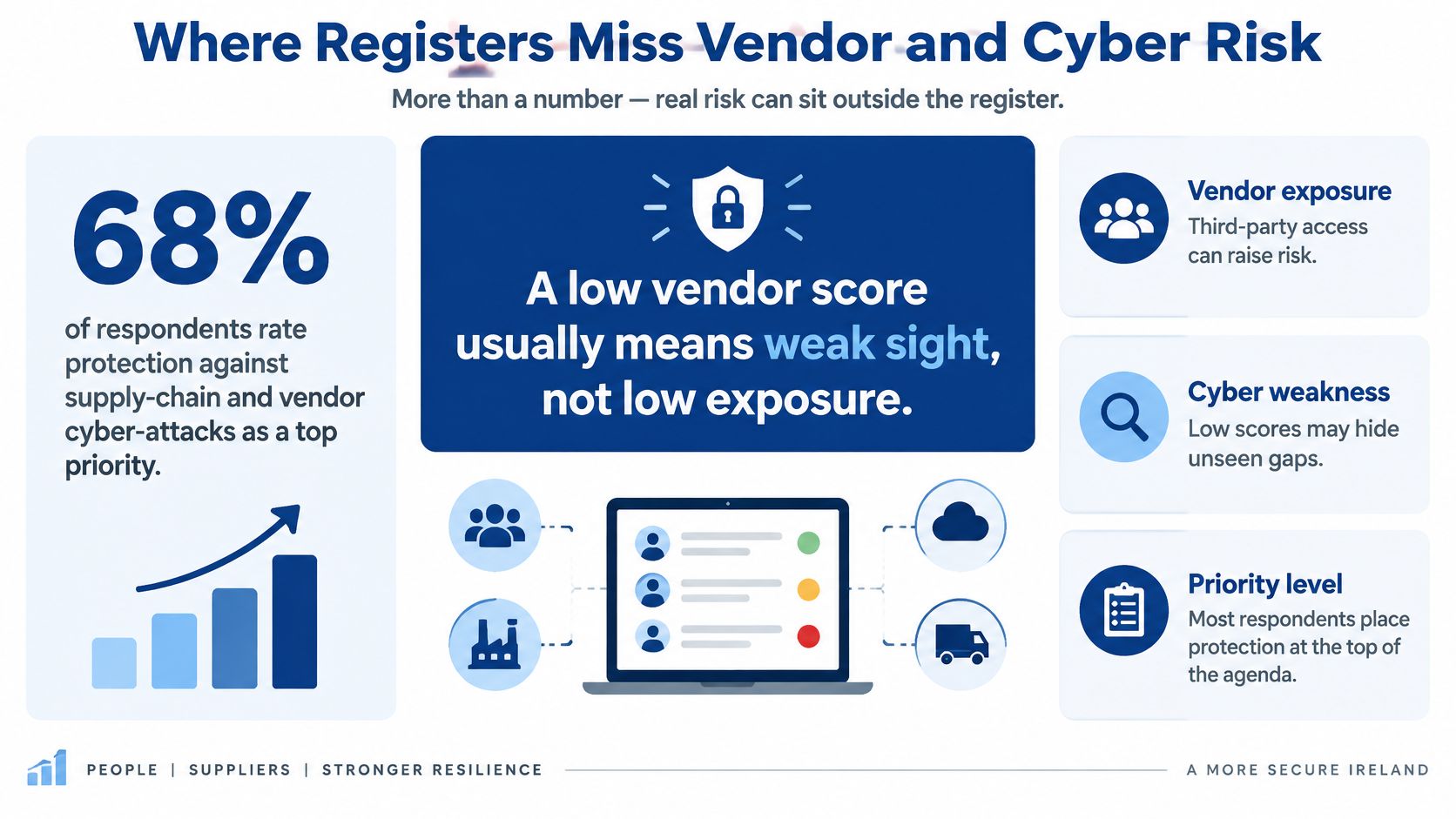
68% of respondents consider protection against supply-chain and vendor-related cyber-attacks a top priority, yet only 4% identify third-party vendor risk as a main concern, according to EY's analysis of Ireland's cyber outlook. This contrast is a reason to scrutinise low vendor-risk scores, not to raise every supplier rating automatically.
A low score may reflect effective safeguards. Alternatively, the organisation may not have mapped a supplier's access, subcontractors or importance to critical operations. The determining factor is whether the assessment can be supported with evidence.
Follow the service dependency
Consider an external payroll provider. Its contract value may be modest, yet the organisation may depend on its system, specialist knowledge and access to employee information.
The key assessment is not whether the provider completed a questionnaire. It is whether the organisation could pay employees safely and on time if that provider became unavailable.
- Map critical dependencies. Identify providers supporting essential services, including relevant subcontractors and hosting arrangements.
- Assess concentration. Determine whether services that appear independent rely on the same provider, platform or physical site.
- Evaluate recovery difficulty. Consider available substitutes, access to usable data and the time and resources required to switch.
- Obtain evidence and test an exit. Compare contractual commitments with access reviews, recovery-test results and incident-notification arrangements. Rehearse how data would be retrieved and the service continued elsewhere.
Contract value is not a reliable measure of operational criticality.
Spend against the dependency
For 2025, 66% of surveyed Irish organisations planned to increase cybersecurity budgets, according to PwC Ireland's Global Digital Trust Insights survey. A planned increase in spending does not establish that vendor exposure has declined. Managers should identify the specific dependencies the investment is intended to protect or test.
In an SME without a dedicated procurement-security team, an operations or finance manager can coordinate the review and obtain technical support where required. These principles for assessing and managing risks in global supply chains can help connect procurement assessment with continuity planning.
Record vendor criticality in the risk register. Escalate a dependency to the board when failure could interrupt a critical service and recovery arrangements remain untested, even if estimated likelihood is low.
How to Score Likelihood and Impact
Illustrative likelihood and impact bands for a risk register
| Band | Score | Likelihood cue | Impact cue |
|---|---|---|---|
| Rare | 1 | Not expected in five years | Negligible cost, no injury, no service loss |
| Unlikely | 2 | Could occur once in several years | Minor cost, first aid, short delay |
| Possible | 3 | Might occur this year | Noticeable cost, medical treatment, a missed deadline |
| Likely | 4 | Expected more than once a year | Major cost, serious injury, a key service down |
| Almost certain | 5 | Expected repeatedly this year | Severe loss, fatality risk, prolonged outage or regulatory breach |
This is an illustrative working scale, not a legal threshold or statistical forecast. Score likelihood and impact independently. An event can be unlikely but severe; the band names describe likelihood, while the impact cues provide a separate reference for consequence scoring.
Define financial impact bands relative to the organisation before applying the scale. Consider effects on people, service delivery and reputation. Where consequences differ across categories, use the most serious credible outcome rather than averaging a significant safety impact with a modest financial loss.
Compare scenarios rather than colours
A delayed invoice that an administrator can correct without affecting payroll or service delivery may have a minor impact, even if delays are relatively frequent.
Uncontrolled vehicle movement in a loading area presents a different exposure. A severe injury remains possible despite a record with no previous incidents. An absence of recorded harm is not sufficient evidence for a low consequence score.
Multiplying scores can help prioritise entries, but the result is a decision aid, not a measured probability. Risks with identical totals may require different treatment because their consequences, uncertainty or control options differ.
- Record inherent exposure. Describe the scenario before accounting for safeguards.
- Assess residual exposure. Credit only controls that are implemented and operating, not planned improvements.
- Document uncertainty. Identify missing evidence, disputed assumptions and dependencies that may increase the impact.
These risk probability and impact assessment techniques offer a structured basis for challenging inconsistent scores.
Stress-test the organisation's capacity to cope
A Central Bank of Ireland stress-testing methodology paper estimated cumulative CET1 capital depletion of 1.43 percentage points under a macro-financial scenario involving a 50-basis-point policy-rate increase, while a severe three-year scenario projected total depletion of 11.08 percentage points. These are modelled banking scenarios, not forecasts for other organisations. They nevertheless illustrate the value of testing capacity under conditions more demanding than the expected case.
For a non-bank organisation, examine a combined scenario: a major customer pays late, a site becomes unavailable and replacement materials become more expensive. Assess available cash, staffing, recovery capacity and the point at which essential commitments cannot be met.
Reverse stress testing begins with a defined failure point. Identify the combination of events that would prevent delivery of a critical service, then assess whether the combination is plausible and whether controls would detect or contain it.
Establish an escalation rule for severe consequences where likelihood is more than remote. Examine reliance on a single site, supplier or system because concentration can magnify a disruption.
Document the rationale for each score, including the scenario, evidence, existing controls and unresolved questions. A colour-coded cell does not explain what changed between reviews.
How to Choose a Treatment That Holds
Four ways to treat a risk
| Treatment | Use when | What changes | Proof it is real |
|---|---|---|---|
| Avoid | Exposure outweighs the objective | The activity stops or is redesigned | Decision recorded and the activity removed |
| Reduce | The activity must continue | Likelihood or impact falls | Control in place, tested and owned |
| Transfer | The financial hit can be shared | Who pays, not who operates | Policy or contract clause with limits stated |
| Accept | Residual risk is tolerable | Nothing operational, but awareness rises | Named owner, limit and review date |
Before selecting treatments, the board should define risk appetite: the amount and type of exposure it is prepared to carry in pursuit of organisational objectives. Management should translate that position into operational limits, such as tolerable service disruption and financial loss.
Acceptance should be an explicit decision against those limits, not a default for unfunded work. An internal appetite statement does not override applicable legal obligations.
Choose the trade-off deliberately
Avoid an activity when its expected benefit does not justify the exposure. For example, an organisation may decline work it cannot perform safely rather than rely on additional approvals for an unsuitable process.
Reduction retains the activity but changes the likelihood or impact of harm. Physical traffic separation, a viable backup supplier or a flood barrier addresses a specific failure mechanism more directly than a general instruction to exercise caution.
Transfer may share financial consequences, but insurance does not restore access to a flooded premises. Review exclusions, limits and operational recovery responsibilities before relying on a policy or contract.
Decision test: If the control owner left tomorrow, could another manager locate the funding, instructions and evidence required to keep the treatment operating?
Climate concern isn't a completed control
A Central Bank of Ireland analysis of Irish firms' climate responses found that more than 75% of responding firms were moderately or very concerned about each of three climate-related risks, while only slightly over half said sufficient investment had already been made. The difference warrants examination of implementation; awareness alone does not establish that an exposure is controlled.
A low climate score may also result from fragmented classification. Storm damage may appear under site disruption while weather-related supplier failure appears under procurement, obscuring a shared underlying exposure.
Translate each hazard into a business scenario. For premises exposed to flooding, assess the potential effects of inaccessible equipment, interrupted deliveries, damaged stock and limitations on insurance cover.
- Assign accountability. Name an owner and document the likelihood range and financial-impact assumptions.
- Fund implementation. Set a budget, completion date and evidence standard for each mitigation.
- Verify completed milestones. Confirm that protection has been installed, an alternative supplier contracted or an energy upgrade commissioned.
- Test residual exposure. Assess liquidity and contractual commitments under a disruption that remains possible after treatment.
An investigation plan is not an operating control. Keep an intolerable residual exposure open for action. Do not label a red-rated risk accept without documented senior-management justification and a clear decision boundary.
How Monitoring Shows Controls Still Work
The Health and Safety Authority's annual report records 61 workplace fatalities in 2025, compared with 36 in 2024, with agriculture, forestry and fishing accounting for 27 deaths, or 44% of the national total. This concentration reinforces the need to tailor monitoring to the organisation's activities and exposure, rather than apply an identical checklist across workplaces.
Machinery inspections, for example, have a different significance in a farming operation than in an office. Where vehicles, moving machinery, work at height or other high-energy activities are present, monitoring should address the relevant tasks and safeguards directly.
The purpose of monitoring is to establish whether controls protect people and operations under actual working conditions.
Combine early warnings with outcomes
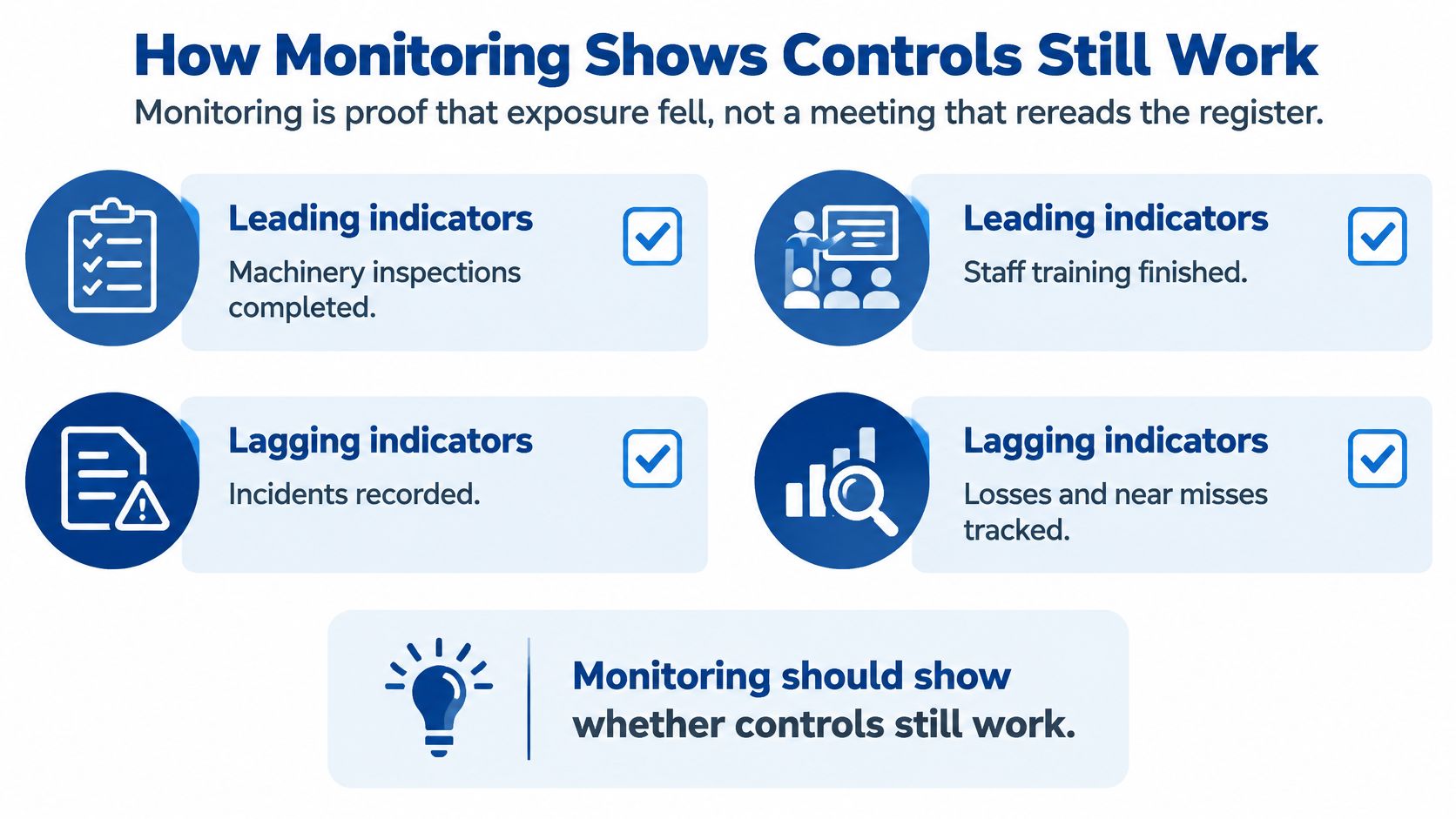
Leading indicators assess safeguards and conditions before a loss occurs. Lagging indicators record outcomes that have already occurred, such as injuries, downtime and financial loss. Both are necessary: activity measures require validation, while outcome measures alone may reveal control failure too late.
| Monitoring focus | Evidence to examine | Management response |
|---|---|---|
| Machinery condition | Completed inspections and unresolved defects | Remove unsafe equipment from use |
| Vehicle separation | Observed routes, barriers and audit findings | Correct conflicting movements |
| Competency | Verified ability before hazardous work | Restrict tasks until competence is confirmed |
| Near-miss follow-up | Investigation quality and overdue actions | Address the cause and verify the correction |
| Actual harm | Injuries, outages and losses | Investigate control failure and reassess exposure |
A high inspection-completion rate can conceal poor practice if forms are signed without examining equipment. Sample completed records, consult operators and observe the activity.
Interpret near-miss counts in context. An increase may indicate improved reporting, while a low figure may indicate reluctance to report. Review the quality of reports and the reporting environment before drawing conclusions.
Make review trigger a decision
As an initial cadence, review high-scoring risks monthly and other material risks quarterly. Also review promptly after a significant incident, near miss, failed control test or operational change, rather than waiting for the next scheduled meeting.
For high-energy work, use appropriate authorisation or permit-to-work arrangements, task-specific safeguards and competent verification. A permit documents authorisation; it does not replace physical isolation or safe working conditions.
Each review should establish:
- Whether ownership remains appropriate. Confirm that the owner has the authority, resources and current knowledge to act.
- Whether controls remain effective. Examine observed practice and test results alongside written procedures.
- Whether failed tests have been resolved. Record the failure, corrective owner and evidence required to verify the remedy.
Do not close an action solely because a revised document has been uploaded. Close it when the responsible manager has verified implementation and assessed whether exposure has decreased.
Start a Register You Will Reopen
The objective of an initial risk review is to support decisions, not produce an exhaustive catalogue. A shared spreadsheet can be sufficient if ownership, assumptions, actions and supporting evidence are accessible.
A first-month working plan
- Week one: Draft ten risks linked to this year's objectives. State the cause, event and consequence, and include operational dependencies as well as financial outcomes.
- Week two: Apply the illustrative scoring bands. Challenge low scores with weak supporting evidence and escalate severe consequences for senior review.
- Week three: Select avoid, reduce, transfer or accept for each material risk. Record the accountable owner, funding decision and completion or review date.
- Week four: Choose two leading indicators, schedule the next review and test a key assumption. Update the relevant entry if the evidence changes the assessment.
Keep the register manageable enough for regular review. By the end of the first month, it should show at least one substantive decision informed by evidence, such as a revised score, an identified control failure or a redirected action.
For structured study, our online Risk Management professional certificate at European Institute of Leadership and Management sits alongside broader Mini-MBA routes for managers with wider learning needs. It is not a university degree.
European Institute of Leadership and Management offers self-paced online education in risk management and related management disciplines. Visit European Institute of Leadership and Management to explore a learning option that supports your responsibilities, and bring a real workplace risk to your study so you can turn the learning into a better assessment and a testable response.