
Project Management Professional: Roles and Credentials

You're coordinating a fit-out, a system rollout, or a team of specialists who don't report to you. The budget is yours to watch, the deadline is yours to defend, and when something slips, you're the person who gets the call. Yet your title says coordinator, engineer, or business analyst, and the job adverts you'd prefer ask for a Project Management Professional credential you don't hold.
That gap is common, and it's fixable. What matters isn't collecting a certificate as fast as possible, but understanding what the role really involves, whether you qualify yet, and how to turn work you've already led into evidence that an examiner and an employer will both accept. Get that sequence right and the credential becomes proof of delivery, not a hopeful substitute for it.
Table of Contents
- The Project Management Professional Role Explained
- PMP Requirements and Eligibility at a Glance
- How to Earn the PMP Credential Step by Step
- Project Manager Career Paths and Salaries
- Why a Credential Alone Does Not Win the Role
- PMP, CAPM and PRINCE2 Compared and Next Steps
The Project Management Professional Role Explained
Project management is coordination under accountability. A project manager works like a conductor: the conductor doesn't play every instrument, but keeps the timing, balance, and score aligned so each section comes in when it should. The same applies to designers, engineers, suppliers, and stakeholders, none of whom report directly to the manager keeping them in step.

In plain terms, the job is to plan, execute, monitor, control, and close a project within agreed limits of scope, time, cost, and quality. That cycle repeats constantly. The manager revises the schedule when a supplier slips, reforecasts cost when scope changes, and keeps decisions visible for everyone affected. A plan written once and never touched again is a plan already failing.
The Five Duties That Make Up Most Days
- Defining scope and building the schedule: What is included, what isn't, and in what order work happens.
- Forecasting costs and tracking spend: A budget that's checked against actuals, not filed away.
- Keeping a risk register current: Named risks with owners, probabilities, and agreed responses.
- Managing stakeholders and procurement: Knowing who decides, who supplies, and who needs warning before a change lands.
- Running change control and confirming handover: Every change assessed before approval, and closure formally accepted rather than assumed.
Read that list again. Each duty produces a document or a decision trail: a scope statement, a cost baseline, a risk register, a change log, a signed handover. That trail of evidence is what "professional" means in Project Management Professional, working to a shared body of practice and being able to prove it, typically through a recognised credential such as the PMP.
Job title and credential are separate things. Plenty of people hold the title without the credential, and some certified people don't yet hold the title. Employers increasingly use the credential as a screening signal, and auditors and interviewers ask the same follow-up question: what did you deliver? The credential gets attention; the documented record of scope, cost, and decisions is what makes the claim believable.
The work is firmly cross-sector in Ireland, where project managers are employed across construction, technology, pharmaceuticals, healthcare, and energy. The methods are also shifting, so keeping up with how artificial intelligence is changing project management is now part of staying credible in any of those sectors.
Working definition: You're acting as a project manager if you're accountable for the scope, time, and cost of work you didn't do alone.
PMP Requirements and Eligibility at a Glance
Eligibility comes before everything else. Check which route fits before booking training, because no amount of study compensates for experience you can't document when the application is reviewed.
| Route | Leading-project experience | Formal education |
|---|---|---|
| Four-year degree | 36 months within the last eight years | 35 hours of project management education |
| High school diploma or associate degree | 60 months within the last eight years | 35 hours of project management education |
Route One for Degree Holders
A four-year degree reduces the experience requirement to 36 months spent leading projects within the last eight years. That window is strict. Leadership work from nine or ten years ago doesn't count, however senior it was, and applicants who discover this late lose months of preparation. Count backwards from the application date, month by month, before assuming you're eligible.
The 35 hours of formal project management education sit alongside the experience, not instead of it. Those hours should cover the full lifecycle, from initiation through closure, and come from a recognised provider who issues proof of completion. Keep the certificate. If an audit asks for it and you can't produce it, the application stalls regardless of how much you learned.
Route Two Without a Four-Year Degree
Without a four-year degree, the requirement rises to 60 months of leading-project experience within the same eight-year window, plus the same 35 hours of education. This route suits experienced practitioners who learned on the job, and it deliberately trades academic history for a longer delivery record. It isn't a lesser route. It just asks for more evidence of practice.
What Counts as Leading a Project
Leading means you directed tasks, managed a budget, led the team, and made decisions. Contributing skilled work as a team member, however valuable, doesn't qualify on its own. Say you ran a warehouse systems upgrade: you agreed the scope with operations, sequenced the installers, held the contingency, and decided to delay go-live when testing failed. That's leading. Coding the integrations to someone else's plan isn't.
Watch two edge cases. First, overlapping projects don't double count. Six months spent running two projects side by side is six months of experience, not twelve, so calculate by calendar time rather than by adding projects together. Second, education hours must be verifiable, so informal reading and unrecorded internal sessions won't satisfy the requirement even if they were useful.
Passing eligibility leads to an exam of 180 questions in 230 minutes, spanning predictive, agile, and hybrid approaches. That mix reflects modern delivery, where few projects run on one method alone.
Do the self-check now. If you've got a degree and 36 months of leading experience inside eight years, you can apply. If you haven't got the degree, the 60-month route is yours. If neither fits yet, the right move is building documented leadership time first, not forcing an application that'll fail review.
How to Earn the PMP Credential Step by Step
Treat the application as your first project under audit. It's planned, evidenced, and reviewed, and the candidates who sail through are the ones who prepared their records before they opened the form.
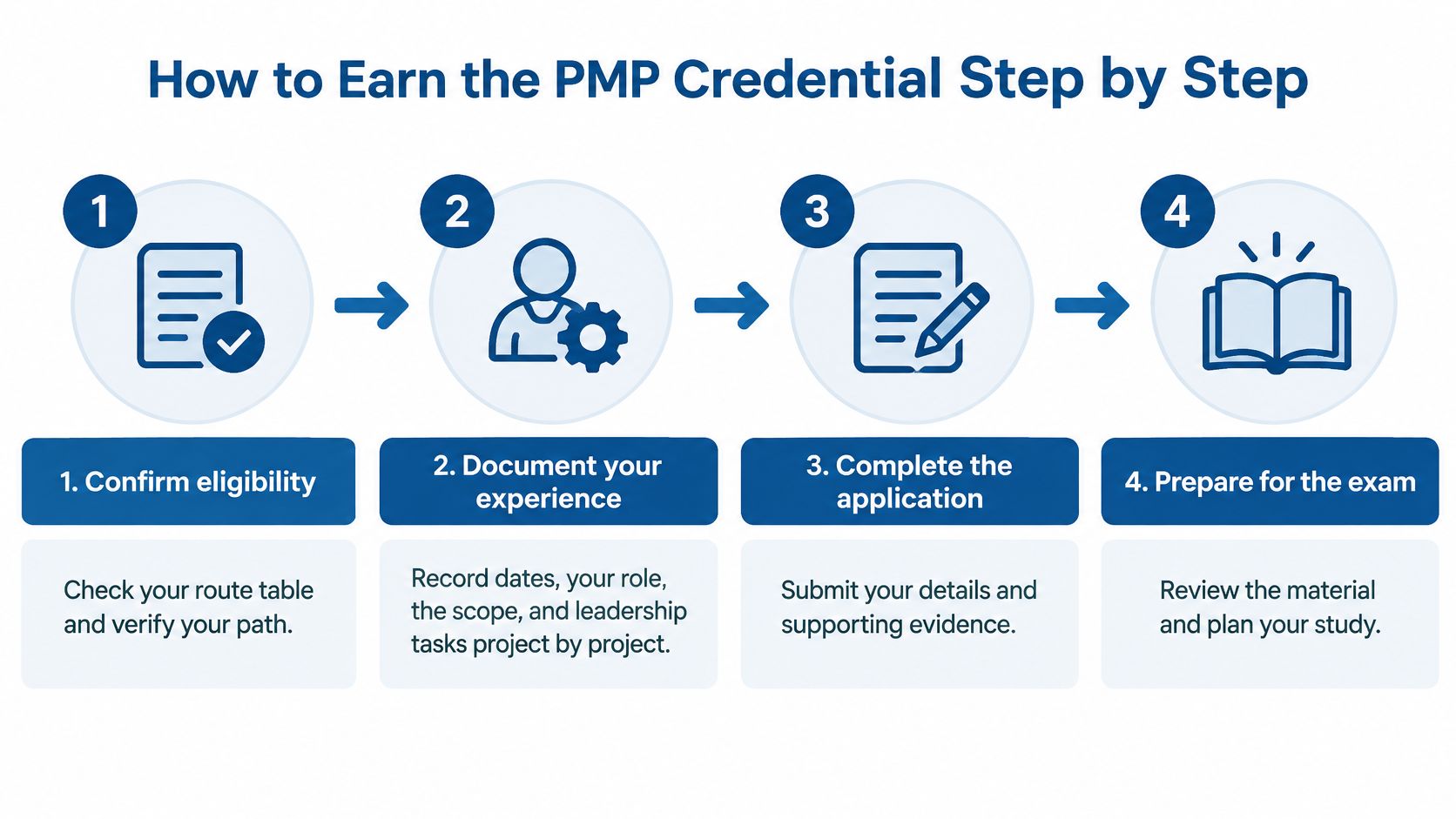
Steps One to Three Prepare the Evidence
- Confirm eligibility against the route table. Match your education to the correct experience threshold and check every month falls within the eight-year window. Doing this first prevents the most expensive mistake, paying for training toward an application you can't yet submit.
- Document your experience project by project. Record dates, your role, the scope, and the leadership tasks you carried out, such as approving changes or managing suppliers. Specifics matter because applications are audited, and a reviewer who can't see leadership in your wording will ask for more proof.
- Complete the 35 hours of formal education. Choose a recognised provider and keep the completion certificate somewhere you'll find it in two years' time. Use the course properly while you're there, since the same material underpins exam questions, especially topics like the importance of risk management in project management, where scenario questions test judgement rather than recall.
Steps Four to Five Handle the Application and a Possible Audit
- Submit the online application and pay the exam fee. Check the current fee on the credentialing body's website immediately before applying, because published figures in older guides go stale. Enter experience exactly as documented in your own records, not from memory at the keyboard.
- Respond fully if you're selected for audit. Supply the supporting evidence requested, which can include education certificates and confirmation of your project roles. Allow several weeks for review and don't book travel or leave around an assumed approval date.
Vague experience entries delay the audit more than any other issue. "Managed project activities" tells a reviewer nothing. "Approved eight change requests and reforecast the budget monthly" shows leadership at work.
Steps Six and Seven Cover the Exam and Renewal
- Book and sit the exam. Expect 180 questions in 230 minutes, mixing predictive, agile, and hybrid scenarios where you choose the best next action rather than recite a definition. Practise under timed conditions, because pacing catches out knowledgeable candidates who linger on early questions and rush the rest.
- Maintain the credential after passing. Earn 60 professional development units in every three-year cycle through courses, webinars, volunteering, or other approved activities. Spread them across the cycle instead of scrambling in the final month, and log each activity as you complete it.
A successful outcome has three parts. You receive the certificate, your name appears in the public registry employers check, and the renewal clock starts on day one. Treat that clock as a rolling commitment to stay current, and the credential keeps signalling what it should, recent, active competence rather than one good exam day years ago.
Project Manager Career Paths and Salaries
Salary bands make the career ladder tangible. In the 2024 IT Search salary survey for Irish project managers, reported salaries were €45,000 to €55,000 for junior roles, €60,000 to €75,000 for mid-level roles, and €75,000 to €100,000 for senior roles.
| Band | Reported annual salary | Typical experience |
|---|---|---|
| Junior | €45,000 to €55,000 | Early-career project roles and coordination support |
| Mid-level | €60,000 to €75,000 | Independent delivery of single projects |
| Senior | €75,000 to €100,000 | Senior leadership of complex, multi-team work |
How the Ladder Usually Runs
Professionals often start as a project coordinator, maintaining schedules, minutes, and trackers under a manager's direction. They progress to project manager with ownership of a single project's scope, budget, and team. From there, senior or programme manager roles coordinate several interdependent projects, and portfolio or PMO leadership sets priorities across all of them. Each step widens accountability, from one plan to many, and from delivery detail toward investment choices.
Demand is expected to keep supporting that ladder. The IT Search project management and change salary guide for 2026 forecasts overall project-management and change hiring growth of 5 to 7% for 2026, with contract positions expected to outperform permanent hiring during the first half of the year, and reports annual ranges rising to €85,000 to €110,000 for highly experienced roles. It is a forecast, so read it as direction rather than a promise.
Sector changes what those bands mean in practice. Construction employers expect fluency in procurement, site interfaces, and staged approvals, while technology employers weight agile delivery and vendor management. Pharmaceuticals add validation and regulatory documentation, and energy projects demand consenting, grid, and long-horizon risk knowledge. The same title in two sectors can be two quite different jobs.
Sector, location, and experience set where you land within each band. A Dublin technology role and a regional construction role won't price identical experience the same way, so benchmark against postings in your own sector before you negotiate.
The pattern beneath the figures is simple. Experienced professionals earn more because they coordinate technical, financial, and operational teams at the same time, balancing trade-offs that no single specialist sees in full. Pay follows the breadth of what you can deliver.
Why a Credential Alone Does Not Win the Role
A certificate proves you studied for the exam. A portfolio proves you delivered. Recruiters spend seconds on the first and the whole interview on the second, so candidates who stop at the certificate reach interviews with nothing to discuss, and that is where their applications stall.
Employers are blunt about the main barrier. In a survey of more than 50 organisations reported in the Irish Examiner's coverage of renewable-energy recruitment, 74% of employers identified insufficient practical experience as a barrier to recruitment, compared with 60% citing general skills shortages. Engineers and project managers were among the hardest roles to fill. The shortage is of proven capability.
The Evidence Employers Look For
- A project charter you drafted: Shows you can define scope and authority before work starts.
- A risk register you maintained: Proves risks were tracked and acted on through the life of the project.
- Stakeholder records: Demonstrates you managed decisions, concerns, and communications deliberately.
- A commissioning or handover checklist: Evidence that you closed work properly and confirmed acceptance.
- A sector-specific portfolio: Even two or three well-chosen artefacts beat a generic claim of transferable skills.
Build this folder as you work, with client-sensitive detail removed. Retrospective reconstruction before an interview produces thin, unconvincing material, while a folder built over months documents growth. Study the key traits of successful project managers alongside your portfolio and match each artefact to a trait you can discuss with a concrete example.
Convert the evidence into CV bullets with figures: budget managed, schedule recovered, team size coordinated, changes approved. "Responsible for project delivery" gives a recruiter nothing to test. "Delivered an office refit six weeks after a contractor withdrawal, within the original budget, coordinating four trades" gives an interviewer something real to probe and gives you answers you are ready for.
Beginners can build this record without waiting for a formal promotion. Supervised work packages, volunteer project roles, internal improvement projects, and realistic simulation exercises all produce artefacts and referees. Take the small, visible piece of work nobody owns, plan it properly, and close it cleanly.
The credential clears the recruiter screen. Documented delivery wins the interview. Build the second while you study for the first, and you arrive as a Project Management Professional in substance as well as name.
PMP, CAPM and PRINCE2 Compared and Next Steps
Three credentials dominate the conversation, and they serve different career stages. Choosing well means matching the credential to your current evidence and target sector, rather than picking the most prestigious name and hoping eligibility follows.
| Credential | Who it suits | Experience required |
|---|---|---|
| PMP | Experienced project managers leading predictive, agile or hybrid projects | 36 or 60 months leading projects, plus 35 hours of education |
| CAPM | Newcomers, team members and people moving into project roles | None |
| PRINCE2 Foundation and Practitioner | Teams working in a structured, process-led method, common in UK and European public sector | Foundation before Practitioner |
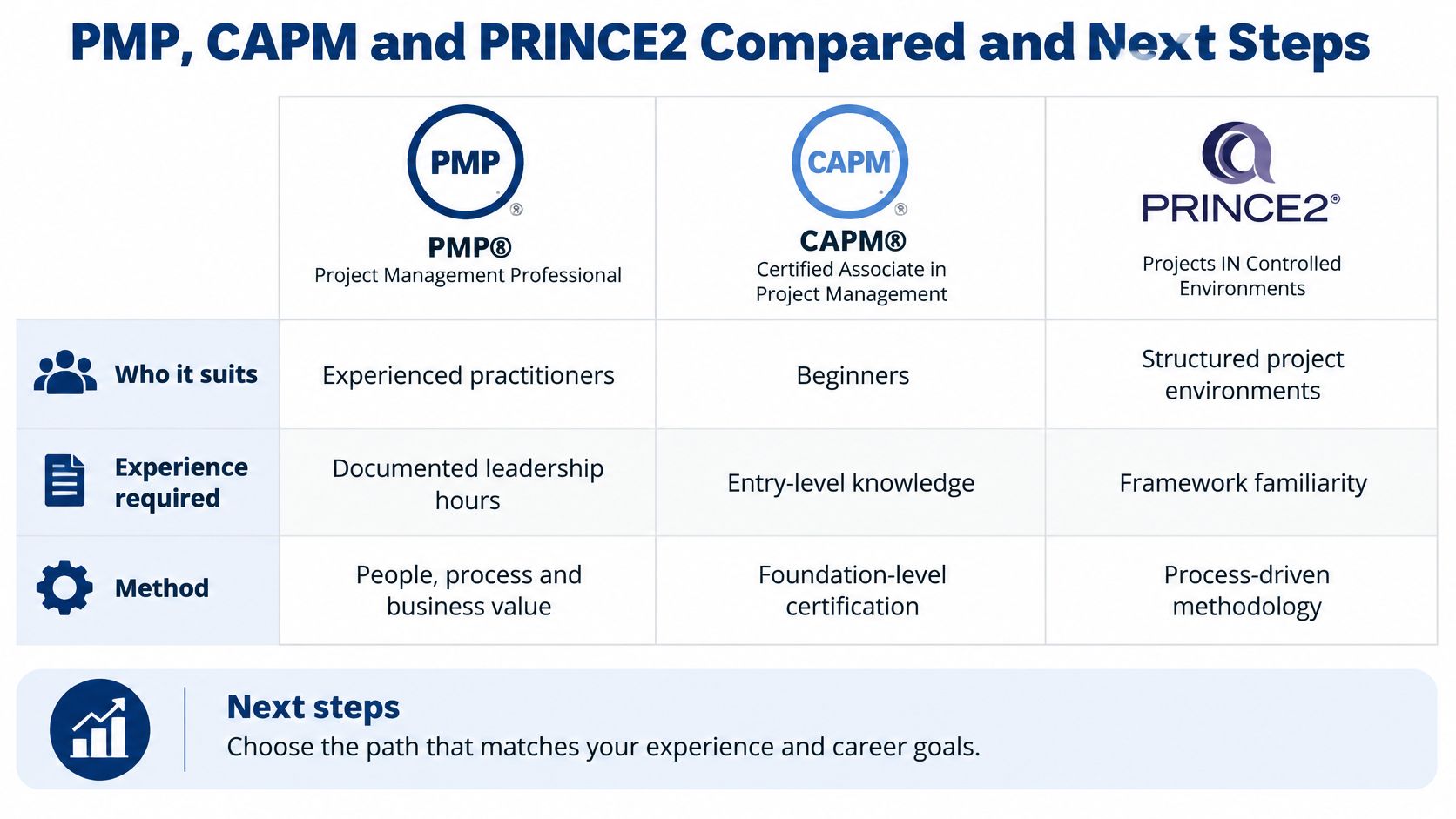
Four Criteria That Settle the Choice
Prerequisites differ sharply. The PMP demands documented leadership experience before you can sit the exam, the CAPM requires none, and PRINCE2 sequences Foundation before Practitioner. Your current record decides which door is open today.
Time to qualify follows from that. A newcomer can prepare for CAPM or PRINCE2 Foundation now, while a PMP candidate who's short on qualifying months faces a longer road of building experience first. Factor in study time carefully, since the PMP's scenario-heavy exam rewards candidates who've applied the material, not just read it.
Method focus separates PRINCE2 from the other two. PRINCE2 teaches one structured, process-led method with defined stages and governance, while the PMP covers predictive, agile, and hybrid approaches and expects you to select and blend them, a distinction worth exploring through project management methodologies before committing. The CAPM covers foundational knowledge across approaches without testing leadership depth.
Employer recognition varies by sector, and the only reliable way to read it is the job market itself. Some employers write PRINCE2 into their requirements because their delivery governance is built around it, while internationally oriented and technology employers often screen for the PMP. Pull twenty adverts for the role you want and count which credential they name. That's your answer, and it beats any generic ranking.
The Decision List by Situation
- New to projects: Start with the CAPM and volunteer for a small project to build artefacts alongside it.
- Already leading projects and meeting the PMP experience rule: Prepare for the 180-question exam and apply.
- Moving into a project role without the required experience: Build a portfolio first and target coordinator or assistant roles.
- Working in a sector that runs on PRINCE2: Choose that path, Foundation then Practitioner.
These credentials aren't mutually exclusive. Experienced practitioners often hold two, pairing a governance method with broader leadership recognition as their sectors demand.
For structured preparation, the European Institute of Leadership and Management offers a Programme Certificate in Project Management aimed at current project managers, team leaders, and people looking to move into a project management role, plus a Mini-MBA in Project Management covering the full project lifecycle from initiation to closure. Before enrolling anywhere, confirm the course counts toward the 35 hours PMI requires.
Set an hour aside for the eligibility table and list the projects you can document, with dates and leadership tasks for each one. That single list tells you whether to apply now, build evidence first, or start with an entry-level credential, and it turns a vague ambition into a plan.
Turn your documented experience into recognised, structured competence with the European Institute of Leadership and Management, whose project management programmes are built for current managers, team leaders, and people moving into the role. Study the full lifecycle from initiation to closure online and at your own pace, and verify how the hours align with your credential plans before you enrol. Start building the evidence and the qualification together at European Institute of Leadership and Management.