
Online Leadership Certificate Guide: What to Know

What does an online leadership certificate prove if a learner has never handled a difficult conversation, delegated work or guided a team through change? Completing the learning and demonstrating leadership are related achievements, but they aren't the same.
A useful certificate provides structured knowledge and a record of successful study. Its career value becomes clearer when the learner can also show how that knowledge changed a workplace decision. Choosing well therefore involves two parallel tasks: checking the credential and planning an opportunity to apply the learning.
Table of Contents
- What an Online Leadership Certificate Covers
- Certificate Levels and What Completion Requires
- Study Time and Cost to Plan For
- Choosing a Leadership Track by Your Role
- How to Complete an Online Leadership Certificate
- Credential Status and How to Verify a Certificate
- Whether It Helps Your Career and How to Prove It
What an Online Leadership Certificate Covers
An online leadership certificate works like a toolkit. Each course adds an approach for handling people, priorities or decisions. The most useful toolkit isn't necessarily the largest; it contains tools that match the learner's responsibilities.
Consider a newly promoted supervisor whose team keeps missing handover deadlines. Working harder won't necessarily solve the problem. The supervisor may need to redistribute tasks, explain expectations, investigate resistance and decide which problems deserve attention first.

People, communication and change
Leadership subjects can be grouped into practical areas, each addressing a different part of that situation:
- Team leadership covers delegation, coaching and teamwork. The supervisor learns to allocate work according to capacity and competence rather than repeatedly relying on the most experienced colleague.
- Communication and influence helps with presenting proposals and handling difficult conversations. A performance discussion becomes more constructive when the manager describes observable behaviour, explains its effect and agrees a next action.
- Organisational change concerns how people adapt to new processes. A project lead introducing a shared handover system needs to understand objections, clarify responsibilities and identify risks.
- Practical management habits include time management, problem solving and decisions under pressure. The learner practises separating an urgent symptom from a recurring cause.
The distinction matters because not every workplace problem needs the same response. Coaching won't fix an unclear process, and a detailed process won't resolve a disagreement about priorities.
Breadth should serve a purpose
Broader leadership study may include innovation and organisational management, while career-skills study concentrates on communication, teamwork and personal effectiveness. A guide to core skills modern leaders need can help learners identify which capabilities deserve attention.
Practical rule: A module earns its place when the learner can name a situation in which its methods would be useful.
Before selecting a course, the learner should write down an upcoming challenge, such as delegating a recurring task or explaining an unpopular change. Comparing that challenge with the module list is more useful than choosing subjects based only on their impressive titles.
Certificate Levels and What Completion Requires
A learner who finishes three Leadership courses and one Project Management course holds four course certificates, not a programme certificate. That distinction sits at the heart of how the levels below work: each award has a fixed course count tied to one designated programme.
| Certificate level | Courses required | Typical scope | What the learner receives |
|---|---|---|---|
| Course certificate | 1 course | One subject, such as Leadership and Organisations | Digital certificate with unique ID and QR code |
| Programme certificate | 4 courses in one designated programme | Focused track, such as Leadership or Project Management | Programme certificate after the four required courses |
| Mini-MBA programme certificate | 6 courses in one programme | Broad introduction to management, such as Leadership or Business Administration | Mini-MBA certificate after the six required courses |
Check the designated course list before enrolling, because the award depends on completing the required count within one programme. Saving a copy of that list protects the learner from a common mistake: picking courses that look useful individually but sit in different programmes, so none of the intended awards is ever triggered.
The levels differ in scope. A single course certificate records study in one subject and suits a defined knowledge gap, such as a supervisor preparing to take responsibility for staff who starts with Leadership and Organisations. A programme certificate ties four related courses together in one discipline. The Mini-MBA certificate requires six courses and covers wider management ground; the Leadership version, for example, addresses leading teams, managing organisations, driving innovation and responding to change in a dynamic business environment.
What successful completion means
A completion requirement differs from an assessment standard. Finishing the courses earns the award, but the learner still needs to know what successful performance involves along the way: a final assessment, a practical task, a required score or another stated condition.
The course description should make clear what is assessed and how the learner will know the requirement has been met. Comparing two options on course count alone misses this. A useful comparison weighs both coverage and assessment, because two certificates at the same level can demand different evidence of learning.
Practical rule: Before paying, write down the three things the certificate will show: the programme name, the number of courses completed, and what was assessed. If any of those answers is unclear, ask before enrolling.
The certificate then records exactly what its level promises. A course certificate confirms one completed subject, a programme certificate confirms a completed sequence, and a Mini-MBA certificate confirms a completed six-course programme. Employers reading that record will still ask what the learner can apply from it, which is why the assessment details matter as much as the award title.
Study Time and Cost to Plan For
A realistic plan starts with confirmed hours and confirmed fees. Self-paced, 100% online study changes when the work happens; the reading, exercises and assessment still take time.
The scale of continuing education is already substantial: the Central Statistics Office's Adult Education Survey 2022 found that 52% of people aged 25–69 had participated in lifelong learning during the previous twelve months. That figure covers formal and non-formal education, so it shows demand for flexible study without proving that every learner chose a leadership certificate.
Establish the full commitment
Before paying, the learner should record answers to these questions:
- Study workload: What is the estimated learning time for each required course, including reading and exercises?
- Assessment effort: Does the estimate include preparation, submission and any permitted resubmission?
- Evidence time: What time is needed to apply one idea at work and keep the result, such as a decision log, meeting plan or process change?
- Total cost: Is payment per course or for the whole programme, and are assessment and certificate issuance included?
- Access conditions: Is there a completion deadline, an access expiry date or a charge for extending access?
- Support arrangements: How can learners request help when instructions or assessment feedback are unclear?
A single course fee can mislead. European Institute of Leadership and Management lists online certificate courses at €15.00 each, while a Programme Certificate requires four courses and a Mini-MBA requires six; the pathway total depends on the required course count and on what the purchase terms include.
Turn hours into a planning number
The workload calculation is straightforward:
Estimated study weeks = total expected study hours ÷ sustainable weekly study hours.
Use a weekly figure that survives a normal workload, including time to produce evidence of application. If the result runs past a review, promotion application or access deadline, reduce the starting scope or confirm a longer access period before paying.
Choosing a Leadership Track by Your Role
A leadership certificate records completed study. Your workplace examples show how you apply it. Start by matching a programme to the responsibilities you hold, or expect to take on, then identify a practical example that could demonstrate what you learn.
| Reader profile | Best-fit track | How the track relates to the role |
|---|---|---|
| Aspiring leader or new team lead | Programme Certificate in Leadership | Develop leadership capabilities for taking on responsibility for a team. |
| Current manager refining skills | Programme Certificate in Leadership | Refine leadership capabilities while managing people and organisational responsibilities. |
| Entrepreneur or business owner | Programme Certificate in Business Administration | Suited to budding entrepreneurs and people managing business responsibilities. |
| IT manager leading technical teams | Information Technology programme | Connects with a role in the information technology field. |
| Project manager | Programme Certificate in Project Management | Connects with responsibilities in project management. |
| Policy analyst or international affairs professional | Programme Certificate in Global Governance | Connects with work involving global governance. |
| Young professional entering the job market | Programme Certificate in Professional Career Skills | Focuses on communication, leadership, time management, problem-solving and teamwork. |
The programme name helps identify a relevant area of study; it does not, on its own, show how well you perform in the role. For instance, a new team lead might pair a leadership course certificate with an example of delegating a task, clarifying expectations and following up with a colleague.
Match the track to the decisions
A first-time team lead often moves from doing the work personally to helping others complete it. As you study, note a workplace situation where you gave clear instructions, delegated responsibility or offered constructive feedback. The certificate records the study; the example shows how you applied it.
An established manager may be refining leadership capabilities while handling competing responsibilities. Record a decision you made, the options you considered and what happened afterward. This gives an employer something concrete to discuss beyond the credential.
For an entrepreneur, the Programme Certificate in Business Administration is aimed at budding entrepreneurs, mid-level managers and people transitioning into a business role. A useful evidence example might describe a business decision and your reasoning, such as how you weighed the needs of a team against the resources available.
Technical managers and project managers can also connect study with a work example. A technical manager might document how they explained a team's needs to colleagues, while a project manager could describe a decision made in the course of their project responsibilities. The example should reflect work the learner did, not imply that the certificate alone proves a particular outcome.
For policy analysts and international affairs professionals, the Programme Certificate in Global Governance may fit the work area. Young professionals entering the job market may find the Programme Certificate in Professional Career Skills relevant to building communication, teamwork, time management, problem-solving and leadership skills. In either case, a specific example from study, volunteering or work can help show how those skills were used.
How to Complete an Online Leadership Certificate
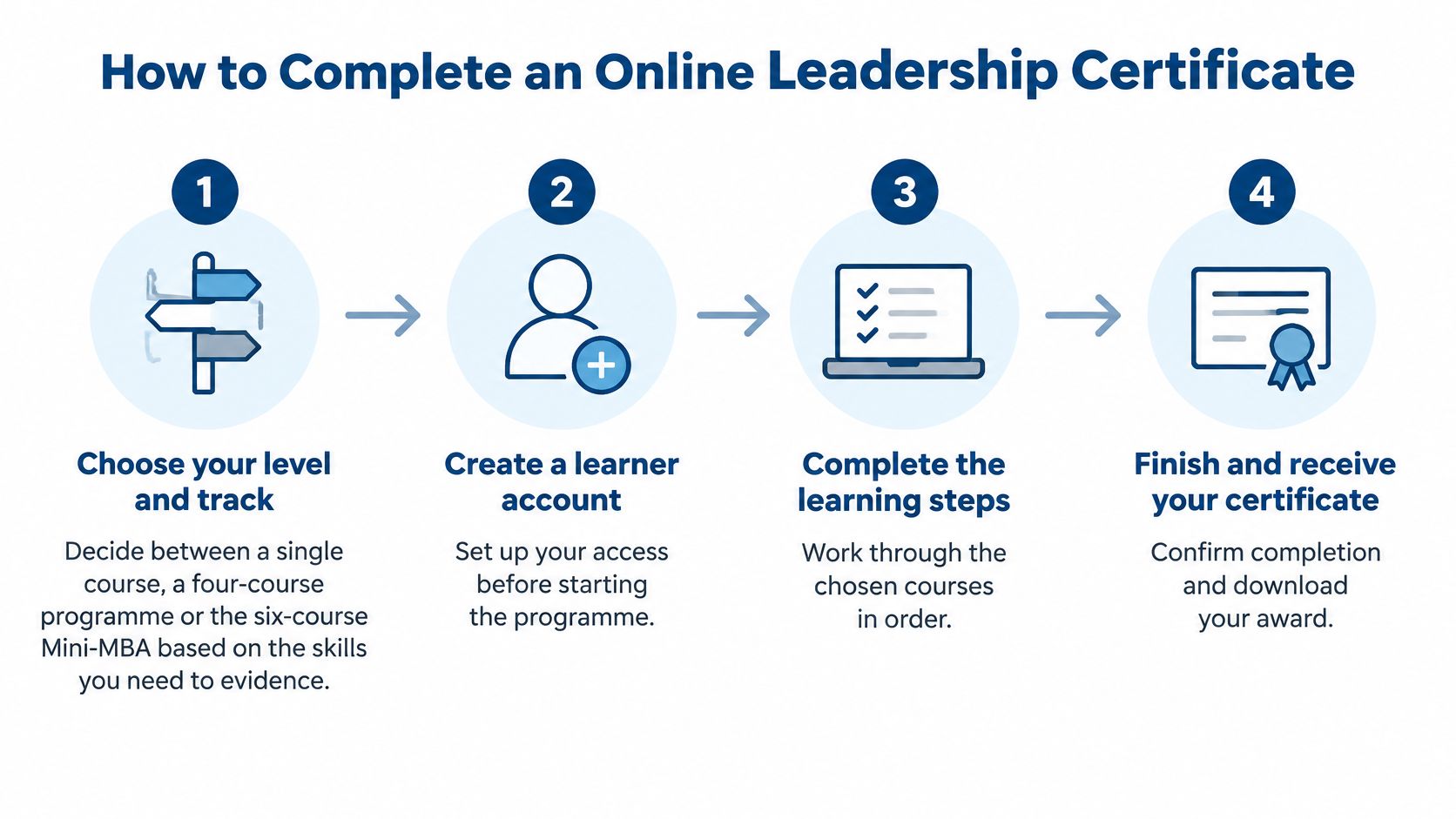
What turns an online course into evidence of useful learning? Complete its requirements, then keep a clear record of both the credential and how you applied the ideas at work. European Institute of Leadership and Management offers self-paced courses online, with online support.
From enrolment to successful assessment
Choose a track that fits your goal. Identify a workplace responsibility you want to handle better, such as delegating tasks or responding to change. Then check that the course or programme you select matches that goal.
Create a learner account and enrol. Enter your details accurately, especially the name you want shown on your completion record. Once you have access, locate the course materials, assessment instructions and online support.
Set up a way to track progress. Use a simple checklist to record modules completed, questions to revisit and assessment requirements. This makes it easier to see what remains without duplicating the study-time planning covered earlier.
Connect each concept to a work task. As you study, note how an idea could apply to a decision or conversation. For example, after learning about delegation, draft a task brief that states the expected outcome, decision boundaries and review arrangements.
Complete the assessment. Read the instructions carefully and check that your submission addresses each required component. Only successful completion of the assessment earns the course certificate.
Keep the learning record organised
Download and store the certificate. At the end of each course, European Institute of Leadership and Management issues a digital certificate with a unique ID and QR code. Keep a copy somewhere secure so you can retrieve it if your device or account changes.
Check your programme progress. If you are working towards a programme certificate, compare your completed courses with the designated programme requirements. Resolve any discrepancies in course names, completion status or personal details before presenting the award.
Keep a study log alongside the certificate. Record the module, a key idea and a specific way you intend to use it. For example, a note about delegation becomes stronger evidence when it describes a task brief you prepared and how you used it with a colleague.
The guide to succeeding in an online learning environment offers further support for managing independent study. The certificate records course completion; your notes and workplace examples show how you put the learning into practice.
Credential Status and How to Verify a Certificate
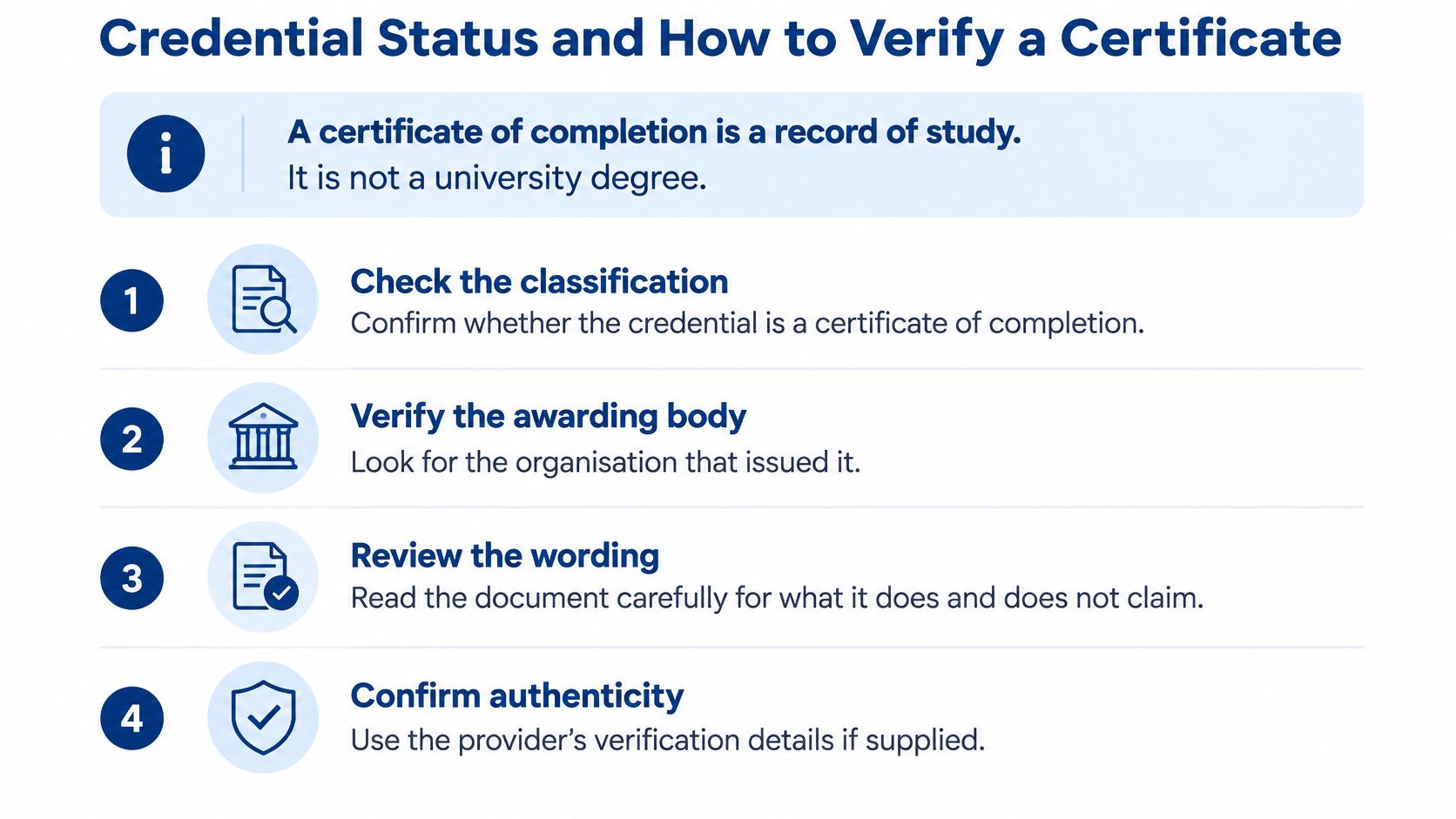
What kind of credential is being awarded? That question should come before assumptions about recognition. A certificate of completion records successful study; it isn't a university degree, and a programme title alone doesn't establish a regulated or nationally recognised qualification.
European Institute of Leadership and Management is a certified member of CPD Certification Service. That is a continuing professional development credential signal, not evidence by itself of statutory accreditation or a place on a national qualifications framework.
Separate authenticity from recognition
Authenticity concerns whether an issuer awarded a document. Recognition concerns whether an employer, awarding body or other organisation accepts it for a particular purpose. A certificate can still be unsuitable for a vacancy requiring a specific qualification.
The following checks address those separate questions:
- Confirm the issuer. The provider's name on the document should match the organisation with which the learner enrolled, and any membership claim should be checked against its stated scope.
- Inspect identifying details. The course certificate should include the unique ID and QR code described in the issuer's certificate process.
- Match the verification record. Scanning the code should lead to a record consistent with the learner's name and course title; European Institute of Leadership and Management also provides a certificate verification facility.
- Check the award wording. The programme name and award type should match the enrolled pathway rather than a different course or broader qualification.
- Clarify formal status in writing. Where national-framework recognition or an external awarding body matters, the learner should request the precise designation and supporting documentation.
Apply the result to the intended use
For general professional development, an employer may consider the subject relevance, assessment and workplace application. A role with a prescribed qualification requirement raises a different question: whether this exact award satisfies that requirement.
The learner should resolve that question with the recruiting organisation before committing to study for that purpose. A completion certificate shouldn't be presented as meeting a regulated qualification requirement without explicit evidence.
Application safeguard: The award title on an application should match the award title on the certificate.
Clear wording protects credibility. It allows the learner to describe professional development confidently without implying academic status, professional registration or recognition that hasn't been established.
Whether It Helps Your Career and How to Prove It
A certificate rarely proves leadership on its own. It provides a learning record, while a convincing career example explains what the learner did, why that approach was chosen and how others responded.
Career motivation is common: in 2024, 64% of people in Ireland who undertook online learning said it was for professional or work purposes, according to the Central Statistics Office. Motivation, however, doesn't establish that an award will produce promotion or employment.
The CIPD's HR Practices in Ireland 2025 report found that 46% cited insufficient practical experience and 35% insufficient overall experience among recruitment difficulties. That makes an evidence plan a useful companion to study, especially for learners seeking greater responsibility.
Build evidence alongside the learning
Choose a manageable project. A handover improvement, induction update or cross-team scheduling problem gives the learner something concrete to influence. The project should have a clear purpose and permission from the person responsible.
Request specific feedback. A manager or project sponsor should comment on observable behaviour, such as whether the learner clarified responsibilities, listened to objections or followed through on commitments. General praise provides less useful evidence than a description of what happened.
Record a defensible result. The learner can compare handover completeness, unresolved queries or another relevant measure before and after the change. Any improvement should be described cautiously, including other factors that may have contributed.
Map the example to a competency. A short portfolio entry should contain the situation, the learner's contribution, the outcome and a reflection. Coaching, influencing, managing change and project coordination need different examples.
Leadership without managerial authority
An early-career learner doesn't need direct reports to practise influence. A volunteer activity or cross-team task can provide a suitable setting when a named sponsor can confirm the contribution.
The account should distinguish personal actions from the team's collective achievement. Confidential information should be removed, and workplace documents should only be included with permission.
Guidance on building leadership skills at any career stage can help identify suitable opportunities. Online learning supplies frameworks, but supervised practice and feedback help the learner discover whether those frameworks work in a particular situation.
Before the first assessment, the learner should name the project that will provide practical evidence. Before enrolment, the decisive question is even simpler: which workplace decision would this certificate help the learner make differently?
European Institute of Leadership and Management offers self-paced online certificate courses, programme certificates and Mini-MBA pathways in leadership and related management disciplines. Prospective learners can visit European Institute of Leadership and Management to compare the relevant pathways, confirm completion requirements and select study that supports a defined workplace project.