
Risk Management Policy: What It Is and How It Works

A supplier stops answering on a Friday afternoon. The operations manager wants to switch providers, finance wants to know whether the extra cost is authorised, and nobody can say who has the final decision. The organisation has a risk register, but the urgent question is missing: who is allowed to accept the risk of waiting, and who can approve a response?
Table of Contents
- What a Risk Management Policy Is and Why It Matters
- The Core Components Every Policy Needs
- Who Owns the Policy Across Your Organisation
- Scoring Risks and Setting Your Risk Appetite
- How the Risk Cycle Runs Day to Day
- A Worked Example and Where Policies Fall Short
- Confirm Your Policy Before the Next Review
What a Risk Management Policy Is and Why It Matters
A risk management policy is a board-approved document that sets out how an organisation identifies, assesses, responds to and monitors risk, who is responsible for each part, and how much risk it is prepared to accept.
A building's fire-safety policy states the rules, names the fire wardens and sets the exit standards. A fire drill is the process that puts those rules into practice. In the same way, the policy sets decision rights and boundaries; procedures describe the actions people take when a risk changes or an incident occurs.

Consider a Cork logistics firm whose main van supplier collapses. The firm has alternative suppliers, but nobody knows who can approve an emergency switch or how much extra cost is acceptable. The decision takes three weeks because managers keep referring it upwards without knowing who has authority. A clear policy would have defined the approver, the spending limit and the conditions for escalating the decision before the disruption began.
Four documents that answer different questions
These terms are related, but they aren't interchangeable:
- Policy: The rules, responsibilities and decision rights.
- Framework: The wider system, including governance, methods and reporting, in which the policy operates.
- Risk register: The live record of individual risks, their owners, ratings, controls and review dates.
- Procedures: The step-by-step tasks people follow to apply a control or respond to an event.
A policy matters when concern about a risk needs to become a decision about resources, limits or action. A Central Bank of Ireland analysis of a 2023 climate pilot survey covered 252 Irish firms and found that firms were concerned about climate-related risks but hadn't invested sufficiently in adaptation, partly because of financial barriers. Concern alone doesn't tell managers what investment to approve, who can approve it or when a delay becomes unacceptable.
A useful first check of an existing policy is whether it answers four questions: Who owns it? What risk does it accept? When is it reviewed? Where is the evidence of decisions and actions kept? If any answer is unclear, the document may describe good intentions without giving staff authority to act.
The Core Components Every Policy Needs
Who in your organisation is allowed to say yes to a risk? A policy earns its keep when it answers that question before anyone has to ask it. Whatever the sector or size, a credible policy resolves eight practical questions, and each answer assigns a decision to a named person, a limit or a date. The table below works as a review sheet: a row with no clear answer is a gap, not a formatting problem.
| Component | Question It Answers | What It Typically Contains |
|---|---|---|
| Scope and purpose | Which risks and areas are covered? | Business units, subsidiaries, key suppliers and outsourced services |
| Risk appetite and tolerance | How much risk is acceptable? | Board statement with measurable limits for each risk category |
| Governance and roles | Who decides and who does the work? | Board, executive owner, risk function, line managers, internal audit |
| Assessment method | How are risks rated? | Likelihood and impact scales, scoring formula, rating frequency |
| Risk register | Where are risks recorded? | Owner, rating, controls and next review date for each risk |
| Response and controls | What is done about each risk? | Accept, reduce, transfer or avoid, with named controls |
| Monitoring and reporting | How do managers know it is working? | Key risk indicators, board reporting cadence, incident logs |
| Review cycle | When is the policy itself updated? | Annual review plus triggered reviews after incidents or major change |
"A low tolerance for disruption" is a sentiment, not a boundary. It tells a manager nothing about whether a short interruption is acceptable, what loss can be approved on the spot or when the board must be informed. Boundaries take a few workable forms: a currency ceiling on losses, a maximum outage before escalation, a cap on how much capacity can sit with one supplier. Any of them turns a general preference into a decision rule.
Who signs the register? Entries that list a department as owner effectively have no owner, because departments coordinate work but cannot be held to account for it. Each risk needs a named person responsible for keeping the assessment current, requesting action and escalating a breach. The entry should also record the controls already in place and the next review date, which is what lets a reader separate a managed risk from a risk that has merely been written down.
Scope and timing deserve the same precision. The policy should set a planned review cycle and name the events that trigger an earlier check, such as a major incident, merger or regulatory change. For scope, the Irish Government's National Risk Assessment 2024 identified 24 strategic risks across five categories, from geopolitical instability and housing to climate change and cybersecurity. A small firm will draw a narrower map, but the map still has to say which activities, sites and dependencies sit inside it.
Length is the wrong test of a policy. A short document that names a decision-maker, a record and a review point for every component beats a long one that describes intentions without assigning authority. Managers drafting their first policy can work through the components in order using this guide to developing a risk management strategy, then check each row above against their own document and mark anything blank or ownerless.
Who Owns the Policy Across Your Organisation
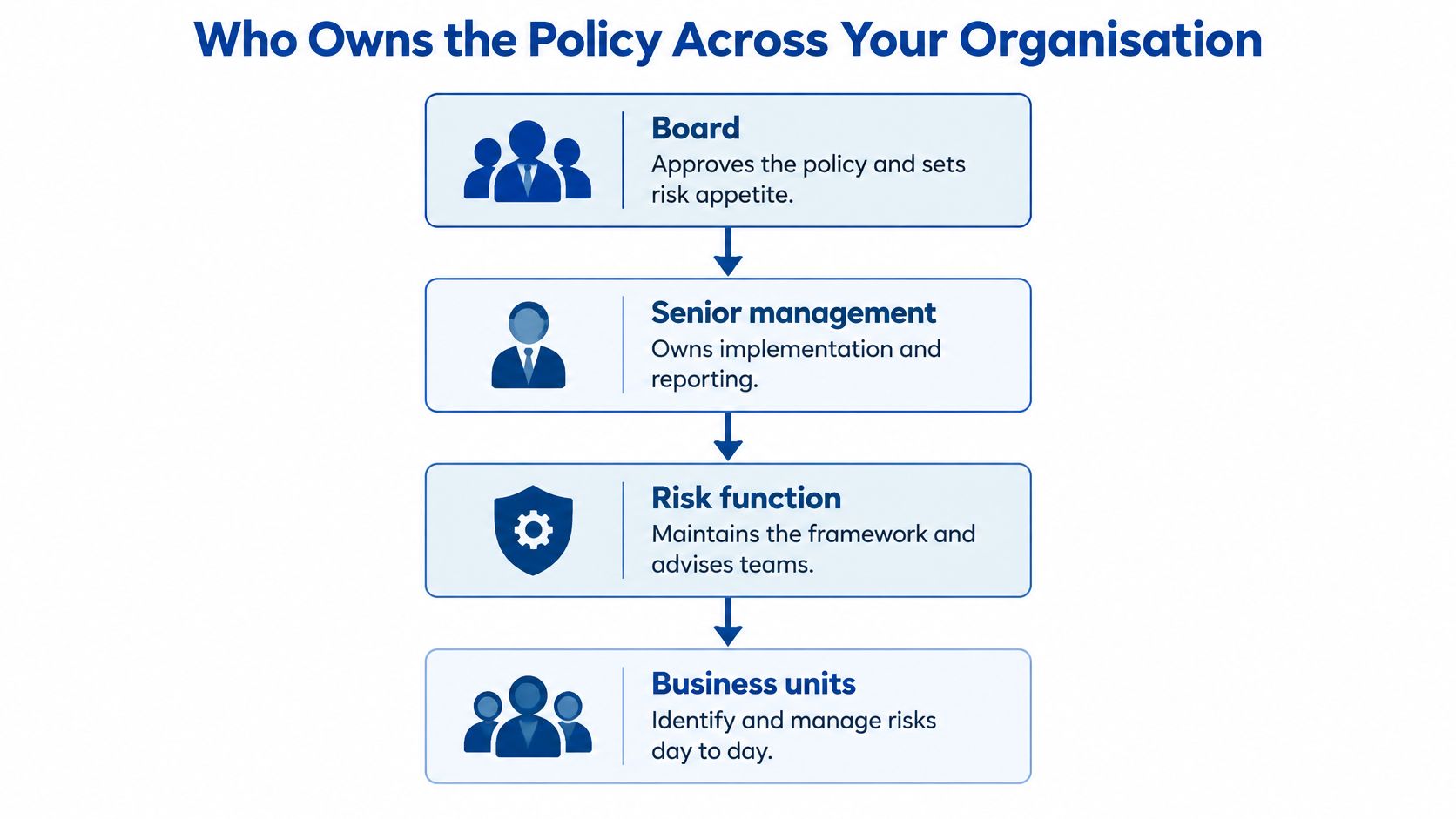
Most policy failures trace back to unowned decisions rather than weak scoring methods. A policy works as a decision-rights document: it states who may accept which risk, up to what threshold, and who must escalate anything beyond it. Authority should run from the board, which approves the policy and sets risk appetite, through senior management and the risk function to the people who manage risks in daily operations.
Assign authority and accountability
The board approves the policy, decides what the organisation is willing to accept and challenges significant risks that exceed those boundaries. A chief executive or another named executive owns implementation, makes sure functions apply the policy and reports material issues to the board.
The risk function maintains the assessment method and helps managers challenge assumptions. In a larger organisation this may be a dedicated team. In a smaller firm the finance lead may coordinate the process, provided risk owners still make decisions about their own operations.
Line managers own the risks in their areas and run the controls. Internal audit independently tests whether the controls and wider system work as intended. That separation matters: the person who operates a control should never be the only person judging whether it works.
Delegation needs thresholds as well as names.
For each role, the policy should say which risks that person can accept alone, which need sign-off from the executive, and which must go straight to the board. A manager who knows their acceptance limit can act quickly inside it and escalate early outside it. A manager without one either sits on a risk too long or pushes every decision upward.
Take a hypothetical 200-person group with a small dedicated risk team. The board approves the policy and the appetite statement, a chief risk officer coordinates the register and reporting, and each division head owns the operational risks in their area. The logistics director might own a supplier-concentration risk, holding it while it stays within the appetite the board set and escalating the moment a review shows it has crossed that line. Titles will differ between organisations; the authority attached to each role is what gives the policy its force.
For covered Irish financial entities, DORA makes documented ICT-risk governance a regulatory requirement. The Central Bank of Ireland's DORA guidance says entities must document their ICT-risk management framework and review it at least once a year, with periodic review permitted for microenterprises, and it describes the board's responsibility for that framework. The policy should connect those formal duties to evidence, including records of ICT assets and dependencies, incident procedures and resilience testing.
Practical rule: Name a person, not just a team. A team can discuss a risk, but a named decision-maker must be able to approve a response, accept a risk within delegated authority or escalate it.
Finish the ownership check by selecting three risks from the register. Each should have one named person who can take action, a clear escalation route and a record showing when the risk was last reviewed. If an entry lists only “IT” or “Operations”, its accountability is still unresolved.
Scoring Risks and Setting Your Risk Appetite
A scoring method makes comparisons more consistent, but it doesn't remove judgement. The organisation needs to define each rating in language managers can apply, then make sure the impact scale reflects its own finances, services and obligations.
A sample five-point method can rate likelihood from 1, rare, meaning less than once in five years, to 5, almost certain, expected within the year. Impact can run from 1, minor, absorbed within the normal budget, to 5, severe, threatening continuity or breaching a regulatory duty. Multiplying likelihood by impact produces a score from 1 to 25.
Impact descriptions should also use organisation-specific measures. For example, a firm might define a loss above 2 per cent of annual revenue as severe. That's an illustrative threshold, not a universal benchmark: each organisation should set a figure that reflects its own financial capacity. Without that definition, two managers may give the same event different scores because one is considering cash loss while the other is focused on service disruption.
Translate appetite into action
Risk appetite is the board's statement of the level and type of risk the organisation is prepared to accept. Tolerance turns that statement into a specific boundary for a particular risk. For example, a board could decide that the organisation will accept losses up to €50,000 from a single supplier failure, but won't accept customer deliveries being interrupted for more than three days. These are sample policy limits, not claims about typical Irish firms.
The Central Bank of Ireland says risk-management capabilities and stress and scenario analysis should be forward-looking and proportionate to a heightened environment shaped by digitalisation, climate change and geopolitical volatility. Its 2025 Regulatory and Supervisory Outlook also places primary responsibility for identifying, managing and mitigating risk on boards and management teams. A risk register without measurable limits leaves those decision-makers without a reliable escalation test.
| Rating Band | Score Range | Typical Action | Review Frequency |
|---|---|---|---|
| Low | 1–4 | Accept and monitor within normal operations | Annually |
| Medium | 5–9 | Manage within existing controls and record an owner | Quarterly |
| High | 10–15 | Escalate to senior management with a named action plan | Monthly |
| Critical | 16–25 | Escalate to the board with a response plan and deadline | Every board meeting until reduced |
The bands are a sample model. Another organisation may choose different boundaries, but the policy should make the method consistent and explain what each rating requires. This guide to risk probability and impact assessment can support managers who need to apply a structured scoring approach.
Any critical risk goes to the board at its next meeting. Any risk that breaches appetite is escalated within five working days, regardless of its score. That second rule matters because a moderate score can still violate a hard limit, such as an agreed maximum period of service downtime.
How the Risk Cycle Runs Day to Day
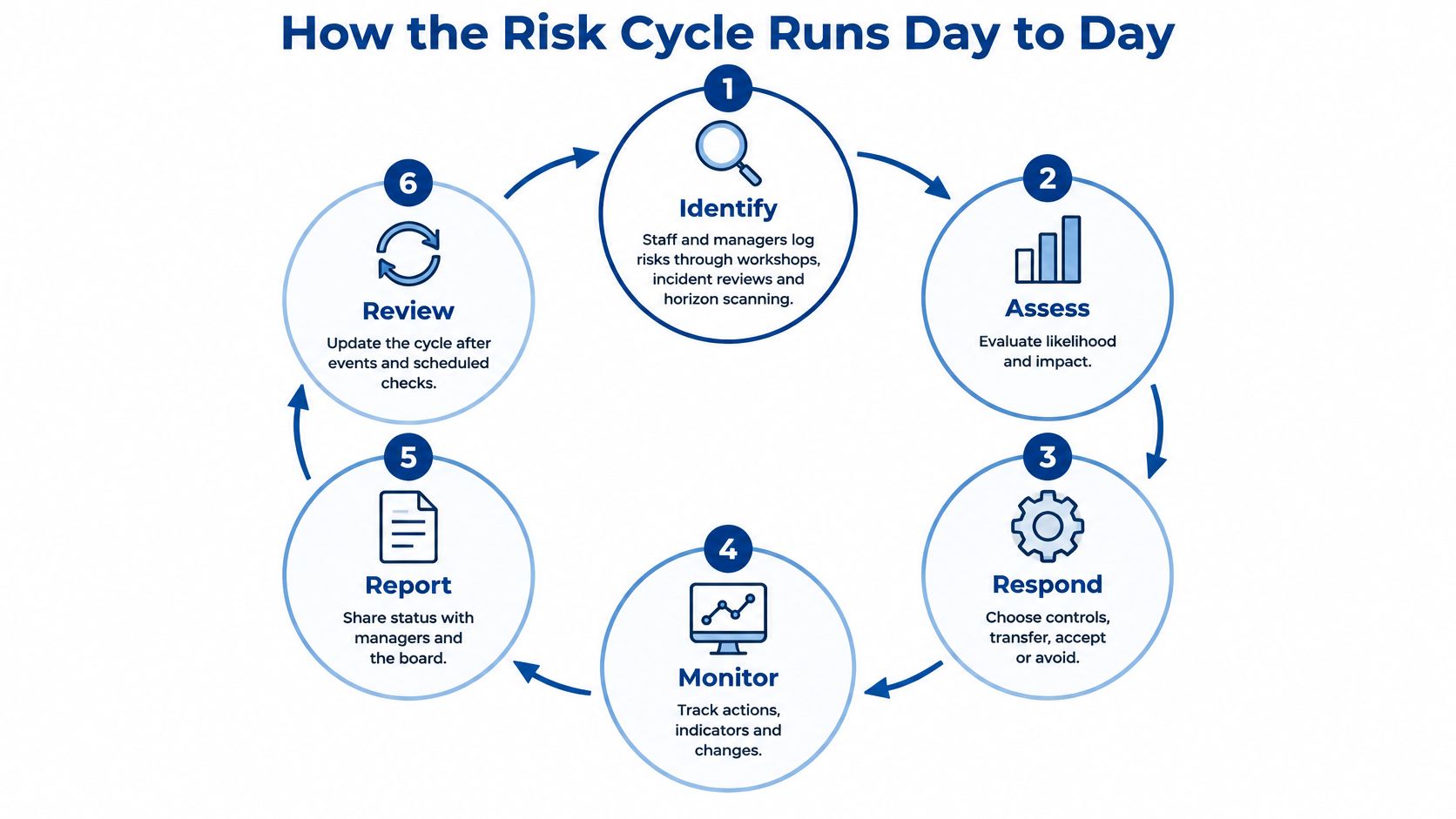
A risk management policy only works when staff use it as a recurring decision process. A register that is updated only for an annual meeting becomes a snapshot of past concerns, not a tool for responding to changing conditions.
Identify. Staff and managers log risks through workshops, incident reviews and horizon scanning. Recording who raised an issue and which objective it could affect helps prevent vague entries such as “supplier risk”.
Assess. Managers rate each risk for likelihood and impact before controls, then assess what remains after those controls are considered. The two ratings help show whether existing safeguards reduce the exposure or only make it feel more manageable.
Decide the response. The authorised person chooses whether to accept, reduce, transfer or avoid the risk and records the reason. The response should fit the organisation's appetite and the likely effect on its objectives.
Implement. The risk owner assigns a control, a person responsible for the work and a deadline. “Improve supplier resilience” isn't an action until someone specifies what will change and when.
Monitor. Managers track indicators that can signal a change before a loss occurs, such as supplier delivery delays or turnover in a critical role. A rising indicator should prompt a review, not appear in a report without explanation.
Report and review. Managers take the most significant risks to the board each quarter and update the register when circumstances or controls change. Reports should make clear what has moved, what decision is required and whether agreed actions are on track.
A practical explanation of the available treatment choices is set out in this guide to developing risk response strategies. The important point is that every response should lead to an assigned action or a documented decision to accept the exposure.
Consider a retailer that identifies a single-source packaging supplier. It rates the risk 4 for likelihood and 5 for impact, then decides to qualify a second supplier and review the exposure monthly until the alternative is ready. The team identifies the risk once, but keeps returning to it as evidence changes. A healthy cycle leaves fewer high-rated items after a quarter and gives every register entry a current review date.
A Worked Example and Where Policies Fall Short
Take a hypothetical mid-sized Irish food manufacturer that relies on a cloud-hosted ordering system. Managers identify it as a single point of failure because a provider outage could stop orders reaching production and dispatch. The team assigns the risk a likelihood score of 4 and an impact score of 5, giving a score of 20, which places it in the sample critical band.
The board sets a tolerance: ordering downtime must not exceed four hours. The IT manager becomes the named risk owner and agrees to arrange a backup provider and a manual order process within six weeks. The register records the control, the deadline and a monthly review date, so the board can see whether the exposure is falling before the backup is ready.
In month five, the provider suffers an outage. Staff switch to the manual process, which keeps ordering open for three hours, inside the four-hour limit. The board pack records what happened, whether the tolerance was met and what needs to change.
The scenario shows why a policy needs decision rights as much as a rating scale. Staff knew who could act, which limit applied and what evidence the board expected afterwards, so the outage became a recorded decision rather than an improvisation.
Why a policy can still fail
A document can look complete and still leave managers without usable authority. Common gaps include:
- Appetite stated only in words: "Low tolerance" gives two managers room to reach opposite decisions about the same exposure.
- No named owner on part of the register: A team label doesn't identify who must act or escalate when a threshold is crossed.
- Reviews only after an incident: The policy misses warning signs that could have prompted earlier action.
- Categories without thresholds: More headings create more entries but don't clarify which risks require decisions, and a long list can spread accountability so thin that nobody knows which risks demand immediate attention.
For regulated financial firms, mapping services and testing recovery can expose dependencies before an outage occurs. The Central Bank of Ireland's operational resilience guidance describes linked capabilities to identify and prepare, respond and adapt, and recover and learn, with resilience embedded in broader governance. That approach is useful beyond regulated firms: a policy should connect the services a firm cannot afford to lose to the people, systems and suppliers needed to keep them running.
One test exposes many of these gaps: ask someone outside the team to explain how a critical risk would be escalated. If the answer doesn't match the policy's named owner, trigger and timeframe, the document isn't yet a dependable decision guide.
Confirm Your Policy Before the Next Review
A manager can complete a useful policy check in an afternoon. The aim is to confirm that the document gives staff authority to make decisions and leaves evidence that those decisions were followed.
Confirm the owner and approval date. The policy should name a board-approved owner and show when it was last approved, so responsibility and currency are clear.
Check that appetite uses measurable limits. A euro loss, downtime limit or other defined threshold gives managers a boundary they can apply consistently.
Sample five register entries. Each should have an owner, a score, a control and a review date, or the register can't reliably guide follow-up.
Check the escalation rules. The policy should name who receives an escalation and the timeframe for sending it, so urgent decisions don't stall.
Locate the evidence. Board minutes, risk reports and incident logs should demonstrate that the organisation reviews risks and follows through on actions. An internal auditing guide can help explain how independent checks support that assurance.
Five checks, one afternoon. The policy is only as good as its last review, and a clean document paired with an empty or stale register is a warning sign that risk may be going unmanaged.
European Institute of Leadership and Management offers self-paced online education in business management, leadership and related professional disciplines, with a catalogue that includes Risk Management among its certificate courses. Managers developing their organisation's approach can visit European Institute of Leadership and Management to explore its courses and programmes.