
Global Governance Courses: How to Choose the Right One

Who makes the rules when no single government is in charge, and which course can make that system easier to understand? Global governance courses study how states, international organisations and other actors create and apply rules across borders. The right option depends mainly on how much depth a learner needs and what kind of credential they want.
Table of Contents
- Global Governance Courses at a Glance
- What Global Governance Means and What It Does Not
- Topics and Institutions a Solid Course Covers
- Applied Case Work from Treaties to Trade Decisions
- Matching a Course to Your Career Goals
- How to Check a Course Before Enrolling and Decide
Global Governance Courses at a Glance
Course formats range from a short, self-paced introduction to an assessed university award. A certificate can document completion, but it doesn't automatically show that a learner can analyse policy or make decisions. The outline and assessment matter as much as the format.
| Format | Typical structure | Credential | Best for |
|---|---|---|---|
| Single online course | One subject, self-paced | Course certificate on completion | Testing interest or filling one knowledge gap |
| Programme certificate | Four courses in one designated programme | Programme certificate | Building a structured foundation in global governance |
| Mini-MBA | Six courses within one programme | Mini-MBA programme certificate | Broader professional development alongside management skills |
| University postgraduate module or degree | Multiple modules, assessed under academic rules | Academic award, with accreditation to be checked | Formal academic study or a career change |
A single online course suits someone who wants to explore one topic, such as international relations, before choosing a longer programme. A programme certificate offers a more connected body of study: at the European Institute of Leadership and Management, completing four courses in a designated programme earns a Programme Certificate. Its Global Governance Programme Certificate takes a multidisciplinary approach to the subject.
A Mini-MBA combines a broader programme with management learning. The European Institute of Leadership and Management's Global Governance Mini-MBA examines the actors and institutions involved in global governance, alongside the challenges and opportunities they face. Its Mini-MBA Programme Certificate requires completion of six courses within a specific programme. That format may suit a professional who wants to connect international affairs with management responsibilities, though it isn't a university degree.
A postgraduate module or degree follows academic assessment rules and may suit someone seeking formal study or a career change. The award and its accreditation should be checked directly in the course information, rather than inferred from words such as “certificate” or “Mini-MBA”.
The table gives readers a quick route to a shortlist. The next step is to test each option against its own outline, especially the topics, applied work and assessment.
What Global Governance Means and What It Does Not
Global governance can be understood as a shared road code agreed by many drivers across many countries. It gives people common rules for using the road, but no single police force patrols every junction or ensures that every driver obeys every rule. In a similar way, global governance comprises the rules, institutions and negotiated norms that states, international organisations, companies and civil society use to address problems no country can solve alone, including trade, disease and climate change.
The European Union offers a practical example of governance operating across levels. Its institutional project began in 1951, when Belgium, France, Germany, Italy, Luxembourg and the Netherlands established the first post-war European community. It has since grown to 27 Member States, combining national governments with shared regional institutions. EU rules cover areas such as trade and competition, while Member States retain substantial national powers, illustrating how authority can be shared without being held by one government. The European Union's account of its institutions and history describes this structure and the roles of its institutions. A wider overview of why global governance matters in a changing world can help place such regional cooperation in context.

Two distinctions worth checking
Global governance isn't only diplomacy. Trade regulators, standards bodies, companies and civil society groups can all shape rules, even when they aren't negotiating treaties between governments. A course focused solely on diplomats and international summits may therefore leave out actors whose decisions affect how rules work in practice.
It also isn't corporate governance. Corporate governance concerns how a company is directed and overseen, including the responsibilities of its board. Global governance concerns rules and cooperation across countries and international bodies. Some course descriptions use “governance” broadly, so the outline should make clear which subject is being taught.
A useful test is whether a course can explain where authority sits, who applies or enforces the rules, and why negotiated agreements can be difficult to change.
Topics and Institutions a Solid Course Covers
A credible course outline should name institutions, actors and the disputes they handle, not rely only on broad promises to teach “global issues”. The table below gives a practical reference. It doesn't mean every course needs equal coverage of every topic: a focused course can be useful if it clearly states its scope.
| Topic area | Example institutions or actors | Question a learner should answer |
|---|---|---|
| Trade and market rules | WTO, EU single market, bilateral trade agreements | How are tariffs and trade disputes settled? |
| Security and defence | UN Security Council, NATO, EU Common Security and Defence Policy | When do collective rules limit national action? |
| Climate and environment | UNFCCC, Paris Agreement | How are emissions commitments monitored and enforced? |
| Finance and development | IMF, World Bank, G20 | Who sets lending conditions, and why? |
| Health | WHO, International Health Regulations | How are disease outbreaks reported across borders? |
| Migration and human rights | UNHCR, Council of Europe | Which body is responsible for asylum seekers? |
| Non-state actors | NGOs, multinational firms, cities | How do they shape rules without formal voting power? |
The topics connect to different kinds of work. A business manager may need to understand how trade rules affect market access and supply arrangements. A policy analyst may focus on how security frameworks shape choices available to governments. A campaigner may want to know how an NGO, a city or a company can influence a decision without having a formal vote.
A syllabus that names the international organisations and institutions involved offers a useful starting point for judging coverage. But names alone don't prove depth. The outline should also show what learners do with the material, such as comparing mandates, analysing a dispute or tracing how a commitment is put into practice.
If a course covers only trade and security, for example, that may be a reasonable choice for a specialist audience. The important thing is that the course describes itself clearly, so learners don't mistake a narrow survey for a broad foundation.
Applied Case Work from Treaties to Trade Decisions
A logistics manager in Dublin learns that a key component supplier may now fall under new EU sanctions. A shipment is due soon. The manager must decide whether to switch suppliers, hold stock, or seek a licence, while understanding which rules apply and who can clarify or enforce them. Applied casework differs from memorising institutional names.

Four layers of a practical decision
Actors: The case asks who makes and implements the decision. The EU Council adopts sanctions, national authorities enforce them, and customs checks shipments. A learner needs to distinguish those roles rather than treating “the EU” as a single actor.
Rules: The manager needs to establish what is banned, which people or organisations are covered, and from when the restriction applies. A strong exercise asks learners to identify the relevant rule and explain how it affects the transaction, rather than assume that every shipment is treated alike.
Risks: A delayed shipment can disrupt operations. Acting without proper checks can create legal exposure and reputational harm. The manager should identify both the immediate supply risk and the consequences of non-compliance.
Trade-offs: Switching suppliers may cost more or take time. Proceeding without resolving uncertainty may carry a greater risk. The decision should weigh those costs openly and explain why one option is preferable.
Other case exercises could ask how Member States coordinate on defence, how an organisation responds to a supply-chain shock, or why climate commitments depend on other partners acting too. The European policy casework and risk questions raised in the EU's wider context underline why learners need practice with contested rules, stakeholder interests and policy trade-offs. A course on negotiation and conflict resolution in international relations can also help learners examine how parties handle competing positions.
A useful assessment might require a short decision memo: identify the actors and applicable rules, compare options, state the risks and recommend a course of action. Multiple-choice questions can test recall, but they can't by themselves show whether a learner can apply concepts to a messy policy problem.
The practical test is simple: does the course ask learners to make and justify a decision, or only to describe the institutions involved?
Matching a Course to Your Career Goals
The best course depends on what a learner needs to do with the knowledge. The following comparison links common professional goals to a suitable starting format and the coverage to prioritise.
| Learner profile | Priority | Best-fit format | Coverage to prioritise |
|---|---|---|---|
| Policy analyst or diplomat | Institutions and actors | Programme certificate or postgraduate module | Multilateral bodies and negotiation practice |
| Business manager or entrepreneur | Trade, risk and regulation | Mini-MBA with a global governance focus | Sanctions, supply chains and market access |
| IT or project manager | Cross-border rules and data | Single course, then a programme | Digital regulation and standards |
| Public-sector or NGO staff | Applied policy | Programme certificate | Casework on current policy problems |
| Young professional entering the job market | Broad foundation and credible credential | Single course, then a programme | Core institutions and an overview of key topics |
A policy analyst or diplomat may benefit from structured study of institutions and negotiation. A manager may instead need to connect international rules with operational decisions, while an IT or project manager may want to begin with a narrower subject and expand later. Public-sector and NGO staff should look for exercises grounded in policy problems, not just general descriptions of international bodies.
Delivery matters too. Flexible, self-paced study can fit around employment, but flexibility without clear milestones or support may leave learners studying alone. In Ireland, the share of individuals undertaking an online course or using online learning materials rose from 24% in 2019 to 46% in 2021. Yet only 42% of learners whose courses moved online during pandemic restrictions rated the experience Excellent or Good; satisfaction was higher among part-time learners at 61%, compared with 29% among full-time learners, according to the OECD's Ireland skills strategy report.
Those figures don't predict how a particular course will feel, but they point to useful questions. A full-time worker should check whether the course offers clear milestones, responsive learner support and manageable assessment, rather than choosing on flexibility alone. Older learners reported better online experiences than younger learners in the same survey, so each learner should test the support channels and study format against their own needs before enrolling.
How to Check a Course Before Enrolling and Decide
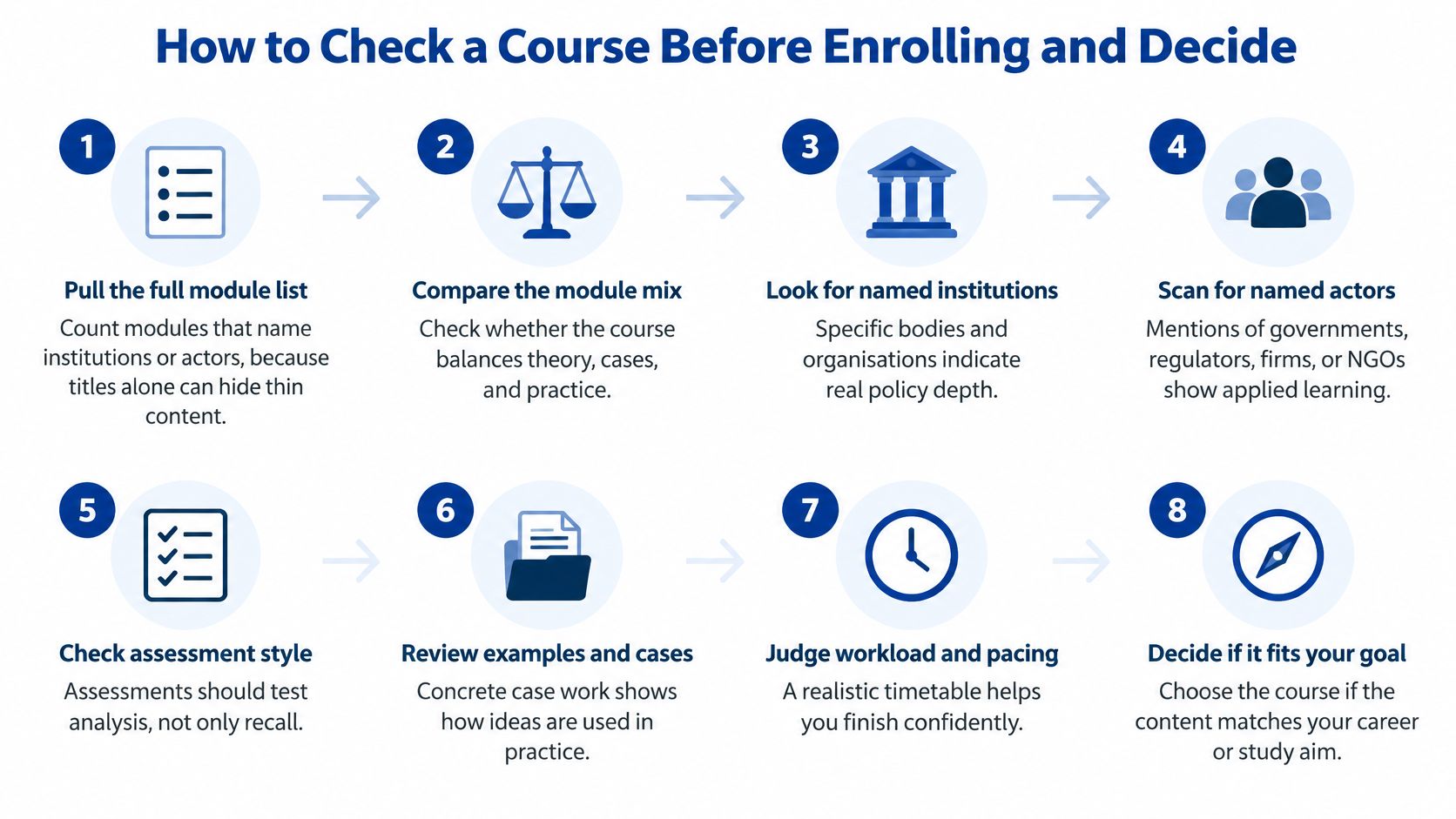
A course description can sound convincing while leaving basic questions unanswered. The outline, assessment and credential details provide firmer evidence. These eight checks turn an appealing description into a decision that can be compared with other options.
Pull the full module list. Count modules that name institutions or actors. Titles can make a course look broad while concealing how little time it spends on actual organisations and decision-makers.
Compare the named bodies with the topic areas. Check whether the outline covers the areas relevant to the learner's goals, such as trade, security, climate, health or migration. Missing areas may signal a deliberately narrow course, or a gap that matters to the learner.
Look for applied casework. A course should use a real policy problem or a clearly described scenario. If the only tasks concern definitions, the learning may remain theoretical.
Read the learning-outcome verbs. “Analyse”, “evaluate” and “design” suggest learners will work with evidence and make judgements. “Understand” and “list” can signal that the course is centred more on recall.
Check the assessment style. Quizzes can check whether learners remember key terms, but written analysis or a decision memo can show whether they can apply concepts and defend a recommendation.
Verify the credential. Check how a certificate can be verified and whether the awarding body and any claimed accreditation are clearly stated. A certificate confirms completion, not mastery.
Review the instructor's experience. Look for relevant work in international affairs, policy or governance, and check whether the course makes the instructor's role and background clear.
Test the workload against a realistic week. Confirm the course length and price before paying. Estimate when study can happen around existing commitments, then set a finish date.
Use the checks to build a shortlist
A course that clearly meets at least five of the eight checks can go on the shortlist; if fewer are clear, look elsewhere or seek information before committing. This is a screening rule, not a guarantee of quality. A learner's priorities still matter: someone seeking applied professional skills may place more weight on casework and written assessment than on breadth.
The format table offers a useful way to compare options. A single course may suit a learner who wants to fill one knowledge gap, while a programme certificate offers a structured foundation. A university award may fit someone pursuing formal academic study, provided the award and accreditation are stated. The European Institute of Leadership and Management's Global Governance Mini-MBA is one example to evaluate, not an automatic choice: its outline can be checked for named actors, practical cases, assessment and fit with the learner's goals.
For support with self-paced study, readers can also review these five tips for succeeding in an online learning environment. The central judgement remains the same: a certificate proves completion, but applied casework and assessment indicate what a learner has practised.
A practical next step is to choose one option today, read its full outline and set a start date within the next two weeks. That turns a general interest in global governance into a manageable decision, while leaving room to reject a course that doesn't meet the checklist.
The European Institute of Leadership and Management offers self-paced online courses, programme certificates and Mini-MBA programmes, including options related to global governance. Professionals comparing formats can review the European Institute of Leadership and Management and assess whether its course outlines match their learning goals.