
Accounting Courses Online: How to Choose the Right One

It is late, the laptop shows a dozen tabs, and every course promises something slightly different. One offers a certificate in a weekend, another mentions professional status, and a third lists topics without saying what the learner will be able to do. Choosing between accounting courses online becomes easier once the title stops being the main clue.
A better starting point is a set of checkable outcomes. How many study hours does the course require, what tasks will be assessed, which software will be practised, and what evidence will remain after completion? Those questions reveal whether a course fits a beginner, a busy manager, a bookkeeper moving into accounting, or an owner who needs to read a cash flow forecast with confidence.
Accounting language also needs unpacking early. A certificate of completion isn't the same as a professional qualification, and a short course on financial statements isn't the same as training for practice. Readers who separate those ideas before enrolling save money, avoid the wrong level, and choose learning that matches the decision they need to make at work.
Table of Contents
- Types of Online Accounting Courses Compared
- Matching a Course to Your Starting Point
- Subjects and Skills an Online Accounting Course Must Teach
- Delivery Formats and Weekly Time Commitment
- Credentials and CPD Recognition to Check
- Confirm the Course Fits Before You Enrol
Types of Online Accounting Courses Compared
| Course type | Typical time commitment | Cost band | Credential | Best for |
|---|---|---|---|---|
| Free open course (MOOC) | 5-40 hours, self-paced | Free to audit; paid certificate in some cases | Completion record, rarely accredited | Testing interest or refreshing one topic |
| Short certificate course | 10-30 hours over 2-6 weeks | Low | Certificate of completion | Filling one specific gap such as bookkeeping or financial statements |
| Multi-module professional course | 40-120 hours over 2-6 months | Mid-range | Certificate, sometimes with assessment | Career switchers and staff needing a structured foundation |
| Professional body qualification route | 300+ hours over 2-4 years | High, including exam fees | Recognised professional qualification | Those aiming for practice or chartered status |
| Online degree or masters | 1-4 years part-time | High | Academic degree | Learners who need a formal academic credential or degree-level entry |
Read the Table by Outcome, Not by Title
The useful rule is simple. Match the type to the outcome needed, not to the most impressive sounding label. A learner who wants to understand a profit and loss account for monthly meetings doesn't need a multi-year qualification route, while a learner who wants to sign off work for clients cannot rely on a short completion certificate.
Free open courses suit curiosity and revision. They help a reader test whether double entry makes sense, revisit depreciation, or learn the vocabulary before spending money. The limit is evidence. A completion record shows exposure to a topic, but it rarely proves assessed competence to an employer, and it doesn't create a right to practise.
Short certificate courses work best when the gap is narrow and named in advance. Examples include preparing a basic set of financial statements, understanding budget headings, or keeping cleaner day-to-day records. They're less suitable when the goal is broad job readiness, because one gap filled well is different from a foundation across financial accounting, management accounting, tax basics and controls.
Practical rule: If the desired result cannot be written as a task, such as reconcile, forecast, explain or prepare, the course type hasn't been chosen yet.
Multi-module professional courses sit in the middle for a reason. They give career switchers and finance support staff a sequence rather than isolated lessons, usually moving from transactions to statements, then to budgets and reporting. A structured option such as a finance and accounting course belongs in this conversation when the reader needs connected coverage rather than a single-topic refresher.
Where Formal Routes Differ
Professional body qualification routes are the only type in the table designed to lead toward a recognised professional qualification for practice. That route brings exams, entry rules, supervised experience in many cases, and ongoing obligations after qualification. It's the right scale for learners aiming at practice or chartered status, and the wrong scale for someone who only needs to interpret management accounts.
Online degrees and masters programmes answer a different need. They provide a formal academic credential, deeper theory and a recognised level of higher education. They suit learners whose employer, promotion path or next qualification step requires degree-level study. They aren't automatically better for practical bookkeeping confidence, because academic depth and workplace task practice overlap only partly.
Many learners stack types sensibly. A free introduction can confirm interest, a multi-module course can build the foundation, and a later short certificate can cover one specialist area such as payroll basics or dashboard reporting. Stacking works when each step has a job to do and the learner checks the outcome before paying for the next level.
Readers who cannot decide yet should start from the short certificate or multi-module row, because those rows force the clearest question first: is the need one named gap, or a structured foundation?
Matching a Course to Your Starting Point
In the 2022 Adult Education Survey, 52% of Irish adults aged 25-69 participated in lifelong learning, according to Central Statistics Office adult education data. Much of that learning serves work and career purposes, which means it competes with a job, family duties and a commute rather than filling an empty weekday.
That pattern should drive course choice. Ambition names the destination. The starting point sets the first rung. A learner with five free hours a week needs a different first step from a learner with fifteen, even when both want the same skill eventually.

| Starting point | Course level to choose | First outcome to check |
|---|---|---|
| Complete beginner | Foundation course in double entry and statements | Records a simple transaction and prepares a trial balance |
| Manager outside finance | Management accounting course with budgets and variance analysis | Reads a budget and explains a variance |
| Bookkeeper moving toward accounting | Multi-module course covering statements, reconciliations and tax basics | Reconciles a bank statement and drafts the three core statements |
| Business owner | Short course on cash flow and budgeting | Builds a cash-flow forecast and reviews it with an accountant |
Use the Ladder Test
Course levels work like rungs on a ladder. Starting too high wastes time and confidence, because every new term depends on an earlier one that has not settled yet. Starting too low wastes money and motivation, because the learner repeats familiar material while the gap stays open.
A complete beginner needs double entry explained slowly, with everyday transactions first. Say a small shop buys stock on credit and later pays the supplier. The learner should be able to show what increased, what decreased, and why the records still balance before moving to full statements.
A manager outside finance needs a different first win. Reading a budget, spotting an unfavourable variance and asking whether the cause is price, volume or timing may matter more than posting journals. A bookkeeper already handles records and needs the bridge into statements, reconciliations and tax basics. A business owner needs cash flow, budgeting and a clearer conversation with an accountant, which is why a focused option such as the Accounting Principles course, covering financial statements, budgets, variance analysis and commonly used accounting software, should be judged against those tasks rather than against a professional syllabus.
Three questions settle the match before enrolment:
- Decision: What decision will this course help the learner make at work or in a business?
- Time: How many hours can realistically be given each week, including practice?
- Proof: What must the course prove to an employer, client or future provider, and which assessment produces that proof?
A match only counts when the first outcome in the table can be checked. Before paying, find the exercise or assessment that produces it, and confirm the syllabus includes hands-on practice with accounting software, since practical tool use is now part of what employers test.
Subjects and Skills an Online Accounting Course Must Teach
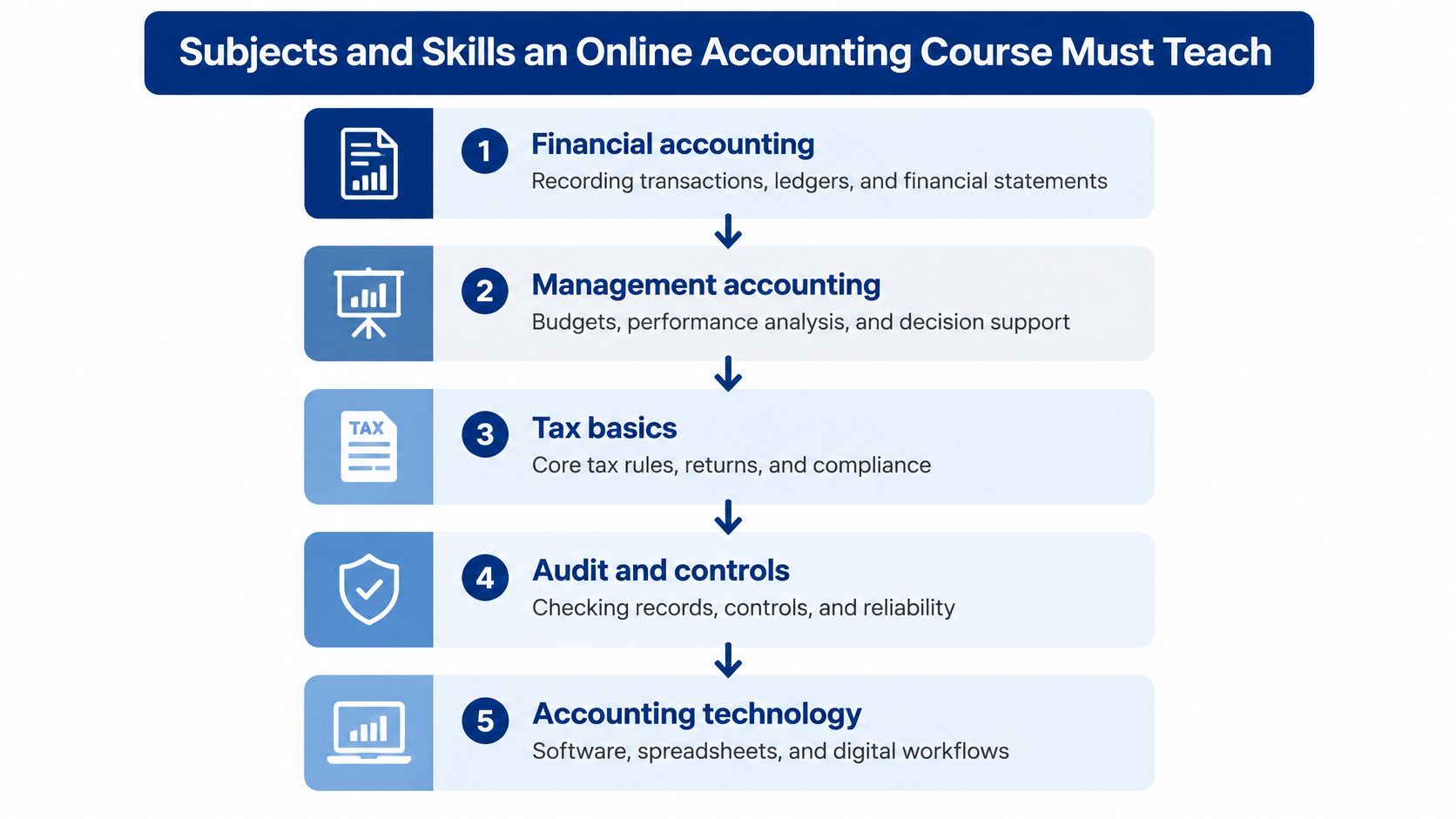
A strong syllabus builds in the order learners usually meet the work. First comes recording what happened, then using those records to plan, check and explain. Skipping the early mechanics makes later topics feel like memorising labels.
Financial Accounting Comes First
Financial accounting covers double-entry bookkeeping, ledgers, the trial balance, and the income statement, balance sheet and cash flow statement. The ledger is the logbook of every journey, recording where money came from and where it went. The statements summarise that logbook so owners, lenders and managers can see performance and position without reading every entry.
Learners often confuse profit with cash at this stage. A sale on credit can raise profit before any money arrives, while a loan repayment can reduce cash without being an expense in the same way. Good teaching separates those ideas with small transactions before introducing full statements.
Management accounting then turns records into decisions. Budgets, forecasts, cost behaviour and variance analysis help a manager ask why actual results differ from plan. If ledgers are the logbook, budgets and statements together form the dashboard that shows where to go next, what needs attention, and which costs move when activity changes.
Tax, Audit and Controls Add the Checks
Tax basics should name VAT, payroll and corporate tax concepts clearly, while stating that detailed rules vary by jurisdiction. A general course can teach recordkeeping discipline and common terms, but it shouldn't pretend that one short module replaces local tax advice. The practical skill is knowing which records support a return and when a specialist needs to review the position.
Audit and controls teach learners to question whether records are complete and reliable. Reconciliations, checks on imported data, approval steps and exception reports all serve the same purpose. They catch duplication, missing invoices and miscoded items before those errors reach a statement or a management meeting.
A syllabus that teaches posting entries but never checking them leaves out half of real finance work.
Technology Is Now Part of the Core
The Technological University Dublin study of digital competencies identifies five dominant technology categories valued in entry-level accounting and finance recruitment in Ireland: data analytics and business intelligence; accounting and financial software; emerging technologies such as artificial intelligence, robotic process automation and blockchain; cybersecurity; and general computing. Frequently cited tools include Microsoft Excel, enterprise-resource-planning systems and Power BI, and employers value practical hands-on proficiency more than purely theoretical understanding.
Labour-market pressure points in the same direction. Reporting on Skillnet Ireland's 2025 national talent research notes that 42% of businesses struggled to source essential skills, 79% expected staff to need digital upskilling, and among SMEs, AI was identified by 37% as a technology skill with growth potential over the next two to three years.
As routine payables, receivables, payroll and reporting become more automated, the human value shifts. Learners need to review exceptions flagged by systems, verify data before it's reported, keep basic cyber-risk awareness, and explain numbers to owners in plain language. Automation can process volume, but it cannot take responsibility for judgement.
Test any syllabus with one question: does it include tasks such as reconciling a bank statement in a controlled workbook or interpreting a Power BI dashboard, where learners check a tool's output, or does it list only topics such as introduction to accounting? The first answer signals applied skill. The second signals exposure.
Delivery Formats and Weekly Time Commitment
| Feature | Self-paced | Live cohort | Blended |
|---|---|---|---|
| Schedule flexibility | High, set by the learner | Low, fixed session times | Medium, fixed checkpoints only |
| Feedback speed | Slow, mostly automated quizzes | Fast, live answers from tutors | Medium, scheduled reviews |
| Completion pressure | Low, depends on self-discipline | High, the cohort keeps pace | Medium, deadlines on assessments |
| Typical weekly hours | 3-6 | 4-8 | 4-6 |
| Best fit | Shift workers and self-starters | Learners who stall without deadlines | Learners wanting structure with flexibility |
Flexibility Has a Trade-Off
Self-paced study works like a gym membership. The learner goes when it suits, which helps shift workers, carers and anyone whose week changes without warning. The risk is also familiar. Without a fixed class, sessions slip, and a course bought with good intentions sits untouched beside everyday work.
Live cohorts resemble a class timetable. Sessions happen at set times, questions get answered quickly, and other learners create pace. That pressure helps people who stall when nobody notices an absence. It suits learners who can protect the same hours each week and who learn well by hearing other people's mistakes discussed openly.
Blended delivery combines recorded content with scheduled tutorials or assessments. It gives flexibility for reading and practice, while checkpoints stop drift. For many working adults, that middle route is easier to sustain than either total freedom or a rigid timetable. Practical habits still decide the result, which is why guidance on succeeding in an online learning environment matters alongside the format itself.
Estimate Real Time, Not Video Time
Course pages often state hours in a way that needs decoding. A sensible estimate separates structured elements, such as lectures, quizzes and assessed tasks, from independent practice, such as rebuilding a spreadsheet exercise until it balances. A course listed at 40 hours can take considerably longer once workbook practice, rereading and corrections are included.
- Structured time: Lessons, guided examples, quizzes and marked tasks with a clear sequence.
- Practice time: Repeating reconciliations, checking formulas and drafting statements without copying a worked answer.
- Review time: Returning to errors, updating notes and preparing evidence for an employer or CPD log.
Deadlines, access periods and support routes matter as much as format. Email support, a forum and tutor feedback create very different waits when a learner is stuck on accruals at 10 p.m. before a work deadline. Access that ends too soon can also turn a manageable weekly plan into a rushed finish.
The planning rule is to allow extra practice time for technical topics such as reconciliations and budget models. Understanding there comes from repetition, not from watching one clean example. A learner who budgets only for watching will usually underestimate the course.
Credentials and CPD Recognition to Check
A completion certificate and recognised CPD are different things, and the gap causes more disappointment than course content itself. A PDF can look formal while carrying no standing with a professional body, and many learners discover the difference only when an employer or membership body refuses the entry. Readers in Ireland need a benchmark before assuming that any online course counts.
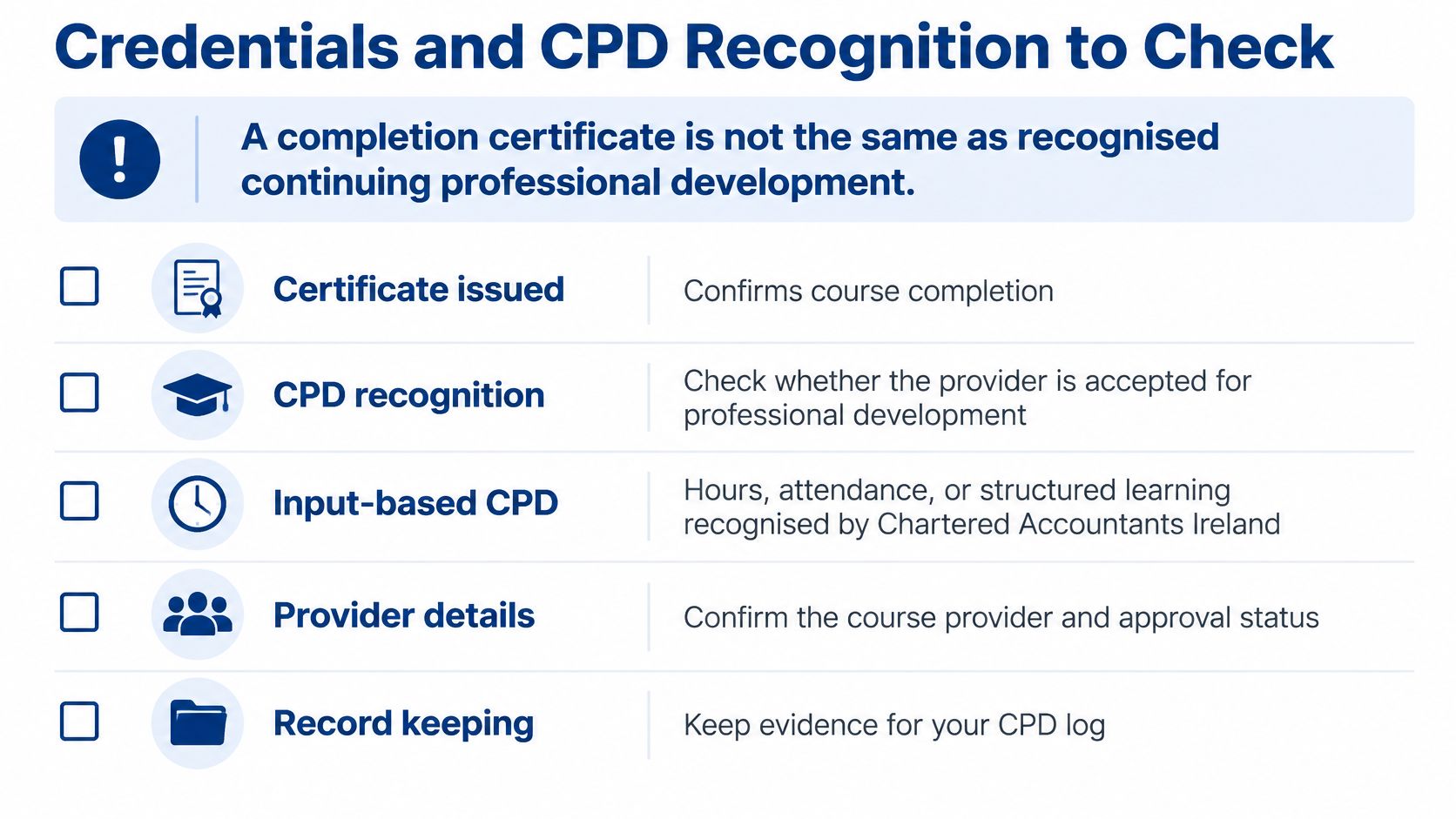
The Chartered Accountants Ireland CPD requirements specify an input-based CPD route of 70 hours annually, including at least 20 hours of structured learning. The same requirements also set at least 10 structured hours in each service area in which a member practises, with limited averaging permitted across a three-year period.
That second condition is the one learners most often miss.
What That Benchmark Means for Course Design
A course intended to feed a CPD log should show measurable learning hours, structured assessments or documented activities, and content mapped to technical areas. Relevant areas include financial accounting, audit, taxation, law and regulation, ethics, or practice management. Lesson count alone proves very little, because ten short videos and ten assessed workshops are not equivalent learning.
Be cautious with any course that implies it satisfies statutory-auditor or professional-body obligations unless the relevant Irish body formally recognises the activity. General professional education can still be valuable, but value and regulated credit are different claims.
| Evidence to request | What it proves | Why it matters for CPD |
|---|---|---|
| Learning objectives | What the course sets out to teach | Shows which technical area the content maps to |
| Structured versus independent hours | How study time is split | Only structured hours usually count toward minimums |
| Assessment record | That the learner was tested, with dates and scores | Shows learning rather than attendance |
| Dated completion certificate | Provider name, learner name and completion date | Needed to record the activity in a CPD log |
| Recognition statement | That the professional body accepts the activity | Required before the course counts as regulated CPD |
Ask Before Enrolling, Not After Finishing
Each row in the table can be requested in one short message before payment. Ask for the learning objectives, the split between structured and independent hours, a sample assessment record, and the exact wording of any recognition statement. Provider recognition pages, including the recognition information published for online certificate courses, repay careful reading: check what the page confirms in writing, because a confident tone alone proves nothing.
Evidence test: If a provider cannot state the hours, assessment method and recognition status in writing, the course should be treated as general learning only.
If a provider cannot supply an item, the course may still suit a beginner, manager or owner who needs understanding instead of credit. The mistake is buying it for a CPD log and discovering the gap later. Keep downloadable completion evidence, objectives and assessment records together from the start, because reconstructing them months later is slow and sometimes impossible.
Confirm the Course Fits Before You Enrol
Choosing a category was the wide filter. The last decision is narrow: one course either matches the goal written down in the self-test or it does not, and four questions settle it. Each answer should come from the course page itself, so a yes means something was stated in writing and a silence means keep asking.
Run the Four-Question Check
- Profile fit: Does the page name a learner profile that matches the reader's level and purpose?
- Subject fit: Does the syllabus cover the subject areas named under Subjects and Skills an Online Accounting Course Must Teach?
- Outcome fit: Does it state learning outcomes specific enough to check after completion?
- Record fit: Does it provide enough structured hours and assessment to support the learner's records, judged against Credentials and CPD Recognition to Check?
Applied to a real listing, the check becomes concrete. An Accounting Principles course states its intended learners plainly: business owners, students of business or finance, career switchers moving into accounting, and anyone who wants to understand an organisation's finances. That answers the first question for those readers. It also tells a qualified practitioner to verify recognition separately before assuming regulated credit.
The syllabus side is equally specific. The course runs across six modules and publishes six outcomes: by the end, learners should be able to understand the fundamental concepts and scope of accounting, interpret and analyse financial statements, conduct financial reporting and analysis, create and manage budgets and forecasts, perform variance and performance analysis, and work with commonly used accounting software and tools. That last outcome doubles as a digital-skills signal, because hands-on software practice is the kind of ability employers now probe when they hire.
Matching is then a counting exercise. A manager who needs budgets and variance analysis can tick two outcomes immediately. A bookkeeper aiming at tax return work finds nothing on the list and knows to choose differently or plan a specialist follow-on.
Delivery answers the remaining questions. The provider describes its courses as self-paced, 100% online, certified, and including online support, which settles format: no classroom, no fixed timetable. What the description leaves open is regulated recognition, since a completion certificate confirms the work was done while professional-body acceptance is a separate fact. One more question is worth asking directly: how long access lasts after enrolment, because self-paced study only helps if the course stays open long enough to finish.
The final step is deliberately small. Write down the three outcomes that matter most, read the syllabus against each one, confirm recognition before paying, and enrol only when all three appear on the page.
Readers who want a structured, self-paced route into financial statements, budgeting, forecasting and performance analysis can explore the accounting options at European Institute of Leadership and Management and compare the stated outcomes against their own three priorities before enrolling.