
Porter’s Competitive Strategies: 5 Options Explained

Two online training providers launch in the same month. One strips out venues, fixed timetables and printed materials, then undercuts every rival. The other charges a premium for deeper curricula, recognised credentials and specialist support. Neither approach is automatically stronger. Each works only when the price, cost base, delivery model and customer promise point in the same direction.
That fit is the practical value of Porter's competitive strategies. The framework asks leaders to choose a position deliberately rather than drift toward being slightly cheaper and slightly better than everyone else. The five options below are cost leadership, differentiation, cost focus, differentiation focus and a hybrid strategy. Each is treated here as a positioning decision, not a textbook label: a diagnostic question a leader can answer this week, a worked example, and the trade-off that must be accepted.
Picking an attractive market settles less than most leaders assume. Firms in the same industry diverge widely in returns, so how you position inside a market matters as much as which market you enter. The sections that follow show how to test that position against your real cost base and your real customers.
Table of Contents
- 1. Cost Leadership
- 2. Differentiation
- 3. Cost Focus
- 4. Differentiation Focus
- 5. Hybrid Strategy (Integrated Cost Leadership and Differentiation)
- How Porter's Competitive Strategies Differ by Target Market, Source of Advantage and Main Risk
- Choosing Your Position and Testing It Against the Market
1. Cost Leadership
Cost leadership means becoming the lowest-cost producer or deliverer in the broad market, then pricing at or just below rivals. The advantage comes from the cost gap, not from a one-off discount. That gap can fund higher margins at market prices or support lower prices to win volume.
In a study of those Spanish firms, firm effects explained 12.7% of the variance in return on assets, while stable industry effects explained 3.4%, according to the analysis of Spanish firm and industry effects. Firms in the same industry therefore diverged materially. Their positioning, capabilities and execution mattered more than membership of an attractive sector.
The Diagnostic Question
Can the firm name three structural cost advantages a rival cannot copy this quarter? Structural means scale, process design, purchasing power, location or technology. It doesn't mean working harder or squeezing suppliers once. If the answer relies on temporary effort, the position isn't secure.
The approach is detailed in the lesson on business-level strategy, which connects broad market scope to the source of advantage. Broad scope matters because fixed costs need volume. A low-cost system built for a small audience rarely produces the lowest unit cost.
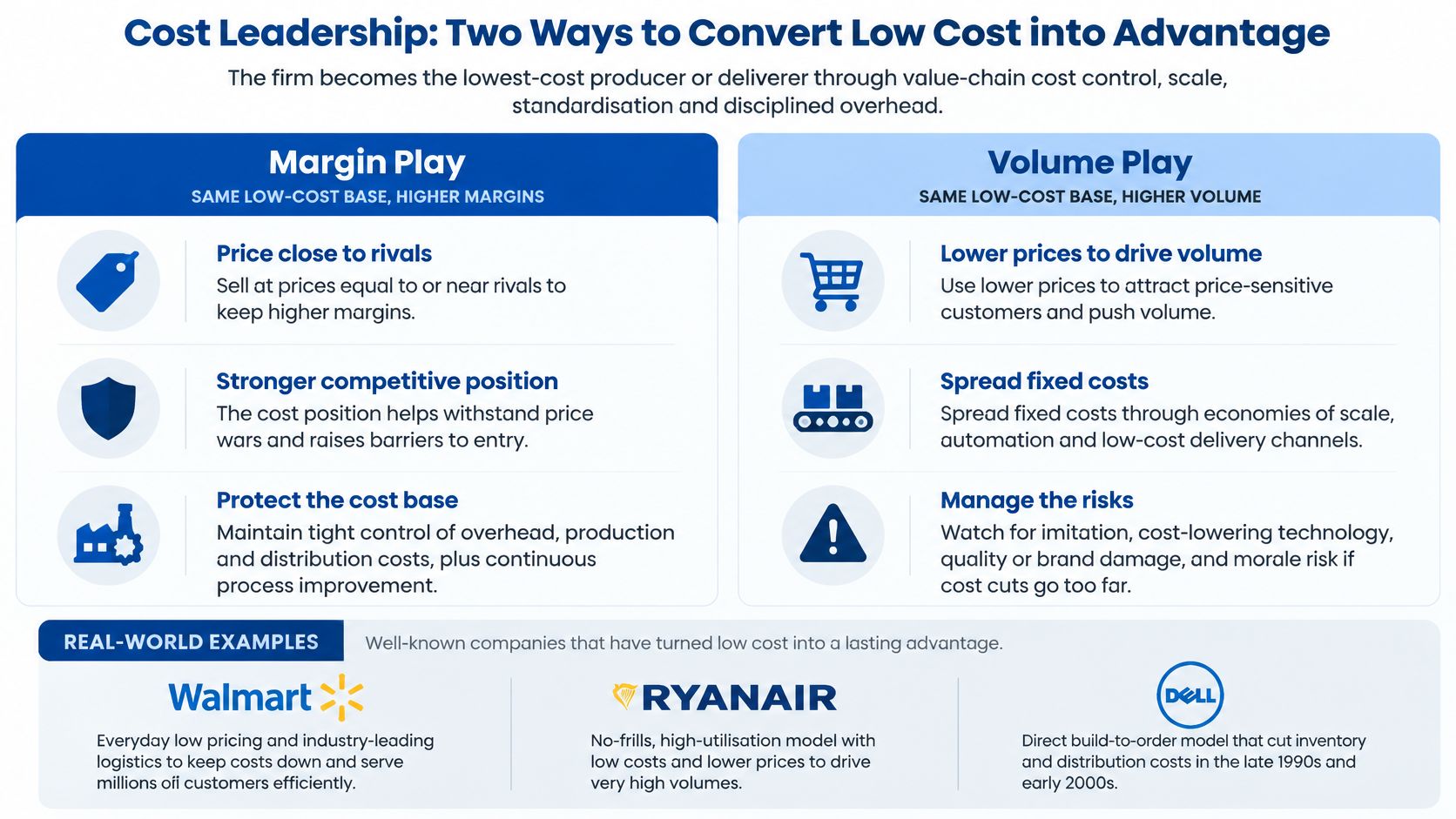
Ryanair shows the operating discipline required. High aircraft utilisation, standardisation and a no-frills offer reduce cost per seat. Walmart uses purchasing scale and logistics to support everyday low pricing. Dell once used direct, build-to-order sales to cut inventory and distribution costs. Each firm removed activities customers valued less than price.
An online course provider can follow the same logic through reusable modules, automated enrolment and self-paced delivery without physical venues. The saving must show up in unit cost per completed learner, not only in total spending.
- Map the value chain: Separate costs that protect quality from costs customers never notice.
- Standardise first: Reuse components, templates and content before adding variants.
- Benchmark unit cost: Track cost per order, seat, account or completion against the closest rival.
- Protect reliability: Customers tolerate fewer extras. They don't tolerate failure in the core job.
Practical rule: A cost leader cuts cost from the system. A weak competitor cuts cost from the customer experience and calls it strategy.
The risk is imitation or a technology shift that resets the cost base. Price wars also punish firms whose advantage is thin. Cost leadership works when scale and process discipline keep widening, or at least defending, the gap.
2. Differentiation
Apple doesn't ask buyers to pay more because a phone contains more parts. Buyers pay for integrated hardware, software, design and the wider ecosystem working as one experience. That's differentiation. The firm offers something customers perceive as distinct and valuable enough to justify a price premium.
Porter's test is strict. The premium must exceed the extra cost of creating the difference. A feature customers admire but won't pay for isn't differentiation. It's added cost. Mercedes-Benz differentiates through engineering, safety and prestige. Nike combines product innovation with brand identity and marketing. In each case, the difference is visible before purchase and reinforced after it.
Where the Premium Comes From
Strong differentiation starts with one valued attribute, then aligns the operating model behind it. Quality, design, speed, reliability, service, credentials and brand can all work. Breadth is rarely the answer. Customers remember a clear reason to choose, and they discount a long list of minor claims.
Irish innovation data points managers toward demonstrable process improvement as one such reason. The Central Statistics Office findings on innovation in Irish enterprises report that 44.9% of enterprises engaged in innovation during 2022 to 2024, with process innovation at 33.6% and product innovation at 20.2%. A provider can therefore differentiate through shorter cycle times, higher completion rates or lower service failure, not only through new features.

The diagnostic question is direct. Which single outcome would customers still pay extra for if a rival matched every other feature? A training firm might answer verified credentials, applied projects tied to current roles, or expert feedback within a defined time. The lesson on choosing a competitive strategy helps test whether that answer supports a premium or merely describes good service.
A worked example clarifies the maths. Say a professional course adds assessed workplace projects and credential verification. Delivery cost rises, but employers can check completion and learners can show applied output. The strategy succeeds only if enrolment price and retention cover assessment, verification and support while leaving a margin. Willingness to pay must be measured through conversion, renewal and price tests, not assumed from positive feedback.
Differentiation fails when firms invest in attributes buyers don't notice, or when rivals copy the visible feature without copying the underlying system. Patents, trademarks, proprietary processes, trusted brand cues and hard-won data slow that copying. Communication matters too. Customers can't pay for value they don't understand before buying.
3. Cost Focus
Cost focus narrows the battlefield. The firm serves one defined segment, product line or geography and becomes the lowest-cost option for that group. It doesn't need the lowest cost in the whole industry. It needs the lowest relevant cost for customers whose needs are specific enough to redesign the offer around them.
Say a regional training provider serves only small retailers in one county with short, modular courses on stock control and rostering. General providers carry broader catalogues, more sales overhead and content those retailers never use. The focused firm removes that surplus, delivers online in brief sessions and prices for owner-managers who won't release staff for full-day training. Focus creates the cost advantage because the offer gets simpler.
Defining the Niche Precisely
A weak segment definition destroys the logic. "Small businesses" is too broad. A useful definition names size, sector, geography, buying trigger and the job customers need done. The lesson on activity-based costing supports that work by showing which activities each segment consumes, rather than spreading overhead evenly and hiding loss-making variants.
Tata Motors' Nano was designed as a very low-cost car for price-sensitive buyers in India, although the model was ultimately commercially limited. The lesson is cautionary. Low cost for a segment still has to meet that segment's status, safety and reliability expectations. Stripping an offer below the accepted threshold doesn't create value. It creates stigma or risk.

The diagnostic question is this. What can be removed because this segment, unlike the broad market, doesn't value it? If nothing material can be removed, the firm has segmentation on paper but no cost focus in operations.
Capability gaps can create that opening. The Central Statistics Office information society statistics for enterprises show AI adoption reached 20.2% of enterprises in 2025, but only 17.2% among small firms compared with 57.7% among large firms. Smaller firms may need affordable, introductory digital training stripped of advanced governance content. A focused provider can serve that need at lower cost than a broad programme built for multinational employers.
- Name the segment narrowly: Use needs and usage, not demographics alone.
- Remove before adding: Every retained activity must serve the segment's core job.
- Watch the edges: A growing niche attracts broad cost leaders with greater scale.
Cost focus fails when the segment is too small to fund the system, or so attractive that larger rivals enter and outspend the specialist. The defence is precise knowledge of the niche and an operating model broader rivals can't replicate without diluting their own.
4. Differentiation Focus
A specialist wins by knowing one group better than generalists do. Differentiation focus serves a narrow segment with a specialised offer that commands a premium because it fits specific needs unusually well. The firm accepts a smaller market and, in exchange, builds a claim inside it that broad rivals struggle to match. Reputation within the niche does the work that awareness does in a broad market.
Porsche focuses on performance-oriented buyers who value driving dynamics over practicality or price. Harley-Davidson sells motorcycle enthusiasts a brand and lifestyle built around the rider's identity. Specialist training providers use the same logic when they build programmes around project management, IT leadership or international governance rather than general education for everyone.
The Diagnostic Question
Which distinct need does the segment have that generalists meet badly, slowly or not at all? The answer must be observable in buying behaviour. Customers complain about generic content, pay for expert access, require sector-specific examples or need credentials recognised in their field. Without that evidence, the niche exists only as a preference inside the firm.
Delivering on the promise depends on internal fit. The lesson on evaluating organizational strengths and weaknesses applies here, because deep expertise, credible faculty, current case material and responsive support are expensive capabilities. A firm lacking them can't hold a specialist premium for long.
Resource concentration raises the stakes in Ireland. The Central Statistics Office release on business in Ireland reports that enterprise R&D expenditure rose to €7.0 billion in 2023, with the ten largest spenders representing 58% of that total. Large and foreign-owned employers can fund advanced innovation and AI governance training. Smaller domestic firms often need foundational management skills first. One curriculum pitched between those needs serves neither group well.
A specialist should be easy to describe and hard to substitute. If buyers can replace the offer with a generalist at a small discount, the focus isn't differentiated enough.
Consider a provider whose entire catalogue is built for IT managers leading their first cross-functional project. Content covers stakeholder control, delivery risk and team leadership through IT scenarios, with assessment based on a live project plan. That specificity supports a premium because a generic management course would force learners to translate every example themselves. Expansion should move to adjacent problems for the same buyers, since unrelated audiences dilute the expertise the premium rests on.
Visible proof sustains the position. Case studies, practitioner content, community involvement and verifiable outcomes signal competence before purchase. The trap is over-specialisation: a niche can shrink, its needs can be absorbed into mainstream offers, or one large client can dominate revenue. Leaders should monitor segment size, dependence on top accounts and whether generalists are closing the capability gap.
5. Hybrid Strategy (Integrated Cost Leadership and Differentiation)
Porter warned that firms trying to be both cheapest and most distinctive often end up stuck in the middle. The warning still holds. A hybrid strategy is different from indecision because it redesigns the system so cost and value improve together. The trade-off isn't wished away. It's removed through process innovation, technology or a new division of labour.
IKEA is the clearest worked example. Distinctive Scandinavian design combines with flat-pack production, efficient logistics and customer self-assembly. The customer accepts assembly work in exchange for design at a lower price. Toyota linked quality and low cost through the Toyota Production System, where defect reduction also removes waste. Zara pairs fashionable design with rapid production and distribution, turning speed into both relevance and lower markdown risk.

Testing Whether the Trade-off Is Real
The diagnostic question is demanding. Which activity raises customer value while lowering delivered cost, and what's the evidence? Digital self-paced delivery can lower venue and scheduling costs while giving learners control over timing. Standardised modules can improve consistency and cut production cost. Automated progress tracking can reduce administration and give learners clearer feedback. Each claim needs a measure, such as cost per completion alongside completion rate or assessment score.
Ireland's policy history shows the same tension at national level. A National Competitiveness and Productivity Council retrospective on the Culliton Report describes how the 1992 Culliton Report linked greater domestic competition to international competitiveness. By the early 2000s, rising costs weakened Ireland's low-cost position, pushing attention toward skills, technology and innovation. The parallel for firms is direct. When cost advantage erodes, differentiation must be built, not announced.
- Challenge inherited trade-offs: List what customers accept by default, then test one assumption at a time.
- Build both capabilities: Cost discipline and distinctiveness must sit in operations, not only in marketing.
- Measure the pair together: Track unit cost with quality, speed or willingness to pay.
The failure mode is drift. Discounts erode the premium while added features raise cost, leaving a mid-priced offer with no clear reason to win. Hybrid positions need constant proof that the system still produces both benefits. Kim and Mauborgne later developed a related idea as value innovation in Blue Ocean Strategy in 2005, but the managerial test remains Porter's. Distinctiveness must be real, and the cost base must support the price.
How Porter's Competitive Strategies Differ by Target Market, Source of Advantage and Main Risk
The five positions reduce to two decisions: how wide a market to serve, and where the advantage comes from. Read each row as a trade-off a leader accepts, then test it with one question: which single advantage would our best customers pay to keep?
| Strategy | Target market | Source of advantage | Main risk |
|---|---|---|---|
| Cost Leadership | Broad, price-sensitive | Lowest unit cost | Rivals copy it; cuts reach quality |
| Differentiation | Broad, value-seeking | A valued difference | Premium stops justifying its cost |
| Cost Focus | One price-sensitive segment | Cheapest offer in that niche | Segment too small to sustain |
| Differentiation Focus | One segment with specific needs | Expertise built for that niche | Offer copied or outgrown |
| Hybrid Strategy (Integrated Cost Leadership and Differentiation) | Broad, wanting both price and quality | Efficiency plus a real difference | Drift toward the middle |
The risk column rewards a vertical read. Broad positions fail by erosion. Focused positions fail when the niche shrinks or gets crowded. The hybrid fails by drift. Whichever row a firm claims, that failure mode is the number to watch first.
Choosing Your Position and Testing It Against the Market
The choice starts with scope, then source of advantage. Broad scope pairs with either lowest cost or a valued difference. Narrow scope pairs with lowest cost for one segment or specific distinctiveness for that segment. A hybrid claim needs stronger evidence than the other four because it asserts that a redesigned system has beaten a trade-off rivals still face.
Write the position in one sentence naming the customer, the advantage and the trade-off accepted. Every option carries one, whether that is a lower price, a higher delivery cost or a deliberately smaller market. If the sentence cannot be written clearly, the strategy is not ready for investment. A diagnostic worth running this week: ask each member of the leadership team to state that sentence independently. When the answers diverge, the position exists in the pitch deck rather than in daily decisions.
A One-Week Market Test
Three checks expose weak fit quickly. First, compare unit cost against the closest rival using the same output measure. Second, ask recent buyers what they would lose by switching, and separate polite praise from a reason they would pay to keep. Third, review lost deals and classify each loss as price, missing value, poor segment fit or weak proof. The pattern shows whether the market sees the intended position.
External change belongs in the same review. A retailer that built its cost position on large physical stores watched online entrants remove the property costs it still carried, and the trade-off it had accepted stopped being a choice. A position that looks sound today can weaken the same way, if buyers begin expecting a feature that was previously a premium extra. Set a review trigger: a rival price move, a technology that cuts delivery cost, or a segment whose needs have shifted. When a trigger fires, rerun the three checks rather than waiting for the annual plan.
The discipline comes down to sequence: pick the customer group, pick the advantage, remove activities that fight that advantage, then keep testing whether buyers and unit economics still confirm the position. Strategies fail less often from a wrong initial choice than from a position nobody re-tests.
Managers ready to apply Porter's competitive strategies to real positioning decisions can explore strategic management programmes and related business courses at the European Institute of Leadership and Management. The catalogue is a practical next step for leaders who need to connect competitive analysis, business-level strategy and implementation.