
Project Management Courses Cork: Compare Your Options

Irish adult-learning participation was estimated at 48.3% in 2022, well above the EU average of 39.5%, according to the European Commission country report on Ireland. That figure reframes the search for project management courses in Cork. Demand for upskilling isn't the problem. Fit is. A cheap course in the wrong format, at the wrong depth, for the wrong sector wastes time a working adult doesn't have. The right choice matches three things to a named job target: the hours a learner can protect each week, the lifecycle depth the role needs, and the credential employers in that sector recognise. Rank options that way, not by price or brand, and the decision gets much simpler.
Table of Contents
- Project Management Course Formats in Cork at a Glance
- Self-Paced Online Courses and Who They Suit
- Evening and Blended Classroom Options in Cork
- Tools and Skills Cork Employers Ask For
- Matching a Course to Cork's Regulated Industries
- Certificates and Credentials Worth Comparing
- A Checklist for Choosing Your Course
- Shortlist Your Course and Start Studying
Project Management Course Formats in Cork at a Glance
Four formats cover almost every option a Cork learner will meet. They differ less on content than on who controls the timetable, and that difference decides completion more often than syllabus quality does.
| Format | Schedule | Tutor contact | Best for |
|---|---|---|---|
| Self-paced online | Any time, at own pace | Online support, usually asynchronous | Working adults and shift workers |
| Live online | Fixed weekly sessions | Real-time tutor access | Learners who need deadlines and live feedback |
| Evening classroom in Cork | Fixed weekly evening sessions | In-person tutor | Learners who prefer face-to-face study |
| Blended | Online modules plus scheduled workshops | Online and in-person mix | Learners who want flexibility and some live contact |
How Each Format Behaves in Practice
Self-paced online study lets a learner start any week and finish in their own time, with support handled online rather than in a live session. European Institute of Leadership and Management delivers its project management courses this way: 100% online, self-paced and certified, with online support. That freedom suits shift workers, people with caring duties, and anyone whose roster changes week to week. The trade-off is obvious. Nobody notices if a module slips, so discipline has to come from the learner.
Live online courses fix the timetable and put a tutor in the room in real time. Questions get answered during the session, and the weekly deadline creates pressure that self-paced study lacks. It suits someone with predictable evenings who has already watched an open-ended course drift.
Evening classroom study in Cork adds face-to-face tutoring and discussion with other learners, which helps people who think best by talking a plan through. Blended study splits the difference. Online modules carry the routine content, and scheduled workshops handle case discussion and feedback. Both carry a cost the timetable hides: travel to and from a Cork venue counts against the same weekly hours the course itself needs.
Format First, Provider Second
Practical rule: Format should follow the hours a reader can protect each week, not the reverse. A course that needs three protected evenings won't fit a rota that offers one.
Count honest weekly hours first, including travel for classroom options, then shortlist only the formats that fit inside that number. Depth and credential checks come after a format survives that test. A course that cannot fit the week fails before the first module, whatever its certificate promises.
Self-Paced Online Courses and Who They Suit
Self-paced delivery suits Cork professionals whose weeks won't hold a fixed class, and the CSO puts real scale behind that group. The Central Statistics Office household digital consumer behaviour release reported that 34% of Irish internet users completed an online course in 2024, up 9 percentage points from 2023, and 64% of those learners undertook online learning for professional or work-related purposes.
That figure covers online courses in general rather than project management specifically, and it still earns its place in the decision. It confirms that self-paced study around a job is now mainstream behaviour in Ireland, so a certificate earned this way sits comfortably inside normal professional practice and raises no eyebrows with employers.
Match the Depth of Study to the Job Target
The learner's target role matters more than any course label. A team lead who runs meetings well but has never built a risk register needs one focused gap filled, and a short course in risk management, change management or time management does that without a long commitment. Someone aiming at a first formal project role needs the whole method in sequence: a Mini-MBA in project management covers the lifecycle from initiation to closure, with the certificate earned by completing six courses within the programme. A lead already running projects who wants project management responsibilities recognised gains most from assessed work that formalises habits and closes blind spots like change control.
Whatever the depth, the proof of learning should be a small portfolio of schedules, risk registers, stakeholder matrices and closure reports, because those artefacts map directly onto the tasks a Cork interviewer will ask about. Self-paced learners get further by building a routine early, and these tips for succeeding in an online learning environment set out a workable one.
Three Questions Before Paying
Ask every self-paced provider the same three questions. First, are there any deadlines, or can enrolment drift indefinitely? Second, does a tutor give feedback on submitted work, or is marking automated? Third, does the course use real artefacts such as schedules, risk registers and closure reports, ideally with downloadable templates?
A yes to all three signals that flexible study will also build workplace evidence. A no to the third usually means the learner finishes with vocabulary and nothing to show an interviewer.
Evening and Blended Classroom Options in Cork
Classroom and blended study suit learners who want a fixed timetable and face-to-face tutoring, and who learn best by discussing live cases with others. Blended formats combine online modules with scheduled workshops, so routine reading happens at home and contact time goes on problems, plans and feedback. Before paying, run five classroom-specific checks.
- The exact weekly timetable: confirm days, start times and term breaks, then test them against shifts and childcare for the full course, not just the first fortnight.
- Class size and feedback: ask how many learners share the tutor and how much individual comment each person gets on project plans, since a large group can mean generic remarks.
- Materials and offline access: check what's supplied, in what format, and whether notes, slides and templates can be downloaded and used offline between sessions.
- Refund and transfer policy: read the terms for missed sessions, deferral and transfer to a later intake before paying, because work rosters change.
- Total travel time: for example, a 30-minute commute each way, several evenings a week, adds hours that sit on top of study time and must be planned for.
The Honest Trade-Off
Travel is the cost learners most often undercount. Compare the full weekly commitment, journey included, with the same course delivered online before deciding. If the classroom version costs two extra hours a week, those hours have to buy something real.
Classroom study clearly wins in one case. When a learner needs structured accountability, live feedback on project plans, or networking with other Cork project staff, and can protect the timetable for the whole course, face-to-face study earns its travel time. If attendance will be patchy, it doesn't.
Tools and Skills Cork Employers Ask For
The scale of project work in Ireland justifies taking tool skills seriously. A national overview of project management courses and careers in Ireland places approximately 35,000 to 39,000 people in project-related roles across construction, technology, healthcare, pharmaceuticals, infrastructure and other sectors, with demand expected to rise through 2035 as a projection linked to housing, renewable energy, digital transformation, life sciences and infrastructure programmes. Cork is identified in that overview as one of Ireland's faster professional-employment centres alongside Dublin.
Transferable Controls Come First
Tools change between employers. Controls don't. A credible course teaches scope baseline, work breakdown structure, critical-path scheduling, earned-value concepts, change control, risk ownership and stakeholder reporting, then shows how those controls operate inside software. A learner who understands why a scope baseline exists can learn a new platform in days. A learner who only knows one platform's menus can't.
| Tool | Typical use | Where requested |
|---|---|---|
| Jira | Agile backlog and sprint tracking | Technology and programme vacancies |
| Azure | Work item tracking and reporting | Technology and programme vacancies |
| Power BI | Project dashboards and reporting | Programme and reporting roles |
| Primavera P6 | Critical-path scheduling | Construction roles |
| Microsoft Project | Scheduling and resource planning | Construction and infrastructure roles |
The pattern in vacancies is consistent. Technology and programme roles name Jira, Azure and Power BI, while construction and infrastructure roles value Primavera P6 or Microsoft Project. A learner should therefore choose a course that teaches tool-neutral principles and includes practical exercises in at least one agile platform and one scheduling or reporting environment. An introduction to project management software tools shows the categories involved before a learner commits to a specialism.
Finish with proof. Keep a short project plan, a dashboard and a risk register in a portfolio that can be shown at interview. Employers trust artefacts more than course titles, and a clean critical-path schedule says more than a bullet on a CV.
Matching a Course to Cork's Regulated Industries
Start with the target vacancy, not the course brochure. A certificate alone does not open regulated-sector roles in Cork. That needs stating plainly, because generic course pages imply otherwise. Cork's pharmaceutical and medical-device base, together with construction and public infrastructure, needs project staff who understand compliance alongside lifecycle theory.
Local vacancy evidence behind a Cork project role advertised on JobsIreland reflects employers seeking budgeting, procurement, governance, risk registers, stakeholder management, scheduling software and contract administration across construction, healthcare, education, infrastructure, pharmaceuticals and technology. Those requirements are the controls that keep regulated work auditable.
How Regulated Steps Change the Lifecycle
In pharmaceutical work, validation gates can sit before go-live, so a project is finished when the evidence pack proves the system works, with audit trails intact. Quality-system fluency matters because a missed signature can block release.
Construction and public-capital projects turn on different pressures. Procurement rules shape how suppliers are appointed, contract administration governs changes and payments, and health and safety and environmental compliance constrain what can happen on site and when. A schedule that ignores those constraints is wrong. A focused course in risk management covers the register discipline these sectors expect, and it works best as one part of the route below.
The Bridge Route in Practice
A low-cost introductory credential builds vocabulary and confidence. It does not replace sector experience or delivered projects, and treating it as a standalone route into senior roles sets a learner up for rejection. Use it as step one of three.
- Take a course with applied exercises: choose one that produces work samples, schedules and risk entries rather than only multiple-choice passes.
- Document a project from the current role: record scope, schedule, risks and sign-off, even for a small internal change, so delivery evidence exists.
- Seek a junior coordination or quality-support post: enter where the regulated context already exists, and learn validation, procurement and audit practice from inside.
When comparing course content, sector relevance shows up in the case work. Look for case studies drawn from pharmaceutical, construction or public projects, and for explicit treatment of procurement, validation and compliance. If every example is a generic office move, choose a different course. Pick the option whose depth, cases and weekly workload match the Cork industry you want next, not the nearest start date.
Certificates and Credentials Worth Comparing
Pick the credential that matches the job advertisement, because a course certificate and a professional qualification prove different things. One confirms completion of a provider's course. The other confirms an independent body tested the learner against a published standard, often with experience evidence attached.
| Credential | Issued by | Typical entry requirement | Best for |
|---|---|---|---|
| Certificate of completion | Course provider | Enrol and complete assessments | Showing learning to a current employer |
| CPD-certified course | Provider that is a certified CPD member | Complete the course | Evidence of continuing professional development |
| CAPM | Project Management Institute | Entry route for newer project workers; confirm current PMI eligibility before applying | Learners starting out in project work |
| PMP | Project Management Institute | Documented project leadership experience plus PMI eligibility; confirm current terms before applying | Experienced project managers |
What Each Level Proves
A certificate of completion shows a current employer that structured learning happened. That helps in a performance review or an internal move, and it can be enough when the employer already knows the learner's work. It carries less weight with a stranger reading fifty CVs.
CPD-certified training adds an external quality marker for continuing professional development. Choose providers whose membership can be checked and whose certificates include verification, so an employer can confirm the award is genuine. It works as a credibility check on the award. These certificates signal professional development rather than degree-level study.
Professional body routes sit above both. The CAPM suits people starting out who want an externally examined credential early. The PMP suits experienced managers who can evidence sustained project leadership. Requirements change, so read PMI's current eligibility pages before paying exam fees or planning around a date.
Use completion certificates to build skill and show intent. Reserve CAPM or PMP for targets that name them, or for a career plan that can gather the required evidence in time.
A Checklist for Choosing Your Course
Run this checklist in one sitting, with two or three target job advertisements open beside it. Each step uses evidence from the comparison points already set out, and each one can eliminate a course quickly.
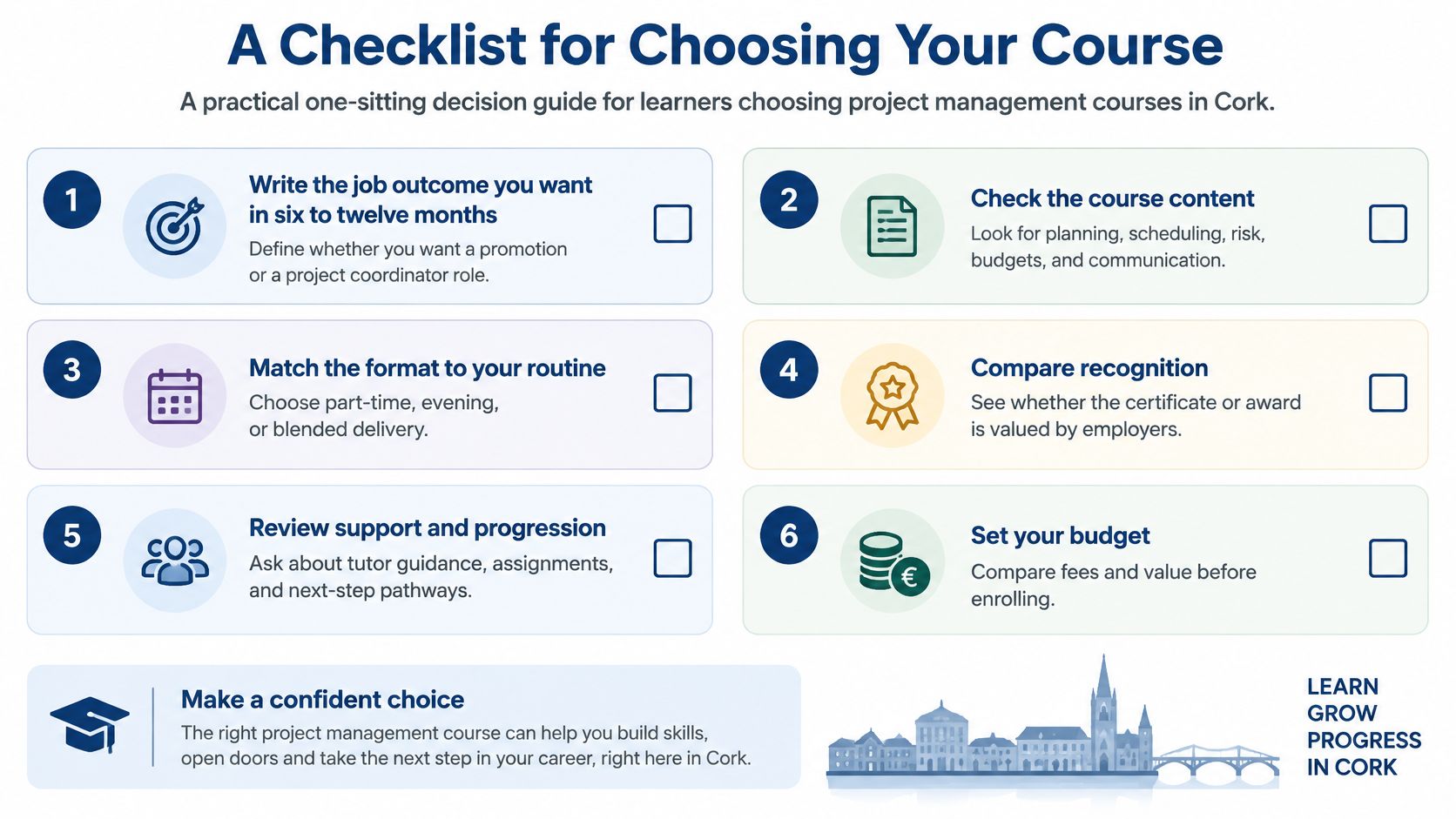
- Write the job outcome for six to twelve months: name it precisely, such as a promotion, a project coordinator post or a team leadership role, because every later check depends on that target.
- Match format to protected hours: use the format comparison to pick self-paced, live online, evening classroom or blended study based on the weekly time available.
- Confirm lifecycle depth: decide whether the gap needs a single topic, the full lifecycle of a Mini-MBA, or a leadership-focused programme, and check the syllabus covers planning, scheduling, risk, budgets and communication.
- Check the tools taught: compare them against the employer tools pattern for the target sector, and favour courses with hands-on exercises over tool demonstrations.
- Check sector relevance: for regulated industries, look for procurement, validation, compliance and contract content, plus case work from comparable projects.
- Check the credential type: match it against the job advertisements being targeted, and note whether they name a professional qualification or accept evidence of structured learning.
- Check delivery specifics: confirm deadlines, tutor feedback and portfolio tasks for online study, or timetable, class size and travel for classroom study. Ground the methodology content too, since a sound grounding in project management methodologies helps a learner judge whether a syllabus is current.
- Compare cost per hour of study: divide the full fee by the total hours the course asks for, rather than comparing headline prices, and confirm the current fee on the provider's page before deciding.
The Mistake This Prevents
Most poor choices share one cause. The learner chose on price or brand alone, then discovered the format didn't fit their week, the tools didn't match local vacancies, or the credential wasn't the one employers named. The checklist forces those discoveries to happen before payment, when they're free.
Shortlist Your Course and Start Studying
Enrol in the one course that passes the checklist and whose format and credential match the next role. Don't keep researching past that point. Extra comparison after a clear winner emerges is procrastination dressed as diligence.
Build the shortlist deliberately. Pick two or three courses, including at least one self-paced option and one live or classroom option where the schedule allows, then cut the list with the checklist and compare what remains against the job advertisements that matter. A course that survives both tests is the right one, even if it isn't the cheapest.
For self-paced learners, the European Institute of Leadership and Management is one practical option to include on that shortlist. Its Mini-MBA in Project Management covers the full project management lifecycle, from initiation to closure, and its Programme Certificate in Project Management is aimed at current project managers, team leaders, and people looking to move into a project management role. Its courses are self-paced, 100% online, certified, and include online support. Check each course's current fee, deadlines and assessment on the provider's site before enrolling, as with any provider.
The First Week, Step by Step
- Book the course that passes the checklist: commit to one, rather than starting two and finishing neither.
- Set a fixed weekly study block: put it in the calendar at a realistic time and protect it like a shift.
- Produce one portfolio artefact in week one: build a schedule or a risk register from a real or realistic project, so evidence starts accumulating immediately.
- Add the verified certificate on completion: place it on the CV and professional profiles alongside the portfolio, not instead of it.
Be clear about the limit. A certificate supports applications, strengthens a CV and gives interview answers structure. It does not guarantee a role. The learners who convert study into work are the ones who pair the credential with artefacts, tool practice and a target sector they can talk about with confidence.
The European Institute of Leadership and Management offers self-paced, fully online project management study, from single-topic certificate courses to a Mini-MBA and programme certificate covering the full lifecycle, with certified awards that can be verified and shared. For Cork learners who need study to fit around shifts, caring duties or a current role, that format removes the timetable barrier while still building portfolio evidence. Visit European Institute of Leadership and Management to compare the project management options against the checklist and enrol in the course that matches the next role.