
CPD Courses Online: Subjects, Formats and Recognition

In 2024, 36% of Irish internet users took an online course, the highest share in the EU and well above the EU average of 18%; in 2019, 13% of Irish people aged 16–74 had completed a course in the three months before the survey, up from 4% in 2017, a 9 percentage point rise and the sharpest among the countries compared, according to Eurostat. The shift took place inside seven years. Ireland's Central Statistics Office reached a similar figure for 2024, finding that 34% of internet users had completed an online course.
That scale is why CPD courses online now sit in the middle of professional life. High enrolment does not guarantee that an employer or regulator will accept a course.
Table of Contents
- Why Online CPD Works for Irish Professionals
- Course Subjects Matched to Your Learning Need
- Self-Paced, Live and Classroom Formats Compared
- What Your CPD Certificate Actually Proves
- How to Check a CPD Course Counts Before You Pay
- Matching Online CPD to Your Situation
- Choose Your Course and Confirm Recognition
Why Online CPD Works for Irish Professionals
Plenty of adults still sit outside that online-course majority. The Education and Training Monitor country report for Ireland records that only 16% of Irish adults had participated in learning during the previous four weeks in the 2024 Labour Force Survey. Demand is real, and it is patchy. A catalogue of flexible courses will not, on its own, turn occasional study into something you can file at appraisal or audit.

Digital access is wide, not even. 72.91% of the population had at least basic digital skills in 2023, the same report notes, while communication and collaboration skills reached 92.62%. A large gap remains between people with tertiary education and those with low or no formal education. Clear navigation, downloadable notes and a real support channel matter, because comfort with a laptop is not the same as comfort with an assessed course.
Leaders who treat learning as part of the job, rather than a spare-time extra, are the ones who finish. The case for that habit is set out in this guide to the importance of continuous learning and development for leaders.
Before you pick a title, answer three questions. What must you prove to your professional body or employer? How many hours a week can you give? How much structure do you need before a course stalls?
Course Subjects Matched to Your Learning Need
Subject first, format second. A short course in the wrong area wastes the hours you do have, and a relevant title still may not count toward mandatory CPD.
Online CPD subject areas by learning need
| Learning need | Subject areas to consider | Why it fits | Typical learner |
|---|---|---|---|
| Limited time to develop skills | Introduction to Logistics and Supply Chain Management; Problem Solving Skills | Short self-paced units fit around existing duties | Employed adults with busy schedules |
| Gaps in business knowledge | Financial Concepts; Investment Fundamentals; Accounting; Economics | Core financial and operational concepts in one place | Entrepreneurs and business owners |
| New leadership responsibilities | Leadership and Organisations; Communication; Teamwork; Time Management | Team leadership and organisational skills | Aspiring and current managers |
| Project or IT ownership | Introduction to IT Management; Digital Transformation; Project Management Mini-MBA | Covers the project lifecycle from initiation to closure | IT managers and project leads |
| Managing change and risk | Risk Management; Change Management; Innovation Management | Practical approaches to organisational change | Managers during restructuring |
| International affairs | International Law; International Relations; Global Governance | Institutions, actors and shifts in international power | Policy analysts and diplomats |
| Regulated-profession CPD hours | Check body-specific rules before selecting any subject | A relevant course may still not count toward mandatory hours | Doctors and other regulated staff |
Limited time. Introduction to Logistics and Supply Chain Management and Problem Solving Skills are built as short units. They suit someone who can give an evening, not a term.
Business gaps. Financial Concepts, Investment Fundamentals, Accounting and Economics put core ideas in one place. An owner who prices by instinct often needs that base before a strategy programme will stick.
New leadership. Leadership and Organisations, plus Communication, Teamwork and Time Management, matches the week a new manager has: one-to-ones, handovers and a diary that no longer belongs to them.
Project or IT ownership. Introduction to IT Management and Digital Transformation sit beside a Project Management Mini-MBA that runs from initiation to closure. That path fits an IT lead who has inherited a plan, not only a technology stack.
Change and risk. Risk Management, Change Management and Innovation Management are the practical set when a restructure is already under way and the team needs a method, not a slogan.
International affairs. International Law, International Relations and Global Governance cover institutions, actors and shifts in power. They fit policy and diplomatic work more than a general management refresher.
Regulated hours. This row is a warning, not a menu. A well-matched subject can still fail a medical or other statutory scheme if the body does not accept the activity.
Mini-MBA options, including Project Management and Business Administration, suit a learner who needs a run of related subjects rather than one isolated course. A single course is enough when the gap is narrow. Browse the full set of online certificate courses and Mini-MBA programmes only after the need is clear. Keep a shortlist of two or three subjects before you compare formats.
Self-Paced, Live and Classroom Formats Compared
Format decides whether a course gets finished. The same subject can be completed or abandoned depending on whether anyone notices you missed a week.
Online CPD delivery formats compared
| Format | Scheduling | Interaction and accountability | Best for | Reported use |
|---|---|---|---|---|
| Self-paced online | Study whenever you choose | Relies on knowledge checks, progress tracking and support | Busy professionals who need flexibility | 84.1% of PD participants used asynchronous online learning in the previous five years |
| Live online (synchronous) | Fixed session times | Real-time tutor and peer contact | Learners who need external structure | 92.2% of PD participants used synchronous online learning |
| Blended | Online units plus set sessions | Scheduled contact with self-study between sessions | Learners who want some face-to-face contact | 92% said online or blended availability would influence willingness to upskill |
| Face-to-face classroom | Fixed venue and times | In-person tutor and peer contact | Hands-on practice or in-person assessment | 91.2% of PD participants used face-to-face delivery |
Reported use figures: Skillnet Ireland research on upskilling and professional development.
Asynchronous study is common, yet it still trails both live and classroom formats on reported use. The gap matters because contact is the variable that differs: a live session has witnesses, while a self-paced module can sit unopened for a month without anyone noticing. Flexibility buys access at the price of accountability.
What each format asks of you
Self-paced online courses, including those from the European Institute of Leadership and Management, are fully online and let you study when the shift ends. Completion then rests on knowledge checks, a visible progress record and access to online support. Without those, flexibility becomes a queue of unfinished modules.
Live online sessions fix a time and put a tutor and peers in the room. They suit someone who will not open a module unless a calendar entry forces it.
Blended programmes keep self-study between booked contact. The survey figure above measures willingness to upskill when a flexible option exists. Whether a learner is still attending in week three is a different question entirely.
Face-to-face classrooms still matter when the skill is hands-on or the assessment has to be in person. Travel and a fixed venue are the cost of that accountability.
If you have missed two planned study sessions in a row before, pick a format with scheduled contact, or set a weekly deadline you treat as a meeting.
In any self-paced course, look for outcome-based units, scenario exercises, progress tracking and a support route when you stall. Practical habits for staying with an online course are set out in these tips for succeeding in an online learning environment.
What Your CPD Certificate Actually Proves
A named certificate PDF and the LinkedIn badge built from it prove the same narrow thing: a provider marked the course complete, and the credential can be displayed. Whether it also counts toward credit, professional registration or a rung on the NFQ depends on the assessment and the issuer standing behind it.
What each credential type shows
| Credential type | What it usually shows | ECTS or academic credit | Likely weight |
|---|---|---|---|
| Course certificate of completion | Completion of a provider course | No | Shows initiative; does not establish regulatory accreditation |
| CPD hours statement | Learning hours, often with an activity log | No | Counts only where that professional body accepts the hours |
| Programme certificate | Completion of a designated course sequence | No fixed ECTS; four designated courses | Shows sustained study in one area |
| Accredited micro-credential | Assessed learning outcomes against published standards | Commonly 5 or 10 ECTS | Stronger where the issuer is credible and the award is portable |
| Academic award or qualification | Full assessment under a validated framework | Yes, credit-bearing | Recognised for progression and professional registration |
A course certificate is awarded when an individual course is completed. A CPD hours statement records time, often through an activity log, and carries weight only where the body that governs you accepts those hours. A programme certificate shows a set sequence. At the European Institute of Leadership and Management, that sequence is four courses in a designated programme, and each course ends with a digital certificate carrying a unique ID and QR code that an employer can use to verify it is genuine. Confirm the exact course list with the provider before treating the sequence as a pathway.
Where micro-credentials sit
Ireland's appetite for ongoing study is high. Participation in lifelong learning was 52.1% among people aged 25 to 69 in 2022, above the EU average of 43.5%, according to CSO figures on staff training and education. The Higher Education Authority's MicroCreds model separates accredited micro-credentials from generic short courses, with the accredited kind assessed against transparent standards and commonly carrying 5 or 10 ECTS, and the national initiative was backed by €12.3 million. At European level, the Council Recommendation on a European approach to micro-credentials for lifelong learning and employability still identifies uneven recognition and portability across sectors and borders as an obstacle to wider use.
Ask any issuer three questions, in this order.
- Credit or hours. Does the certificate carry ECTS, or only CPD hours?
- Comparison. Can an employer set it beside an Irish NFQ-aligned award?
- Next step. Does it support progression into a programme or professional registration?
If a certificate cannot say what was assessed and who stands behind it, read it as proof of completion and nothing more.
Labour-market value sits in assessment, issuer credibility, stated outcomes and portability. Price and a profile graphic move none of those.
How to Check a CPD Course Counts Before You Pay
Completing CPD courses online and earning CPD that a regulator will record are different events. Irish recognition can require activity-specific standards, stated learning objectives, learner interaction or self-assessment, supporting references, evidence of completion and a post-course evaluation.
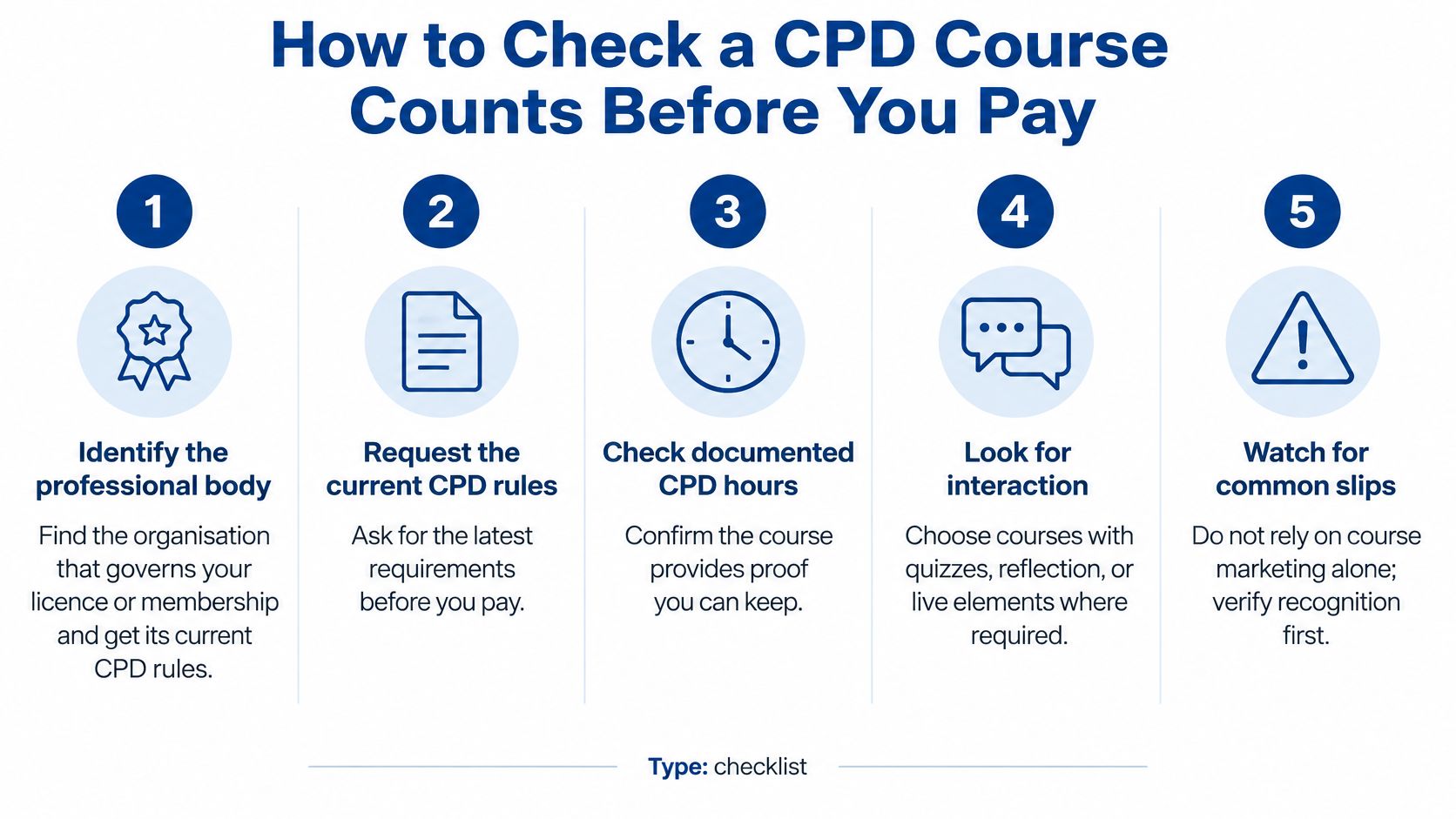
The Royal College of Physicians of Ireland states that online CPD activities may need learner interaction or self-assessment and downloadable evidence of completion. Its framework is being formalised for doctors from July 2026, so treat that date as a planned change rather than a rule already in force for every activity.
The checks, in order
Split the questions by who answers them. Two belong to your regulator or employer. Three belong to the provider.
Ask the body that governs your licence or membership first.
- What counts. Confirm whether the body records hours, points or credits, and whether this course type is eligible. If you hold no licence, ask what evidence your employer's training policy wants, and check the policy date. People often plan against a generic document downloaded two years ago.
- Whether recognition is automatic. Some schemes count eligible activity on submission; others need prior sign-off. Enrolling first and asking later is how people pay for hours they cannot claim. Ask also whether a post-course evaluation or written reflection is expected, since a missing one can leave the activity classed as participation only.
Then put three questions to the provider.
- What the course states. The description should say what you will be able to do, and include interaction or self-assessment where your rules require them. A video with no check is a weak file in a regulated audit.
- Who accredits it. A provider certificate does not establish regulatory acceptance. CPD Certification Service provides recognised independent CPD accreditation compatible with global CPD principles, and the European Institute of Leadership and Management is a certified member of that service. Membership does not replace your own body's list. Ask which body accredits the provider, then check that body yourself; treating a logo as approval is the common slip.
- What you keep. Confirm you will receive downloadable proof of completion you can store. At the European Institute of Leadership and Management, each course ends with a digital certificate carrying a unique ID and QR code. A login page that disappears when the subscription ends will not help an auditor.
Provider recognition pages, such as the institute's note on course recognition, are a starting point. The decision rests with your own body's rules.
Copy this before you pay. You want five yeses.
- Body. Do you hold the current rules of your professional body or employer?
- Unit. Have you confirmed hours, points or credits for this specific course?
- Design. Are objectives and any required interaction or self-assessment in the course description?
- File. Will you get downloadable evidence you can keep?
- Approval. Is recognition automatic, or do you already have prior approval in writing?
Matching Online CPD to Your Situation
In 2024, 64% of Irish internet users who undertook online learning said it was for professional or work-related purposes, the Central Statistics Office reports. The purpose is usually the job. The right course still changes with the job.
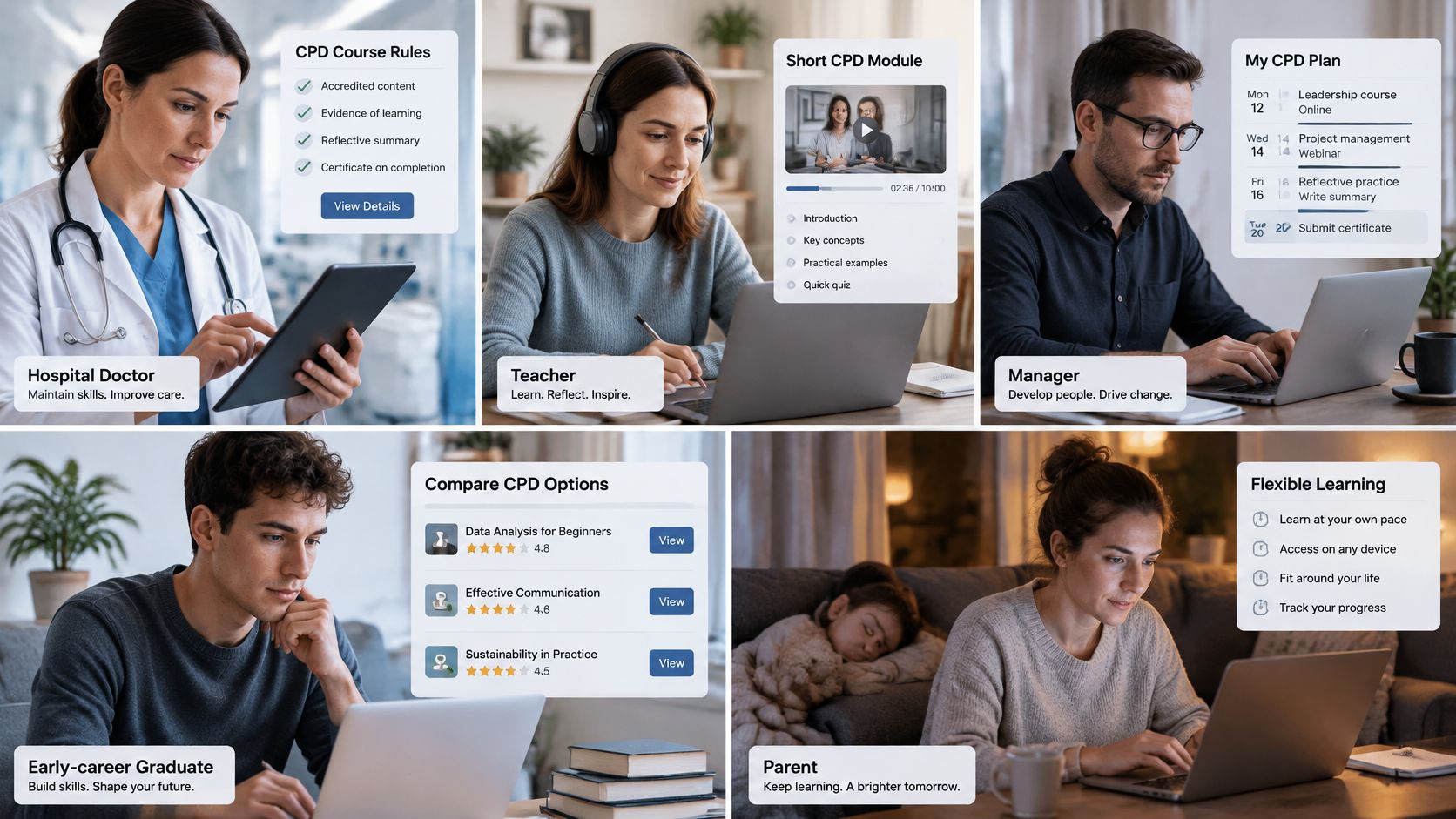
A hospital doctor who must log hours. Start from the college or medical council rules, then choose a course with interaction and a file you can download. A general business module can be useful on the ward and still be ineligible. The check that changes the choice is a written answer on whether this activity type is accepted.
An IT team lead moving into projects. A Project Management Mini-MBA, or a sequence across IT management, risk and change, matches the new brief. Add a live element if self-paced study has already slipped. The check is your own record. Two abandoned evening courses mean the flexible option is the weaker one.
An owner who needs the numbers. Financial Concepts and Investment Fundamentals, taken at your own pace, cover the gap without a long programme. Apply one idea to a real budget or pricing decision in the same month. If the role needs credit toward a later qualification, this pair is the wrong weight.
A recent graduate building a first profile. One short introductory course with a clear completion certificate is enough to start. Move to a programme pathway only if you want a visible sequence rather than a single badge. The check is the vacancy. If the employer asks for a qualification, a participation certificate will not stand in for it.
A policy analyst on global governance. Global Governance and International Relations match the subject. Credit matters only if the role or a later application requires it. If the post is skills-based, a non-credit course can still be the better use of time.
The same course is a strong choice in one job and a weak one in the next. Match the evidence you must produce, not the title you like.
Choose Your Course and Confirm Recognition
A low fee and a self-paced timetable mainly reflect access, not whether a body will record the hours. Listed online certificate courses at the European Institute of Leadership and Management are priced at €15.00 each, self-paced, fully online, and supported online. Those are buying facts. Recognition sits with your professional body or employer, so settle it before payment rather than after.
Work through this once, on paper.
- Shortlist. Pick two or three subjects from the learning-need table that match the gap you named.
- Format. Use the missed-session test: scheduled contact if you drift, self-paced if you keep your own deadlines.
- Recognition. Apply the yes-or-no checks from earlier, then get written confirmation from your professional body or employer before you pay.
- Evidence and help. Confirm the provider issues a certificate with verifiable proof of completion, and that online support is available if you stall. A digital certificate with a unique ID and QR code is the file you will produce later.
- Enrol last. Pay only when that written confirmation is in hand, then file it with your CPD records next to the certificate.
File the written confirmation with the certificate itself, so it survives an inbox clear-out.
The catalogue at the European Institute of Leadership and Management combines individual certificate courses in subjects such as leadership, finance, IT and risk management with Mini-MBA and programme certificate pathways in disciplines including Business Administration, Project Management and Strategic Management. A programme certificate requires four courses in a designated programme, so it suits a learner building toward a broader credential rather than a single subject. Run the checks above first, then compare subjects in the European Institute of Leadership and Management catalogue only against the evidence your role demands.