
Supply Chain Management Jobs: 10 Careers for 2026

Which decision do you want to own on a Tuesday morning? Most write-ups treat supply chain management jobs as isolated titles. Buyers buy, planners plan, warehouses pick. That reading hides the chain. One forecast becomes a purchase order, then a pick task, then a freight booking, then a quality hold, then a board conversation about cash and service.
Supply chain work is no longer one job. It is a family of specialised roles spanning data, buying, planning, warehousing, freight, quality, consulting and executive leadership. The ten roles below follow a career path, from analyst entry points to the chief supply chain officer seat. Each section is built around the decision that role owns, plus the skills employers test, a realistic scenario and a first step you can take without waiting for a perfect CV.
Read them as one system. The analyst decides what the data is saying. Procurement decides who supplies the business and on what terms. Logistics and transport decide how goods move. The demand planner decides what customers are likely to want. Inventory decides how much cash sits in stock. The warehouse decides whether orders leave accurate and on time. Supplier quality decides what is allowed in. The consultant decides which design should change. The CSCO decides whether the whole system serves the strategy. Pick the decision that matches how you already think.
Table of Contents
- 1. Supply Chain Analyst
- 2. Procurement and Sourcing Manager
- 3. Logistics Manager
- 4. Demand Planner
- 5. Inventory Manager
- 6. Warehouse Operations Manager
- 7. Transportation Manager
- 8. Supplier Quality Manager
- 9. Supply Chain Consultant
- 10. Chief Supply Chain Officer (CSCO)
- Comparing the 10 Supply Chain Management Jobs
- Mapping Your Move into Supply Chain
1. Supply Chain Analyst
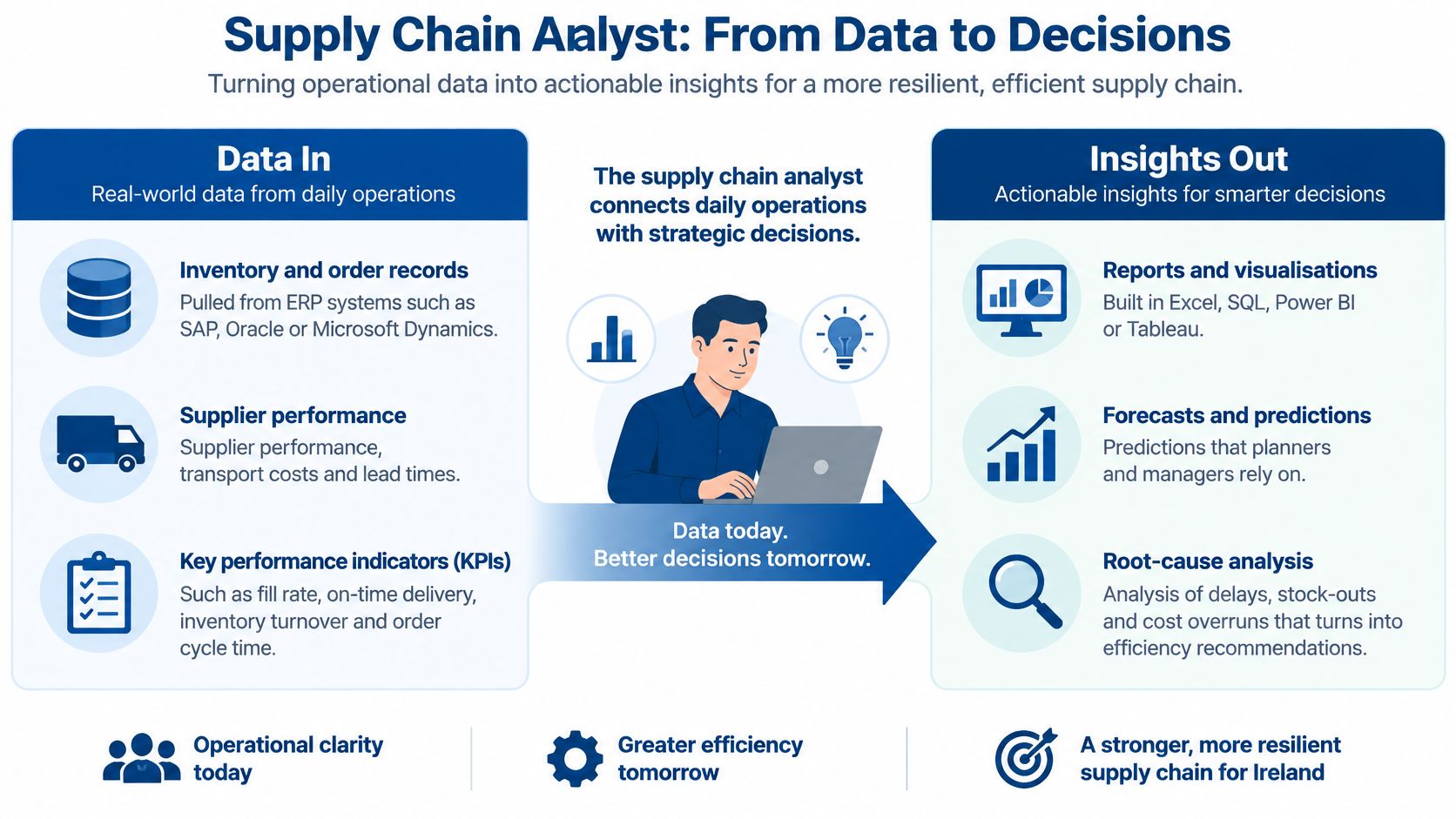
The analyst owns one decision that keeps resurfacing: which number is strong enough to change a plan. Orders, inventory, supplier performance, transport cost and lead time stay noise until someone cleans them, checks the bias and names the action.
A retailer sees late deliveries clustering on two routes. A weak note says the supplier is unreliable. A useful one proposes a revised collection window and a lane-level cost comparison the transport manager can run. At a consumer goods plant, the same skill replaces a monthly spreadsheet pack with one current dashboard, so planners stop arguing about whose file is right.
Ireland's planning layer is already large. SOLAS estimated average employment in transport and logistics occupations at 110,800 people in 2023, 4.0% of the national workforce, with stock control, transport and distribution administration accounting for 31,200 of those jobs.
Practical rule: If you cannot explain a chart in one sentence a planner can use, it is not finished.
What employers test comes down to three habits:
- SQL and one visual tool: Adverts ask for queries and dashboards, not a vague interest in data.
- A short portfolio: Three sanitised analyses beat a CV line that only says Excel.
- Shared language: OTIF, lead time and bias stop you presenting charts nobody can act on.
Build around the meeting you want to influence. If the question is service, show where OTIF fails by lane. If it is cash, show which SKUs drive weeks of cover. If you want structured practice while assembling those examples, a supply chain analytics and KPIs course can be a useful reference, but the proof remains an analysis a planner can use.
2. Procurement and Sourcing Manager
A manufacturer that negotiates every nut and bolt the same way wastes senior time. The daily decision is what to buy, from whom, and on what terms, with unit price only the easiest part to argue.

Segment spend before any tender. Routine items belong in catalogues and simple reorder rules. Strategic components get the negotiation calendar, dual-source plans and annual risk reviews. When a critical part comes from one plant, a second qualified source can cost more per unit and still be the cheaper decision once downtime enters the maths.
Recruiters already feel that gap. The SOLAS Difficult-to-Fill Vacancies Survey, drawing on Irish recruitment-agency evidence from November 2023, found logistics-related vacancies made up 7% of difficult-to-fill categories, including procurement managers, planners and supply chain analysts.
How to negotiate without chasing the lowest quote
- Category first: Label spend as routine, advantageous, bottleneck or strategic before you open a tender.
- Total cost: Include freight, quality failures, inventory and payment terms, not only the invoice price.
- Risk file: Write a supplier risk note and review it at least once a year.
The role sits between analysis and execution: analysts supply the spend data, logistics managers inherit the lead times and transport consequences. For a structured refresher on sourcing choices, the procurement and sourcing strategies course fits the category-first approach above.
3. Logistics Manager
A missed carrier cut-off at 6 p.m. turns a next-day delivery promise into a refund by the end of the week. That is the decision this role owns daily: what ships, on which lane, and where stock sits between supplier and customer. Transport, warehouses, network shape and carrier contracts all sit inside it. Get it wrong and customers feel it before finance does.
Small choices compound. A distributor that despatches every order the day it lands pays for speed customers never asked for. Consolidating regional orders into fixed shipping days cuts the rate, but stretches lead time and raises the stakes when one load runs late. The reverse trade applies as well: a wider order window eases dock pressure, yet pushes the cut-off risk back onto the carrier.
Service promises only hold when they account for dock capacity.
The Department of Transport reported in 2024 that 69% of workers in the sector were male and 31% female, and that digital skills were three of the top fifteen skills requested in online job advertisements. A logistics manager who can read a system, rather than only a phone list of hauliers, is easier to hire and easier to promote.
Track cost per delivery and on-time-in-full every week. Review carrier performance each quarter. Keep Incoterms and customs rules current, because a cheap rate that lands the duty on the wrong party costs more than it saves. The introduction to logistics and supply chain management course is a clean way to lock that vocabulary before you manage a network.
4. Demand Planner
A consumer goods company often runs three forecasts at once. Sales expects a promotion lift, finance plans to last year's volume, and the statistical model says something flatter. The demand planner turns those into one number the business commits to, then hands it to production, purchasing and inventory. The model sets the base. Promotions, seasonality and a sales team's optimism decide whether that base is usable.
A short consensus meeting, with one agreed number for the top products, usually beats a clever model nobody trusts. Functions that keep private forecasts end up overbuying some lines and missing others. A fashion retailer can go further and let recent store sales pull replenishment on trending sizes, while the seasonal buy stays on a longer horizon.
Accuracy is not the same as bias
Report forecast accuracy and forecast bias separately. Accuracy measures the size of the miss. Bias tells you whether you always guess high or always guess low, and a team that watches only the first number will keep overordering the same lines. Sales and marketing need to flag promotions before the forecast locks, while there is still time to build the stock.
Skillnet Ireland reports that 56% of Irish businesses expect their skills requirements to change within two to three years, and that sustainable supply chain management is a growth-relevant skill for 36% of businesses. A planner who can show how a forecast changes both stock and waste is more hireable than one who only quotes a percentage error.
Use a short horizon for replenishment and a longer one for capacity. Do not force one number to do both jobs.
5. Inventory Manager
A distributor cannot give every SKU the same attention. The small slice of lines that carries most of the value gets tight counts, frequent reviews and clear reorder points; the tail gets lighter control and a slower clock. The daily decision is how much cash to park on shelves so service stays high.
That trade-off sits between the forecast and the warehouse. Demand planning supplies the expected usage, operations supplies space and labour, and inventory policy turns both into stock targets. Slow movers need a monthly obsolete list with a named owner, otherwise components keep arriving for products no one still sells.
Settings that should not sit still
- ABC first: Put control effort where the value sits.
- Safety stock each quarter: Reset it against actual demand variability, not last year's nervous guess.
- System versus floor: Reconcile recorded stock with physical counts on a fixed cycle.
Raising safety stock after every complaint only masks the underlying cause. If service slips, check the forecast bias and the supplier's lead time before tying up more working capital. For a role change from coordination into stock ownership, the course title to look for is Inventory and Transportation Management.
6. Warehouse Operations Manager
An e-commerce centre that sends pickers across the whole building for every order burns labour on walking, not picking. Zone picking, with fast lines near the pack benches, raises lines per hour and shortens the path between scan and ship. That is the warehouse operations manager's daily territory: receiving, put-away, picking, packing and dispatch, measured in throughput and error rate on every order the planner promised.

A warehouse management system with barcode scans cuts the "I thought it was the right bin" error that a paper list cannot see. The trade-off is real: training time and a messy first fortnight while staff learn new routes and scan habits. The saving is fewer reships, fewer credit notes and fewer calls from the transport desk about loads held for a repack. Sites that skip the system investment usually pay the same money back through labour overtime and error correction, just in a less visible line.
Three numbers worth a daily huddle
- Picks per labour hour: Shows whether the layout and the roster match the order profile.
- Order accuracy: Catches scanning gaps before customers do.
- Dock-to-stock time: Shows whether receipts are clogging the floor.
Map the layout around high-velocity items and plan peak staffing months ahead, not the week the promotion lands. A supervisor who only walks the floor and never reads the tablet will miss the bottleneck. A supervisor who only reads the tablet will miss an unsafe aisle. You need both.
7. Transportation Manager
A transport manager opens the day with outbound loads due before the weekend and a regional lane still priced on a handshake rate no one has benchmarked in two years. The daily call is practical: consolidate orders into a fuller trailer, pay for a direct truck, split volume across carriers, or hold freight for the next cycle and risk the dock promise.

That handshake rate is the test. Tendering the lane to several carriers can reset price and reveal capacity, while keeping a challenger carrier on a small share gives cover when the incumbent runs out of tractors. A transport management system can merge orders and cut empty running, but only if planners release work early enough to build a legal, drivable load.
The pressure reaches beyond the office. Ireland's Department of Transport says the logistics and transport sector employs more than 246,000 people and accounts for 12% of all difficult-to-fill vacancies nationally, while almost one-third of HGV drivers are over 55. Office-based transport roles still depend on that ageing driver base, so approved backup carriers and alternate routes belong in the plan.
Judge a lane on cost per mile or per tonne-kilometre beside on-time arrival, claims and emissions. A cheap lane that misses the dock is expensive.
8. Supplier Quality Manager
A carmaker emails a defect report to its tier-one supplier and waits. The same fault arrives in the next shipment, and the one after that. The daily decision in this role is which defects stop at the gate, which go back to the supplier as a dated corrective action, and which suppliers lose the business entirely.
Audits, incoming checks and corrective actions are the tools. A missed defect becomes a recall, a stopped line or a customer who does not come back. Joint root-cause work on the process that produced the fault is slower than firing off a complaint, and it is the work that holds. A food company can rank suppliers on a scorecard and give consistent performers preferred status, which makes the audit calendar risk-based instead of a fixed visit for everyone.
What to keep ready for an auditor
- Risk-based visits: Audit the suppliers who can hurt you, not only the ones who are nearby.
- Shared defect data: Agree a joint improvement number, then review it.
- Current files: Specifications, certificates and change records must match what is shipping.
A quality manual that suppliers never see protects nobody, and a company that starts inspecting only after a complaint has already shipped the defect to its customer. Incoming checks catch today's lot. The process that produced it stays broken until someone owns the corrective action. If you are moving from an analyst or buyer role into this seat, learn one corrective-action method properly, such as 8D, and use it on a live supplier before you collect further badges you cannot explain.
9. Supply Chain Consultant
An S&OP implementation is the classic consulting brief. Sales, finance and operations each hold their own numbers, and the consultant has to get all three to agree a single plan, then leave a meeting rhythm the client can keep after the engagement ends. The deliverable is a diagnosis, a model and a process with a named owner on the client side.
An inventory reduction programme is different work again. The consultant finds where safety stock doubled up across sites, which slow-moving SKUs to delist and what the freed cash is worth, then hands the new stock policy to the planner who will run it. The test is whether the client can run the plan alone six months later.
ManpowerGroup Ireland reported that in 2025, 82% of employers in Ireland's Industrials and Materials sector had difficulty finding candidates with the skills they needed, and named operations and logistics among the hardest-to-find areas. That shortage is why clients hire outside help, and why a generalist who "does supply chain" loses to someone who can show a result.
Specialise. Network design, S&OP or procurement analytics is enough. Write the business case in money a finance director recognises, and keep a short record of measurable outcomes you are allowed to describe.
10. Chief Supply Chain Officer (CSCO)
A retailer sources a core category from one region. Unit costs are low, lead times hold, and a single port closure can idle stores for weeks. The board appoints a CSCO to diversify that supply base and accepts paying more in year one to get it. Resilience bought against margin is the daily trade-off at this level.
A second common mandate is structural. Pull procurement, planning, manufacturing, logistics and, often, customer service under one executive, so cross-functional trade-offs stop being settled in side meetings. The role reports to the CEO or COO, and its working language is resilience, margin and service. Either mandate fails when the holder can talk stock turns all day and goes quiet when the CFO asks what a point of service costs.
The talent constraint is already on the leadership agenda. CIPD Ireland, drawing on the World Economic Forum's Future of Jobs research, reported that in 2025 76% of Irish respondents identified skills gaps as a barrier to organisational transformation, while 43% expected access to talent to worsen over the following five years.
Two functions beat one glittering title. A CSCO who has only ever bought, or only ever planned, will miss the constraint in the function they never ran.
Build commercial literacy beside the operational record. The board funds the chain that protects revenue.
Comparing the 10 Supply Chain Management Jobs
The fastest way to compare these jobs is to ask what each person decides before lunch. Titles differ and tools differ, but the daily decision defines the job spec. That decision also points to the next seat, because senior supply chain leaders usually earn credibility across adjacent decisions.
| Role | Decision it owns | Trade-off that exposes a weak fit | Next seat in the chain |
|---|---|---|---|
| Supply Chain Analyst | Which number to trust before money or stock moves | Model elegance against operational noise; a clean model that ignores late trucks gets ignored | Procurement, demand planning or logistics once a recommendation survives contact with the floor |
| Procurement and Sourcing Manager | What to buy, from whom, on which risk terms | Unit price against supply risk; the cheapest quote can become the most expensive stoppage | Demand planning or logistics, then CSCO after a second operating function |
| Logistics Manager | How goods move and sit between sites | Speed against landed cost; faster freight can hide a warehouse bottleneck | Transportation or warehouse operations, then multi-site operations lead |
| Demand Planner | How much demand to commit to | Forecast accuracy against agility; chasing every wobble whipsaws factories and suppliers | Inventory manager or integrated business planning lead |
| Inventory Manager | How much stock to hold and where | Availability against cash; service improves until excess stock quietly eats margin | Demand planning or logistics manager |
| Warehouse Operations Manager | How much volume a site can process safely today | Labour plan against cut-off times; pushing overtime protects service until errors rise | Logistics manager or transportation manager |
| Transportation Manager | Which carrier and mode gets each lane | Rate against reliability and compliance; a low tender loses if freight misses the window | Logistics manager, then multi-site operations lead |
| Supplier Quality Manager | Which supplier defects stop at the gate | Containment against supplier development; rejecting lots protects customers but does not fix the process | Procurement and sourcing manager or operations quality lead |
| Supply Chain Consultant | Which constraint is worth fixing first | Quick wins against structural change; a polished model fails when the client cannot staff it | Return to an operator seat with a wider mandate |
| Chief Supply Chain Officer (CSCO) | Which trade-offs the company will accept across functions | Local targets against enterprise outcome; each function can hit its KPI while the chain loses | End of the chain; owns the combined result of the nine decisions above |
If a role tempts you but its trade-off sounds unbearable, believe the trade-off.
Mapping Your Move into Supply Chain
These ten seats form one career path. Start where your current strengths already match the decision. People who like cleaning a messy spreadsheet should enter as analysts rather than warehouse managers. People who already run a shift should aim at warehouse or transport leadership before they chase a CSCO title. People who negotiate well can move from coordinator into procurement once they can show category logic and a risk file.
Close one gap at a time. Read two live job adverts for the target role and list the skills they repeat. If both ask for SQL and a forecast accuracy measure, that is the gap. If both ask for carrier tendering and Incoterms, build that instead. A certificate that does not match the advert will not move the application.
European Institute of Leadership and Management offers online, self-paced certificate courses in logistics and supply chain management, plus Mini-MBA programmes that include Business Administration and Strategic Management. The institute is a certified member of the CPD Certification Service. Learners complete courses around an existing job, verify the certificate, and add it to a LinkedIn profile. That is a credential an employer can check, which carries more weight than a line that only says you are interested in supply chain management jobs. It is professional education rather than a university degree, so pair it with a small piece of work you can talk through in an interview.
The concrete step this month is short. Shortlist two roles from this list. Write the skills each advert demands in two columns. Enrol in one course that closes the widest gap between those columns and what you can already prove. Then do one small project, a forecast error chart, a spend segmentation, or a carrier scorecard, and put the result next to the certificate. Hiring managers trust the pair.
Pick the course that matches the decision you want to own, then show the credential to employers. Visit European Institute of Leadership and Management and choose the course that closes the gap on your shortlist.