IT Project Manager Role: Duties, Skills and Career Path
The billing upgrade was approved at a Tuesday steering meeting and handed over by Friday. Nobody asked whether twelve weeks was realistic, whether the finance team had anyone free for testing in August, or who would tell the contact centre that invoice layouts were changing. That gap between an approved idea and a dated plan with names against it is the actual work.
If that gap is where you currently stand, half inside delivery and half still doing your old technical job, the role of IT project manager is closer than most job descriptions suggest. It's also less glamorous and more exposed than the title implies.
Table of Contents
- What an IT Project Manager Actually Owns
- Skills That Separate Good IT Project Managers
- How an IT Project Moves Through Its Lifecycle
- Managing Scarce Specialist Skills Across Your Project
- Governing AI-Enabled Projects Responsibly
- Salary Levels and Career Progression for IT Project Managers
- Building Your Route Into the Role and Your Next Steps
What an IT Project Manager Actually Owns
Say a Dublin software firm approves a customer billing upgrade. The approval is a decision. The delivery is a plan. The IT project manager converts one into the other: milestones with dates, owners with capacity, a costed budget, a risk log somebody reads, and a reporting rhythm the sponsor trusts. Developers own code, testers own coverage. The project manager owns whether anyone can state, on any given Friday, how far along the work is.
That accountability reaches past the schedule. It covers the seven areas in the table below, and many people moving into the role already handle three or four of them informally.
| Area | What you own | Typical output | Main counterparts |
|---|---|---|---|
| Scope and requirements | Agreed deliverables and change control | Scope statement and change log | Business sponsor and users |
| Schedule and delivery | Milestones, dependencies and critical path | Integrated plan and Gantt chart | Developers, testers and suppliers |
| Budget and cost | Spend against the approved baseline | Cost forecast and variance report | Finance and sponsor |
| Risk and issues | Early warning and escalation | RAID log | Steering committee |
| Resources and vendors | Allocation of people and contracts | Skills heat map and contract schedule | Line managers and procurement |
| Quality and acceptance | Testing exit criteria and sign-off | Test summary and acceptance record | QA leads and end users |
| Stakeholders and change | Communication plan and user adoption | Status reports and training plan | Users and operations teams |
The demand side makes this coordination valuable rather than administrative. An Irish Government report on digital specialist skills estimates roughly 168,800 digital specialists in employment in 2025, with demand projected to exceed 215,000 by 2030 under its baseline scenario and an annual shortfall of around 5,500 specialists (Department of Enterprise, Tourism and Employment). Scarcity turns sequencing into a real decision. Somebody has to determine which initiative gets the one integration engineer this quarter.
A practical self-audit takes ten minutes. Write down which of these you already do without a title for it:
- Change control: you've told a stakeholder no, or "not in this release", and held the line.
- Cost tracking: you know what a piece of work cost against what was quoted.
- Escalation: you've taken a problem to a manager early rather than late.
Areas you've handled informally count as experience. Areas you've never touched are the ones training has to cover.
Skills That Separate Good IT Project Managers
A strong technician does not automatically make a strong project manager, and organisations keep learning this the expensive way. Technical depth is useful: it lets you challenge an estimate, spot a design that will be expensive to reverse, and ask a supplier why an integration needs six weeks. But the role is judged on different outputs. Did decisions get made? Did risks stay visible? Can you account for the spend?
| Skill | Why it matters | Evidence of competence | Junior level | Senior level |
|---|---|---|---|---|
| Planning and scheduling | Keeps delivery dates credible | Baseline plan with dependencies | Maintains task lists | Plans multi-project portfolios |
| Risk management | Surfaces problems early | Maintained RAID log | Logs and reports risks | Sets escalation thresholds |
| Technical literacy | Challenges estimates and designs | Explains trade-offs in plain terms | Understands the terms used | Assesses architecture options |
| Stakeholder management | Secures decisions and funding | Stakeholder map and communication plan | Runs status updates | Manages sponsors and boards |
| Commercial awareness | Links spend to benefits | Benefits register and cost forecast | Tracks spend against budget | Negotiates vendor contracts |
| Change leadership | Gets users to adopt the result | Adoption plan and training schedule | Supports rollout | Designs organisational change |
Expectations shift with seniority in a predictable pattern. Juniors keep plans accurate and report status transparently. Seniors decide when a problem stops being the team's to solve, set the threshold that triggers escalation, and manage the relationship with a sponsor who is being asked for more money. The plan is the same artefact; the judgement around it is different.
Stakeholder management is the skill people overestimate in themselves. Consider a finance director who refuses a change request mid-delivery. Arguing about urgency gets nowhere. Rebuilding the case does: restate the benefit against the budget that remains, show what gets deferred if the change is approved, and let the sponsor choose. That's not persuasion, it's presenting a decision clearly enough for someone else to make it.
Practical rule: if a stakeholder's objection can't be answered with a document you already maintain, the problem is your reporting, not their attitude.
Negotiation and communication are learnable through repetition, which means the honest move is to rate yourself row by row before booking any course. Two skills decide whether a project survives a bad quarter: planning credibility and risk visibility. Lose either and the sponsor stops believing the reports.
How an IT Project Moves Through Its Lifecycle
The lifecycle is a sequence of decisions, not a set of documents. In Ireland, the governance framework published by the Department of Finance gives that sequence real teeth: ICT projects need an appropriate business case, a named project sponsor, a project board, stage gates and formal change control, and new projects expected to cost more than €25,000 require Management Board approval under Circular 14/2021. Delivery typically runs on PRINCE2 principles, supported by a PMO tracking status, expenditure and resources, with regular reporting to an ICT oversight committee.
Treat those structures as engineering controls. They exist to stop immature work progressing and to make public spending auditable.
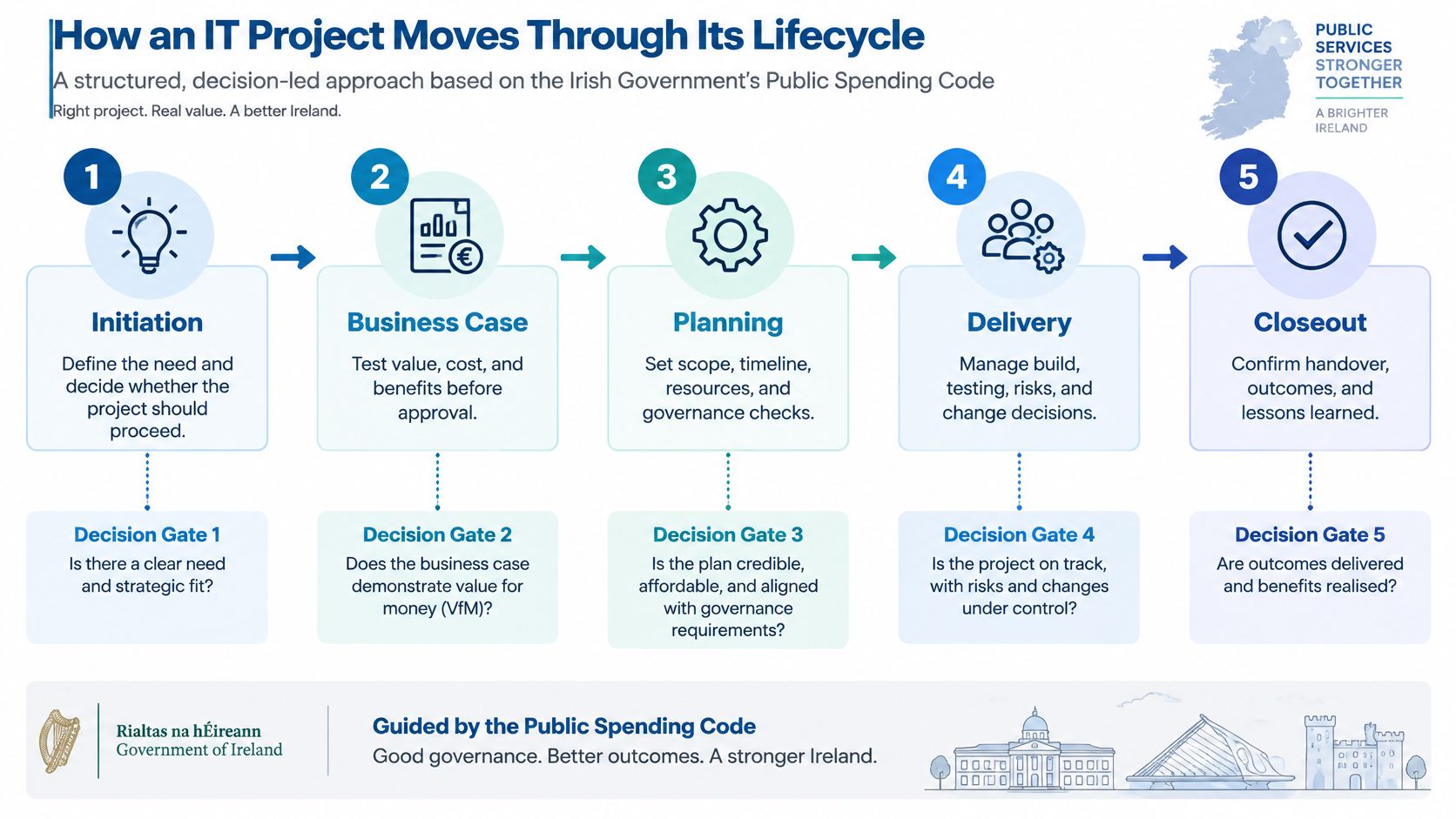
- Initiation. Write the business case, name the sponsor, form the board. The gate is approval. The common slip is starting work before benefits are measurable, which leaves you defending a project nobody can value.
- Planning. Build the integrated plan, RAID log and benefits register, then baseline scope, schedule, cost and resources. The common slip is baselining a schedule the team never estimated; a date inherited from a slide is not a plan.
- Execution. Run delivery, track progress through the PMO, and test every change request against benefits, risk, dependencies and remaining budget. The common slip is approving changes in a corridor and discovering the scope growth at the next gate.
- Monitoring and control. Report on a fixed rhythm and escalate deviation early. The common slip is a green status issued after the forecast has already moved, which destroys trust faster than a red one.
- Closure. Confirm acceptance, hand ownership to operations, release people, record lessons. The common slip is closing without measuring whether the benefit arrived.
The method itself matters less than the discipline around it. Where a team prefers iterative delivery, the project management methodologies question is mostly about cadence, not about abandoning governance: gates move to release boundaries, the baseline becomes a release plan with a controlled backlog, and every change still passes the same four-part test.
Before any stage review, run a short gate-entry checklist. Sponsor signed off, baseline current, top three risks each with a named owner, funding confirmed for the next stage. If any answer is no, the review isn't ready.
Gate rule: a project that can't state its top three risks with owners attached isn't being managed, it's being watched.
Managing Scarce Specialist Skills Across Your Project
Ireland's digital workforce is large, and specialist supply is still tight. In 2025, ICT specialists represented 6.30% of Irish employment, above the EU average of 5.0%, while 82.82% of people aged 16 to 74 had at least basic digital skills. Even so, the European Commission estimates Ireland would need approximately 8,700 additional ICT specialists annually to meet its Digital Decade trajectory, a pace not yet achieved (EU Digital Skills and Jobs Platform).
The consequence for delivery is specific: demand for cloud engineering, cybersecurity, data, software and integration expertise can exceed internal capacity, pushing you towards contractors or vendors.
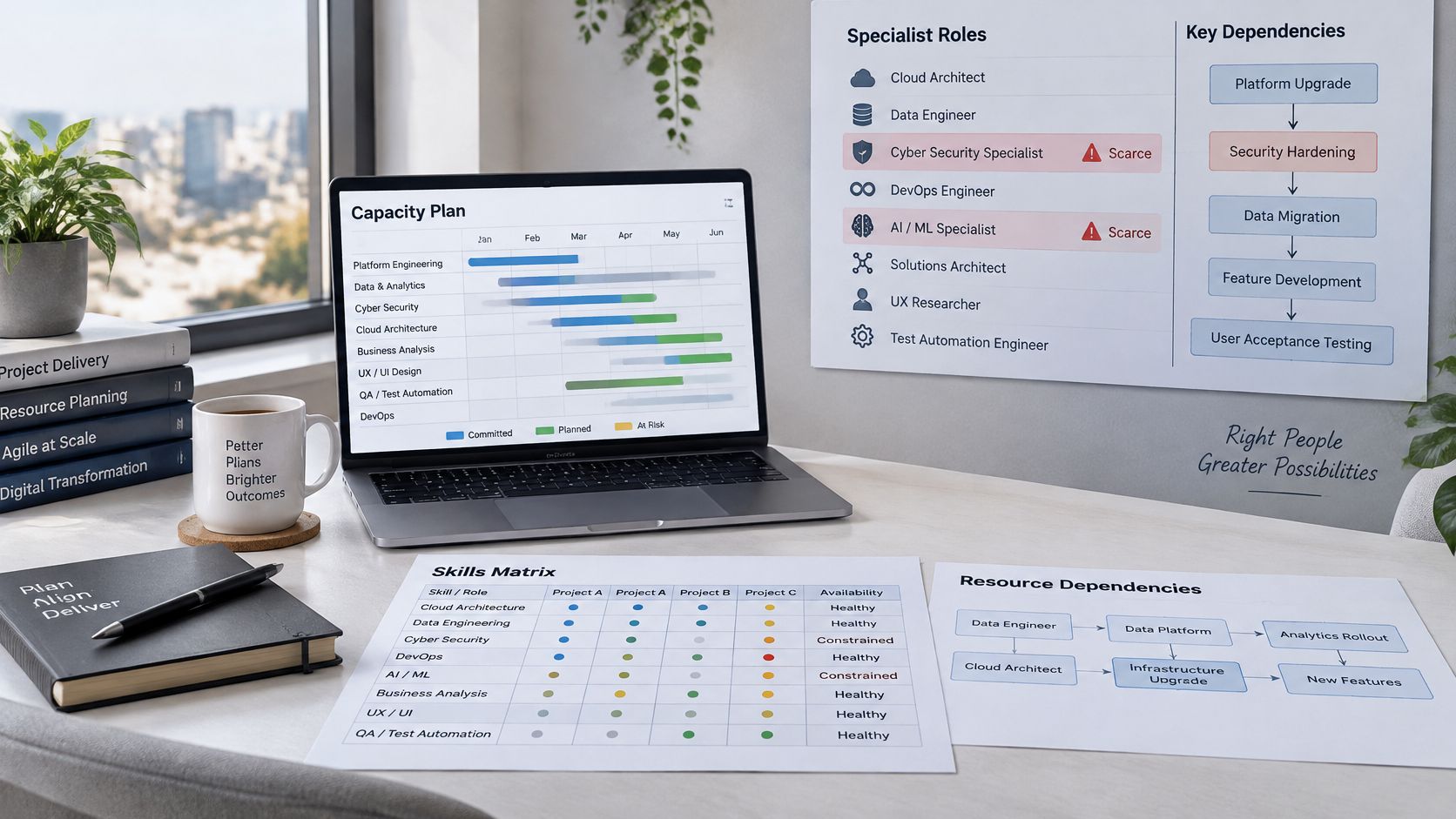
Plan capacity by skill, not by headcount. A team of ten can stall because one person understands the integration layer, and adding two generalist developers changes nothing. Four practices, in order:
- Map critical skills: cloud, security, data, software, integration. Name the person, not the team.
- Flag single-person dependencies: anything with one name beside it is a schedule risk before it's a people problem.
- Reserve availability before committing milestones: confirm the specialist's dates, in writing, before the plan is baselined.
- Contract for knowledge transfer: cross-training or documentation requirements belong in supplier agreements, not in goodwill.
Build a skills heat map with four columns: capability, allocation percentage, availability date, replacement lead time. As an illustration, take a cloud engineer allocated 60% across two projects. Their time becomes the constraint on a migration, so the cutover date moves and the dependency goes into the log with a date attached. Hope is not a resourcing strategy.
Where a critical role has no feasible substitute, the risk belongs on the steering committee's escalation path, because its impact is schedule-critical rather than operational. The same logic applies when hiring: the guidance on recruiting and retaining IT talent is easier to act on when the gap is quantified by role rather than described as a general shortage. A digitally mature country does not guarantee delivery capacity on your project, in your quarter.
Governing AI-Enabled Projects Responsibly
Irish enterprise adoption moved fast. The Central Statistics Office reports the share of enterprises using artificial intelligence rose from 8% in 2023 to 20% in 2025, with 57.7% of large enterprises using it against 28.6% of medium-sized and 17.2% of small enterprises. The most common applications were data mining at 10.8%, natural-language generation at 9.3% and workflow automation or decision support at 6.2%, while 73% of enterprises used paid cloud services (CSO Business in Ireland 2025). Most AI delivery guidance lists tools. The operational questions are harder.
At initiation, four need answers before the business case is approved:
- Name a model owner in the RACI, with authority to pause the service.
- Write data quality, privacy, bias and explainability tests into acceptance criteria.
- Budget post-launch monitoring as a running cost, not a one-off.
- Agree a rollback trigger with the steering committee at the stage gate.
Consider a claims-triage model accepted on accuracy alone. Six months later its error rate rises for one customer group. Because bias testing was never an acceptance criterion, there's no agreed threshold for pausing it, so scope reopens under change control while the model stays live. Governance written late costs more than governance written early. The wider shift is covered in how artificial intelligence is changing project management.
Salary Levels and Career Progression for IT Project Managers
Pay steps up with scope and accountability rather than years served. The 2024 Project Management Salary Survey from IT Search puts the Irish bands at the levels below (IT Search salary survey).
| Level | Typical annual salary | Typical scope | Contract day rate |
|---|---|---|---|
| Junior project manager | €45,000–€55,000 | Small workstreams under a senior manager | €500–€650 per day |
| Mid-level project manager | €60,000–€75,000 | One project end to end with its own budget | €500–€650 per day |
| Senior project manager | €75,000–€100,000 | Programmes, portfolios and escalation paths | €500–€650 per day |
| Contract project manager | Paid per day, so annual income follows days billed | Fixed-term delivery across any level | €500–€650 per day |
What separates the bands is decision rights. A junior manager keeps a workstream plan accurate and reports status to somebody else who owns the budget. A mid-level manager holds the budget, negotiates with the vendor and answers to the sponsor directly. A senior manager governs several projects at once, sets escalation thresholds, and is the person the organisation calls when a programme turns amber.
Progression tends to follow four steps in order: deliver one small project to closure, then own a budget and a vendor relationship, then lead a multi-team programme, then move into portfolio governance. Skipping the second step is the common mistake, because commercial ownership is where credibility is built.
Contract rates suit experienced managers who can start quickly and carry their own insurance and downtime. Converting a day rate into a comparable salary means multiplying it by the days billable, then subtracting the benefits a permanent role provides. Survey bands are snapshots, so check live listings before any negotiation.
Building Your Route Into the Role and Your Next Steps
A tester gets handed a slipping integration plan two weeks before a gate and told to get it back to green. That is often how the route in starts: somebody gives you the coordination problem because you are already close to the work. Ireland's adult-learning habit helps, since many candidates build the role while still employed.
Three routes work, each with evidence attached:
- From developer, tester or analyst: take on a small project and formally own its plan. The evidence is a project charter you wrote.
- From business analysis or operations: build a recognised method qualification. The evidence is a risk log you maintained through a live delivery.
- From team leadership: own the budget and schedule of your team's work. The evidence is a closure report you signed.
Make the evidence specific to delivery in Ireland: a charter that names the stage gates it must pass, a risk log that tracks scarce specialist availability, and a closure report that records vendor handover, benefits owner and any AI data or model risks. Hiring panels can check artefacts faster than they can check adjectives.
Structured online study fits around a job. The Programme Certificate in Project Management from European Institute of Leadership and Management is aimed at current project managers, team leaders and people looking to move into a project management role, and the Mini-MBA in Project Management covers the full project management lifecycle, from initiation to closure.
Then act over three weeks. Week one: use the earlier self-audit to choose the two responsibility areas you handle least. Week two: rate yourself on the six skills and practise the weakest on a live task, such as rebuilding the dependency plan around a specialist with limited availability. Week three: sit in on a stage gate or steering meeting and record how decisions are minuted, who owns each action and which risks were accepted or fixed. For the wider move, the path for transitioning from a specialist role to a leadership position maps the same shift from doing the work to owning outcomes.
European Institute of Leadership and Management offers online, self-paced programmes for people who are already coordinating technology work and want the structure behind it, including a Programme Certificate in Project Management and a Mini-MBA in Project Management that runs from initiation through closure. If the audit showed gaps in planning, risk or commercial ownership, that is the material to close them with. Visit European Institute of Leadership and Management to compare the programme options and start with the one that matches the gap you found.