
Strategic IT Management for Business Alignment
Only 66.1% of Irish small and medium-sized enterprises had at least a basic level of digital intensity, according to CSO figures cited in an Irish parliamentary record. That reframes strategic IT management: leadership cannot assume that buying advanced technology means an organisation has the capacity to use it well. The harder decisions concern ownership, scarce skills and which investments deserve funding when the organisation can't deliver everything.
Table of Contents
- What Strategic IT Management Decides
- An Alignment Map for Priorities and Resources
- Stage Gates for Projects and AI Use Cases
- Why Scarce Digital Talent Shapes Strategy
- Cyber Resilience and Cloud Dependence
- Close One Gap in the Next Ninety Days
What Strategic IT Management Decides
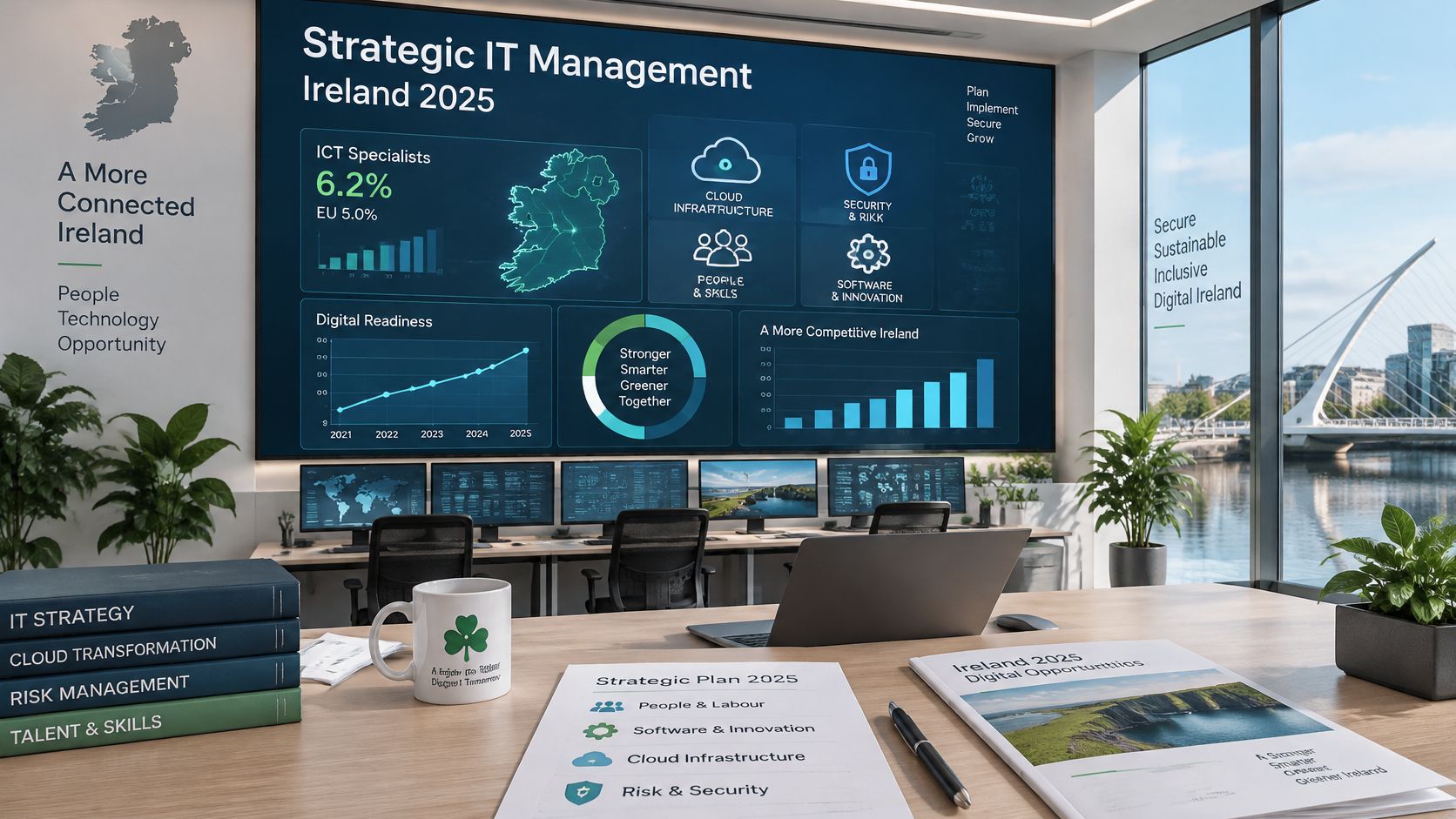
In 2025, ICT specialists represented 6.2% of total employment in Ireland, compared with 5.0% across the European Union, while more than four in five Irish ICT specialists had completed tertiary education, according to the Ireland ICT specialists profile. Coordinating that specialist expertise requires more than a service desk. Leaders must decide where technical effort will make the greatest business difference.
Strategic IT management is the repeated choice of which priorities, budgets, projects and skills will carry the organisation's strategy, and which demands will be refused. Operational IT keeps the ship's engines reliable; strategic management chooses the route, the cargo worth carrying and the crew the organisation can recruit. Neither succeeds without the other.
A business decision before a technology decision
Consider an Irish distributor whose sales team wants a customer portal while finance wants an accounting replacement. The technology team could assess both products, but that wouldn't settle the strategic question. If customers leave because delivery promises are unreliable, improving stock information might deserve priority over either purchase.
The board should ask which investment changes the constraint on the business. A useful distinction in digital transformation for managers is between installing a system and changing how people work and make decisions.
For the current quarter, leadership needs answers to these questions:
- Business outcome: Which result must IT improve, such as order reliability or service continuity?
- Capability ownership: Which expertise must remain inside the organisation, and which can be bought?
- Strategic risk: Which ignored dependency could prevent delivery of the business plan?
A technology proposal isn't a strategic priority until leadership can explain what it displaces.
The distributor's decision should therefore name the operational result, the accountable business sponsor and the capacity being committed. An alignment map makes those choices inspectable rather than leaving them as statements of ambition.
An Alignment Map for Priorities and Resources
Alignment map from business question to IT evidence
| Business question | IT response | Decision owner | Evidence to track |
|---|---|---|---|
| Where will we grow | Customer-facing products and joined-up CRM data | Business sponsor with the CIO | Revenue influenced and cycle time |
| Where must cost fall | ERP, automation and energy-saving ICT, only where data is ready | CFO with the CIO | Cost per transaction and energy saved |
| What must not fail | Identity, recovery testing, supplier exposure and incident escalation | Board risk committee with the CIO | Time to detect, time to contain and recovery time |
| Which skills are missing | Build, buy or partner for scarce specialist roles | CHRO with the CIO | Vacancy fill time and skills coverage |
| Which data or AI bets are real | Stage-gated use cases after data quality and risk checks | Data owner with the CIO | Benefit metric and leakage incidents |
Read the map as a set of commitments
Growth starts with a customer problem, not a product catalogue. The business sponsor should explain how joined-up customer relationship management data will improve a commercial decision, while the chief information officer establishes whether the organisation can deliver the required integration. Revenue influenced needs a documented attribution rule so every sale isn't credited to the latest system.
For cost and productivity, the chief financial officer should distinguish genuine savings from work transferred elsewhere. Automating invoice entry achieves little if finance staff spend the same time correcting exceptions. Cost per completed transaction should include those corrections.
Resilience requires the risk committee to identify services whose interruption would threaten operations. The technology team supplies evidence, but business leaders determine which disruption is tolerable.
The talent row connects the chief human resources officer with technology leadership. An approved position isn't evidence of available capability; a credible staffing route is.
For data and AI, the data owner must accept responsibility for the information used and the result measured. A successful demonstration doesn't establish that a service can operate safely or produce a worthwhile return.
Run a quarterly decision meeting
Strategy resembles a restaurant menu: the organisation should offer dishes its kitchen can cook well, not everything a supplier puts on a slide. A disciplined review makes that capacity limit explicit:
- Select at most three funded outcomes. These are proposed governance limits, not universal benchmarks. Narrow commitments make competing demands visible.
- Record what won't receive funding. Deferred requests need an explanation, not an indefinite promise.
- Name one accountable owner per row. Several contributors can help, but collective responsibility mustn't conceal missing authority.
- Agree the next evidence review. Record the baseline, reporting method and decision that disappointing results would trigger.
Before approval, split expenditure into run and change lines. Running existing services and changing the business consume different kinds of capacity, even when the same employees perform both.
Set a cloud-spend ceiling for each business service, including subscriptions, consumption charges and supporting integrations. Finance can then challenge rising expenditure against a recognisable service rather than an unexplained technology total.
For a smaller firm, the same rows apply without requiring separate executives for every role. The funded scope should be narrower, modular and cloud-compatible, perhaps improving customer records rather than replacing an entire enterprise suite. The first empty evidence cell identifies the practical gap to close.
Stage Gates for Projects and AI Use Cases
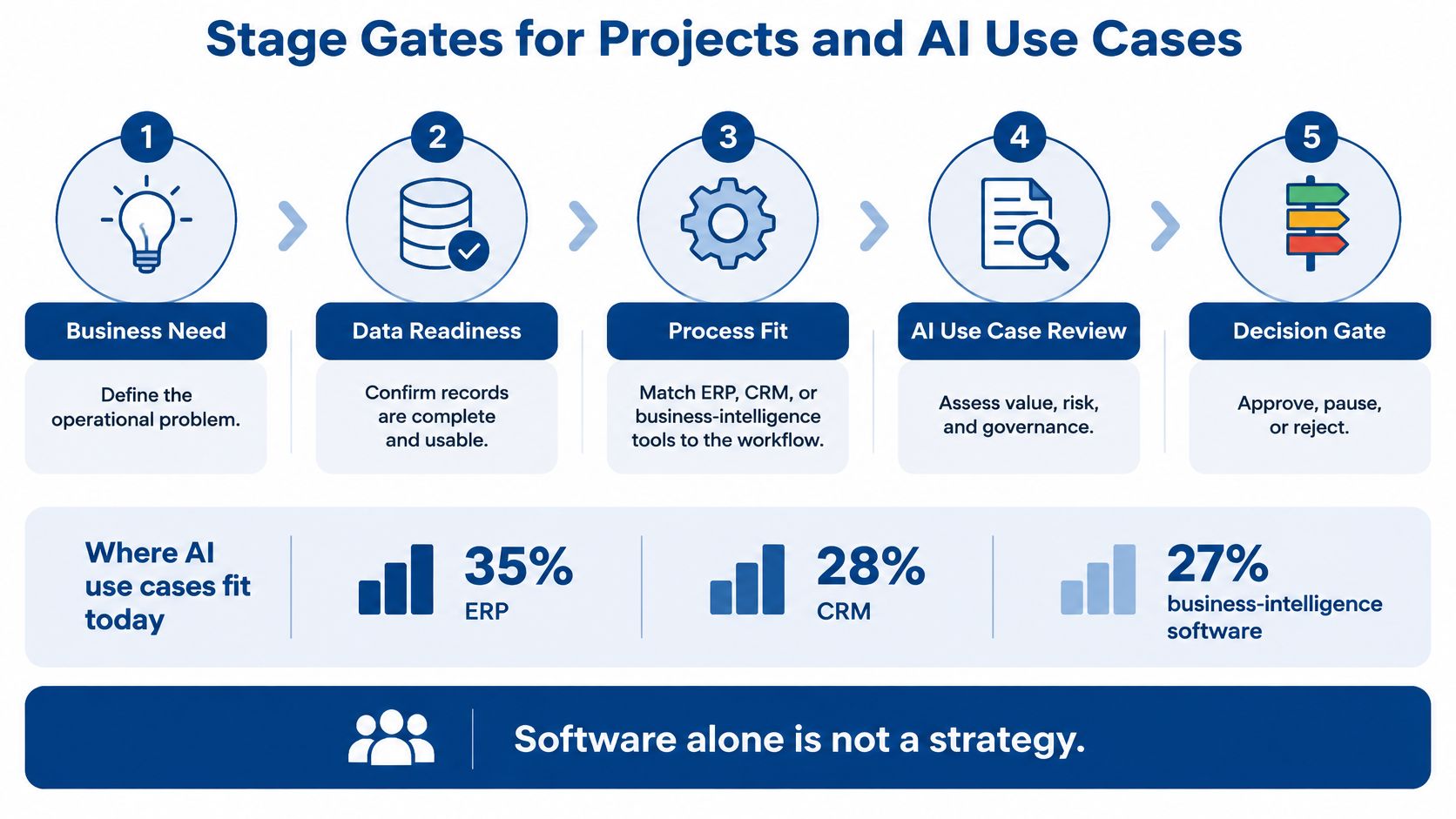
Software alone is not a strategy. In 2025, 35% of Irish enterprises used enterprise resource planning software, 28% used customer relationship management systems, and 27% used business-intelligence software; AI adoption exceeded 20%, while fixed broadband of at least 500 Mbps was available to 59% of large enterprises compared with 35% of small enterprises, according to the CSO's Information Society Statistics for Enterprises.
Those figures describe adoption and infrastructure. What each deployment earns is a separate question, and a stage-gate process exists to keep asking it. Enterprise resource planning, or ERP, joins operational and financial activities; CRM supports customer relationships; business intelligence supports analysis. Their usefulness depends on compatible records, explicit ownership and decisions that employees can act on.
Use staged funding instead of unconditional approval
A stage gate is a decision point at which an owner approves, changes, pauses or rejects further spending. The gate earns its place only because it can stop money. A review that produces a status slide and nothing else never reaches that test.
Validate data quality and process readiness. Check representative records, reconcile definitions and name the person authorised to resolve disagreements. If sales defines an active customer differently from finance, that conflict must be settled before a shared report becomes an automated decision. Widespread adoption of ERP, CRM and analytics doesn't remove this prerequisite.
Pilot a bounded use case. Choose a specific workflow, a named owner and a short review window. Document the current result before making changes, retain a workable fallback and limit access to the information needed. The breadth of AI adoption makes this discipline relevant beyond specialist technology businesses.
Continue only when benefits justify it. Compare the result with the baseline, including support effort and correction costs. The sponsor tracks the measures named in the approval: cycle time, forecast accuracy, energy consumed and revenue protected. The connectivity difference between large and small enterprises also means successful pilots need deployment plans matched to local infrastructure.
A business case should record these conditions before work begins. Otherwise, teams can finish a technically competent project without anyone being responsible for the improvement that justified it.
Apply stricter judgement when AI ambition outruns capability
In EY's 2026 survey of 150 Irish CIOs and CTOs, 82% were investing in AI, 36% identified skills shortages as the biggest barrier, and only 31% said they were aware of and well prepared for AI-enabled cyber-risk exposure. These are findings about surveyed technology leaders, not adoption rates across all Irish enterprises.
The management implication is selective restraint. Investment momentum gives leaders more proposals to assess; it doesn't create the staff, reliable information or controls required to deliver them.
Stage gates for projects and AI use cases
| Gate | Fund only if | Pause if |
|---|---|---|
| Business outcome | An owner names a metric such as cycle time or forecast accuracy | The case is only a technology experiment |
| Data readiness | Definitions and ownership are stable enough for a pilot | Records are duplicated or undefined |
| Skills | The team can run the use case or a partner is already contracted | Capability confidence is weak and no partner exists |
| Cyber and leakage | Access, logging and data rules cover generative tools | Leakage through generative AI is uncontrolled |
| Benefits check | A date is set to keep, change or stop the pilot | Nobody will measure the result after go-live |
A demand-forecasting pilot proceeds only after the data owner confirms the sales history is usable, access to generative tools is logged, and a review date gives the sponsor authority to stop it. Planners then compare forecast accuracy with the existing method and record every occasion when human judgement overrides the output.
A customer chatbot with no leakage control and nobody able to maintain it should be paused, however persuasive the demonstration. Procurement approval cannot substitute for operational readiness.
Funding discipline: The next release of money should purchase evidence, not merely another period of activity.
The architecture should also fit the organisation running it. Modular interfaces, manageable data transfers and cloud-compatible components allow a smaller enterprise to expand gradually. Requiring the same infrastructure and specialist support everywhere would turn a design preference into an avoidable barrier.
Why Scarce Digital Talent Shapes Strategy
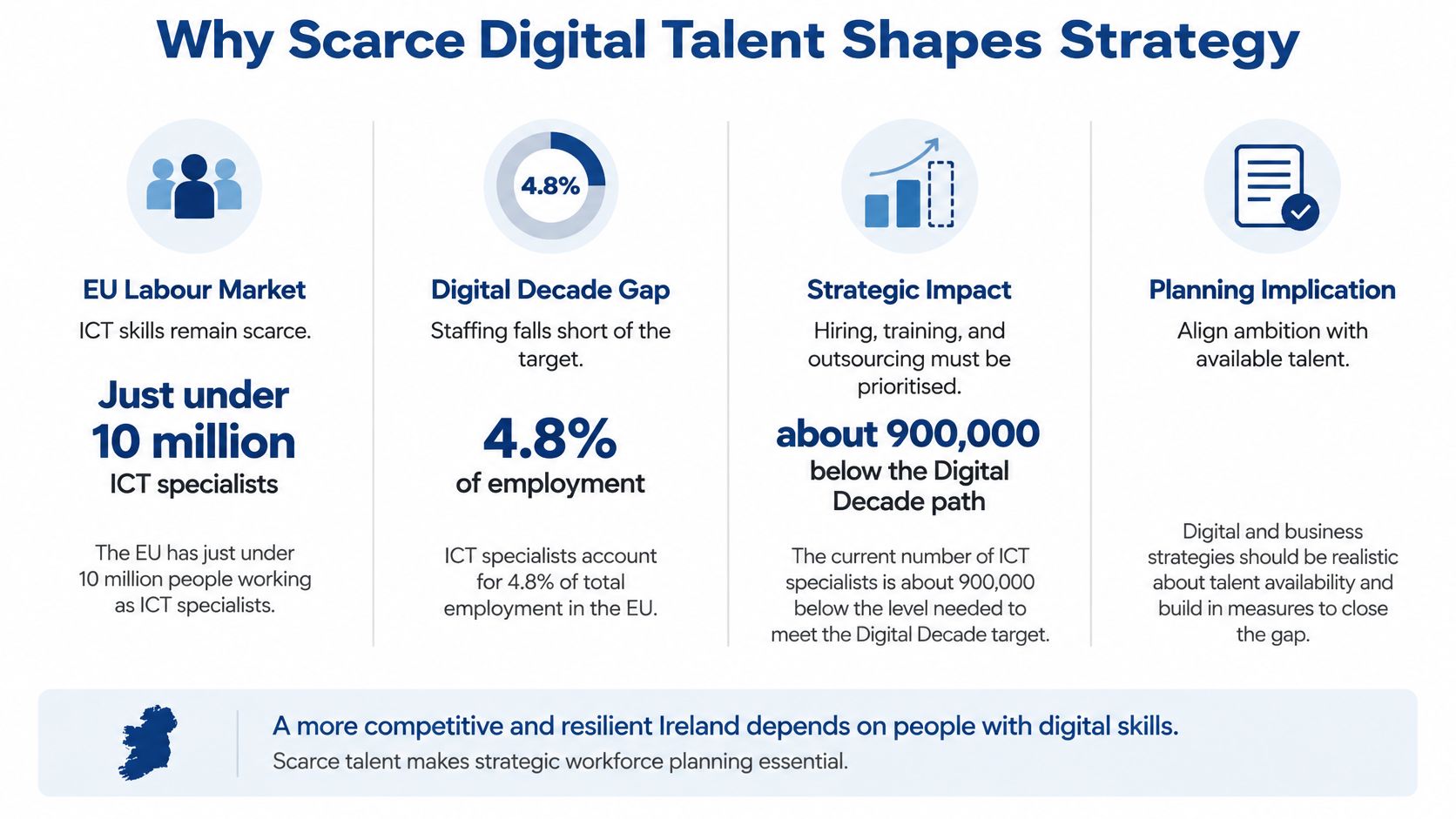
The EU employed just under 10 million ICT specialists in 2023, representing 4.8% of total employment and approximately 900,000 below that year's Digital Decade trajectory; the cited trajectory calls for approximately 12.2 million specialists, about 6% of employment, by 2030, while a baseline scenario without major investment acceleration projects a possible shortfall of 7.8 million, according to the Council of the European Union document, which also reports that 57.5% of EU enterprises recruiting or attempting to recruit ICT specialists in 2023 had difficulty filling vacancies.
These measures describe different aspects of the constraint, including a conditional projection rather than a guaranteed outcome. For an individual organisation, the immediate lesson is simpler: approving expenditure doesn't guarantee access to expertise.
Choose a skill source before committing delivery
Cybersecurity, cloud architecture, data engineering, software development and technology leadership require different staffing decisions. Recruiting every capability internally may suit neither the workload nor the available time.
Build, buy or partner for scarce roles
| Scarce capability | Build | Buy | Partner |
|---|---|---|---|
| Cybersecurity | Develop staff through certification and succession | Recruit for critical control roles | Contract a managed security provider |
| Cloud architecture | Train platform engineers on target designs | Hire senior architects for core platforms | Engage a cloud partner for migration design |
| Data engineering | Reskill analysts into pipeline roles | Recruit engineers for shared data models | Outsource build of ingestion pipelines |
| Software development | Grow internal teams on modular standards | Hire for product-critical roles | Use delivery partners for surge capacity |
| Technology leadership | Develop successors from senior staff | Recruit a CIO or CTO where gaps persist | Retain an interim executive for transitions |
Build suits capabilities the organisation will repeatedly need and has time to develop. Training should include supervised work on actual systems, not course completion alone.
Buy, meaning recruit, suits enduring responsibilities that require internal judgement and accountability. A product-critical engineering role may justify recruitment even when temporary delivery capacity comes from elsewhere.
Partner suits specialist, transitional or variable demand. Contracts should specify knowledge transfer, access controls, documentation and exit arrangements, so external delivery doesn't leave an internal ownership gap.
Protect the expertise already available
Waiting to hire everyone before adapting the portfolio is itself a strategy, and it will fail when critical appointments remain unfilled. Leaders should change scope, sequence or sourcing rather than retain dates that assume unavailable people.
Continuous development belongs within workforce transformation and employee development, alongside succession and retention. Managers should protect learning time, distribute system knowledge and automate routine work so specialists can concentrate on decisions requiring their expertise.
A useful capacity review examines named people and competing commitments, not merely approved headcount. If a funded project has no named skill source, it isn't yet a deliverable project.
Cyber Resilience and Cloud Dependence
Ireland's National Cyber Security Centre received 5,276 reports in 2023, including 721 confirmed cybersecurity incidents requiring response, according to its National Cyber Security Annual Update. For boards, the key question is how disruption could affect services, customers and the ability to resume operations.
The exposure is tangible. 12% of Irish enterprises reported a security incident that temporarily made ICT services unavailable in 2024, while 73% used paid cloud-computing services in 2025, the fourth-highest proportion in the EU, according to the CSO's Business in Ireland publication.
Give the board operational evidence
Rather than treating response and recovery measures as isolated targets, boards can use them to identify where disruption will leave the organisation waiting. Detection time indicates how long an incident may go unnoticed; containment time shows how long harmful activity may continue; recovery time reveals how long a critical service could remain unavailable. Supplier exposure and tested recovery coverage add context: they show whether several services depend on the same provider and whether recovery procedures have been exercised.
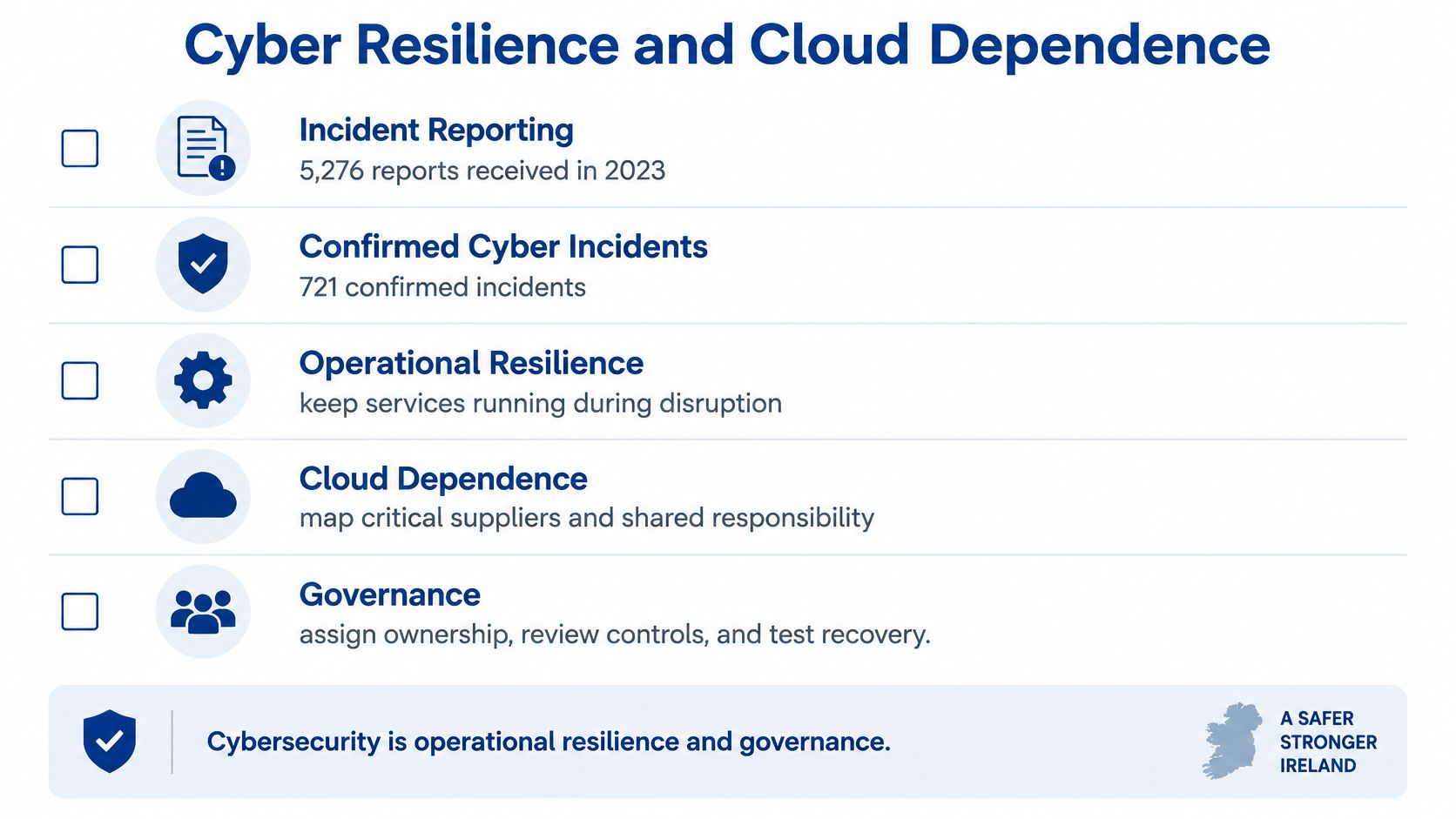
Cloud services can support expansion without equivalent investment in owned infrastructure. They also require clear decisions about identity, configuration and third-party dependence. A provider's availability commitment covers the provider's service; the customer still needs a workable way to restore its own operations.
Set conditions for architectural approval
Before moving a high-criticality workload, the business owner should document the impact of losing it. Identify affected customers, manual alternatives and dependencies on other services.
Then test recovery. A backup job records that data was copied; a restoration test shows whether the data and the business process can be brought back into use. Both matter.
Incident escalation should specify who assesses applicable NIS2 obligations, who authorises notifications and how decision-makers can be contacted during disruption. These responsibilities form part of cybersecurity, data protection and responsible digital governance.
An architecture decision that cannot name its recovery owner is incomplete.
Close One Gap in the Next Ninety Days
Leadership should choose the alignment-map row with the weakest evidence, not the most exciting technology. An undocumented recovery process may deserve attention before another AI experiment; an absent data owner may matter more than an additional analytics licence.
A ninety-day brief should turn that weakness into a bounded management commitment. The purpose isn't to promise a complete transformation, but to establish whether the organisation can make a decision, assign responsibility and produce usable evidence.
Write a brief that can be reviewed
- Business outcome: State the operational improvement, such as restoring the order service reliably.
- Owner: Name the person with authority to resolve obstacles and accept the result.
- Skill source: Specify development, recruitment or a contracted partner, including the work that source will perform.
- Review measure: Identify evidence such as vacancy fill time, recovery-test coverage or a pilot benefit.
The owner should also record what would count as an unsuccessful result. A test that reveals missing recovery steps can still be useful, provided management funds the correction rather than relabelling the test as a success.
A second transformation programme shouldn't begin while this brief remains unfinished. Unresolved ownership won't improve when leaders add another initiative.
Match development to the management gap
Sometimes the missing capability is managerial rather than technical. A leader may understand systems but struggle to challenge budgets, manage staffing trade-offs or connect project results with the business plan.
The European Institute of Leadership and Management, a certified member of the CPD Certification Service, offers a self-paced Mini-MBA Information Technology Programme covering essential management skills, human resources management, innovation management, project management, marketing essentials and IT management. Its Mini-MBA in Strategic Management is designed to develop the knowledge and skills needed to develop and implement effective strategic plans; both are professional programmes, not university degrees.
The IT route fits technology managers broadening their management responsibilities. The strategic-management route fits leaders responsible for the plan itself. Course selection should match the empty evidence cell, with learning applied to the decision that remains unresolved.
The European Institute of Leadership and Management offers self-paced professional programmes connecting technology responsibilities with wider management decisions. Leaders seeking to strengthen strategic IT management can visit European Institute of Leadership and Management to compare the Information Technology and Strategic Management pathways, then select the route that supports their ninety-day brief.