Short Courses Online: How to Choose the Right One
What does a certificate with your name, a unique ID and a QR code prove?
Many shoppers looking at short courses online compare three things: price, duration and subject. Those are the easiest columns to read and the least useful. The question that decides whether the money and the evenings were well spent is harder. What will an employer be able to check, and what will they conclude once they've checked it?
Table of Contents
- Short Courses Online at a Glance
- Subject Areas and the Professionals They Suit
- Certificates, Micro-credentials and Mini-MBAs Compared
- How to Check a Course Before You Enrol
- Costs, Time and Completion Risks Beyond the Price
- Matching a Course to Your Career Goal
- Choose Your Course and Start This Week
Short Courses Online at a Glance
Four formats cover almost every purchase decision, and they differ in commitment far more than in subject matter.
| Format | Commitment | Typical price | Best for |
|---|---|---|---|
| Individual certificate course | One subject, self-paced | €15.00 per course | Filling one specific skill gap |
| Mini-MBA programme | Six courses to earn the programme certificate | Shown per programme on the programme page | Broad management grounding in one discipline |
| Programme certificate | Full programme in one discipline | Set by the course count in that programme | A structured pathway into a new responsibility |
| Accredited micro-credential | Assessed unit with stated learning outcomes | Set by the awarding body rather than the platform | Evidence an employer can verify |
Start with the commitment column. A single certificate course is one subject taken on its own, self-paced, with nothing else required to finish it. A Mini-MBA asks for six completed courses before the programme certificate is issued, so the honest commitment is six times the work, spread across whatever timeline you can protect.
A certificate and an assessed credential are different products. Finishing a course earns a digital certificate with a unique ID and QR code, which confirms you completed the material. An accredited micro-credential goes further: an awarding body outside the platform states the learning outcomes and assesses whether you met them. That outside check is why it takes longer to complete, and why an employer can put more weight on it.
Price carries the least information here. Individual certificate courses are listed at €15.00 each, which makes the single course the cheapest entry point on the table and the easiest one to abandon. That figure alone says nothing about whether the course closes the gap you have.
Demand for online study is well established: in 2024, 61% of Irish internet users had completed an online course or used online learning materials in the previous three months, the highest share among EU member states against a union average of 33%, according to Eurostat. Supply has kept pace. A single catalogue can list 20 certificate courses across management, finance and technology before you even reach the Mini-MBA programmes, so the main work is choosing the right format for the job.
Three questions settle the format before price enters the discussion:
- What does the job need? One named task, such as costing a supply route or running a project kickoff, points to one course.
- How many hours a week are realistic? A single course survives a busy month; a six-course programme needs a longer runway.
- What will the employer want to check? A certificate shows you completed the course; an assessed credential shows someone tested what you can do. If the role calls for the second, buy accordingly.
Subject Areas and the Professionals They Suit
A course earns its place on your CV through the subject it teaches, so read past the title and check the subject area before comparing anything else. The table below maps each subject area to the role it serves best.
| Subject area | Representative course | Professional it suits |
|---|---|---|
| Logistics and supply chain | Introduction to Logistics and Supply Chain Management | Operations and procurement staff |
| IT management | Introduction to IT Management | IT managers and technology team leads |
| Leadership | Leadership and Organisations | Aspiring leaders and current managers |
| Investment and finance | Investment Fundamentals | Entrepreneurs and business owners |
| Risk and change | Risk Management; Change Management | Managers and project leads facing change |
| Problem solving | Problem Solving Skills | Early-career professionals |
| International relations | International Relations | Policy analysts and diplomats |
| Project management | Project Management Mini-MBA | Current and aspiring project managers |
Online study is already a familiar format in Ireland. In 2024, 34% of internet users in Ireland reported taking an online course, up from 25% in 2023, according to the Central Statistics Office. Format is no longer the hurdle for most Irish learners; the hurdle is choosing a subject that maps to a real task.
Broader programmes stretch across eight disciplines: business administration, information technology, leadership, project management, innovation management, global governance, financial management and strategic management. A single course sits inside one of those disciplines. Completing the six courses within one programme earns the programme certificate.
Match the task, not the title
- Write down the task you struggled with this quarter. Be specific: restructuring a team, costing a supply route, presenting a business case that got rejected.
- Match that task to a subject in the table. Choose the subject that covers the task most directly, whatever its course title happens to be.
- Shortlist two or three subjects and drop the rest. A shortlist of seven is a way of postponing the decision.
A team lead facing a restructuring gets more from change management than from a general leadership taster. An operations analyst who keeps hitting stockouts needs logistics and supply chain. The task names the subject, and the subject names the course.
Then run the employer test. A manager reading your CV will ask one question: can this person do the task the role requires? A completion certificate confirms you finished the course, so the subject underneath it carries the meaning. Choose the subject that answers the manager's question, and the certificate has something to say.
Certificates, Micro-credentials and Mini-MBAs Compared
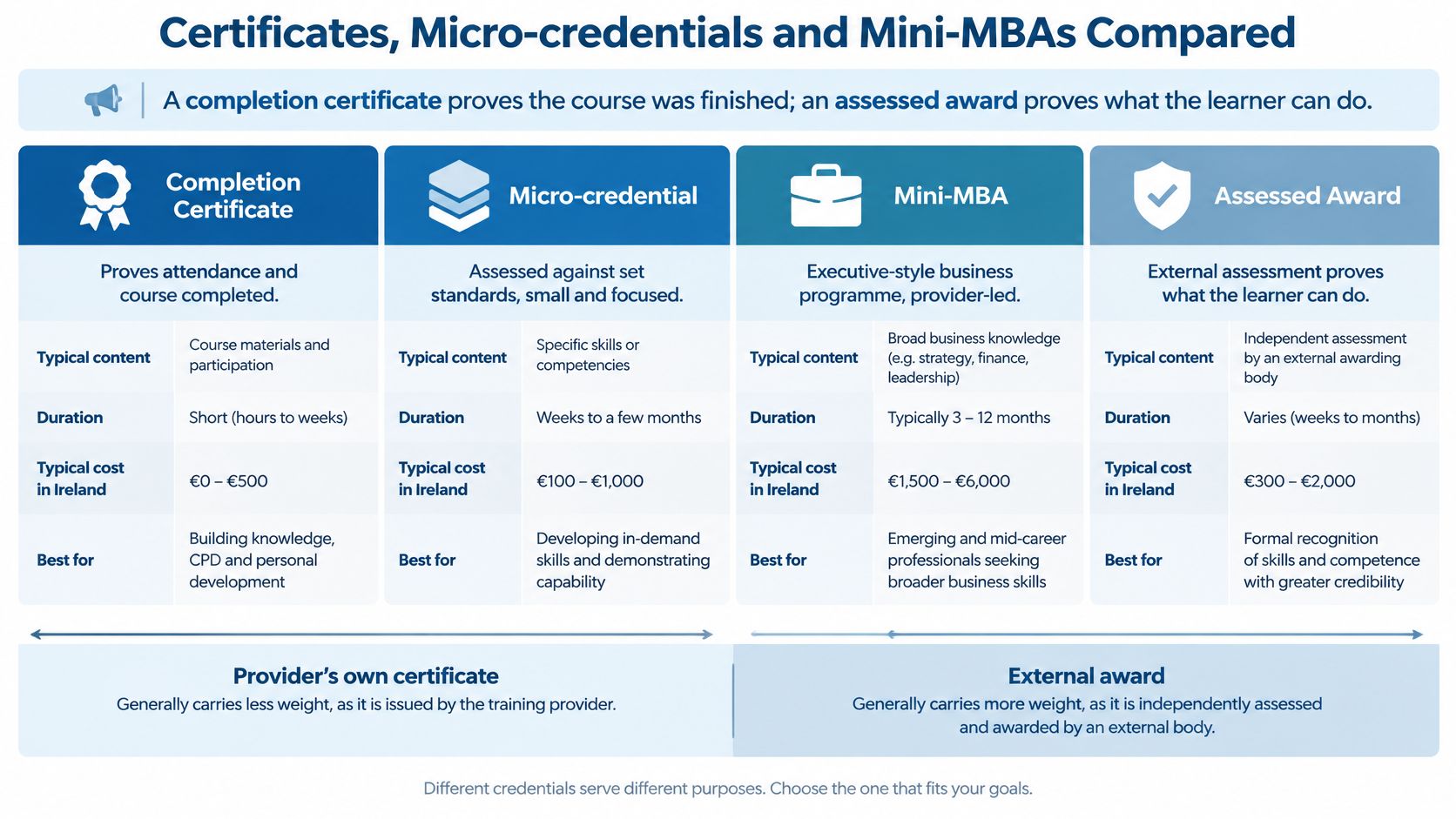
A completion certificate proves the course was finished. An assessed award proves what the learner can do.
That distinction does most of the work when you compare credentials, and it's the one buyers skip. Four credentials appear in this market, and they sit on different sides of the line between a provider's own certificate and an externally awarded qualification.
The chart below sets out the four side by side before the detail.
| Credential | What it evidences | How to check it | Level or credit stated |
|---|---|---|---|
| Course certificate of completion | Finishing a self-paced course | Unique ID and QR code on the digital certificate | None stated; a provider award |
| Mini-MBA programme certificate | Six courses completed within one programme | Provider certificate verification | None stated; a provider award |
| Accredited micro-credential | Assessed learning outcomes | Awarding body records | Credit value and national framework level |
| Higher-education non-major award | Assessed academic study | Awarding institution | Certificate up to 30 ECTS credits |
A course certificate of completion is awarded when an individual course is finished successfully, and the digital certificate carries a unique ID and a QR code at the end of each course. Treat it as evidence of initiative and recent study, which is useful in an interview, rather than as proof of measured competence.
A Mini-MBA programme certificate requires completing six courses within one programme. Confirm the full set before you assume you're one module from finishing.
A micro-credential states expected learning outcomes, a credit value and a level on the National Framework of Qualifications, and it's recognised by the awarding body rather than by the platform that taught it. A higher-education non-major award is normally a certificate of up to 30 ECTS credits.
The market is crowded enough to confuse anyone. Ireland's Human Capital Initiative created 1,711 industry-led courses, and 5,182 learners selected government-subsidised micro-credentials across 837 courses (Higher Education Authority). Subsidised, accredited and platform-issued awards now appear in the same search results at wildly different weights.
Quality and Qualifications Ireland's 2025 green paper adds the check worth making: in Further Education and Training, micro-credentials are called components, each carrying expected learning outcomes, credit and a level on the National Framework of Qualifications, and components are automatically transferable between providers (QQI green paper on micro-credentials). Ask whether the award is a QQI component before you treat it as portable.
If the choice comes down to a short management programme or a longer degree, the difference between a Mini-MBA and a traditional MBA turns on time, cost and what the qualification is designed to signal. Whichever route you take, pair the certificate with a project, a portfolio piece or a workplace application. One document alone rarely settles a hiring decision.
How to Check a Course Before You Enrol
Seven checks separate a course worth paying for from one that looks right in a listing. Work through them in order; the first three tend to eliminate the most options.
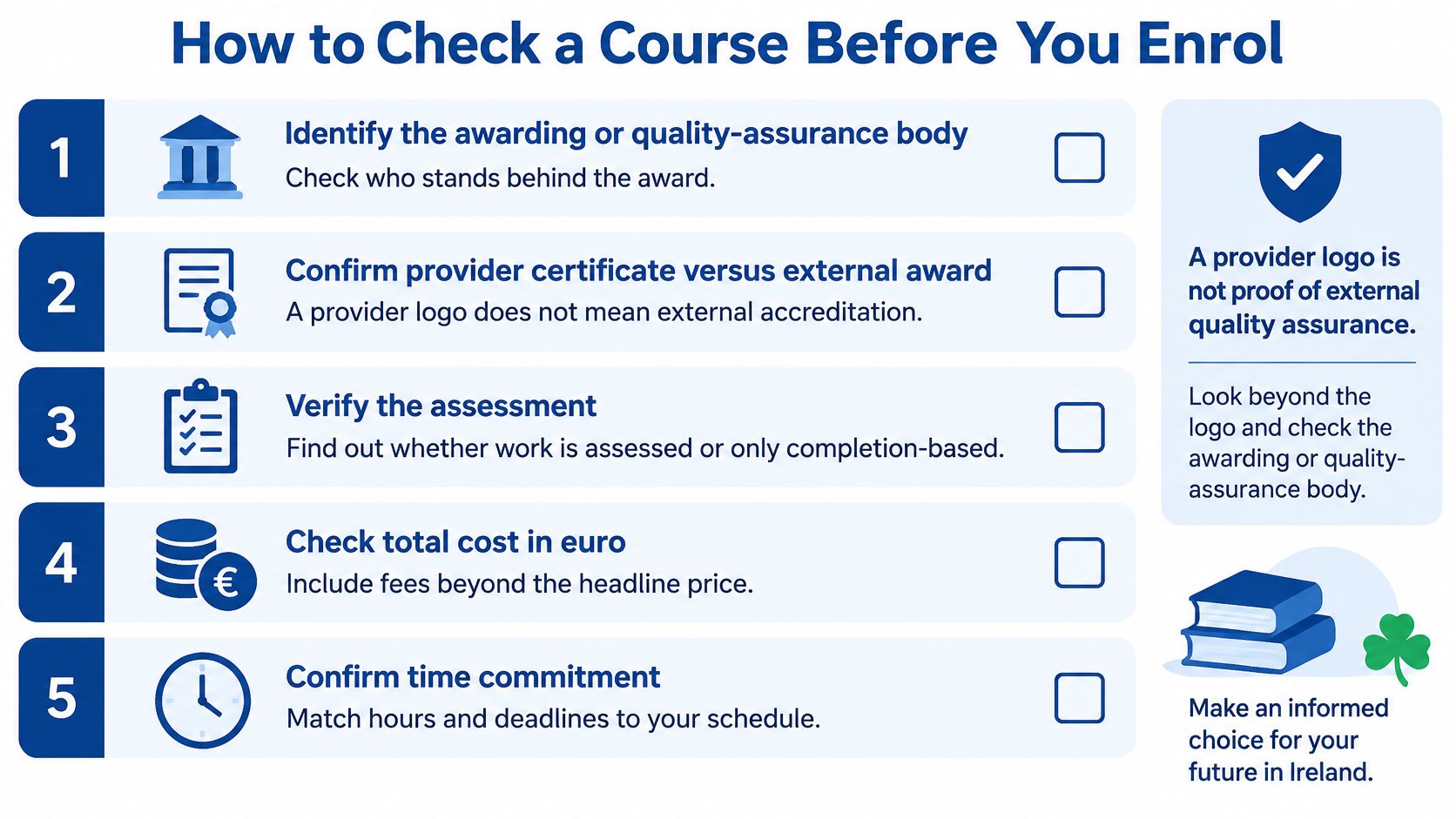
Identify the awarding or quality-assurance body. A provider's own certificate and an external award carry different weight. The common slip is assuming a provider logo means external accreditation when it means nothing of the kind.
Confirm the credential type. Distinguish a certificate of completion from an assessed award with stated learning outcomes. If the page won't tell you which one you're buying, assume the weaker version.
Read the assessment method. Look for a graded task, an exam or a project. A course with no assessment proves less, however good the video production is.
Check the stated workload in hours. Compare it with the time you can protect each week. The most common mistake is underestimating how long self-paced study takes after a full working day, not at a weekend desk.
Confirm the support available. Online support, feedback on assignments and a route to ask questions separate a course you finish from one you stall in. Digital confidence isn't evenly distributed in Ireland: European Commission analysis of the gap puts 88.23% of tertiary-educated adults at basic digital skills or above, against 14.43% of those with low or no formal education (European Commission analysis of Ireland's digital skills gap). If your confidence is thin, choose the course with the most structure, not the shortest one.
Name the output you'll have at the end. A project, a portfolio piece, a workplace application. If you can't describe it in one sentence before enrolling, you won't have it afterwards.
Test employer relevance against live job ads. Search current advertisements for the skill names in the course title and count how often those words appear. Irish employers already buy this kind of training in volume: Skillnet Ireland reports 84,515 learners engaged in training in 2025, including 12,655 workers in digital-skills programmes (Skillnet Ireland annual report). If the job ads use different words from the course title, the certificate won't bridge the gap.
A course that passes all seven checks is still only a starting point. It's preparation for the evidence you build afterwards, not proof of job readiness on its own. If the weak point is your study routine rather than your course choice, five tips for succeeding in an online learning environment addresses the habits side.
Costs, Time and Completion Risks Beyond the Price
A low price lowers the cost of starting. It does not lower the cost of finishing.
Self-directed study at scale is now ordinary rather than exceptional: enrolment in eCollege, Ireland's national online learning platform, grew sharply in 2024, according to SOLAS. Self-paced formats hand the timetable to the learner, and that freedom is exactly where the risk sits. Nothing on the calendar says "study now," so the week fills with everything else.
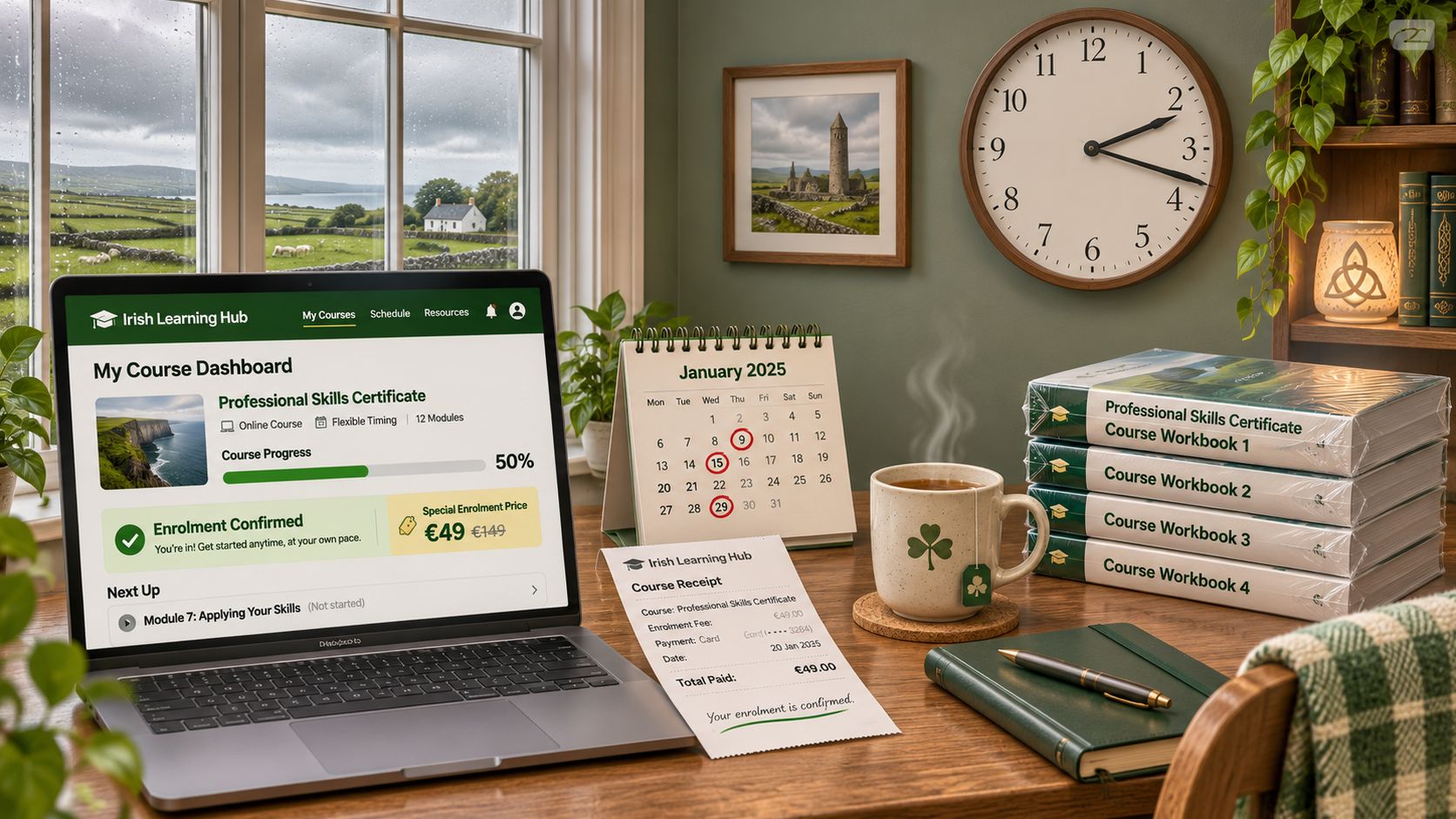
Self-paced study removes the two things that keep people moving: a deadline and a room of people expecting you next week. Completion then depends on one protected weekly slot, and on nothing else. Treat that slot like a shift you have agreed to work, because it is.
The total cost has four parts. The listed price is the visible one, and at €15.00 per online certificate course it is the smallest. The second is the hours, which you pay whether or not you finish. The third is the opportunity cost of a course that doesn't match your job, because those evenings weren't available for the course that would have. The fourth is quieter: a certificate that doesn't answer the employer's real question. Each course at the institute ends with a digital certificate carrying a unique ID and QR code, which proves you completed the material. Employers tend to ask a different question: what can you do now that you couldn't before? A completed course you can point to in an interview answers that. An abandoned one cannot.
A planning rule that works: decide your weekly hours before enrolling, put those hours in the calendar as fixed appointments, and set a finish date four to six weeks after starting.
A cheap course abandoned at 40% costs more in lost time than a slightly dearer one that gets completed and applied at work. If fitting study around a job is the main obstacle, a day in the life of an online student balancing work, life and learning shows what a realistic week looks like.
Matching a Course to Your Career Goal
The Irish labour market gives the choice some urgency. ManpowerGroup data cited in a Generation Ireland report on the tech skills gap indicates that around 83% of Irish employers faced significant difficulty finding skilled professionals in 2025, up sharply from 34% in 2019. Demand of that size rewards people whose skills match the job, and it filters out everyone whose certificate answers a question the employer never asked.
That question is the test to apply to every option below. A course certificate confirms you completed one course successfully. A programme certificate confirms you completed a set of courses in a named field. Each proves something different to an employer, so pick the one that answers the question your target role raises.
Leaders, technology managers and project leads
For a newly appointed team leader, the starting pair is Leadership and Organisations plus Problem Solving Skills. The Leadership Mini-MBA makes sense when the role will span multiple teams, because a programme certificate carries the weight of a full sequence rather than a single course. Pick one of the two routes this month and block two evenings a week for it.
IT professionals who already run stand-ups, review budgets or mentor juniors have done parts of management informally. The step up is Introduction to IT Management, then the Information Technology Mini-MBA if the role is broadening rather than deepening. The timing is supported by the wider picture: the European Commission's 2025 Education and Training Monitor for Ireland reports that demand for digital and scientific skills exceeds supply and that ICT was Ireland's fastest-growing sector by average annual employment growth over the preceding five years, at 9.8%. This month: list the three management tasks you already do informally and match them to the programme's subjects.
Project work gives the clearest matching exercise. A project manager weighing the Project Management Mini-MBA can map one live project onto the programme's course list and see which stage consistently causes the stall. The course that covers that stage is the right first enrolment.
Founders, analysts and first-job applicants
Entrepreneurs face a narrower question: which single financial decision keeps getting deferred? If it is an investment choice, the answer is Investment Fundamentals. If it is reading the company's own numbers, Financial Concepts. A business owner running the whole company may need the Business Administration Mini-MBA, an intensive and fast-paced course covering the fundamental areas of general business management. This month: write down the one financial decision you keep deferring.
Policy analysts and diplomats should compare the international law and international relations options against the Global Governance programme, judging each against the actual brief rather than the most familiar title. Reread the brief you are working from and highlight the governance question inside it; that question names your course.
Someone entering the job market for the first time is better served by one finished certificate than three started ones. Begin with a single course, Time Management or Teamwork, and browse the next course only after the certificate lands.
Each completed course is one step in a longer sequence of learning, and the importance of continuous learning and development for leaders explains why employers read a sequence differently from a single line on a CV.
Choose Your Course and Start This Week
If the gap is narrow and specific, one management skill or one financial concept, start with a single individual certificate course. Individual courses are listed at €15 against an original price of €99, delivered 100% online and self-paced, with online support and a digital certificate carrying a unique ID and a QR code at the end.
If the responsibility is broad or new, such as leading a team across functions for the first time, the relevant Mini-MBA is the better buy, and the plan has to account for the six courses needed before the programme certificate is issued.
Run the checks before you pay
Take the seven checks from earlier and run them against the course outline on the provider's website. Confirm the subject matches your task, the assessment exists, the hours fit your week, and the certificate is one an employer can verify. If a listing can't answer those questions, that's the answer.
A certificate you can explain in an interview beats a qualification you can't apply.
One rule settles the whole decision: choose the option whose outcome you can show an employer within three months, block the study time in this week's calendar, and write down the first deliverable you'll produce before you open the first module. That single sentence of preparation is what turns a completed course into evidence.
The European Institute of Leadership and Management offers individual certificate courses, Mini-MBA programmes and programme certificates across business, leadership, technology, finance and governance, all delivered online and self-paced with online support and a verifiable digital certificate at the end of each course. If you're choosing between a single course and a broader programme, European Institute of Leadership and Management publishes the full catalogue, module scope and certificate details so you can run the checks above before you enrol. Pick the subject that matches this quarter's task and start the first module this week.