
Leadership of Teams: A Practical Guide for Managers
A Tuesday standup can sound fine until the notes come back. Five people each did solid work, yet the launch date slid: two assumed the other owned the client handover, the remote colleague saw the changed priority on Thursday, and nobody had agreed what “done” meant. Effort was high. The system around it was not.
Team leadership lives in that gap. Communication, motivation and accountability behave like one circuit. A weak connection in one shows up elsewhere as foggy priorities, flat effort or a deadline nobody owns. In Irish workplaces, where hybrid weeks are ordinary, the pattern is easy to miss: fix one pillar and leave the others loose, and the same symptoms return.
Table of Contents
- Why Leading Teams Is Harder Than It Looks
- The Three Pillars Every Team Leader Needs
- How Communication Keeps a Team Aligned
- What Motivates Team Members
- Accountability Without Micromanagement
- Leading Hybrid Teams Fairly
- Common Mistakes Team Leaders Make and How to Fix Them
- Start Leading Your Team Better This Week
Why Leading Teams Is Harder Than It Looks
A retailer rolls out new stock software across its stores. The IT lead configures the system, a trainer runs the sessions, and the regional manager briefs the staff. Three weeks later, half the stores are still ordering off the old spreadsheet. Every task on the project plan shows complete, because nobody owned the moment where training met the shop floor.
Supervising only confirms that each task got done. Team leadership manages what happens between tasks: who hands what to whom, which priority wins when two collide, and what the colleague working from home heard. Those joins are invisible on any individual status report, which is why a team can look busy right up until the week it arrives late.
A second difficulty sits underneath. People are usually promoted for doing the work well, then judged on a system nobody taught them to read. The habits that made someone a strong contributor, solving problems personally and fast, can crowd out the slower work of agreeing ownership and explaining decisions.
The strain is visible across Ireland. The CIPD's HR Practices in Ireland survey reports that 91% of organisations face skills shortages, with leadership and influencing skills affected in 22% of organisations, and limited line-manager capacity constraining HR impact for 61% of respondents. Many managers are expected to guide people and drive change without the time or training to do it deliberately.
The rest of this guide treats communication, motivation, and accountability as one connected system. Before reading on, score your team from 1 to 5 on each pillar and mark the lowest.
The Three Pillars Every Team Leader Needs
Communication, motivation, and accountability form a single system that carries the team's work. A team can hold lively weekly updates and still miss every date, because nobody agreed who owns the final handover. Another can hit every deadline and still deliver flat, minimal work, because no one explained why it matters. A weak pillar never stays weak in isolation. The strain travels.
Leaders tend to over-invest in the pillar that feels most natural. Rewards go up while objectives stay vague. Standards stay high while the purpose goes unexplained. The symptom shows up in ordinary working life: repeated questions, quiet meetings, or problems everybody sees and nobody names.
How to read the pillars
| Pillar | Core practice | Daily or weekly habit | Warning sign |
|---|---|---|---|
| Communication | Explain the reason behind every decision | Short weekly team update with a visible decision log | Team keeps asking the same questions |
| Motivation | Make people's contribution visible and their input safe | Specific recognition and a regular challenge slot in meetings | Ideas stop coming and people stay quiet in meetings |
| Accountability | Agree clear outcomes, owners and deadlines | Brief check-in on commitments and a review of missed ones | Deadlines slip without anyone raising it |
Read the right-hand column first. The warning sign that appears earliest usually points to the pillar that is straining the other two. Quiet meetings can look like a motivation problem when the underlying cause is that decisions were never explained, so people stopped offering ideas that would be ignored.
Practical rule: Treat the lowest pillar as the starting point. Fixing a second pillar first often hides the cause.
Score the team from 1 to 5 on communication, motivation, and accountability. Write the lowest score at the top of the notes and start there this month. The pillar that already feels comfortable can wait.
How Communication Keeps a Team Aligned
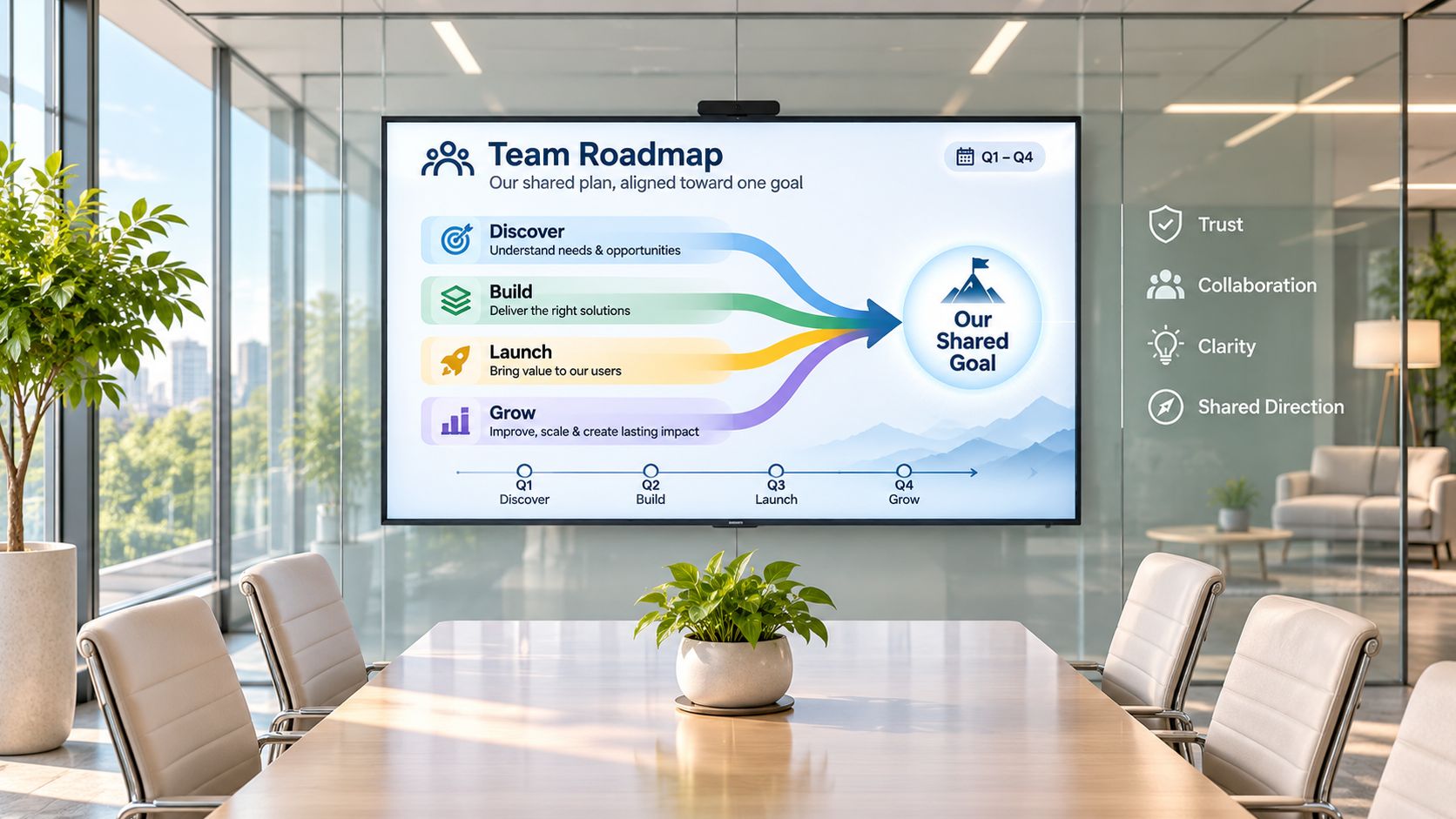
In the leadership of teams, communication is less about frequent announcements and more about a shared goal and trust in what people hear. A long email can still leave three versions of the priority in the room.
A three-step loop
- Say the goal and the reason. Use plain terms. "Ship the client pack by Friday because the review board meets Monday" beats "focus on quality this week".
- Show it through decisions. People read actions before words. If the stated goal is quality and the only praise goes to the fastest delivery, the underlying goal has already been announced.
- Check understanding. Ask each person to restate the goal in their own words. Where the restatement drifts, explain it again. Do not treat silence as agreement.
A team lead once said quality mattered most, then praised only the fastest deliveries. Within a month the team noticed. Checks got shorter and defects rose. The spoken message never changed. Behaviour did.
Consistency is measurable. Silicon Republic's report on Irish and European workplace trends notes that 82% of employees in Ireland's Best Workplaces said management's actions aligned with its words, versus 51% across Ireland. That gap is a credibility signal. Strategy can be sound and still fail if observed decisions contradict it.
Three routines to start this month
- Weekly update and decision log: Record what was decided, by whom, and why. Keep it short enough to read in five minutes.
- Monthly pulse question: Ask whether the team trusts the direction. Track the share who say yes, and assign a follow-up when it drops.
- Priority check: Once a week, compare stated priorities with how time and attention were spent.
Leaders who want a fuller method for everyday clarity can use this guide to effective communication in the workplace. The test is simple. If two people describe this month's goal differently, the loop is not finished.
What Motivates Team Members
Motivation sits between communication and accountability in the same system, and its failures surface as everyday symptoms: silence in meetings, work done to the letter of the brief, problems reported late. Compliance produces the minimum that avoids trouble. Commitment produces discretionary effort, the extra check, the early warning, the idea nobody requested. Leaders strongly influence which response they get. Pay buys attendance. The second response is earned a different way.
An Ireland-focused doctoral study of 122 employees, including 101 working in Ireland, found that transformational leadership had a strong positive association with employee engagement (Pearson r = .51, p < .001), according to the DBS doctoral thesis on leadership and engagement. Multiple regression in the same study found that transformational leadership and team psychological safety predicted engagement, and organisations running Lean or Six Sigma initiatives scored higher on all three. The findings are correlational and cross-sectional. They support an actionable association without proving that leadership alone caused the difference.
The reason safety matters is simple. People calibrate effort against what happened the last time they spoke up.
Four actions that make input safe
- Invite challenge in improvement meetings. Ask what could go wrong before asking who agrees.
- Explain the reason behind each process change before asking people to adopt it.
- Recognise a specific contribution and link it to a team outcome in the same week. Generic praise gets a shrug.
- Report back which suggestions were adopted and why others were set aside.
A team lead asked for ideas in a Lean improvement meeting, adopted two of seven suggestions, and explained why the rest were parked. More ideas arrived the following quarter. People had seen that speaking changed something, and that a parked idea cost them nothing.
When psychological safety is low, extra pay and perks leave disengagement in place. Make it safe to speak before adding another reward.
Further ways to turn participation into steady effort sit in this piece on employee engagement strategies. Build the meeting habit first; a new bonus scheme can wait.
Accountability Without Micromanagement
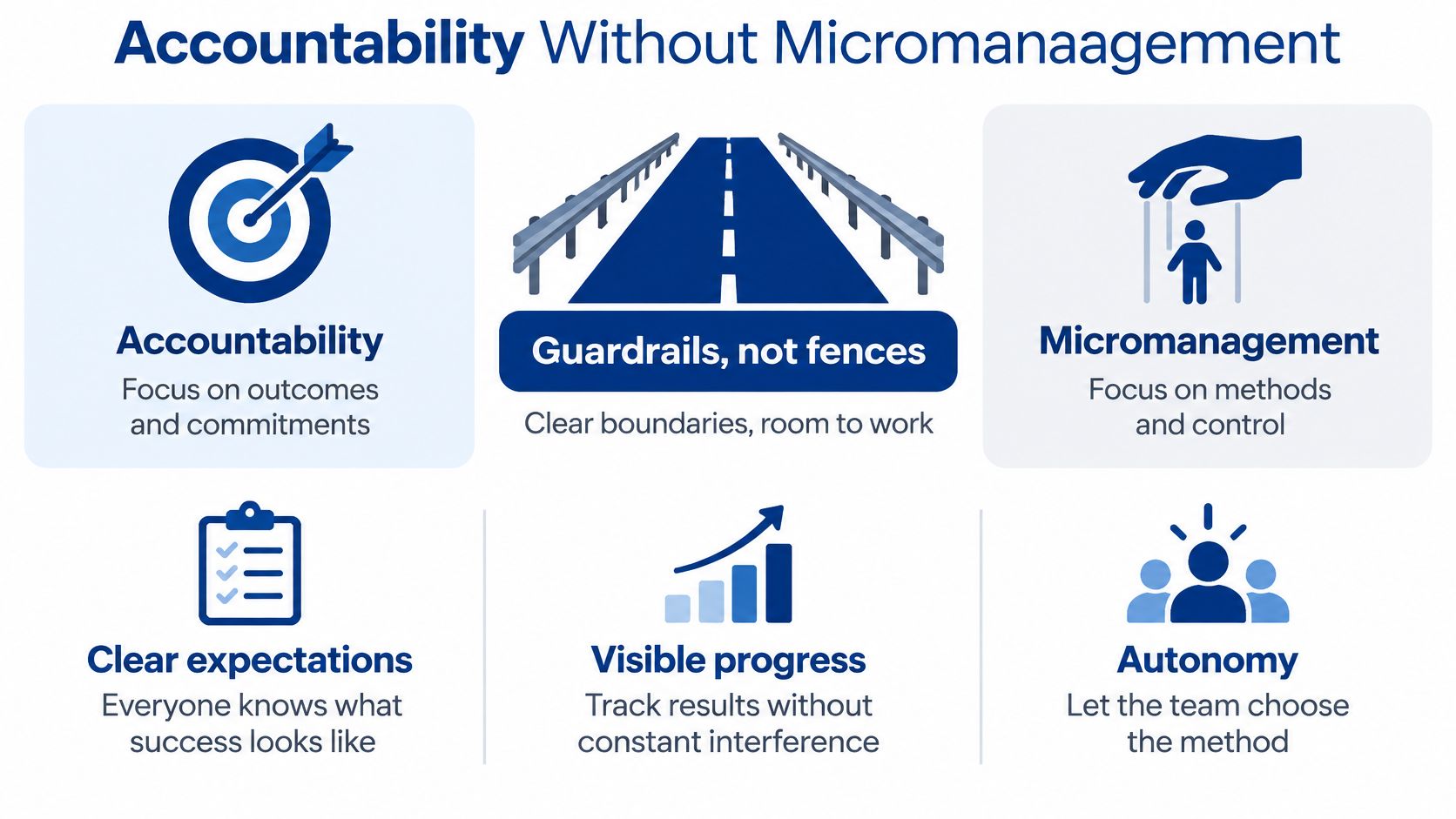
Accountability is about outcomes and commitments. Micromanagement controls the method. The first asks whether the result landed. The second watches every keystroke. Teams need guardrails, not fences: clear boundaries, and room to choose the route.
Shared decisions are already common in European workplaces. Eurofound's 2024 European Working Conditions Survey found that 59% of workers were in teams sharing common tasks and able to plan their work. Within those teams, members could choose the timetable in 49% of cases, and team members chose their own leader in 27% of cases, a figure of at least 37% in Austria, Ireland, Finland, Slovenia, and Sweden. Leaders can involve people in how work is done and still keep ownership of outcomes.
A sequence that holds without hovering
- Agree three fields for every commitment: the outcome, the owner, and the date, plus how progress will be checked.
- Run a brief weekly check-in on open commitments. Ten minutes is enough when the fields are already written.
- Hold a fortnightly review of anything missed. Scale the cadence to risk, and speak the same day when quality or safety is at stake.
- Diagnose the obstacle before changing the plan. If a commitment is missed twice, ask what got in the way first.
A missed date is information. It might be an unclear outcome, a blocked dependency, or an owner who never had the authority to decide. Changing the person before naming the obstacle teaches the team to hide problems.
For a wider set of review habits, see these performance management best practices for leaders. The standard stays the same for every owner, including the most senior person in the room.
Leading Hybrid Teams Fairly
A remote analyst notices that the people in the office get the spontaneous briefing, the visible task, and the nod after the meeting. Nothing dramatic happened, yet motivation drops because the communication system and the accountability system are giving different answers about who matters.
The familiar advice, communicate, trust people, and stay flexible, is only a starting point. It leaves the operational question open: who gets visibility, development, meeting influence, and fair evaluation when some people are remote and others are onsite?
In Ireland this is not an edge case. The CIPD HR practices in Ireland 2025 report records that 43% of Irish organisations said more than half of their employees worked in a hybrid or flexible way in 2025. CIPD Ireland also recommends specific training so managers can operate in hybrid settings and handle difficult conversations about onsite attendance. A written policy can still produce unequal days if each manager improvises.
Run a fairness test before changing tools. Ask remote and onsite members separately whether they get the same chances to contribute, be seen, and develop. Different answers show which pillar is leaking: unclear communication, uneven access to motivating work, or accountability that tracks presence instead of outcomes.
- Attendance rules: Write who attends in person, and rotate that time so one group is not always absent.
- Meetings: Make every meeting remote-inclusive. Everyone joins by video, and decisions go into a shared log.
- Visibility: Rotate who presents to senior leaders, rather than defaulting to whoever sits nearby.
- Development: Give remote members the same stretch assignments, and check access each quarter; PwC's Irish Workforce Hopes and Fears Survey 2026 found that only 45% of Irish workers strongly or moderately agreed they had the learning resources they needed, down from 57% the previous year.
- Evaluation: Judge performance against the same written criteria and evidence of outcomes, not presence in the office.
Applied consistently, these rules make hybrid teamwork fair in practice. For the wider leadership context, read about the rise of remote and hybrid work and its implications for leaders.
Common Mistakes Team Leaders Make and How to Fix Them
The most frequent mistake is avoiding the difficult conversation. The issue returns as private complaints, then as a missed commitment, then as a motivation problem that was never a motivation problem. Five other patterns sit beside it: rescuing work, uneven standards, generic praise, meetings that end without decisions, and a team that stalls when the leader is away.
| Mistake | Early warning sign | Fix |
|---|---|---|
| Avoiding difficult conversations | Issues come up repeatedly in private complaints | Hold a short, specific conversation within one week of the issue |
| Rescuing struggling work | The leader is redoing tasks at the weekend | Agree a check-in at the next milestone and let the owner recover the work |
| Uneven standards | Team members compare notes on who gets away with what | Write down the standard and apply it to everyone, including senior colleagues |
| Generic praise | Recognition meets a shrug or no response | Name the specific action and the outcome it supported, in the same week |
| Meetings without decisions | Discussions repeat across several meetings | Close each meeting with an owner, a decision and a date |
| Dependence on the leader | Work stops when the leader is away | Document the decision rules and name a deputy for each area |
Which fix to run first
Some fixes take a single week. Scheduling the difficult conversation, opening a decision log, or naming a deputy can start before Friday. Others take a quarter. Rebuilding trust after uneven standards needs repeated, visible consistency, not one announcement.
Match each warning sign to a pillar. Avoided conversations and uneven standards point to accountability. Generic praise and meetings without decisions point to communication and motivation. Test one fix against one pillar so the change is visible.
A manager stopped rewriting late reports at the weekend and set a check-in on the next milestone instead. The owners delivered on time within six weeks, because they recovered their own work. Review the chosen fix after four weeks. If the warning sign is unchanged, the wrong pillar was treated.
Start Leading Your Team Better This Week
Pick up the scores from the opening self-check. The lowest of communication, motivation, and accountability is the only pillar to touch this week. Working on all three at once makes it impossible to see what changed.
- Name the weakest pillar and tell the team which habit will be practised, so the experiment is visible.
- Hold a fifteen-minute conversation with three questions: what is the goal this month, what is getting in the way, and what would make the next step easier.
- Agree one commitment with a named owner and a date, and record it in a decision log.
Track one measure each month. Use the share of team members who say they understand the direction, or the number of commitments completed on time. Improvement usually shows over a few months, not a few days. Judge the trend, not a single week.
The Mini-MBA in Leadership Programme is designed to teach skills to lead teams, manage organisations, drive innovation, and handle change in a dynamic business environment. The Programme Certificate in Leadership is designed for aspiring leaders, current managers, and executives looking to refine their leadership capabilities. Choose one habit from this guide and practise it for four weeks, then review the result with the team before adding a second habit.
The European Institute of Leadership and Management offers self-paced online programmes that help aspiring leaders and current managers build practical skills in leading teams, communication, and organisational change. Its leadership pathways connect everyday team habits with the wider work of managing organisations and navigating change. Visit the European Institute of Leadership and Management to see which leadership programme fits the next step.