
Project Coordinator Role: Duties, Skills and Career Path
The meeting ends, but nobody can say whether the latest delivery date has made it into the schedule. The task list looks tidy, yet the team is working from different assumptions. Someone needs to connect the dates, owners and decisions before a manageable change becomes a missed commitment.
That's the practical appeal of becoming a project coordinator: making the plan trustworthy enough for people to act on. The role suits someone who enjoys organising work, questioning unclear updates and following through, but it also requires judgement about where coordination ends and management authority begins.
Table of Contents
- What a Project Coordinator Does Each Week
- How the Coordinator and Project Manager Share the Work
- Skills That Set Strong Coordinators Apart
- Career Path From Coordinator to Project Manager
- Examples From Construction and Digital Delivery
- Common Misconceptions About the Role
- Decide Whether the Coordinator Route Suits You
What a Project Coordinator Does Each Week
On Monday morning, a product launch is at risk. The supplier has moved its delivery date, but testing still starts against the original schedule. The project coordinator notices the mismatch, confirms the revised arrival date and checks which test activities need the equipment.
Ireland's official Project Management Competency Framework describes the project leader/project co-ordinator as leading a workstream within a larger project, accountable for objectives and results within agreed scope, performance, cost and schedule, while meeting quality, safety and sustainability standards. That's an operational responsibility, not a diary-management job.
The working week in practice
- Build the plan. The coordinator connects supplier delivery, equipment checks, testing and launch readiness through timescales and milestones. A list of dates isn't enough unless the dependencies are visible.
- Organise the team. Each handover needs an owner, an expected input and an agreed completion condition. Otherwise, everyone can finish their own task while leaving the next team unable to start.
- Track cost, resources and time. The coordinator checks actual progress against the plan, including whether rescheduling creates idle time or extra expense.
- Update stakeholders. A useful report explains what changed, what it affects and which decision is needed. Copying task descriptions into a presentation doesn't provide that clarity.
- Identify risks and issues. A possible delivery delay is a risk; a confirmed missed delivery is an issue. Each needs an owner and a response.
Core responsibilities of a project coordinator
| Responsibility area | Typical tasks | Typical output |
|---|---|---|
| Planning | Build workstream plans, set timescales and milestones | Schedule and milestone plan |
| Coordination | Organise team members and align handovers | Shared task list and owner register |
| Monitoring | Track cost, time and resources against plan | Weekly status and variance report |
| Stakeholder communication | Run updates, meetings and action logs | Meeting notes and status updates |
| Risk and issue tracking | Log risks and flag slippage early | Risk log and escalation notes |
| Document control | Maintain versions, approvals and records | Controlled document register |
The stage-manager analogy fits: the coordinator knows where every cue and prop belongs, while the director decides the show. Effective monitoring of project progress means checking the evidence behind the schedule, not merely collecting reassuring updates.
A candidate can pick two duties from the table and check whether a job advert describes their tasks, outputs and authority clearly.
How the Coordinator and Project Manager Share the Work
| Area | Project coordinator | Project manager |
|---|---|---|
| Scope | One workstream or delivery stream | Whole project from initiation to closure |
| Budget | Tracks spend against workstream allocation | Owns overall budget and forecast |
| Decisions | Recommends changes and escalates | Approves changes to scope, budget or timeline |
| Stakeholders | Day-to-day contact across teams | Senior sponsors and external parties |
| Reporting line | Reports to the project manager | Reports to the sponsor or programme board |
| Accountability | Delivery of agreed tasks and plans | Overall outcome and benefits |
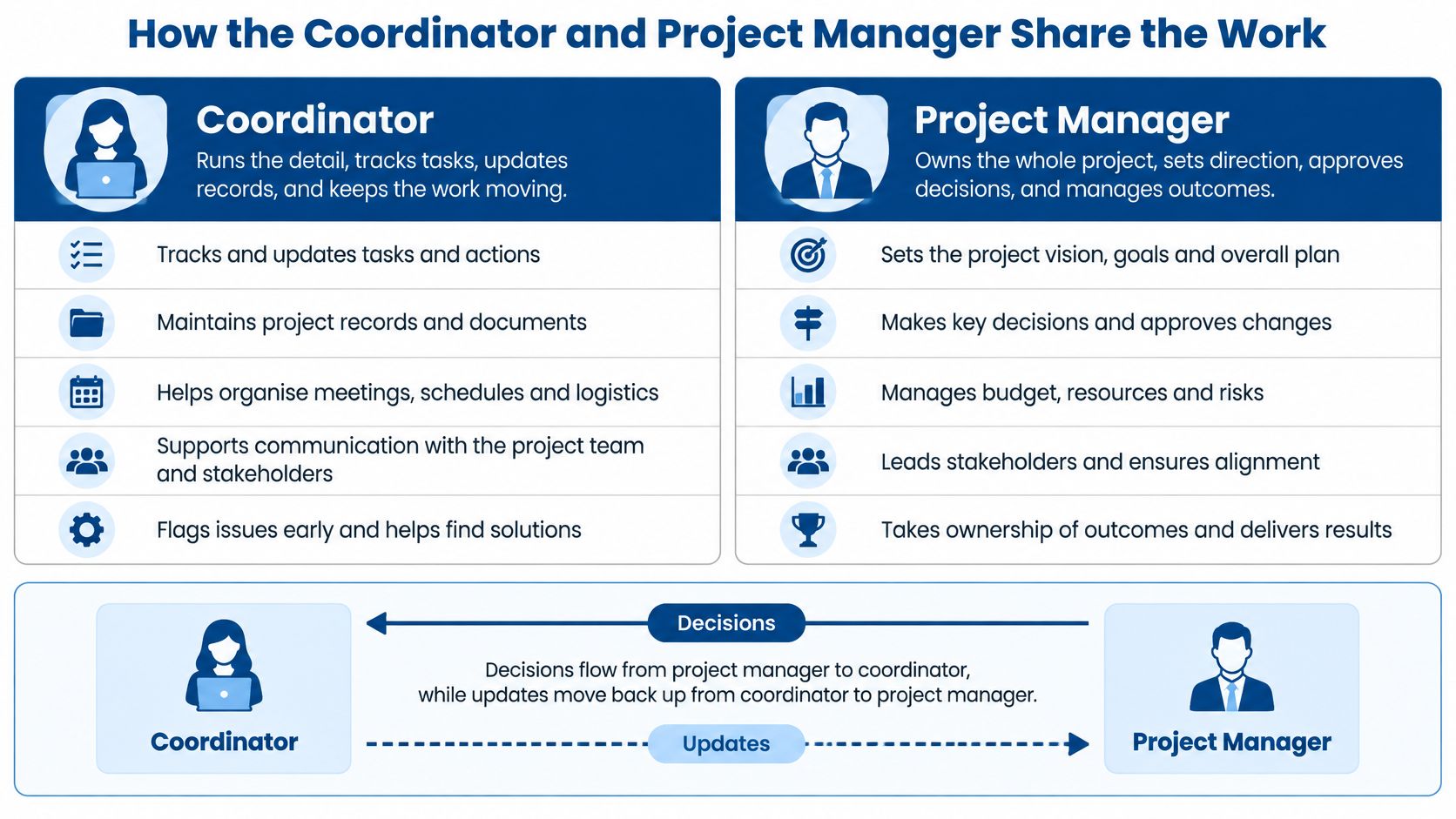
The coordinator runs the detail; the project manager owns the whole. The comparison describes a typical arrangement, but approval limits must be explicit: a project manager may still need sponsor or board approval for changes beyond delegated authority.
How a supplier delay becomes a decision
Suppose a supplier confirms that essential components won't arrive before testing starts. The coordinator checks the affected dependencies, identifies work that can continue and proposes a revised sequence within existing authority.
The escalation should contain options, not just bad news. Keeping the launch date might require expedited delivery or additional testing capacity; moving it might protect the budget but disrupt customer commitments.
The project manager evaluates those trade-offs and approves a response within their authority, or seeks a higher-level decision. The coordinator then records the approval, updates the working schedule and ensures affected teams stop using the superseded version.
Practical rule: A revised working forecast isn't an approved change to the committed deadline.
In a small firm, one person may perform both roles. That doesn't remove the distinction between preparing a recommendation and authorising its consequences. In a large programme, the coordinator may report to a project manager who answers to a programme board.
The relationship works best when the manager delegates routine coordination without requiring approval for every follow-up, while the coordinator avoids making commitments on the manager's behalf. Escalation becomes frustrating when those boundaries remain unwritten.
A useful organisational test is to identify who signs off a budget change. If neither the coordinator nor the manager can explain the approval route, the immediate problem is unclear governance rather than a missing job title.
Skills That Set Strong Coordinators Apart
The OECD Skills Strategy Ireland assessment identifies significant shortages in management skills, specifically project management, change management and leading multicultural teams. It also identifies digital-skills shortages, including software, coding and data analytics, making technical understanding relevant alongside interpersonal ability.
Skills need visible evidence
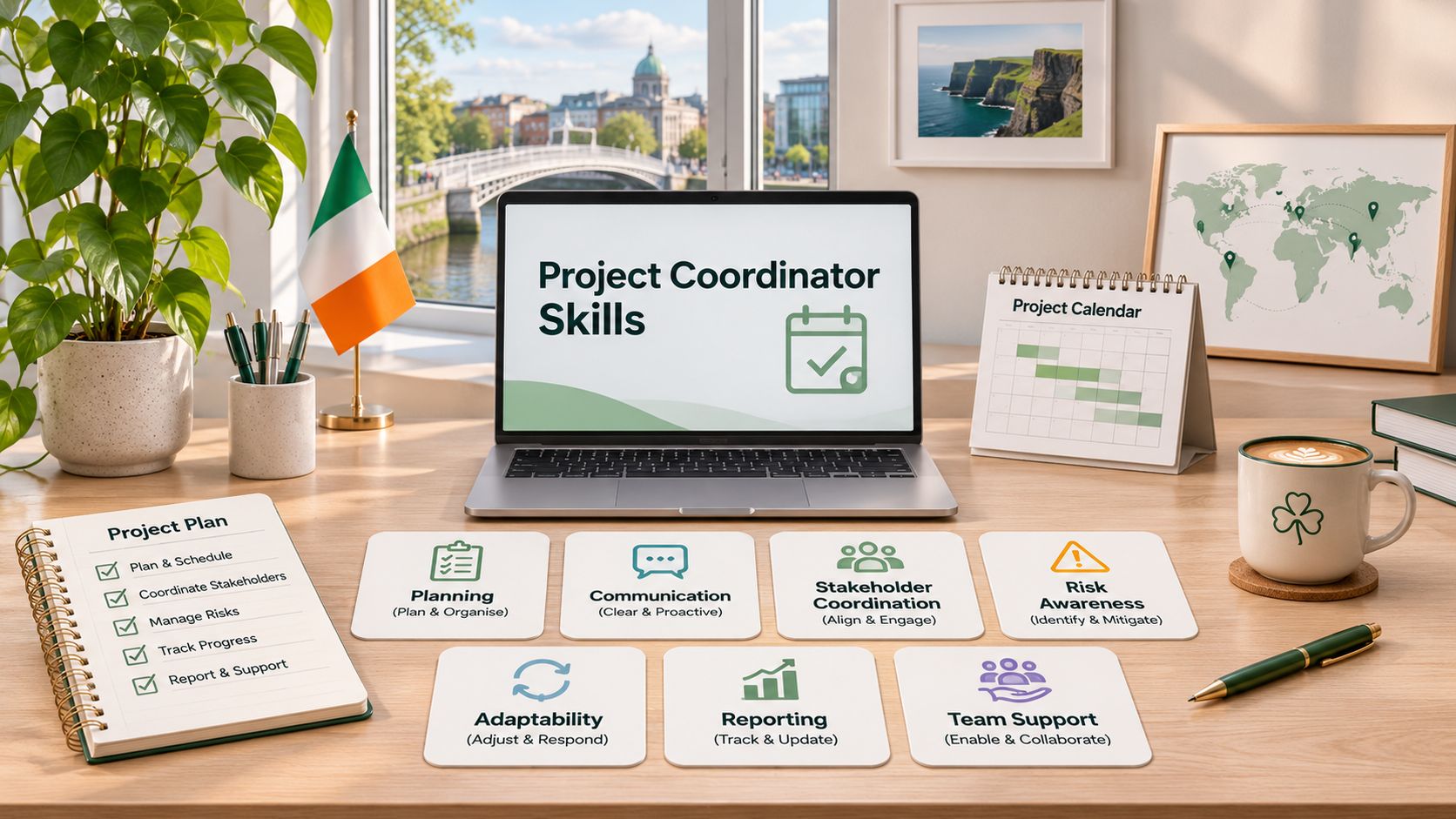
Being organised or a good communicator is a claim. A dependency map that reveals a scheduling conflict, or meeting notes that result in a clear decision, provides evidence.
- Planning and scheduling. Map dependencies before producing a Gantt chart. For example, show that training materials require an approved process, not merely a draft. A short scheduling course followed by rebuilding a small internal project plan provides useful practice.
- Clear written communication. Turn an unfocused meeting discussion into decisions, actions, owners and deadlines. Shadowing a project manager's reporting cycle helps develop concise updates that distinguish facts from assumptions.
- Stakeholder handling. Secure a handover commitment from a team that doesn't report to the coordinator. Practice comes from running a cross-team initiative and confirming agreements in writing rather than relying on goodwill.
- Numeracy. Reconcile planned and actual effort, then separate work already charged from costs still committed. A financial-concepts course can support practice with a simple forecast showing expected remaining expenditure.
- Risk logging. Record a possible approval delay with its cause, delivery impact, response owner and escalation trigger. Reviewing that log with a project manager builds judgement more effectively than collecting risks without follow-up.
- Change management. Explain why a plan moved and which working arrangements must change. Coordinating a small process rollout provides experience in briefing affected colleagues and checking understanding.
- Digital fluency. Understand how the team records work and produces reports. Tracing a dashboard figure back to its underlying records is a practical exercise in checking completeness, duplication and stale updates.
The traits of successful project managers become relevant before someone receives the title. Reliability, for example, becomes visible when colleagues can act on a coordinator's update without having to verify every detail themselves.
The most underrated skill is knowing what to resolve and what to escalate. A missing task owner may need a conversation; a conflict affecting safety, approved scope or contractual commitments needs the appropriate decision-maker.
Career Path From Coordinator to Project Manager
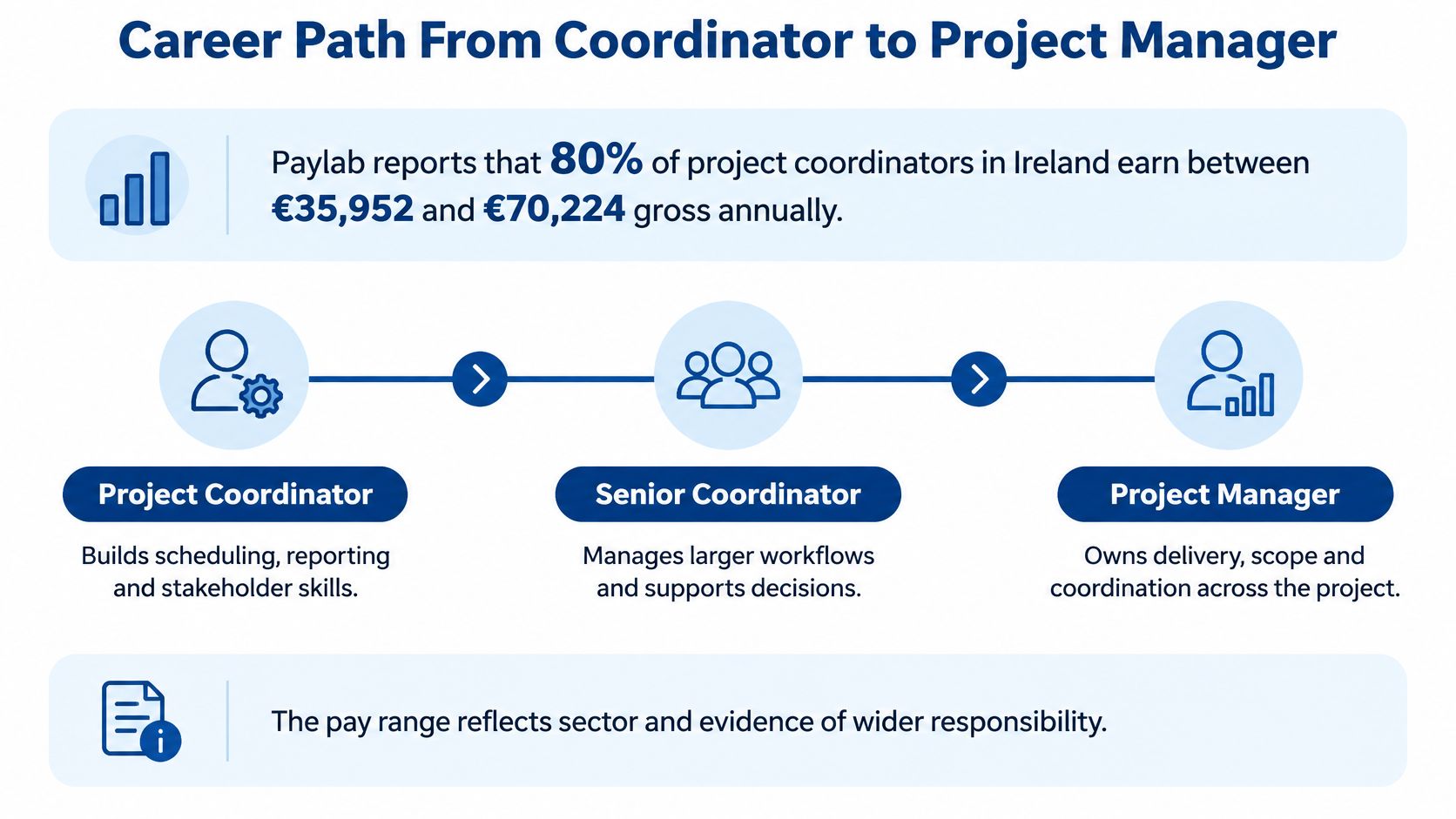
Paylab's project coordinator salary coverage for Ireland reports that 80% of people listed as project coordinators earn between €35,952 and €70,224 gross annually. Use that band as market context when comparing roles: sector, programme complexity and the level of decision support expected will place a coordinator very differently inside it.
A role that maintains meeting records sits apart from one coordinating technical handovers, forecasting workstream expenditure and preparing decisions for senior stakeholders. The second role is already doing parts of project management under supervision, which is why job titles alone mislead.
Career stages from coordinator to programme level
| Stage | Typical role | Evidence that moves you up |
|---|---|---|
| Entry | Project administrator or assistant | Accurate schedules and clean reporting |
| Coordinator | Project coordinator | Owns a workstream plan and its risk log |
| Senior coordinator | Senior project coordinator | Runs multi-team delivery with budget tracking |
| Project manager | Project manager | Owns scope, budget and outcomes end to end |
| Programme level | Programme or portfolio manager | Balances several projects against strategy |
Build an evidence-led progression case
- Prove reliable delivery across a full project cycle. Follow an initiative through planning, execution, handover and closure. Retain appropriately anonymised evidence of accepted deliverables, resolved issues and lessons applied, without taking confidential employer records. A closure summary showing baseline, approved changes and final acceptance carries more weight than a folder of minutes.
- Accept responsibility for a small budget or team. Agree the limits first. A convincing example explains the original allocation, decisions made within it and how the final result compared with the approved expectation. If authority stopped at tracking spend, say so; claiming ownership beyond the mandate weakens the case.
- Request ownership of a workstream. Seek responsibility for its plan, dependencies, risks and acceptance before applying for a project manager post. This tests readiness under supervision instead of leaving the next employer to discover the gaps.
A risk log becomes progression evidence when it leads to action. Recording an unavailable specialist is administration; securing a decision on an alternative resource and protecting an agreed handover shows delivery judgement and marks where coordination ends. The coordinator can recommend, chase and keep the plan truthful, while the accountable manager approves the change.
Domain expertise strengthens that case. In digital delivery, understanding testing and data readiness makes reporting more useful; in construction, understanding sequencing and trade interfaces improves the questions a coordinator asks. Technical familiarity should support specialist decisions and leave qualified technical authority intact.
Moving from support into ownership also means moving from a specialist role into a leadership position while keeping the habits that made the plan trustworthy. Courses can supply vocabulary and methods; the progression file that matters shows scope owned, decisions supported and outcomes accepted. Promotion tends to follow the row already being demonstrated.
Examples From Construction and Digital Delivery
The Irish government's analysis of skills for residential construction and retrofitting identifies a project-management skills gap in supervising craft workers and other skilled trades, and estimates 50,831 new entrants across managerial, professional, skilled and semi-skilled occupations between 2023 and 2030. That requirement covers the wider workforce, not project coordinators alone.

A retrofit handover
Consider a retrofit job where electricians, plasterers and scaffolding crews have received separate instructions. Without a joined-up sequence, crews could arrive together, an inspection could be missed and completed finishes could require reopening.
The coordinator checks the sequence with the site lead, confirms inspection points, tracks material deliveries and maintains the site log. The revised arrangement gives each trade a clear readiness condition before attendance is confirmed.
The coordinator doesn't certify electrical work or decide whether scaffolding is safe. Qualified personnel retain those responsibilities; the coordinator ensures their checks and approvals appear in the delivery sequence.
A software release
On a software release, development tasks might look complete while business testing remains unsigned and data migration still lacks an owner. A launch calendar alone won't reveal whether the service is ready.
The coordinator brings test sign-offs, migration tasks and release dependencies into a shared readiness view. Business teams receive a weekly update identifying unresolved conditions before go-live, while technical leads retain authority over technical acceptance.
The transferable duties are concrete:
- Sequence dependent work. Inspection before finishing, or migration rehearsal before release approval.
- Confirm ownership. Every readiness condition needs someone responsible for resolving it.
- Preserve decision records. Approval status must remain traceable, even as artificial intelligence changes project management.
A candidate can compare these scenarios with their own sector and list three duties that transfer directly, then identify the specialist knowledge needed to perform them credibly.
Common Misconceptions About the Role
It's just administration and minute-taking.
Accurate records give the team a reliable account of decisions, owners and dates. The coordinator also tests whether a slipped milestone affects later work, then puts that consequence in front of the right people. Planning and risk work depend on active questioning and careful follow-through.
It's a dead-end job.
Progression can lead through senior coordination into project management. What matters is the scope of the work. A person who starts by maintaining reports can move towards owning a defined delivery area, provided they can show decisions supported, commitments met and results accepted.
The coordinator keeps the forecast accurate by checking that each workstream's status reflects current evidence.
That duty requires discipline without giving the coordinator control over every dependency. A late supplier input may sit outside their authority, but its effect on the delivery sequence belongs in the plan. Clear records let the project manager make a decision with the current position visible.
Coordinators have no influence.
A well-supported escalation can change a management decision before money or time is committed. Influence comes from presenting credible options and consequences, even without approval rights. A coordinator who tracks actions, checks assumptions and surfaces conflicts early gives managers something practical to act on.
The job is identical in every sector.
Trade sequencing and software release readiness require different knowledge and acceptance criteria. Generic coordination methods need adaptation to the work, not mechanical reuse. In one setting, the critical evidence may be an inspection approval. In another, it may be test sign-off or a migration readiness check.
For someone already taking minutes and chasing actions, the first misconception may be the easiest to accept. The key check is whether the role allows investigation, recommendations and responsibility for a defined part of delivery.
Decide Whether the Coordinator Route Suits You
The route suits people who enjoy bringing order to incomplete information, rather than maintaining a tidy task list. It also requires comfort with polite persistence: a coordinator must sometimes challenge an optimistic update from a more senior colleague.
An honest assessment starts with these questions:
- Current responsibilities. Does the candidate already perform most of the weekly planning, coordination, monitoring, reporting and risk duties?
- Working preferences. Do they enjoy keeping many moving parts aligned, including follow-ups that don't produce an immediately visible result?
- Future accountability. Do they want to progress from completing tasks towards owning outcomes and explaining difficult trade-offs?
Choose a gap that can be closed at work
The responsibilities table provides a practical baseline. A candidate can mark existing strengths, choose a missing capability and agree an assignment that makes improvement observable, such as preparing a workstream forecast or managing a handover.
If the gap is lifecycle knowledge, European Institute of Leadership and Management's Mini-MBA in Project Management covers the full project management lifecycle, from initiation to closure. Its Programme Certificate in Project Management is aimed at current project managers, team leaders and people looking to move into a project management role.
These are certificate courses rather than university degrees. Their usefulness should be judged by the skills gained and how those skills are applied at work, not by treating the course title as a substitute for delivery experience.
A workable development plan lists three duties already performed, names one skill to build this quarter and sets a calendar date for reviewing progress. The review should examine a real output and its effect on delivery, rather than course completion alone.
European Institute of Leadership and Management offers self-paced online certificate courses and project management programmes for developing structured delivery skills. Visit European Institute of Leadership and Management to compare the project management learning options with a specific gap in planning, monitoring or workstream ownership, then pair the learning with a practical workplace assignment.