
Training and Management: How Managers Shape Learning
88% of Irish firms consider developing management skills a strategic priority, according to the Expert Group on Future Skills Needs report, published in April 2025. The same report found that 49% have no formal budget for management and leadership development. That gap between intention and infrastructure explains more about why workplace learning underperforms than any course catalogue does.
Management works like the operating system for training. A course is an application, and it can only run on whatever the organisation has installed underneath it. Budget decides who attends. The calendar decides who finishes. What a manager does in the weeks afterwards decides whether any of it sticks. Buyers tend to scrutinise the application hardest and the operating system barely at all.
This is written for the people who control those settings: first-time team leaders, owners of small firms who cannot spare a manager for a week, and HR or L&D staff assembling development plans from a standing start. By the end, a reader should be able to audit the management choices in their own organisation and know which one to fix first.
Table of Contents
- Why Training Stalls Without Management Support
- What Management Means for Workplace Training
- How Managers Run the Training Cycle
- Real Workplaces Where Management Changed Learning
- Benchmarks Irish Organisations Track for Training
- Common Misconceptions About Management-Led Learning
- Your Next Step in Building Management Capability
Why Training Stalls Without Management Support
Ireland doesn't have a shortage of management courses. In 2019, more than 1,100 management-training courses were available and collectively recorded more than 81,000 enrolments or participating managers, according to the Department of Enterprise, Tourism and Employment's summary of that research. Supply exists. People sign up. And still the capability gap persists, team after team.
The reason is that a course is a seed, not a crop. A seed carries potential, but it grows only where somebody has prepared the soil, arranged the water and protected the light. In an organisation, the manager is the grower. They decide whether the learner has time, whether the new skill is welcome in daily work, and whether anyone ever asks about it again.
That's why two identical courses produce opposite results. Same content, same assessment, same certificate. Different soil.
Three levers sit with the manager, and none of them is about content quality:
- Funding and protected time. A course nobody is scheduled to attend is a wish, not a plan.
- Choice of what to learn and why. Learning aimed at a real performance gap gets used; learning aimed at a general aspiration gets filed.
- Follow-up. Without a review conversation and an applied task, new knowledge decays into habit.
Notice what's missing from that list: the course itself. Content is rarely the bottleneck. The operating system around it usually is, and that operating system is made of management decisions about money, calendar space and attention. Training and management are, in practice, the same conversation held at different volumes.
A course can supply knowledge. Whether that knowledge reaches the work is settled before the first session and after the last one.
Engagement matters here too, because learners who feel their development is taken seriously behave differently from those handed a login and left alone. The engagement practices that keep people applying what they learn are usually management routines rather than HR initiatives: a check-in, a shared goal, visible interest from the person who set the task.
That's the audit to run. Which of those three levers does your organisation operate, and which one has nobody's name on it?
What Management Means for Workplace Training
Two words carry most of this article, so define them plainly.
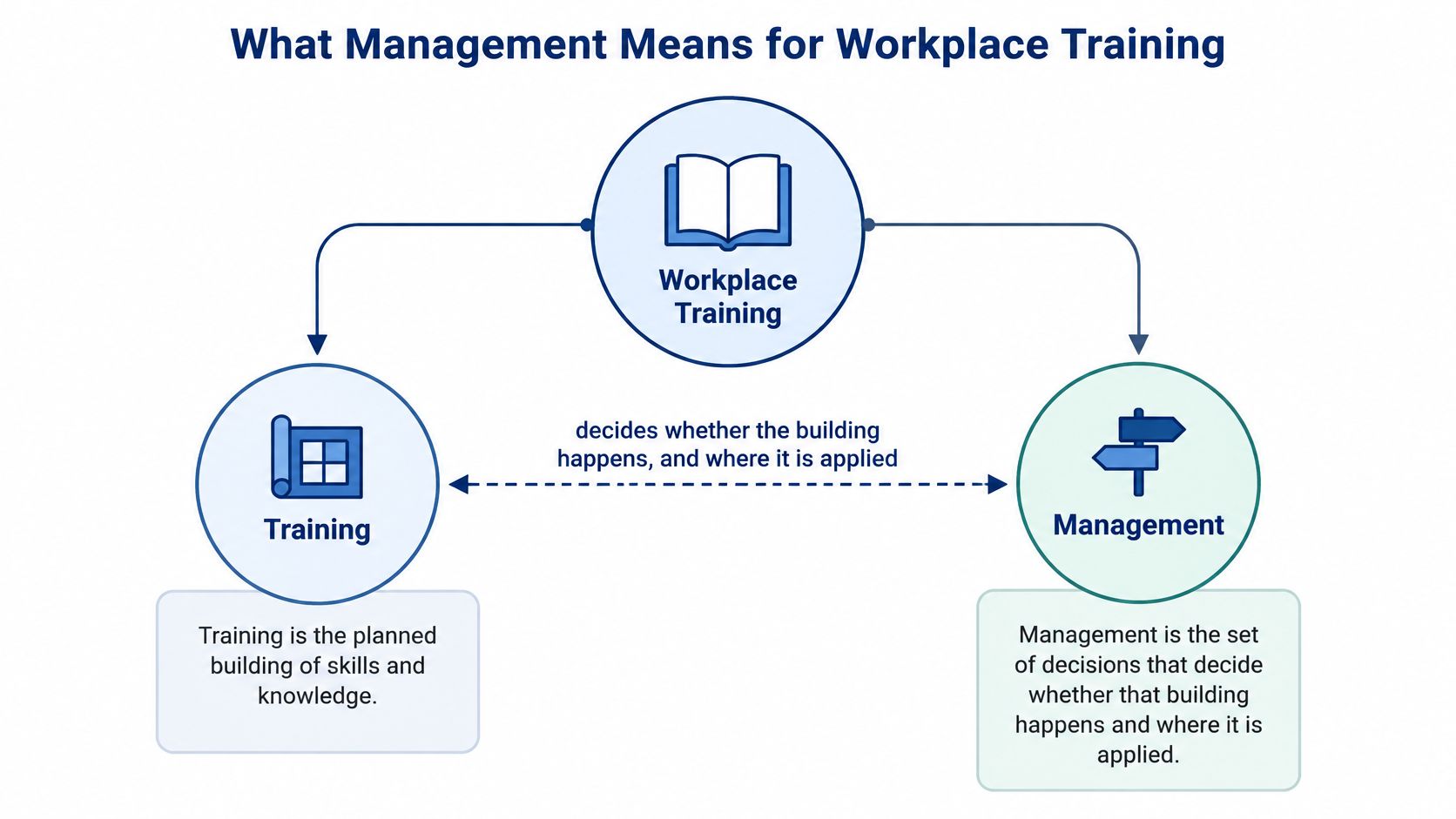
Training is the planned building of skills and knowledge against a named gap. It has a target: a task that isn't being done well, or won't be done well by the people now expected to do it.
Management, in this context, is the set of decisions that determine whether that building happens, where the result gets applied, and whether it survives the next busy quarter.
The two are related but separable, which is where most confusion starts. The map below shows how they connect.
The car, the road and the practice time
A driving lesson makes the split obvious. The instructor teaches steering, clutch control, observation. That's training. The car, the insurance, the quiet road and the hours between lessons belong to somebody else, usually a parent or an employer. Take away the car and the practice hours, and the lessons produce a person who can describe driving.
Workplaces run the same pattern. A line manager can book a course, but unless they also supply the equivalent of the car and the road, meaning real tasks, real decisions and real time, the learning stays descriptive.
Six responsibilities that decide the outcome
| Management responsibility | Effect on training | Signal to watch |
|---|---|---|
| Setting the business need | Links learning to a real performance gap | Learners can name the problem the course will solve |
| Allocating budget | Decides which programmes are affordable and sustained | A recurring line in the budget, not a one-off spend |
| Protecting learning time | Determines whether study happens at all | Scheduled blocks in team calendars |
| Choosing the right learning | Matches content to role and level | Learners can explain why this course fits their role |
| Supporting application on the job | Turns knowledge into changed behaviour | Visible new practices in team routines |
| Reviewing results | Shows whether the investment paid off | Agreed indicators reviewed at set intervals |
Development grows a person, training fixes a gap
These two get used interchangeably and shouldn't be. Development is the long arc: the exposure, stretch assignments and study that make someone capable of a bigger role in three years. Training is the short, targeted intervention that closes a specific gap now, such as writing clearer handovers or running a budget review without support.
Both matter, and they need different decisions. Development is funded annually and reviewed yearly. Training is funded per gap and reviewed within weeks.
Money sharpens the point. In 2025, 45% of Irish business decision-makers reported gaps in financial-leadership capabilities, including managing investments and maximising growth, according to the Irish Management Institute's Leadership Barometer as reported by RTÉ. A gap that specific is a training decision, not a development aspiration, and it needs a manager to name it, fund it and check it.
How Managers Run the Training Cycle
Learning that gets used follows a repeatable loop, and a manager runs the loop, not a training provider. Six steps, with the reason for each, and the slip that usually breaks it.
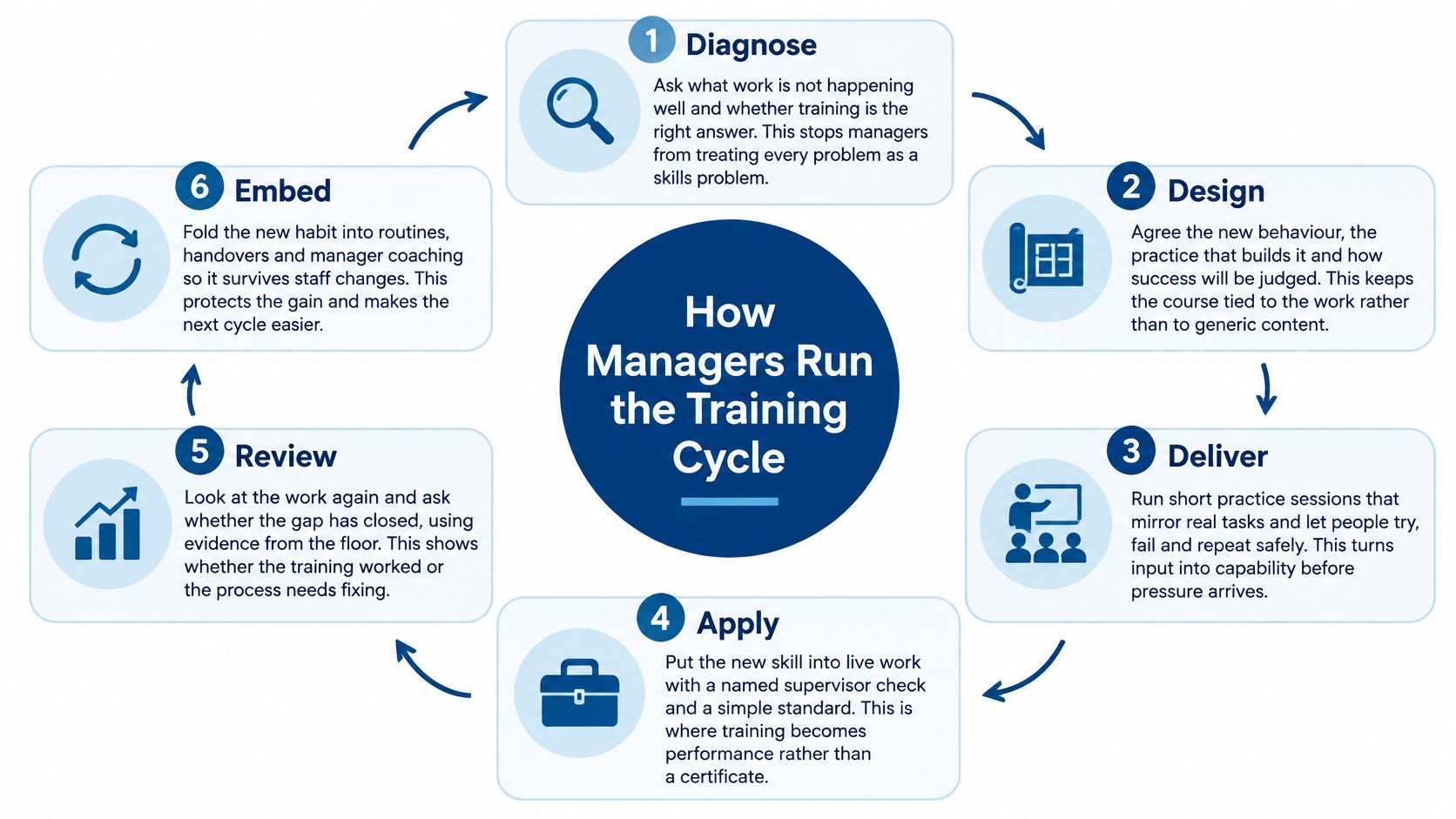
- Diagnose the gap. Ask what work isn't happening well, and whether the cause is skill, process, tools or staffing. Training is the right answer only when the missing ingredient is capability. The common slip is skipping diagnosis entirely, which produces courses nobody needed and a quiet conviction that training doesn't work.
- Set one or two outcomes. Name what will be different in the work: a faster approval cycle, fewer customer complaints, fewer rework loops. Aims such as "better leadership" can't be reviewed, so they never are.
- Choose the format and protect the time. Decide the shape of the learning and put it in the calendar before anything else. A weekly slot of a couple of hours often beats a single full day because practice gets distributed. The slip is announcing the course without moving a single meeting.
- Agree the application before it starts. Name the one task each learner will do differently in week one. If nobody can name it in advance, nobody will notice it afterwards.
- Review two to four weeks later. Hold a short conversation about what's visible in the work. This is the step that most often disappears, and its absence is why learning fades without anyone deciding it should.
- Decide the next step. Extend the practice, adjust the approach, or stop and try a different diagnosis. A cycle without a decision becomes an annual ritual.
What employers say they will pay for
Delivery format is one of the manager's decisions, and it's worth knowing which shapes employers fund. A South-East Regional Skills Forum survey of 205 businesses, conducted by South East Technological University, found that 64% were willing to fund one-to-two-day online courses and 63% would fund a format of three to four hours weekly over eight to twelve weeks, as set out in the survey presentation. The survey drew on organisations employing more than 5,500 managers and is regional, so read it as evidence of preference rather than a national forecast.
| Format | Employers willing to fund | How it fits the cycle |
|---|---|---|
| One-to-two-day online course | 64% | Fits a single block with the review in step 5 |
| Three to four hours weekly over eight to twelve weeks | 63% | Fits the fixed weekly slot in step 3 |
Either works. What matters is that the format is chosen deliberately based on the time the team can release, and that the review date exists before the first session. Where the learning design itself needs thought, the practical range of learning and development methods is worth reviewing before committing a budget.
In a small team, a working cycle looks modest: one outcome, one fixed slot, one review date in the diary. The ambition sits in the repetition, not the size of the intervention.
Real Workplaces Where Management Changed Learning
Three scenarios show how the same course produces different results depending on the decisions around it. The details are illustrative; the pattern isn't.
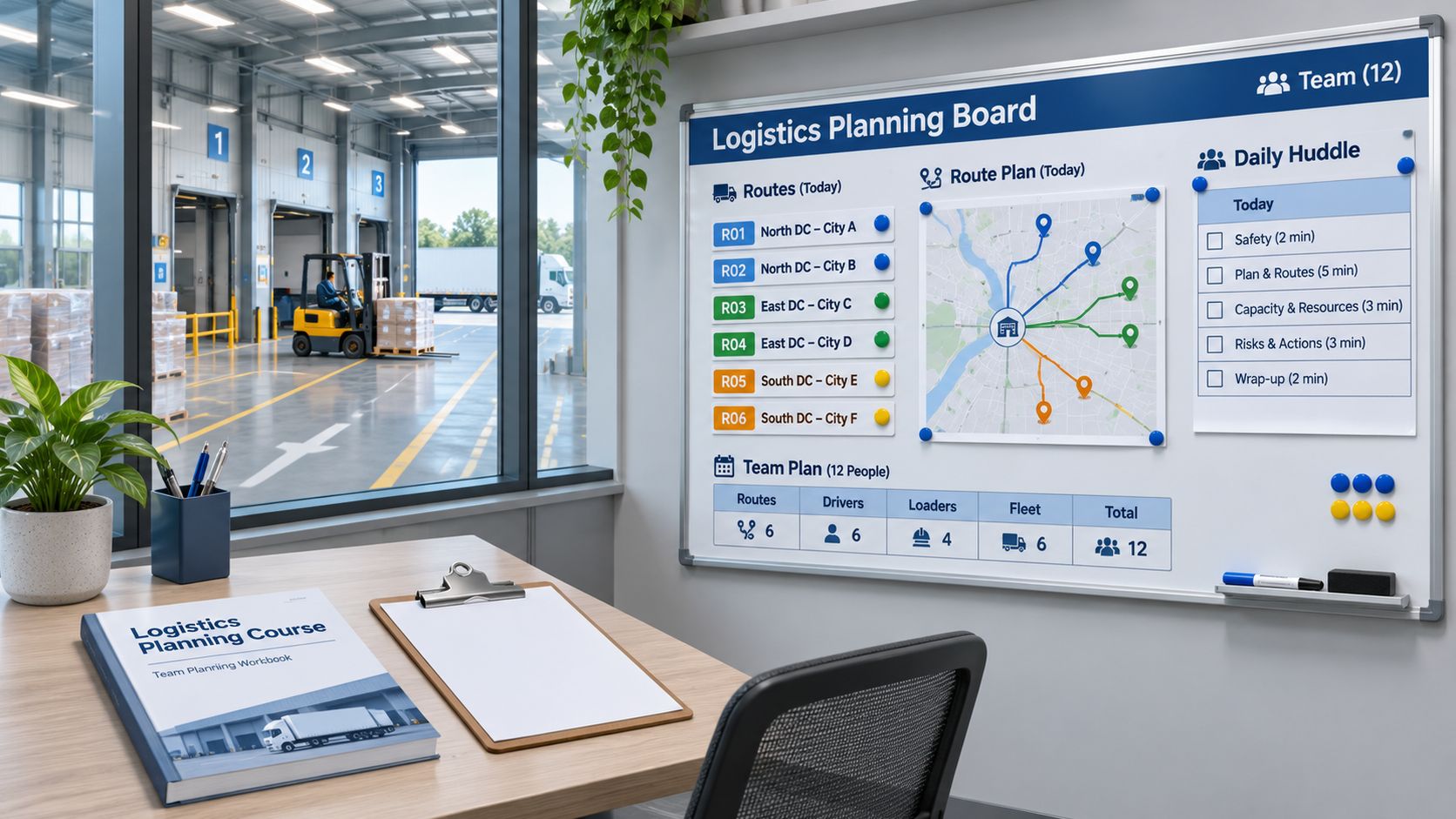
A regional logistics operation with a team of twelve put four supervisors through a planning course. Attendance was complete, feedback was warm, and nothing changed. Schedules were still built the night before and revised by phone all morning. The operations manager then made two adjustments: the training slot moved into paid working hours so supervisors weren't studying at nine in the evening, and a monthly fifteen-minute review was set to look at schedule accuracy. Errors fell across the following quarter, not because the content changed but because somebody started asking about it.
A family-run retailer sent two staff on a customer-service certificate. The owner had tried this before and watched certificates arrive while nothing else did, so this time each participant was asked for one page: the single idea they would use that week, and what the team would see when they used it. The pages went up in the staff room. Within a month the handover routine at shift change had altered, and the two participants were coaching colleagues.
A technology firm with six IT managers enrolled them on a project-management programme. Individually they learned a great deal; collectively nothing moved, because every project continued to run the old way. The turning point came when the leadership team named which three projects would use the new method and how progress would be reported to the wider business. Once the method had somewhere to live, people used it.
The pattern behind the three cases
In all three, the content was sound. In all three, the difference came from a decision about time, purpose or follow-up. Somebody either supplied the conditions or didn't.
The common thread: the course changed nothing until a manager changed something the course could not reach.
The limits are real. These are scenarios rather than measured trials, and results vary with the job, the team and how much discretion people have. A tightly scripted role gives learning fewer places to land than a role built on daily judgement calls. What travels across contexts is the sequence: decide the outcome, buy the time, agree the application, look again.
Building that sequence into routine is the substance of building a learning organisation that retains top talent. Retention follows visible development, and visible development follows managers who treat it as work rather than as a perk.
Benchmarks Irish Organisations Track for Training
A benchmark has two jobs. Access measures ask who was released to learn. Outcome measures ask what changed afterwards. Access is easier to count because enrolment, completion and survey responses already sit in HR data; outcome evidence needs a named indicator, an owner and a review date before it exists.
The access measure worth using
Start with Eurostat's Labour Force Survey dataset trng_lfs_04, which reports the share of employees in education or training during the previous four weeks, with annual data from 2004 to 2025 and an occupation dimension: in 2021 it put Irish managers at 14.9%, against 16.6% across the EU, while participation in leading countries such as Finland and Sweden exceeded 40%. That occupation split is what makes the dataset useful, because managers can be compared directly with the staff they lead. A persistent gap points at supervisory capability. A low rate across both groups points at something structural, such as no protected study time and no learning budget.
The employer-side baseline sits in the CSO's Continuing Vocational Training release: 69% of Irish enterprises provided staff training in 2020, ranking Ireland 16th among the EU27; formal management development ran at 67% in micro-businesses and 88% in medium-sized enterprises between 2017 and 2020; and 57% of large enterprises named management skills as the most important skill area for future development. These figures measure different denominators, so read them as separate gauges rather than one score. Employees answer surveys, enterprises report provision, and managers occupy the narrow seat where permission, cover and follow-up are decided.
The wider adult population gives a useful cross-check on willingness. The CSO's Adult Education Survey comparison found that 52% of adults aged 25 to 69 in Ireland took part in lifelong learning in 2022, against 44% across the EU-27, placing Ireland sixth of the 27 member states. Appetite is present. The tighter question is whether the operating system around a learner supplies time, cover and a reason to apply the material.
| Measure | Ireland | Comparison |
|---|---|---|
| Managers in training, previous four weeks (2021) | 14.9% | EU 16.6% |
| Micro-businesses in formal management development (2017-2020) | 67% | Medium-sized firms 88% |
| Enterprises providing staff training (2020) | 69% | Ranked 16th of EU27 |
| Adults aged 25-69 in lifelong learning (2022) | 52% | EU-27 44% |
Why size comes before motivation
The 69% enterprise figure is often read as a story about attitude. Capacity explains more of it. In an eight-person firm, releasing one supervisor still removes one of eight people from live work; in a firm of two hundred, the same absence is far easier to cover. Compare within the same size band before concluding that people cannot be bothered.
Practical rule: pair every participation figure with one outcome indicator, such as retention, absence or project-delivery variance, reviewed on a fixed date.
Participation captures access and engagement; it leaves transfer unmeasured. The evaluation side of this, including how to pick indicators that survive a busy quarter and still mean something to a line manager, is covered in training evaluation and metrics. Benchmarks show where the system is under strain; budget, time and follow-up decide whether the course reaches Tuesday's work.
Common Misconceptions About Management-Led Learning
Three beliefs do most of the damage, and each one is easy to test.
A completed course means a capable manager
Completion measures attendance. A certificate proves somebody sat through sessions and passed an assessment, which is a reasonable proxy for knowledge and a poor proxy for practice. The gym comparison holds: buying the membership changes nothing, while turning up twice a week with a plan changes a great deal. The better approach is to attach one applied task to every course and review it in the work. At the next development review, ask a plain question about what this person now does differently on a Tuesday.
Training is an event you schedule once
An annual training day feels efficient and rarely sticks. Skills fade without practice, and a single intensive day gives the learner one exposure and no repetitions. Short, recurring cycles beat it, partly because they fit around live work and partly because a weekly slot makes application unavoidable. The question worth asking is when the next repetition falls, not whether the event went down well.
Low uptake means low motivation
In small firms the barrier is usually capacity rather than interest. Nobody can cover the desk for the hours required, so the course stays unbooked and the learner stops mentioning it. Blaming willingness before checking capacity is both unfair and inaccurate. The question is whose work would need covering, and for how long, before anyone concludes that people aren't interested.
Managers are learners too. A team watches what its leader does with their own development far more closely than it listens to what they say about it.
These patterns appear everywhere from logistics yards to professional-services teams, which is why the fix is procedural rather than cultural. Change what gets scheduled and reviewed, and behaviour follows.
Your Next Step in Building Management Capability
Start with an audit, not a purchase. Take the six responsibilities table from earlier in this article and mark each row against four questions: is it funded, is it scheduled, is it followed up, is it reviewed? Most organisations find one or two rows with nobody's name beside them. That row is the constraint, and it's cheaper to fix than another course.
Then run one full cycle rather than a programme. Choose a single performance gap with a measurable edge, such as approval cycles that stretch past three days or handovers that keep getting reworked, and work through the six steps over eight to twelve weeks. Put the review date in the diary before the learning begins, because the week after the course is when good intentions lose to urgent work.
When comparing providers, four checks do most of the filtering:
- Role fit. Can the content be matched to the level and tasks of the people who will study?
- Delivery that fits work. Is the study pattern compatible with release time the team can approve?
- A route to application. Does the programme require learners to apply something to their own workplace?
- Evidence of changed practice. Can the provider show what learners did differently, not just how many finished?
Online study suits this pattern in Ireland. In the three months before Eurostat's 2024 survey, 61% of Irish internet users had taken an online course or used online learning material, the highest share in the EU, with 36% completing an online course against 18% across the EU, according to Eurostat's survey findings.
Where a structured route helps, the Mini-MBA in Leadership Programme from European Institute of Leadership and Management is designed to teach skills to lead teams, manage organisations, drive innovation and handle change in a dynamic business environment, delivered online and self-paced so it can sit alongside full-time work. Hold it to the same four checks as anything else, and remember that the programme supplies the learning while the decisions described here still decide whether it's used.
First action: choose the gap you'll examine and book the review date before anyone enrols.
Both tasks take under an hour. Both are the difference between a course that fills a calendar and one that changes a Tuesday.
European Institute of Leadership and Management offers self-paced online programmes in business management and leadership, including a Mini-MBA in Leadership that covers leading teams, managing organisations, driving innovation and navigating change. If the argument above has landed, the next move is to give a manager a structured route to build capability, alongside the budget and calendar space that make it usable. Visit European Institute of Leadership and Management to compare the programmes and choose the one that matches the gap you've identified.