Organisational Change: A Practical Guide for Irish Leaders
The email arrives on a Tuesday afternoon. From the first of next quarter, the team moves onto a new scheduling system, two roles report to a different manager, and everyone is asked to embrace the opportunity. Nobody has said what happens to the work that already fills the week.
That gap between the announcement and the ordinary Tuesday is where most organisational change lives or dies. Not in the strategy deck, and not in the steering committee, but in whether the people doing the work can see what's being asked of them, whether anyone has counted the extra hours, and whether a question they raised changed the plan.
Change is routine in Irish workplaces. It's also uneven. A 25-person practice and a 400-person manufacturer face the same technology shift with wildly different capacity to absorb it. What follows traces the full cycle, from naming the type of change through to protecting job quality, with the evidence that should shape each decision.
Table of Contents
- What Organisational Change Covers in Practice
- The Drivers Pushing Organisations to Change
- Why Change Programmes Stall and How to Spot It
- Protecting Job Quality and Workload During Change
- Leading Change Step by Step with Staff Participation
- Change in Practice Across Firm Sizes
- Check Your Readiness Before the Next Change
What Organisational Change Covers in Practice
Organisational change is a deliberate shift in how an organisation is structured, how work flows, which tools people use, how people behave, or where the business is heading. The word deliberate does the work in that sentence. Plenty of things drift by accident; a change programme is a decision to move from one way of operating to another, with a transition that someone has to manage.
The closest everyday comparison is renovating a house while the family still lives in it. The work is planned, sequenced and budgeted, but the kitchen still has to function on a Wednesday night, the children still need somewhere to sleep, and the dust reaches rooms nobody intended to touch. Every change programme shares that property. The organisation keeps operating at full load while it's being rebuilt.
What separates change from a routine adjustment
Not every disruption counts. Hiring a new team member, revising an annual target, or switching a supplier are adjustments inside an existing way of working. They don't reshape how people do their jobs. Change does: it alters reporting lines, decision rights, workflows, required skills, or the business model itself.
| Type | What changes | Typical trigger | Example |
|---|---|---|---|
| Structural | Reporting lines, units, headcount | Merger or downsizing | Merging two sales teams into one division |
| Technological | Systems, tools, data flows | New software or automation | Moving payroll onto a cloud platform |
| Process | Workflows, approvals, handoffs | Efficiency targets or recurring errors | Replacing paper sign-off with digital approval |
| Cultural | Norms, behaviours, decision style | Leadership change or values reset | Shifting from top-down approval to team-led decisions |
| Strategic | Products, markets, business model | Competitive pressure | Moving from selling hardware to subscriptions |
Sorting the change into a type is not academic housekeeping. It tells a leader which lever matters. A structural change succeeds or fails on decision rights, meaning who owns what after the merger and who breaks a tie between two former teams. A technological change succeeds or fails on testing, training and a realistic account of which tasks get easier and which get harder. Apply the structural playbook to a process problem and the organisation gets a new org chart with the same old bottlenecks.
The Drivers Pushing Organisations to Change
In 2024, 40% of Irish technology leaders said their organisations were planning or executing a transformation or change programme, according to the EY Ireland Tech Leaders Outlook. That number reframes the question. The useful inquiry isn't why change happens, but what is pushing it, because the driver decides who feels the change first and how much warning they get.
Four families account for most of the pressure, and they rarely arrive alone.
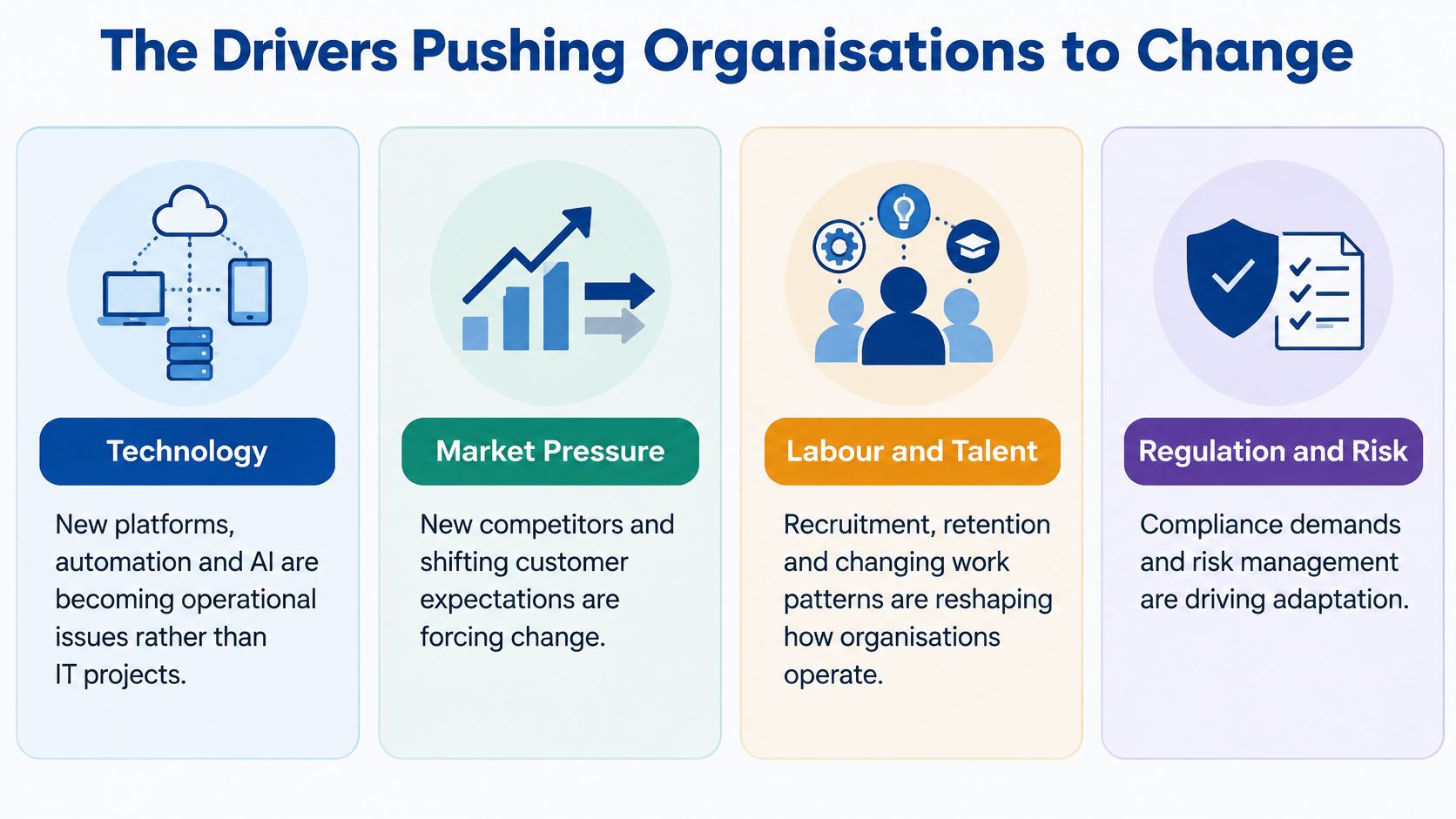
Technology is the loudest. New platforms, automation and AI have stopped being IT projects and become operational questions about who does what, with which data, under whose sign-off. That shift is why digital transformation is now a management subject rather than a technical one.
Labour is the easiest driver to underestimate. In 2024, 23% of workers in Ireland reported changing organisations during the previous 12 months, up from 19% in 2023 and 14% in 2022, according to Microsoft Ireland's Work Trend Index. Rising mobility means a change programme competes for attention with the option of leaving, and scarce skills have to be grown rather than hired.
| Driver family | Examples | Signal to watch |
|---|---|---|
| Technology | New platforms, automation and AI | Becomes an operational issue, not an IT project |
| Market pressure | New competitors, customer expectations, margin squeeze | Falling share or margin |
| Regulation and governance | Reporting duties, data rules, sustainability requirements | Compliance deadline or audit finding |
| Internal triggers | Mergers, acquisitions, new leaders, staff turnover | Falling performance or rising turnover |
A driver that can't be stated in one sentence usually produces activity without direction. The test is simple: name the driver, say what must be measurably different in twelve months, and say who will feel the change first. A retailer adopting a new stock system because competitors are undercutting on availability passes that test; the same rollout justified as "modernisation" doesn't.
Naming the driver early also sets the tone for how staff hear everything that follows. Announced as a compliance obligation, it invites minimum compliance. Announced as a response to a problem the team already complains about, it invites help.
Why Change Programmes Stall and How to Spot It
Just under 30% of EU employees reported that restructuring had occurred at their workplace during the previous three years, according to Eurofound's European Working Conditions Survey. The same evidence records what exposure costs: greater work intensity, higher self-reported stress, more absenteeism and presenteeism, and lower satisfaction with working conditions. Stalls leave those traces before they show up in a status report.
Digital change adds a pressure that lands unevenly. Eurostat reported that in 2024, 74% of EU businesses reached at least a basic level of digital intensity. The figure was 73% among small and medium-sized enterprises and 98% among large businesses, so the organisation with the fewest specialists is often absorbing the most change.
Four root causes account for most of what looks like resistance: decisions nobody explained, workloads that rose without review, skills gaps nobody named, and a culture where raising a problem carries a cost. Each produces a recognisable symptom, and each has a specific remedy.
| Symptom | Likely cause | Fix |
|---|---|---|
| Staff agree in meetings then ignore the new process | Change announced but not explained or consulted | Run consultation sessions and publish the rationale and expected job impacts |
| Overtime rises after rollout | Workload not reassessed alongside new tasks | Map tasks, decision rights and workload, then reallocate before scaling |
| Adoption stalls after training | Skills gap or no access to learning | Check access to learning resources and run role-based upskilling |
| Pilot teams hide problems | Early failure treated as blame | Create safe feedback loops and review failures as learning |
| Leaders report progress, frontline reports confusion | Messages stop at middle management | Set cascade briefings with two-way questions |
The first three months are the diagnostic window. Review the table monthly and act on the first symptom rather than waiting for a formal gate review, because by the gate the workaround has usually hardened into the new normal and unpicking it costs more than fixing it did.
Protecting Job Quality and Workload During Change
The 2025 Working in Ireland Survey, drawing on more than 4,300 workers across the island, found that supportive management, positive workplace relationships and employee voice were associated with better wellbeing, while work intensity and job insecurity harmed it. Eurofound's analysis of Irish workplace evidence points the same way: change commonly arrives bundled with new technology, increased responsibilities and intensified work.
Standard guidance treats buy-in as a message to deliver. It's a set of conditions to manage, and workload is the condition most often skipped:
- Map the new tasks. List what the change adds, what it removes and what it makes slower before anyone touches a system.
- Estimate the hours. For each affected role, put a number on the time gained or lost. Guessing in the abstract hides the problem.
- Make room. Remove, delegate or postpone existing work so the new tasks have somewhere to land.
- Set a workload ceiling. Agree in advance what level of overtime is unacceptable and check it at each pilot review.
- State the job-security position plainly. Say which roles change, which don't, and what hasn't been decided yet.
Practical rule: if overtime rises after rollout, pause scaling and reallocate work before continuing.
Leading Change Step by Step with Staff Participation
The ESRI's nationally representative study, based on a survey of more than 5,000 employees, found substantial organisational change in Irish workplaces, with technology introduction particularly frequent and especially prevalent in the public sector. Its most useful finding is a mechanism: when employees are informed and involved in decisions affecting their work, they are more likely to support the change.
Participation is an implementation control: it changes what gets built. A staff suggestion that alters the rollout plan works like a thermostat adjusting the heat. The same suggestion collected after the plan is signed off is a thermometer on the wall. It records the temperature and does nothing about it.
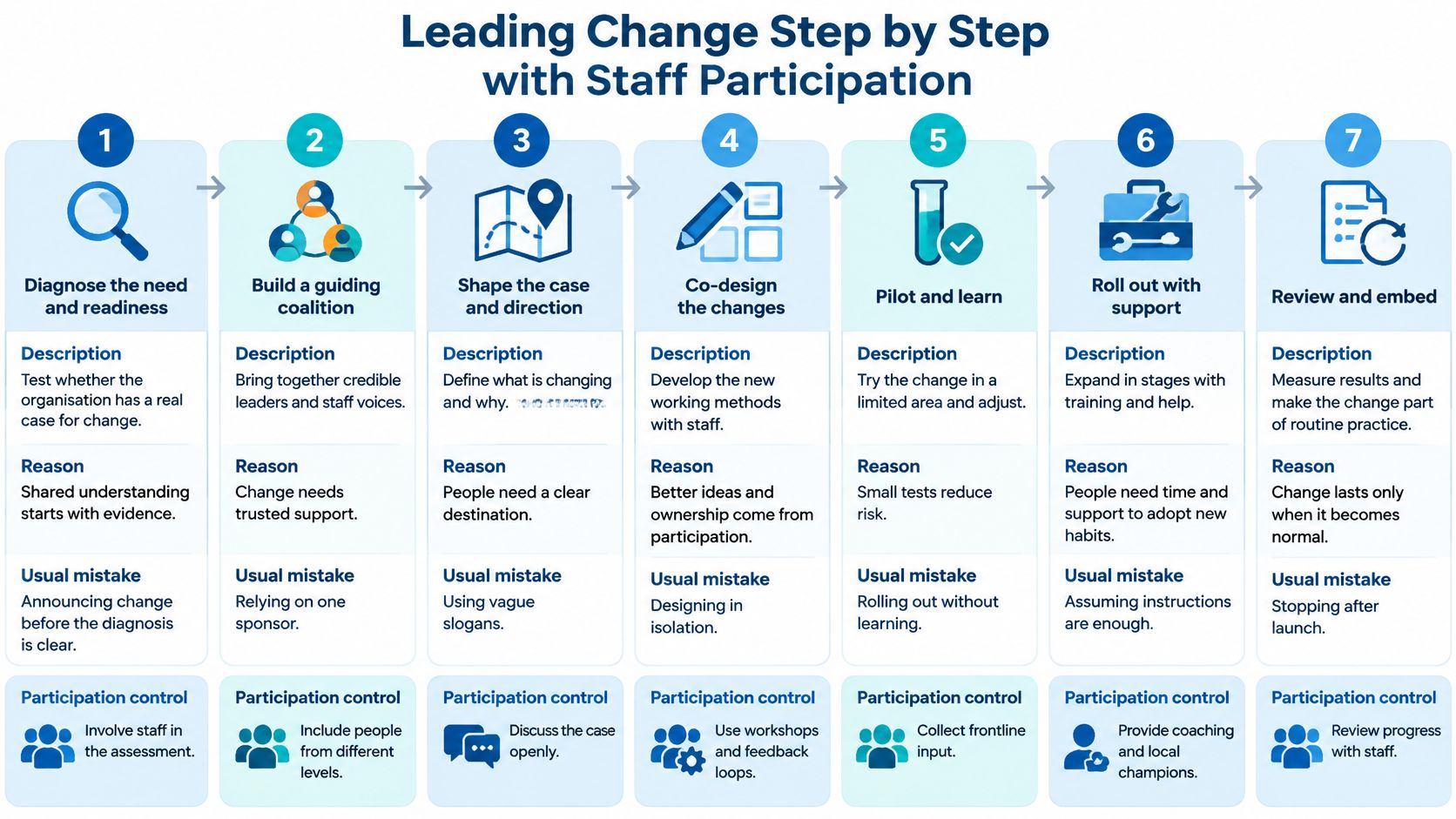
Seven steps from diagnosis to embedded practice
Diagnose the need and readiness. Test whether the organisation has the time, the skills and the trust to take the change on, and name the driver in one sentence. Skills is usually the gap: 76% of Irish respondents identified skills gaps as a barrier to organisational transformation, according to CIPD's future of jobs report for Ireland. The usual mistake is skipping the diagnosis to save a fortnight and spending six months recovering.
Define the purpose in plain terms. State what will be different in twelve months and who will feel it first. "Become more agile" isn't a purpose. "Cut order-to-invoice from nine days to three, starting with the accounts team" is. A vague purpose produces activity without direction, and staff learn to wait it out.
Build a guiding coalition. Recruit managers and staff who carry the message in corridors and canteens, alongside the sponsor who signs the budget. A programme that hangs on one sponsor has a single point of failure, and sponsors get promoted, reassigned or drowned in other priorities. The mechanics of building that wider support repay deliberate study; this guide to employee engagement strategies covers the practical side.
Consult affected staff before the design is fixed. Participation has to arrive early enough to change the plan. Say a customer service team warns that the new case system will add four minutes to every call. That concern becomes a staged rollout with two weeks of parallel running and two hours of temporary cover per shift. The test is whether staff changed a decision. If the answer is no, the session was a briefing, and the room knows it.
Pilot with one willing team for four to eight weeks and record what breaks. A pilot run by the most enthusiastic team with no baseline data proves nothing except that enthusiasm exists. The conditions for learning matter as much as the pilot: only 49% of Irish workers said their team treated failure as an opportunity to learn and grow, and only 57% said they had access to the learning and development resources they needed, according to PwC's 2025 Irish Workforce Hopes and Fears Survey. If the pilot team can't report what broke without fear, the results will look clean and mean little.
Measure the controls, not the attendance. Track consultation coverage, issue-resolution time, post-implementation acceptance, adoption, workload and wellbeing. Training completion tells a leader who sat in a room, which is the weakest possible proxy for whether the work changed.
Embed and close formally. Rewrite job descriptions, adjust performance measures, hold a close review at three months and a follow-up at twelve.
A concern raised in consultation that gets no documented response within two weeks means participation has failed. Fix the response before the next workshop, not the workshop itself.
The sequence loops. A failed pilot sends the team back to step two with better evidence, which is cheaper than carrying a known flaw into a full rollout.
Change in Practice Across Firm Sizes
The same method looks different depending on how many people and specialists an organisation can put behind it.
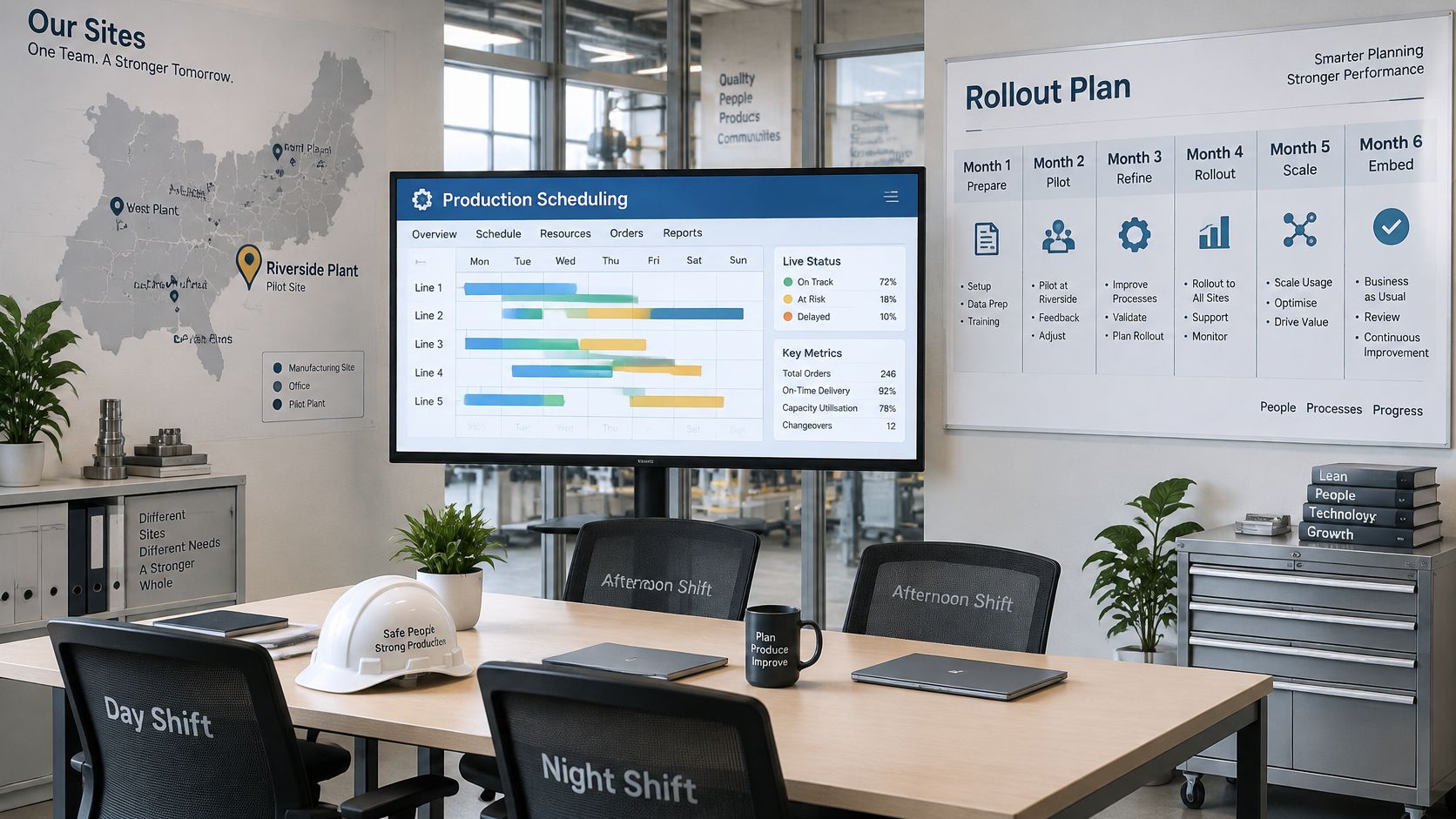
Take a 400-person regional manufacturer adopting a new production scheduling system. It runs the system in one plant first, brings shift leaders into the design sessions, and phases the rollout over six months across the other sites. Overtime falls rather than rises, because the workload mapping happened before the second plant went live rather than after.
Now take a 25-person professional services firm introducing AI-assisted drafting. It has no specialist team and no data function, so it runs a three-week trial with two willing staff, sets out in advance what evidence would justify a wider rollout, and pays for external training for the first cohort. The pilot costs a fortnight of one partner's attention and settles the question for a fraction of what a full deployment would have cost.
The national picture supports both stories. The Central Statistics Office reported that the proportion of Irish enterprises using artificial intelligence rose from 8.1% in 2023 to 20.2% in 2025, and 73% used paid cloud-computing services in 2025, placing Ireland fourth among EU Member States on that measure. It also notes that enterprises with 250 or more persons engaged remain stronger adopters than smaller firms.
That last point carries the lesson. A large-firm playbook, with a central programme office, a full-time change team and enterprise-wide training weeks, will overload a small firm and deepen the capability gap it was supposed to close. Scale the method to capacity. Hybrid arrangements complicate this further, since consultation that worked in a shared office needs deliberate redesign, as this look at remote and hybrid work sets out.
The two cases differ in size but share one feature: a defined pilot, a named owner, and a clear decision about whether to stop or scale.
Check Your Readiness Before the Next Change
Run the check before the plan hardens. Five questions, each put to a specific person rather than answered at a desk, will surface most of the risk in an afternoon.
- The driver. Could a frontline employee, asked in the corridor, state what is forcing the change in their own words?
- The purpose. Could a team lead say what will be different in twelve months, and for whom?
- Consultation. Is there a named date when affected staff can still alter the design, rather than merely hear about it?
- Workload. For every role that gains tasks, is there a named task that stops?
- Learning. Does every affected role have named training and support, with time allocated to take it?
Score each answer: 2 for yes with evidence, 1 for yes on paper only, 0 for no. A total of 8 or more is a workable starting point. Any 0 halts the rollout until it is fixed, and a workload score of 1 should be treated as a 0, because unfunded hours are the first thing staff notice.
A gap often hides in a single item. A firm preparing a new rostering system scores 2 on driver, purpose, consultation and learning, but the workload review shows supervisors absorbing the change administration on top of a full week. That gap is cheap to fix now, by dropping a named task or arranging temporary cover. After go-live, the same supervisors are the ones training everyone else.
Writing the answers down first helps too: a short, honest business case forces the driver, the cost and the expected benefit onto one page that staff can read and challenge.
Managers who want structured grounding can look at the European Institute of Leadership and Management. Its Mini-MBA in Leadership Programme is designed to teach skills to lead teams, manage organisations, drive innovation, and handle change in a dynamic business environment, and its online certificate courses include Change Management.
Plan the change around the people who have to live with it. Everything else, the systems, the charts and the timelines, is scaffolding around that single principle.
The European Institute of Leadership and Management teaches this work in a format built for people already doing it, with fully online, self-paced courses and programmes that fit around a full week. Its Change Management course and Mini-MBA in Leadership cover the practical ground this guide describes, from diagnosis and stakeholder consultation to embedding a change so it survives the first quiet quarter. Visit European Institute of Leadership and Management to see the course and programme options before the next change programme lands on the desk.