
International Law and Human Rights: How the System Works
If your own constitution and statutes already protect your rights, what does a treaty signed in New York or Rome add?
More than many assume, less than campaigners sometimes claim, and in a different place than either group expects. International law doesn't replace the domestic rulebook. It sets a floor under it, and it builds a forum outside the state where a complaint about that floor can be heard. Nearly everything confusing about international law and human rights follows from those two features: a floor, and a forum.
The harder puzzle sits between them. A state can hold a binding legal duty and still administer it badly, and that distance between the obligation and the daily experience of the person it protects is where most rights work happens. One Irish case, asylum accommodation, shows how to test whether a right is legally enforceable or only declared.
Table of Contents
- How International Law Protects Human Rights
- Which Instrument Binds and Where to Take the Claim
- How a Human Rights Complaint Moves Through the System
- Why Enforcement Remains the Weakest Link
- Why Strong Rights on Paper Often Fail in Practice
- Choose Your Next Step in International Human Rights Study
How International Law Protects Human Rights
A state's own law is the internal rulebook of a house. The residents write it, and a majority can rewrite it whenever politics shifts. International law works more like a shared building code agreed between neighbours. It fixes minimum standards (fire exits, load-bearing walls) that no single owner can lower, and it gives the other owners standing to complain when one of them starts knocking through a structural wall.

Three sources that bind, one that persuades
- Treaties are written agreements that states sign and then ratify. A treaty binds only the states that complete that process, and only on the terms they accepted, including any reservations they attached.
- Customary international law binds all states whether or not they signed anything, because it grows out of consistent state practice combined with a sense of legal obligation. The prohibition of torture sits here, which is why a state that never ratified a torture treaty still isn't free to torture.
- General principles are rules recognised across major legal systems, such as good faith, or the principle that no one should be judge in their own cause. Courts reach for them when treaty text and custom run out.
Not everything called a right is legally binding. The Universal Declaration of Human Rights was adopted in 1948 as a declaration, not a treaty. It's the most quoted human rights document in existence and the one readers most often mistake for binding law. Its provisions are widely treated as reflecting customary standards, so it carries real weight, but the route to that weight runs through custom and through the treaties drafted afterwards, not through the Declaration's own status. The lesson on the United Nations and its role in international law traces how the Charter, the Commission on Human Rights and its successor Council turned that text into binding obligations.
What makes human rights law distinctive is the direction of the duty. Ordinary treaty law has states owing obligations to each other: breach a trade agreement and the other government complains. Human rights treaties have states owing obligations to people inside their jurisdiction, so the party holding the claim is an individual, not a foreign ministry. A person in detention in a state that has ratified the International Covenant on Civil and Political Rights relies on that covenant's guarantee of humane treatment and conditions. No embassy has to intervene on their behalf.
The first test to apply to any rights claim: does it rest on a treaty the state has actually accepted, on a customary norm that binds regardless, or on a declaration that persuades without binding? Settle that before arguing about whether the right was breached.
Which Instrument Binds and Where to Take the Claim
Seven instruments do most of the work in European human rights practice. Read the table as a lookup, not as a hierarchy: a declaration at the top of the list can be less enforceable than a treaty at the bottom.
| Instrument | Main subject | Who it binds |
|---|---|---|
| Universal Declaration of Human Rights (1948) | General civil, political, economic and social rights | Non-binding declaration, widely treated as reflecting customary standards |
| International Covenant on Civil and Political Rights (1966, in force 1976) | Civil and political rights | States that have ratified |
| International Covenant on Economic, Social and Cultural Rights (1966, in force 1976) | Economic, social and cultural rights | States that have ratified |
| Convention against Torture (1984, in force 1987) | Prohibition of torture and cruel treatment | States that have ratified |
| Convention on the Rights of the Child (1989, in force 1990) | Rights of children | States that have ratified |
| European Convention on Human Rights (1950, in force 1953) | Civil and political rights in Europe | Council of Europe member states |
| EU Charter of Fundamental Rights (proclaimed 2000, binding since 2009) | Rights within EU law | EU institutions, and Member States when implementing EU law |
Three checks to run before anything else
- Is the state bound? Ratification is the hinge. A state that hasn't ratified a treaty isn't bound by its text, though customary norms such as the prohibition of torture apply anyway.
- Can an individual complain, and by which route? Many treaties create obligations without creating a petition procedure. Optional protocols and separate declarations are what open that door.
- What limits the route? Admissibility rules, time limits, the requirement to exhaust domestic remedies and the forum's own subject-matter scope all narrow what a tribunal will hear.
Reservations change the answers. A state can ratify a treaty while excluding a particular provision from its acceptance, and those carve-outs are published with the ratification record. Checking that a government signed a document tells you very little on its own. Checking the ratification record and the complaint procedures it has accepted tells you what a claimant can do.
The EU Charter row is the one readers most often overstate. The European Parliament's factsheet on fundamental rights in the EU sets out that the Charter binds EU institutions, bodies, offices and agencies in all their actions, and binds Member States only when they're implementing EU law. That's narrower than a national bill of rights covering every act of government. The trigger is a link to EU law, not the fact that a public body behaved badly. The same factsheet notes that EU institutions and Member States must respect the Charter in the EU's external relations.
Apply the checks in a fixed order and the confusion clears. Identify the state and the act first. Then ask whether an EU institution is acting, or whether the national measure falls inside the field of EU law. Only then pick the forum and read its conditions.
Two scenarios show how much turns on that sequence. A privacy or fair-trial complaint against a Council of Europe state goes to the European Court of Human Rights, after domestic remedies are exhausted. A torture allegation in a ratifying state reaches the UN Committee against Torture only where that state has accepted the committee's individual complaints procedure. Same facts, different forum, different conditions. The sources of international law lesson covers how custom and treaty interact at the drafting stage, which is where most of these distinctions originate.
How a Human Rights Complaint Moves Through the System
What turns a treaty promise into a case a court will hear? Procedure, and procedure is where most complaints live or die. The European system is the clearest worked example. The European Convention on Human Rights was opened for signature in Rome on 4 November 1950 and entered into force on 3 September 1953, creating a system in which individuals can bring complaints against states before an international court. The European Court of Human Rights now serves the 46 member states of the Council of Europe, and its 2025 annual report records 31,800 applications allocated to a judicial formation, a 10% increase on 28,800 in 2024, with 914 judgments delivered covering 7,011 applications.
The sequence below is the one worth memorising. The notes under each stage explain why it exists and where claims usually fail.
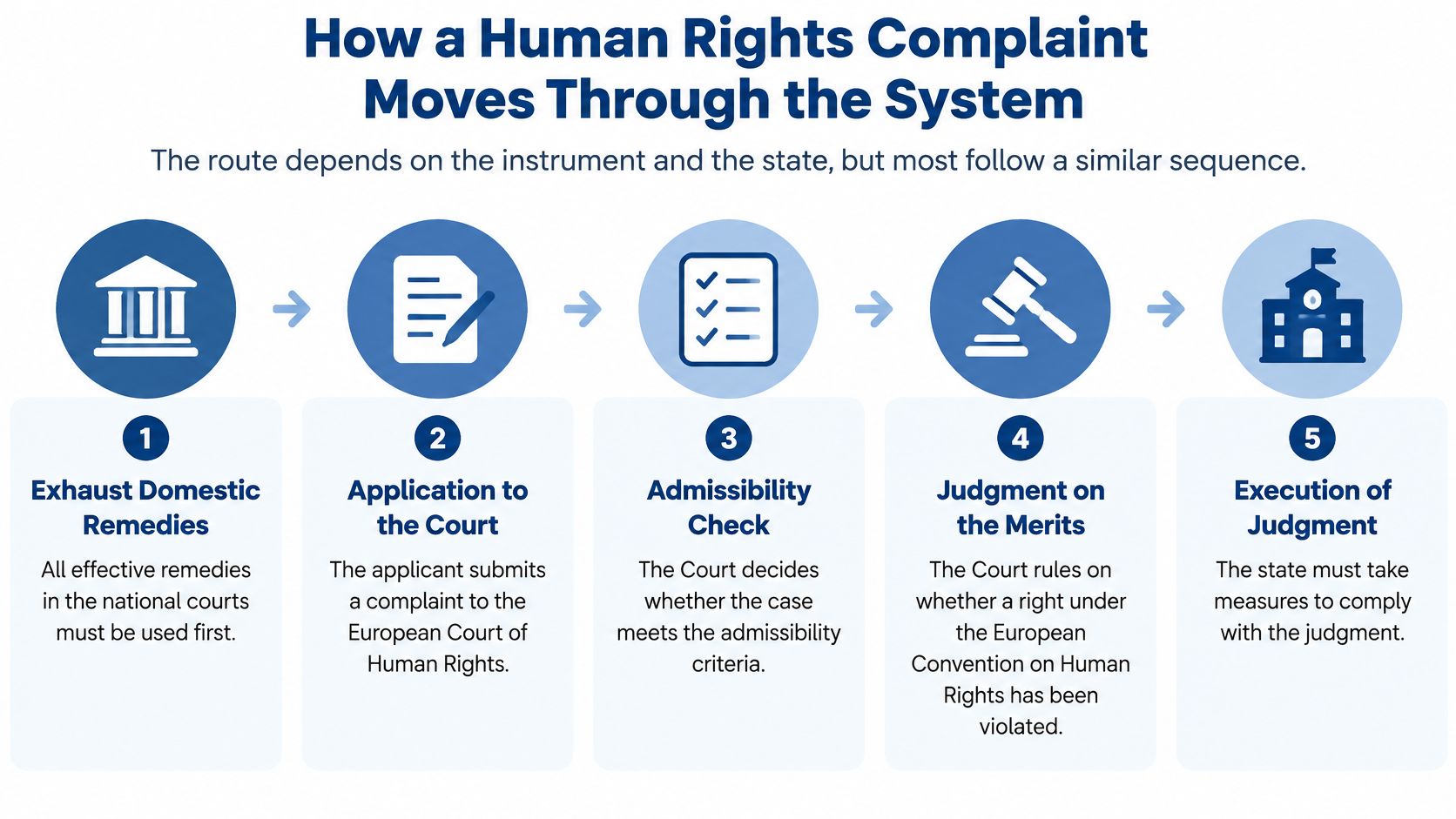
- Exhaust effective domestic remedies. National courts get the first chance to fix the problem, and Strasbourg hears what they leave unresolved. The common slip is raising the Convention argument for the first time in Strasbourg, when no domestic court ever heard it.
- Check time limits and victim status before drafting. Filtering keeps the court functioning. The slip is missing the deadline, or complaining about a law in the abstract without being affected by it.
- Lodge the application. Filing starts the state's response period. Applications arrive without the domestic judgments attached, which delays everything that follows.
- Clear admissibility screening. This stage protects court capacity, and it's where most claims stop. Screening works like triage at a hospital door: everyone may arrive, but only cases meeting the criteria get treated. Assuming a sympathetic story survives is the mistake.
- Merits examination. Admissible cases receive written submissions and sometimes a hearing, and the state answers in full.
- Judgment. The court finds a violation or rejects the claim, and the reasoning becomes a reference point for later cases.
- Execution under the Committee of Ministers. Supervision continues until the state adopts the measures required.
Ireland's figures show how much of the system lives at step four. The Court country profile for Ireland records 38 applications concerning Ireland decided in 2025, all declared inadmissible or struck out, with no judgment finding or rejecting a violation in an admissible case, and 36 applications allocated to a judicial formation against 22 in 2024. Procedural requirements such as exhaustion, time limits and victim status decide cases before anyone argues the merits.
Run a concrete claim through that filter. A resident challenging conditions in Irish asylum accommodation might have a serious case on the facts, yet the application still has to clear every gate in order: domestic courts first, deadline met, personal victim status shown. A right that is binding on paper stays merely declared if the file fails at any one of those gates, which is the gap this whole system runs on.
A finished case rarely ends with a payment to one person. It produces an individual remedy plus general measures that change law, policy or practice, and those general measures are what reach everyone else in the same position. The regional organisations and international law material places that court structure alongside the other regional systems built on the same logic.
Why Enforcement Remains the Weakest Link
No world court hears every human rights question, and no state is obliged to obey a body it never consented to. Enforcement depends on three variables: which body is deciding, which treaty it applies, and what the state agreed to. What matters in practice is less the label on the mechanism than what happens the day after it rules.
| Mechanism | What it can order | Who keeps the file open | Where it falls short |
|---|---|---|---|
| European Court of Human Rights judgment | Individual redress and general measures for the respondent state | The Committee of Ministers supervises execution | Compliance still depends on sustained pressure on the state |
| UN treaty body views and concluding observations | Recommendations and follow-up reporting | Independent committee experts revisit the record at the next cycle | A government can accept the findings and change little |
| Universal Periodic Review | Recommendations that states accept or note | UN Human Rights Council members at the next review cycle | A recommendation that is noted carries no obligation to act |
| UN Security Council action | Binding measures, subject to veto | The 15 council members, five of whom hold veto power | Rarely used for individual human rights claims |
| International Court of Justice | State-to-state rulings between consenting parties | The disputing states themselves | No route for an individual claimant |
Read the right-hand column and the pattern appears. Even the strongest mechanism in the table produces a file that stays open only as long as someone keeps pressure on it. Treaty body recommendations and review outcomes generate monitoring pressure: a government must explain itself at the next cycle, and domestic civil society gains a document to hold it to. None of these mechanisms sends a bailiff.
Ireland shows how many tracks run at once. Its compliance work passes through the European Convention system supervised by the European Court, through UN Universal Periodic Review procedures, and through reporting under the Council of Europe Framework Convention for the Protection of National Minorities. The Department of Children, Disability and Equality coordinates those responsibilities across the EU, UN, Council of Europe and OECD, and acts as the national liaison point for the EU Fundamental Rights Agency.
That structure means a rights question has to be mapped to its own instrument, supervisory body, reporting cycle and domestic implementing department. Take reception conditions for asylum seekers as the test case: the enforceability question is which body supervises compliance and which Irish department carries the file. Ask who checks the homework. Treating international law as one framework produces advice that sounds principled and leads nowhere.
A judgment opens a supervision file that stays open until the state acts on it.
The scale of that open file is documented in the Council of Europe's implementation review: in 2025 the Committee of Ministers closed 949 supervision cases, up from 894 in 2024, and 194 leading cases, the ones that usually need structural reform to stop a violation repeating, up from 161, while roughly 8,300 individual applications connected to conflicts remained pending, 85% of them concerning the conflict between Ukraine and Russia.
Why Strong Rights on Paper Often Fail in Practice
Why does a state bound by clear treaty duties on reception conditions end up housing asylum seekers in tents? Ireland is the worked case. International-protection applications rose from 2,648 in 2021 to 13,160 in 2025, and the Irish Human Rights and Equality Commission cites AIDA reporting of 18,132 applicants in state accommodation alongside official homelessness of 17,447 people in May 2026, a figure that excludes rough sleepers, people in international-protection accommodation and hidden homelessness. Overcrowded emergency centres and substandard tented facilities have raised concerns about dignity, basic needs and mental health, and IHREC has flagged 2026 legislative changes covering restricted legal advice, "non-entry" legal fictions and expanded detention or de facto detention.
Monism, dualism and the route into domestic law

The gap between signature and service comes down to plumbing. A monist system runs one connected pipe: once a treaty is ratified and in force, it flows straight into domestic law, so a judge can apply it and a litigant can argue it. A dualist system keeps two separate pipes. The treaty binds the state on the international side, but nothing reaches a domestic tap until parliament passes connecting legislation.
Ireland is dualist. Ratified rights reach an Irish courtroom only when legislation, the Constitution or equality law carries them there, so the practical test for any specific right is whether that domestic route exists. Three steps run the test.
- Name the right and its source. Be precise, because "the right to housing" and "the right to adequate reception conditions" travel through different instruments.
- Check the domestic route. Find the statute, constitutional provision or equality ground that gives it effect, and note what remedy that route offers.
- Identify the accountable body. A positive obligation lands on a named department, agency or local authority, not on the state in the abstract.
Run the Irish case through those three steps and the last one bites hardest: who is legally answerable when emergency accommodation falls below standard, or when access to advice is restricted? Public opinion suggests people can see the gap even where they cannot name the pipework. A 2026 nationally representative poll of 1,205 adults, reported by IHREC, found that 84% believed everyone should be treated equally regardless of background and 91% rated affordable housing as important, yet only 49% believed refugees and asylum seekers had access to adequate accommodation and 47% believed they were treated fairly. Strong support for rights coexists with low confidence that institutions deliver them.
Monitoring is how that gap gets measured rather than asserted. The European Commission has published annual reports on the application of the EU Charter of Fundamental Rights since 2010, and its 2025 mid-term review of the 2020 strategy found most EU-level measures implemented while identifying further action needed across 2026 to 2030.
A right is only as strong as the domestic route that makes it enforceable. Where that route is missing, the treaty still binds the state; the person affected, though, holds a claim with no courtroom to hear it.
Choose Your Next Step in International Human Rights Study
The skill this article has been building is a habit of asking where a right lives: in a treaty text, in a supervisory body, or in a domestic courtroom. Applied to Irish asylum accommodation, the question is whether a resident whose housing falls short holds a claim a court will hear, or only a commitment the state has signed. Anyone who can trace that route for a new situation is already doing the work practitioners do.
The next steps depend on what you want to do with the skill.
- Read the primary texts for your own state. Start with the ratification record and any optional protocol, then read the provision you care about rather than the preamble. A treaty's scope usually sits in its definitions and its derogation clauses, not its opening sentences.
- Follow the supervisory output. European Court judgments appear on HUDOC, execution progress is tracked through the Committee of Ministers' supervision records, and UN treaty bodies publish concluding observations after each review. Reading two or three cycles of one country teaches more than reading a textbook summary.
- Match further study to your goal. Academic research rewards a postgraduate law route; legal practice rewards advisers who file claims and know admissibility cold; NGO monitoring rewards people who can compare a government's commitments against its delivery.
For readers who want the legal architecture before the advocacy, European Institute of Leadership and Management offers a self-paced online international law course among its individual certificate subjects. Its Mini-MBA in Global Governance examines the actors and institutions involved in global governance and the challenges and opportunities they face, which is the same mapping skill used above to trace a right from treaty text to delivery. The institute is a certified member of CPD Certification Service, and its courses run fully online so study can sit around existing work. Visit European Institute of Leadership and Management to compare the international law course with the global governance programmes.