
How to Motivate a Team: A Practical Guide for Managers
94% of civil servants in Ireland said they persevered when work did not go well, but only 47% said they felt inspired by their job, according to the 2015 Civil Service Employee Engagement Survey. That gap is the whole problem in one line. Perseverance is cheap to measure and easy to mistake for motivation: a team can hit its deadlines, cover its shifts and stay quiet in meetings while running entirely on willpower.
Managers tend to answer that flatness by adding energy from the outside. A new incentive, a louder stand-up, a workshop. Those interventions fade within a fortnight because they treat a symptom without naming the cause. Unclear purpose, an unreasonable workload, no say over how the work gets done and unrecognised effort all look identical from a distance, and each one needs a different response.
Getting good at how to motivate a team starts with a single discipline: work out what is draining people before choosing a tactic. Skip that step and every technique below will fail politely.
Table of Contents
- Diagnose What Is Actually Draining Your Team
- Set Goals Your Team Will Genuinely Own
- Build a Recognition Routine That Lasts
- Keep Hybrid and Remote Staff Equally Motivated
- When Pressure Is the Problem, Not the Solution
- Run Your First 90-Day Motivation Check
Diagnose What Is Actually Draining Your Team
The question most managers skip is whether they are looking at a motivation problem at all. Low effort looks the same from the outside whatever is producing it, and the fixes diverge completely depending on the answer. A team drowning in work doesn't need a purpose workshop. A team that can't see why its work matters doesn't need a workload review, although it usually gets one, because workload is easier to count.
Start with what is visible this week. Six signals cover most of what a team leader meets, and each has a most probable driver plus a first check that takes a day or two. None of them requires a survey, a consultant or a budget line.
| Signal | Likely driver | First check |
|---|---|---|
| Missed deadlines falling on the same people | Unmanaged workload | Count open tasks per person over two weeks |
| Work completed but no energy or initiative | Unclear purpose of the work | Ask each person which outcome their work changes |
| Quiet in meetings, few ideas raised | Low voice and autonomy | Ask which working practices help them perform |
| Repeated short absences | Pressure treated as normal | Review hours, breaks and leave taken |
| Good results but rising turnover | Weak recognition or unfair treatment | Compare appreciation and feedback across the team |
| Hesitant decisions and skill gaps | Low confidence in competence | Check training access and clarity of responsibilities |
Running the check before the intervention matters because guesswork is expensive in a way that stays invisible. A manager who decides the problem is recognition, then launches a thank-you channel, gets three weeks of goodwill and then watches the same two people absorb the same overload. Nothing changes underneath, so nothing changes on the surface.
Satisfaction and strain coexist more often than managers expect. In 2025, 64% of Irish workers said they felt satisfied with their work at least once a week, while 36% felt overwhelmed at work at least once a week, according to PwC Ireland's Workforce Hopes and Fears Survey. Read the two numbers together. A team can answer "fine" on a Monday and still be running on reserves, and the person least likely to complain is usually the one whose signal a manager notices last.
Run the cheapest check first
Practical rule: the first check should cost less than the intervention it prevents.
The "quiet in meetings" row deserves particular care, because voice is a safety question as much as a motivation one. Teams stop contributing when speaking up has carried a cost before, which is why a guide to psychological safety in the workplace is more useful here than any engagement poster.
Pick the signal that repeats most often, not the one that irritates you most, and finish its first check before deciding anything. The table sorts hypotheses. It doesn't deliver verdicts. A pattern that survives two weeks of checking is worth acting on, and a pattern that disappears once a deadline passes was never a motivation problem.
Set Goals Your Team Will Genuinely Own
Goals handed to a team get accepted. Goals built with a team get defended. That difference shows up around week six, when the first obstacle lands and someone either shrugs or starts solving.
Take a support team whose repeat contact rate keeps climbing because customers ring back about delivery dates nobody gave them. That thread runs through all six steps.
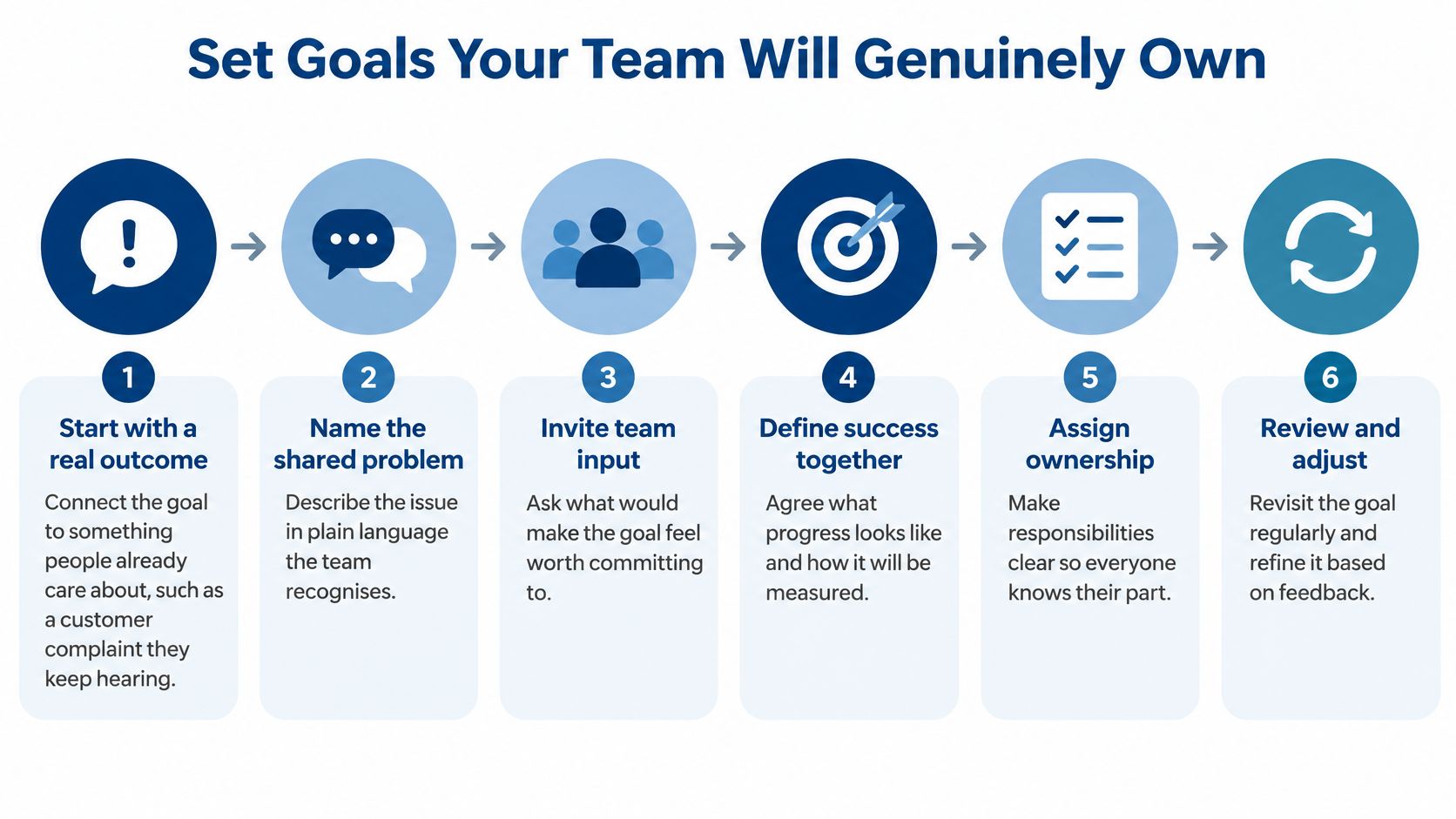
Start from an outcome people already hear about. The repeat calls are real, annoying and familiar to everyone on the team. An abstract target such as "improve first-contact resolution by 12%" carries none of that weight. "Stop the same customer calling twice about the same thing" does.
Name the problem in the team's own words. Ask each person what they would change and write down the phrases they use. If the team says dispatch updates arrive after the customer has already rung, the goal has just changed, and it's now the one they'll work on.
Define success before work starts. Agree the measure and the target in advance so nobody renegotiates the finish line later. Gallup's published guidance on acting on engagement data is to define success prospectively: a minimum five-percentage-point improvement in the targeted pulse score, higher participation and documented completion of agreed actions, as set out in its Ireland country-level workplace data. For the support team, that means a stated fall in repeat contacts plus a pulse question asking whether people know what good looks like this month.
Give every action one owner and one deadline, and cap the list at two or three. Six initiatives spread across a team is a wish list. Two owned actions with dates is a plan, and the cap forces the prioritisation conversation that otherwise never happens.
Check the goal against the person carrying it. A match between someone's skills and their responsibilities is what turns a target into something they can move. Stretch is useful; a goal that outruns someone's skills, tools or authority produces delay and quiet withdrawal instead.
Review at 60 to 90 days, then adjust rather than abandon. A first attempt that misses tells you the design was wrong somewhere. Dropping it teaches the team that goals here are temporary, and the next one attracts less effort.
This mirrors how strategic planning and goal-setting works above team level: fewer commitments, clearer ownership, a date attached to each one.
What should exist at the end is a single page. The outcome, the measure, a named owner for each action and the review date. If it takes a deck to explain, it isn't a team goal yet.
Build a Recognition Routine That Lasts
In 2024, 82% of employees at certified Irish Best Workplaces said their line manager provided regular performance feedback, compared with 55% at non-certified organisations, according to Great Place to Work data reported by The Irish Times. The gap isn't about the size of the thank-you. It's about whether feedback arrives often enough to be useful and specific enough to act on.
Recognise that within teams, the difference between the two groups is routine, not generosity.

The weekly fifteen minutes
A one-to-one that covers five moves in a quarter of an hour beats an annual review nobody remembers:
- What enabled progress this week. The answer tells you where the friction is.
- One specific contribution and its effect. Name the behaviour, not the personality.
- One obstacle you can remove. If you can't remove it, say so and say why.
- One next action, agreed out loud. Not assigned. Agreed.
- Anything you promised, written down and closed. Unclosed commitments are how managers lose credibility.
The fortnightly team review
Once a fortnight, link recognition to observable behaviours the team needs repeatedly: sharing knowledge before someone asks, recovering a difficult customer, escalating a risk early instead of late. Specificity is what makes it a signal rather than a mood. The Irish picture backs the social side of this. Research involving 1,000 full-time employees in Ireland found that 74% agreed public appreciation from colleagues helps create a more positive workplace atmosphere, with 60% making a point of thanking colleagues, and among those 69% preferring verbal appreciation, according to Workhuman's Irish recognition research.
What ruins it
- Generic praise. "Great job lately" describes the weather, not the work.
- Compulsory public recognition. Some people would rather not be the centre of attention, and forcing it teaches them to avoid achievement.
- Rewards used to cover an unrealistic workload. A voucher is not a redesign.
- Different treatment for remote colleagues. Praise that only lands on people in the room is a policy, not an accident.
A colleague covered two extra shifts during a bad week and said nothing. In the next one-to-one, name the behaviour and its effect: two customers got their deliveries and a teammate didn't cancel leave. That's recognition. The blank test is simple enough to apply this week: can you name what each person on your team did well in the last fortnight, and why it mattered?
Keep Hybrid and Remote Staff Equally Motivated
Offices reward presence efficiently. The person at the next desk gets the quick question, the visible project and the incidental feedback; the person at home gets the agenda and the outcome. Left alone, that asymmetry hardens into something that looks like a personality difference and behaves like a motivation gap.
Ireland's 2025 CIPD data shows that 43% of organisations have more than half of their employees working flexibly or hybrid, while 48% report that hybrid work negatively affects managers' ability to manage and two-thirds say it limits informal learning, according to CIPD's HR practices in Ireland 2025 report. That's a design problem with a management solution, not an argument about whether hybrid work is good.
Four principles do most of the work:
- Define performance by outcomes, not presence. Judge the delivered result and the standard it met. Hours logged and seats filled tell you nothing about output.
- Give equal access to feedback and stretch work. Keep a written list of who gets the interesting assignments over a quarter. Patterns show up there before they show up in a resignation.
- Build deliberate informal connection. A fixed fifteen-minute start-of-week call with no agenda beyond "what's in your way" replaces the corridor better than a monthly social.
- Make recognition asynchronous and visible. Written praise in a shared channel reaches everyone at the same speed, including the people who weren't in the room.
Autonomy is the part managers skip. PwC's 2023 Irish Workforce Hopes and Fears Survey reported that only 24% of Irish workers would publicly advocate for their company, 10 percentage points below the global result, and that although more than half were satisfied with their jobs, only 42% felt able to choose a way of working that suited them, according to PwC's 2023 Irish survey.
Satisfaction is not empowerment. A team can be content and still have no say in how it works.
For leaders weighing the wider trade-offs, the practical implications of the rise of remote and hybrid work go well beyond scheduling. Ask each person one question and write down the answer: which working pattern lets you do your best work, and what would you need to keep it going? Then check whether the people who ask for the most flexibility are also getting the visible projects. If they aren't, the problem was never motivation.
When Pressure Is the Problem, Not the Solution
Motivation has limits, and managers who ignore them do damage. No amount of praise fixes a job that can't be finished inside the hours available, and treating a rational response to poor design as an attitude problem pushes people towards silence. Low effort is sometimes the most sensible thing a person can do with the job they've been given.
The Irish evidence on wellbeing makes the scale clear. CIPD findings report that 36% of organisations found employee wellbeing more challenging over the previous year, that mental-health challenges affected absenteeism in 25% of organisations, that burnout was a concern for 29%, and that more than half cited inadequate management support as contributing to poor mental health, according to CIPD Ireland's work on promoting wellbeing. Some of that sits outside a line manager's control. Some of it doesn't.
The diagnosis order matters. Check priorities first, then workload, then how much control the person has over the work, then fairness, then trust in you as their manager. Commitment comes last. Many teams get the sequence backwards.

| Situation | First response | Escalate when |
|---|---|---|
| Priorities unclear or changing each week | Agree one written priority list with the sponsor | Leaders give conflicting priorities |
| Workload consistently above capacity | Remove or re-scope tasks before any motivation effort | The gap persists after re-scoping |
| Little control over how work is done | Offer discretion over method, schedule or location | Policy blocks reasonable flexibility |
| Signs of burnout or mental-health strain | Pause goal-setting, talk privately and signpost support | Immediately, to HR or occupational health |
| Unfair treatment or low trust in the manager | Check the facts and correct decisions visibly | The pattern continues after correction |
| Low commitment after redesign | Discuss honest options about role fit | A timeline and support are needed from HR |
Managers who want a structured way to hold the conversation in row four can use this guide to managing stress for leaders as a starting frame.
The test for motivation as a tactic: if the same flatness survives clarified priorities, a reduced workload and real discretion, stop motivating and start redesigning.
The pattern to watch for is a problem that persists after a genuine attempt at goals and recognition. At that point the next step isn't another conversation about engagement. Low commitment after redesign may mean the role doesn't fit the person, and that deserves a direct, respectful conversation: what would a good year look like, what would you rather be doing, what would need to change here? Sometimes the honest answer is a move. Pretending otherwise costs both sides.
Run Your First 90-Day Motivation Check
A quarter is enough time to find out whether any of this works, provided the baseline is recorded before anything changes.
- Pick one signal and write down its current state. Take the pattern from the diagnosis table that repeats most often, and record specifics. Two people carrying overdue work for three consecutive weeks beats "morale feels low".
- Run a short anonymous pulse. Three to five questions on purpose, workload, recognition and voice. Keep it anonymous or the answers will be diplomatic.
- Start the weekly one-to-one and the fortnightly review. Give both two weeks before judging fit. The first session is awkward for everybody.
- Agree two or three actions with owners and deadlines. Write them down and put the dates in a calendar you check regularly.
- Repeat the pulse at 60 to 90 days and compare it with the baseline you set. Then keep, adjust or escalate.
One question belongs in every pulse: whether people feel inspired by the work, not only able to get through the week. A team can score well on effort and still be producing initiative-free compliance, and the two measures predict very different futures.
Write three things down on Monday: the signal you chose, the baseline question, the date of the 60-day review. The quarter will fill up regardless. The review date only happens if it's already in the calendar.
The European Institute of Leadership and Management teaches these habits through self-paced online study, including a Mini-MBA in Leadership Programme designed to teach skills to lead teams, manage organisations, drive innovation and handle change in a dynamic business environment, alongside individual certificate courses in subjects such as leadership, teamwork and communication. If diagnosing workload, running a recognition routine and designing fair hybrid practice are the parts of the job you want to get better at, European Institute of Leadership and Management offers a practical place to start.