
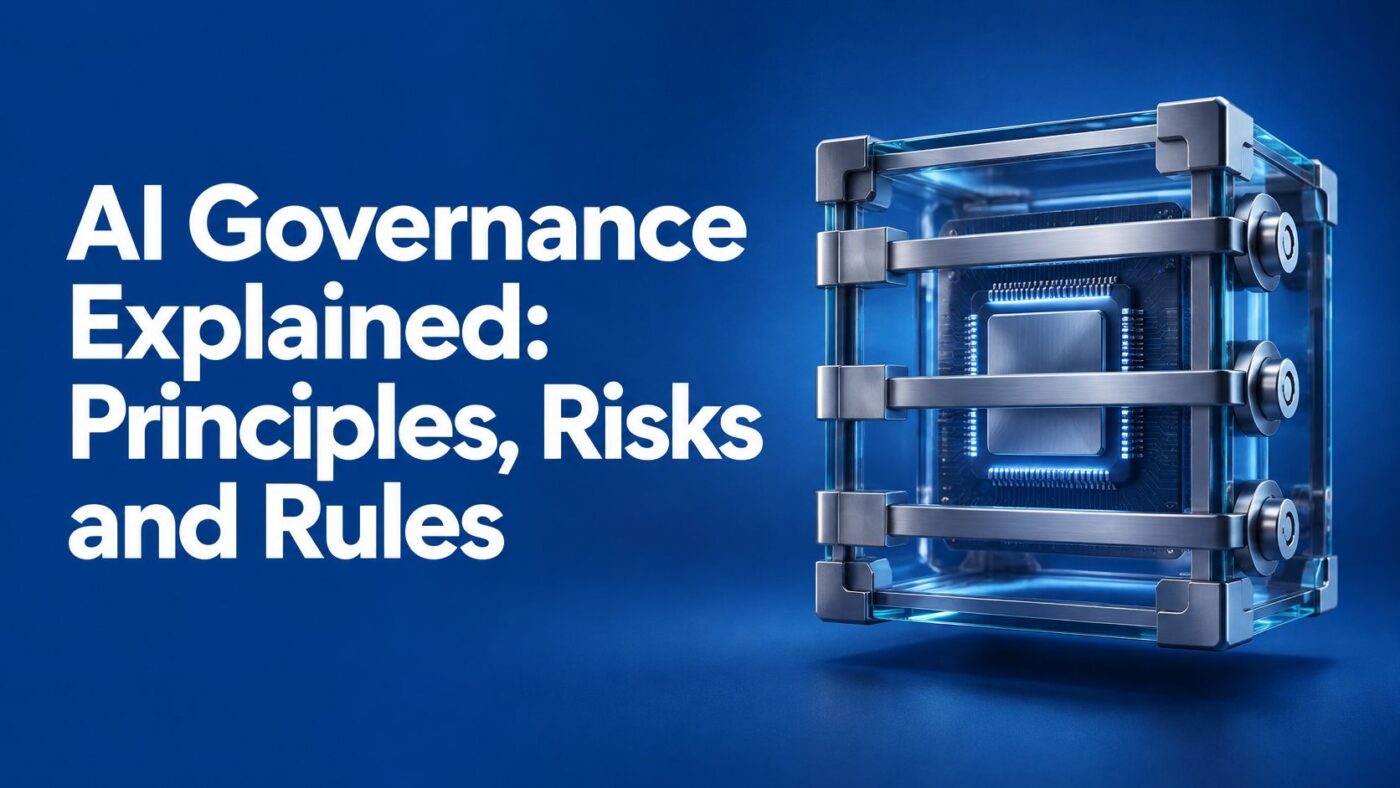
AI Governance Explained: Principles, Risks and Rules
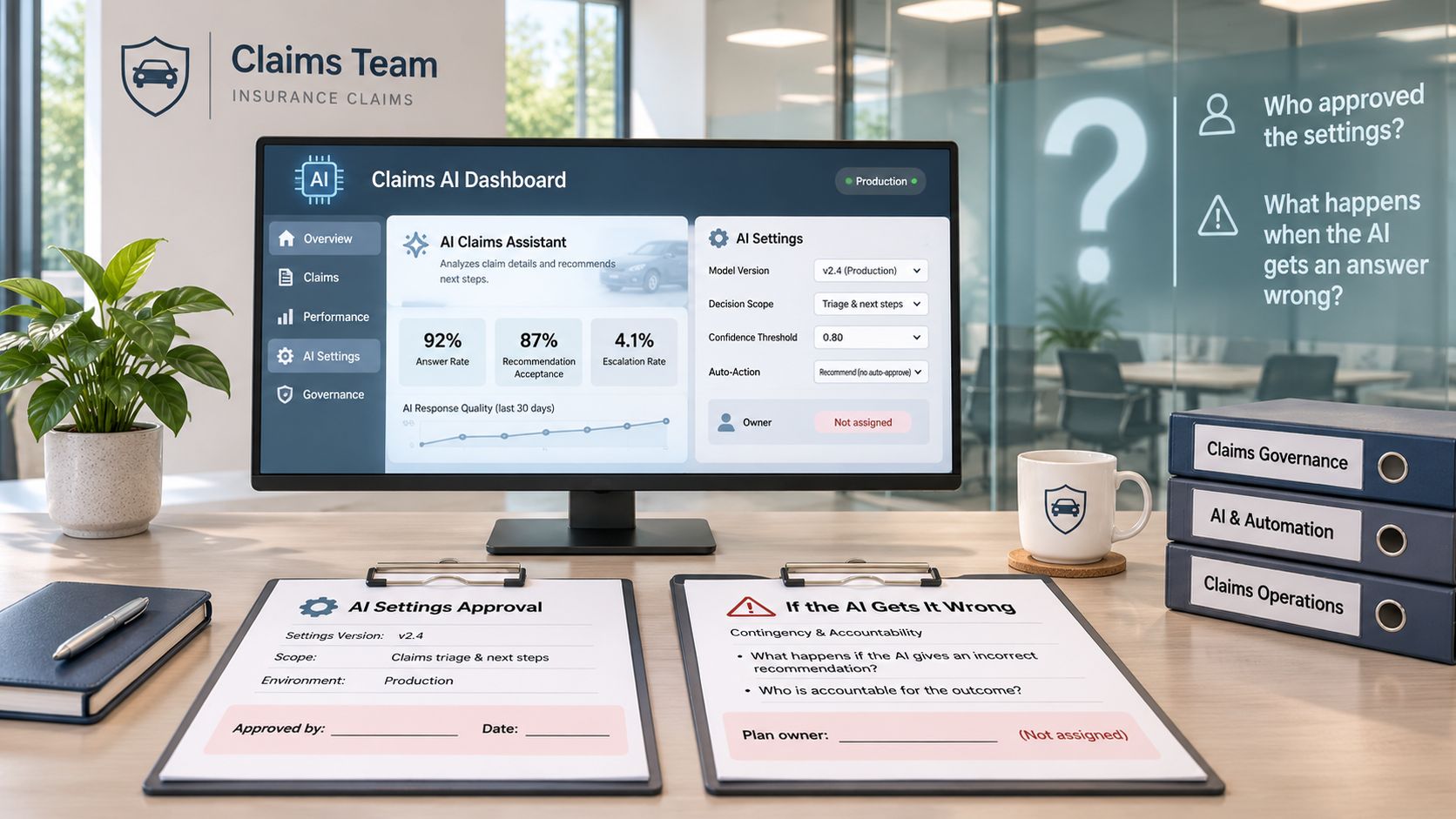
The claims team switched on an AI tool in January to sort incoming cases by urgency. By spring the backlog had cleared and everyone agreed it was working. Then a customer complained that her case had been marked low priority twice, and nobody in the room could say who had approved the model's settings, which version was live, or what the agreed process was when the tool got an answer wrong.
That isn't a technology failure. It's a governance failure of the most ordinary kind. The tool worked; the decisions around it were never written down, so nobody could defend them.
AI governance is the discipline that closes that gap. It covers the rules, roles, processes and records that decide how AI is selected, built, bought, used, monitored and retired, so an organisation can show that a system does what it's meant to do and can explain itself when it doesn't. This guide works through the principles, the risk levels European law now sets, and the ownership and budget decisions that turn a policy document into something that holds up under pressure.
Table of Contents
- What AI Governance Means in Plain Terms
- The Four Risk Levels Every Organisation Must Map
- Who Owns AI Decisions Inside an Organisation
- Risks That Governance Must Control First
- Key EU AI Act Dates for 2026 and Beyond
- How to Build AI Governance Step by Step
- Budget and Enforcement Decisions
What AI Governance Means in Plain Terms
A facilities coordinator notices a new option in the office software the company already pays for and switches it on. The feature now ranks maintenance tickets automatically. Nobody logs the change, nobody checks how the ranking works, and within weeks the help desk is fielding complaints about urgent requests sinking to the bottom of the queue. The vendor supplied the tool, but the organisation made the decision to run it, and the organisation is the one that has to answer for it.
AI governance is the evidence trail that lets an organisation show a system works: the approvals, records and checks that prove it behaves as intended and that reconstruct what happened when it didn't. Its purpose is narrow and practical, and it applies whether the system was built in-house, bought from a vendor or delivered as an update to software the company already ran.
Principles, structures and controls
Governance works in three layers, and organisations that build only the top one end up with statements nobody can audit.
- Principles set the standard, such as fairness, transparency, accountability, safety and privacy.
- Structures decide who chooses, who approves and who checks, including the committees and named owners who carry real authority.
- Controls are the specific checks run on each system, from access permissions and test records to approval gates and rollback plans.
Governance works like the steering and braking system of a car rather than the speed limit painted on the road. Regulators set the limit. Steering and braking belong to the driver, and they are what let a car take a corner safely and stop when conditions change.
A system nobody can explain after the fact was never governed, however well it performed.
The boundary is wider than many expect. A tool bought from a vendor, a feature switched on inside an existing package, a model reached through an API: all of it sits inside the same perimeter. The organisation still answers for the outcome, even when a supplier built the machinery.
The quickest audit is also the simplest. Pick any AI system currently in use and look for its record: what it does, where it came from, when it was last checked. If no entry exists, the governance around that system exists only as intent.
The Four Risk Levels Every Organisation Must Map
Most European organisations take their working vocabulary from the EU Artificial Intelligence Act, adopted by the Council of the European Union on 21 May 2024 and in force since 1 August 2024. The Council of the European Union's overview of the AI Act sets out the model at its centre: four risk levels, from unacceptable to minimal, each carrying a different expectation of the organisation that deploys it.
The framework reaches a growing share of businesses. More than 13% of EU businesses used at least one AI technology in 2024, against 8% in 2023, according to Eurostat's digitalisation analysis. Each of those adopters has at least one use case to classify.
| Risk level | Typical examples | What the organisation must do |
|---|---|---|
| Unacceptable | Social scoring, harmful manipulation, certain biometric practices, emotion recognition in workplaces or schools | Do not deploy; the practice is prohibited |
| High | Critical infrastructure, recruitment, education, law enforcement, migration, access to essential services | Risk management, data governance, logging, human oversight, accuracy testing, incident reporting |
| Limited (transparency) | Chatbots and AI-generated content | Tell users they are interacting with AI or viewing AI-generated content |
| Minimal | Spam filters, AI in video games | No new obligations; voluntary codes of conduct encouraged |
Reading the table in practice
Unacceptable risk is a short list of practices banned outright. Emotion recognition in a workplace or a school is the clearest example for most managers, because it can sound like a harmless engagement survey until someone describes the camera.
High risk covers the domains where a wrong output changes a person's life: recruitment, education, law enforcement, migration, access to essential services such as credit and benefits, and the running of critical infrastructure. A system that ranks job applicants belongs here. So does one that triages applications for a housing service.
Limited or transparency risk is the widest category in daily use. A customer-facing chatbot or an AI-generated image needs a clear label, not a committee. Minimal risk covers spam filters, AI opponents in video games and a recommendation row in a shop, where no new obligations apply and voluntary codes of conduct are the sensible next step.
Why the use case sets the level
The most common classification error is to label a model rather than a task. The same underlying model can be minimal risk when it drafts internal meeting notes and high risk when it screens CVs. Nothing about the software changed; the consequence of being wrong did.
Obligations attach to the deployment, which means the deploying organisation carries responsibility even when a vendor supplies the engine. Supplier due diligence is not a substitute for knowing what the system does inside the organisation's own workflow.
Three questions settle most classification arguments.
- What decision does it inform? A draft nobody acts on differs sharply from a score that triggers a rejection.
- Who is affected? Employees, applicants, patients, students and customers carry different exposure from internal analysts.
- Does it touch a listed domain? Where a use sits in recruitment, education, credit, migration or law enforcement, treat it as high risk until a competent authority says otherwise.
Who Owns AI Decisions Inside an Organisation
Ownership is where most programmes collapse. The tool sits in IT's estate, the contract sits with procurement, the risk sits with the business unit, and accountability sits nowhere. When a regulator or a customer asks who approved a change, the trail runs into a meeting nobody minuted.
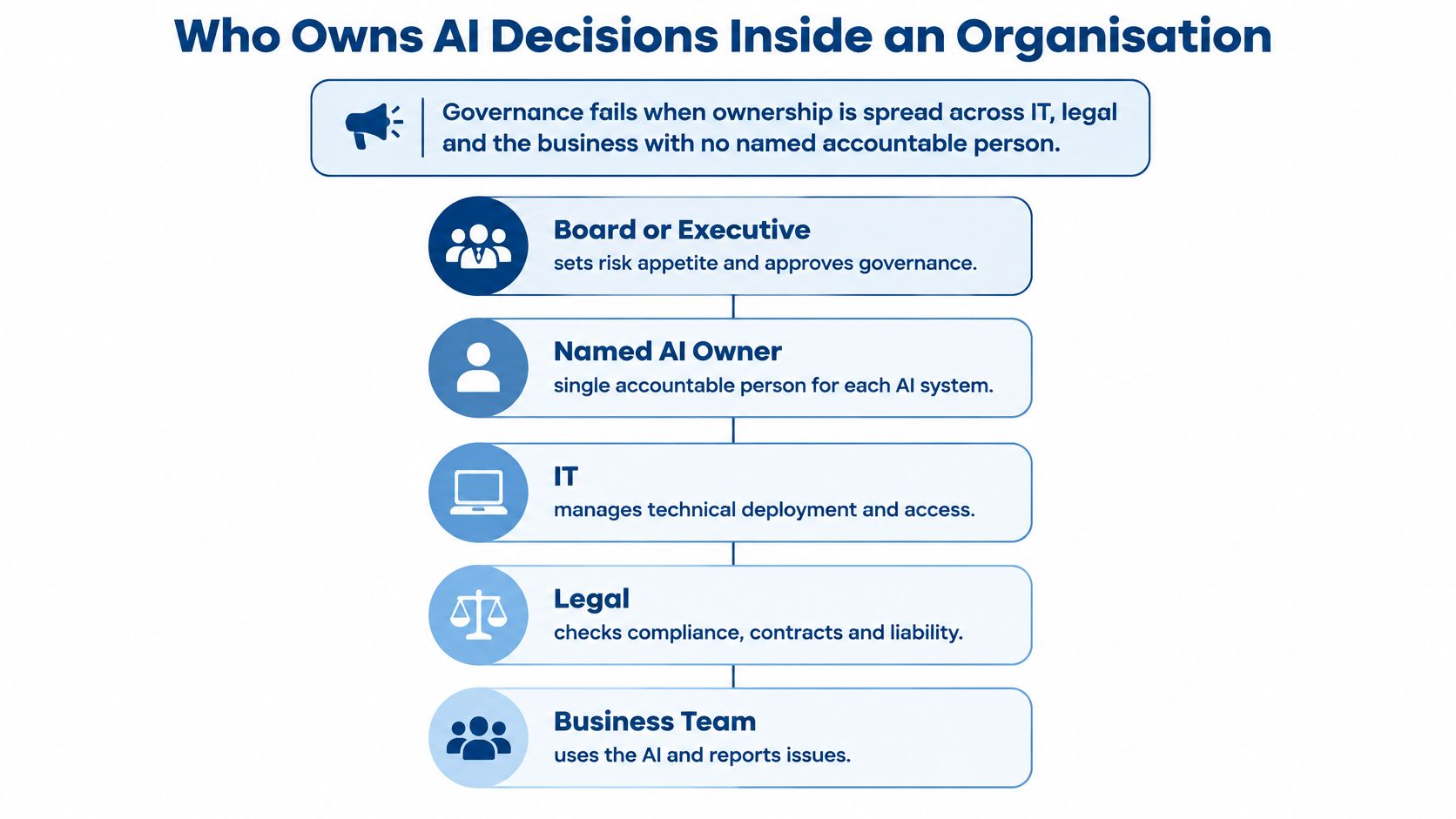
Governance fails when ownership is spread across IT, legal and the business with no named accountable person.
The fix is a short hierarchy with named people, visible to anyone who asks.
The roles that have to exist
At the top, a board or executive sponsor sets risk appetite and approves the governance approach, which means deciding how much risk the organisation will trade for speed. Below that, a named AI owner answers for each system from launch to retirement. IT handles technical deployment, permissions and monitoring. Legal checks contracts, compliance and liability, including what a vendor has promised and what it hasn't. The business team uses the system and reports issues, which only works if reporting is safe for the person doing it.
For small firms, one person often holds several of these roles. That's acceptable. What isn't acceptable is leaving the roles unwritten, because the first dispute reveals who was assumed to be responsible.
The named owner's job is more concrete than the title suggests. They write the intended-purpose statement, track performance against it, handle complaints and decide when the system should be retired. They are the person who says no. Leaders rethinking decision rights across a business will find related ground in this look at AI and automation implications for European leadership.
Supervision in Ireland is distributed by design
Ireland supervises AI through existing regulators rather than a single AI authority. The Department of Enterprise, Tourism and Employment's guidance on the EU AI Act explains that bodies including the Data Protection Commission, the Central Bank, the Health and Safety Authority, Coimisiún na Meán and An Coimisiún Toghcháin take responsibility according to the risks and sectors they already regulate, with a central coordinating function aligning enforcement. In 2025 Ireland designated 15 national competent authorities to oversee and enforce the Act, as the Department's announcement set out.
The practical consequence is that one system can need explaining to several regulators. A recruitment tool that scores candidates touches personal data, employment practice and, where the employer is a bank, prudential expectations. That argues for one internal framework and clear escalation routes rather than a separate compliance project per authority.
Two questions expose most ownership gaps. Who signs off on deployment, and who has the authority to stop the system? If the second answer names someone who has never been told, the framework is fiction.
Risks That Governance Must Control First
Deployment is running well ahead of control. An Ireland-focused IDC/SAS study found that 46% of surveyed organisations were already using agentic AI, yet only 9% had a formal AI-governance framework at the most mature level, and fewer than half, 44%, described their data infrastructure as managed or optimised, as reported in the IDC and SAS research on AI impact in Ireland. The gap is not academic.
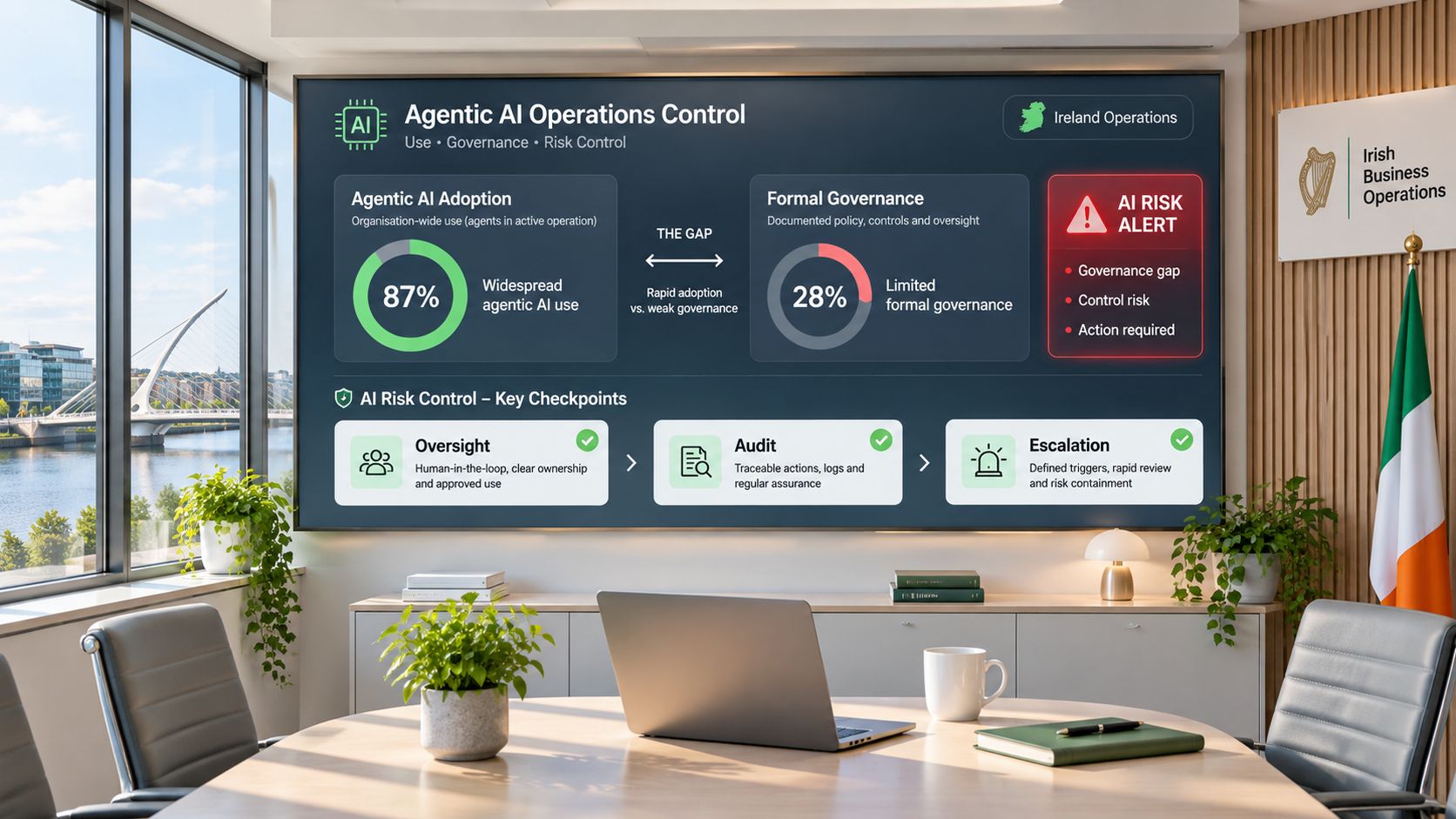
Agentic systems plan, call tools, modify records and run multi-step actions, so one wrong assumption can propagate through several systems before a person notices. Four risk families cover most of what goes wrong, and each has a matching control.
Data and security risks
Stale, incomplete or unauthorised data is the most common failure, and it stays invisible until an automated decision reaches a customer. An agent reading a customer record last updated two years ago will act confidently on the wrong facts.
Security risks arrive through the same door. Prompt injection tricks a system into ignoring its instructions, tool misuse turns a helpful integration into an unintended action, and data leakage pushes confidential material into logs or a third-party service. The controls are unglamorous: least-privilege access so an agent sees only what its task requires, approval gates before any consequential action, immutable event logs that record what was asked and what was done, and model and prompt versioning so every change can be traced.
Fairness and operational risks
Fairness problems surface where AI shapes access to work or money. A screening model trained on past hiring patterns reproduces them, and the damage lands on applicants who never see the reasoning. Testing against defined error and fairness thresholds before launch, then re-testing after any data change, is the minimum.
Operational risk is the family managers underestimate. Model drift degrades accuracy, a vendor retires an endpoint, or an update changes behaviour in a workflow nobody re-tested. Without rollback or kill-switch procedures, the only recovery option is a scramble.
Scaling rule: no agent gets a new permission until logging and rollback for its existing permissions have been tested in a live scenario.
Adversarial testing belongs in the same discipline. Prompt injection attempts, deliberate tool misuse, data leakage scenarios and out-of-distribution requests show where an agent's boundaries actually sit, as opposed to where the design document says they sit. Teams that want a structured method can build one through risk management training rather than inventing a framework mid-incident.
The management signal is straightforward. AI scaling should follow control maturity, never lead it. An organisation that can't reconstruct why an agent acted last Tuesday isn't ready to give that agent a bigger role next month.
Key EU AI Act Dates for 2026 and Beyond
A compliance calendar only earns its place when it changes ownership, evidence and spending. Ireland's AI Office guidance on compliance obligations sets out the staged timetable; read each date as an operations prompt that decides which systems need a named owner first.
| Date | Milestone | Who it mainly affects |
|---|---|---|
| 1 August 2024 | Act entered into force | All organisations placing or using AI in the EU |
| 2 February 2025 | Prohibitions and AI-literacy duties began to apply | All providers and deployers |
| 2 August 2025 | General-purpose AI rules and governance arrangements began to apply | Providers of general-purpose AI models |
| 2 August 2026 | Transparency duties and most remaining rules and enforcement began | Most organisations using AI |
| 2 August 2027 | Operational AI regulatory sandbox is expected in each Member State | Innovators and regulators |
| 2 December 2027 | High-risk rules for Annex III systems will apply | Deployers of listed high-risk systems |
| 2 August 2028 | High-risk rules for AI in regulated products (Annex I) will apply | Manufacturers of regulated products |
What the timetable now demands
The early duties are already live. Prohibitions and the AI-literacy duty have applied since 2 February 2025, so an organisation that has not trained staff on how AI is used is carrying an overdue obligation rather than a future one. Rules for general-purpose AI models and the related governance arrangements have applied since 2 August 2025.
The 2 August 2026 milestone has also passed: transparency duties and most remaining rules and enforcement began then. If inventory and risk classification are still incomplete, transparency work has nothing reliable to describe. A customer-facing chatbot cannot be labelled correctly if nobody recorded that it exists.
Later dates reward sequencing. Member States are expected to have an operational AI regulatory sandbox by 2 August 2027 for supervised testing of novel products. High-risk rules for Annex III systems will apply from 2 December 2027, and rules for high-risk AI embedded in regulated products under Annex I will apply from 2 August 2028.
Use the table as a planning baseline, then have procurement and budget owners confirm the current wording with the competent authorities before a contract or spend decision depends on a date. Personal-data duties run alongside the AI timetable, so a system handling personal data will meet both regimes; this guide to European data privacy laws for leaders explains the overlap that catches first-time deployers.
How to Build AI Governance Step by Step
Adoption is no longer a pilot question. The Central Statistics Office figures on AI use in enterprises show use more than doubling in two years, with adoption still heavily concentrated in the largest firms.
| Measure | Group | Value |
|---|---|---|
| Year | 2023 | 8.1% |
| Year | 2025 | 20.2% |
| Enterprise size | Large enterprises | 57.7% |
| Enterprise size | Medium-sized enterprises | 28.6% |
| Enterprise size | Small enterprises | 17.2% |
The size gap is the governance problem in miniature. Small firms meet AI the same way large ones already have: through features embedded in everyday tools rather than labelled projects, with data mining, language generation and workflow automation among the most common uses. Nobody held a go-live meeting for the feature that arrived in a routine software update. The first job is finding what is already running.
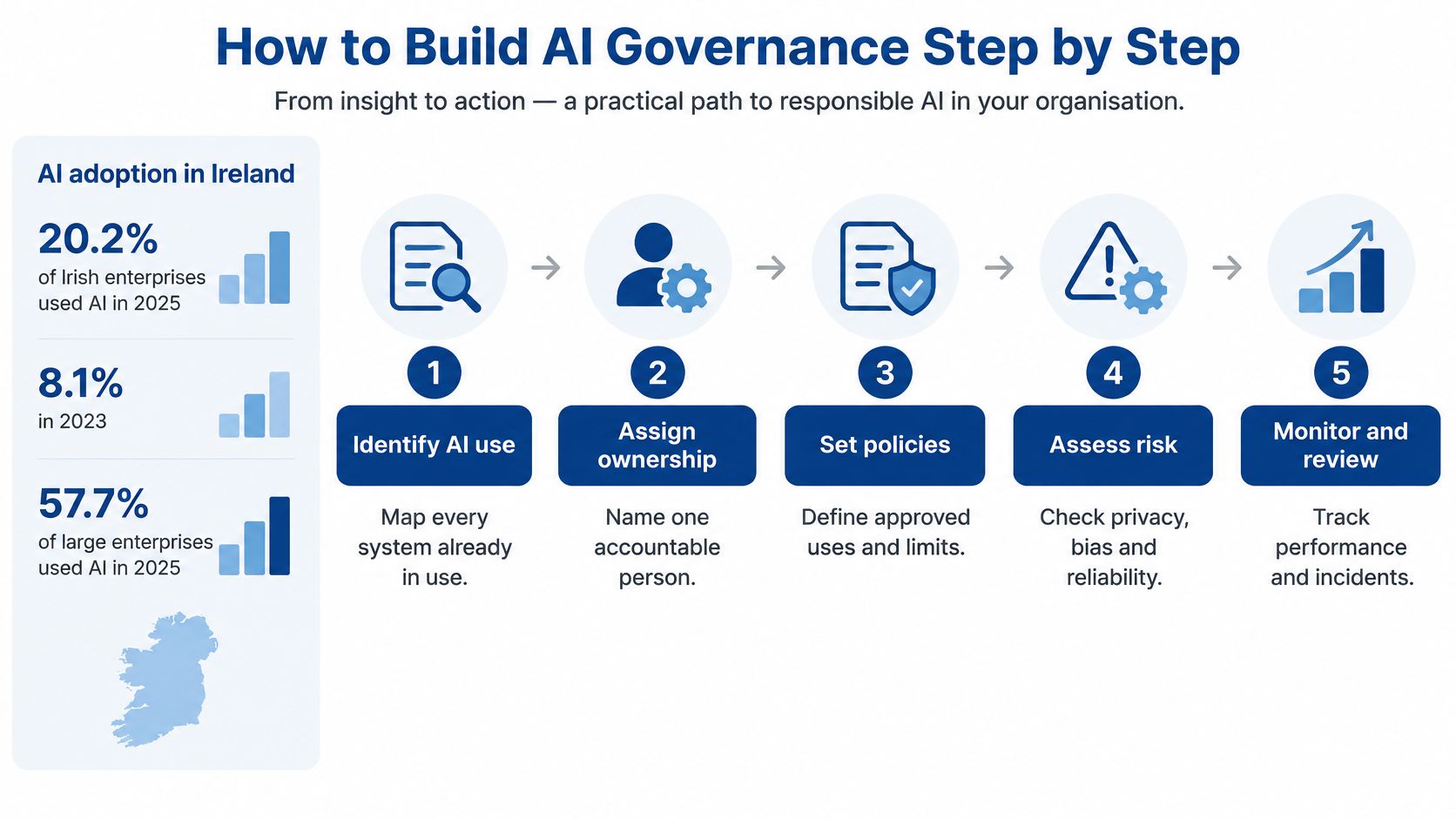
Seven steps that survive contact with reality
An AI register works like the asset ledger finance already keeps. Everything on it has an owner, a condition and a review date, and anything missing one of those is a liability.
1. Build an inventory. Record every system, including AI features inside existing software, with vendor, model version, data source, affected group and owner. A register compiled once describes last year's estate, so assign its upkeep to a standing role rather than a project with an end date.
2. Classify each entry. Apply the four risk levels and the three-question test to every line, judging the use case rather than the vendor. A trusted product can carry a high-risk deployment, and reputation is not a classification criterion.
3. Name one accountable owner and a backup, with written authority to pause the system. A name without that authority is decoration.
4. Set approval gates for consequential actions and define where human review is mandatory. Review lives or dies on allocated hours; a gate nobody is resourced to staff stays open.
5. Test before launch and monitor afterwards. Set error and fairness thresholds, schedule drift checks, and document a rollback and kill-switch procedure. The first incident is the wrong moment to discover there is no rollback plan.
6. Train people on limits and failure modes. Staff need to know what each tool is for, where it fails and when to escalate. A product demonstration teaches features and leaves the failure modes unlearned.
7. Review quarterly and retire. Re-check the register every quarter and retire anything that has lost its owner. Estates grow when nothing is retired, until nobody can describe what the organisation runs.
For managers who want the wider frame behind these decisions, the European Institute of Leadership and Management's Programme Certificate in Global Governance takes a multi-disciplinary approach to the complexities and challenges of governance on a global scale, which is the context in which sector rules and supervisory expectations keep shifting.
What a working register looks like in month one
Every system is listed. Each line carries an owner, a risk level, a test record and a review date, and each is also an allocation: review hours, testing time and a name to call when the system fails. Nothing sits on the list described as "under investigation" without a name against it.
That's a modest outcome, and it's the one that makes everything afterwards possible.
Budget and Enforcement Decisions
Money follows risk, or it should. Spreading a governance budget evenly across every system produces a register that is complete and useless, because a recruitment model and a spam filter receive identical attention. Tier the spend so high-risk systems carry heavier testing, logging and human-review time.
Four cost lines worth funding
- Inventory and tooling. A register people update, plus the discovery work needed to find embedded AI features.
- Owner time. Named accountability is an allocation of hours, not a job title added to an existing role.
- Testing and monitoring. Pre-launch evaluation, drift checks and incident rehearsals, sized to the risk level of the system.
- Legal and contractual review. Vendor terms, data processing arrangements and liability clauses, revisited whenever a model or purpose changes.
Enforcement of the remaining rules begins in August 2026, and the arithmetic shifts at that point. Until then, gaps are a management problem. After it, they're a supervisory one, and Ireland's distributed model means a single system can draw attention from more than one authority: the Data Protection Commission where personal data is involved, the Central Bank for financial services, the Health and Safety Authority for workplace safety.
The value question is as pressing as the compliance question. In the Central Statistics Office analysis of AI use in Ireland, 61.9% of Irish respondents reported lacking a structure for capturing value from generative AI, and only 51.3% believed their AI strategy would be compliant. Both figures point at the same gap: nobody has defined what good looks like, so neither benefit nor compliance can be demonstrated. Making that case in financial terms is the same discipline set out in this guide to building a business case.
Three measures for the board pack
The board pack needs the share of systems with a named owner, the share with a risk level and a test record, and the share reviewed in the last quarter. Three numbers, tracked over successive months, say more than a policy document ever will.
Board question: which AI system could we not explain to a regulator today?
The answer belongs next to the register figures, because it turns an abstract worry into a list of names and dates. If the list is short, the governance is working. If it's long, the next budget conversation already has its agenda.
Managers who want to build this capability rather than improvise it can study through the European Institute of Leadership and Management, which delivers fully online, self-paced courses and Mini-MBA programmes covering risk management, leadership, project management and global governance, alongside programme certificates in the same disciplines. The institute is a certified member of CPD Certification Service, and its programmes are built around practical responsibilities such as overseeing projects, managing teams and analysing governance arrangements. Visit European Institute of Leadership and Management to compare the current pathways and choose the one that matches the systems the organisation is accountable for.