
10 Essential Project Management Templates for 2026
More documentation won't fix a team's delivery problems. In a PwC survey of Irish project managers, 46% said their organisations lacked the skills needed to exploit digital-tool opportunities, according to PMI Ireland's account of the findings. A polished spreadsheet can record a deadline, but someone still has to challenge the estimate, confirm capacity and act when delivery slips.
That's why project management templates work best as operating agreements, not administrative paperwork. Each needs an owner, an update rhythm and a clear consequence when the information changes. Without those habits, a schedule becomes a picture of yesterday's intentions and a risk register becomes a filing exercise.
A useful template changes a decision, clarifies responsibility or triggers action. Otherwise, its maintenance needs questioning.
The templates below form a practical kit for planning, scheduling, managing risk, tracking delivery and reporting across the project lifecycle. They aren't a requirement to maintain every document on every project. A small internal improvement needs less structure than a construction programme or an organisation-wide system migration.
Each template earns its place differently. The important questions are where it helps, where it breaks down and how the team keeps it connected to actual work. The strongest starting point is the smallest set that makes scope, ownership, progress and decisions visible.
Table of Contents
- 1. Gantt Chart Template
- 2. Project Charter Template
- 3. Work Breakdown Structure (WBS) Template
- 4. RACI Matrix Template
- 5. Risk Register Template
- 6. Kanban Board Template
- 7. Project Status Report Template
- 8. Product Backlog Template for Scrum
- 9. Stakeholder Register Template
- 10. Project Closure and Lessons Learned Template
- The 10 templates compared
- Building Your Template Kit and the Skills Behind It
1. Gantt Chart Template
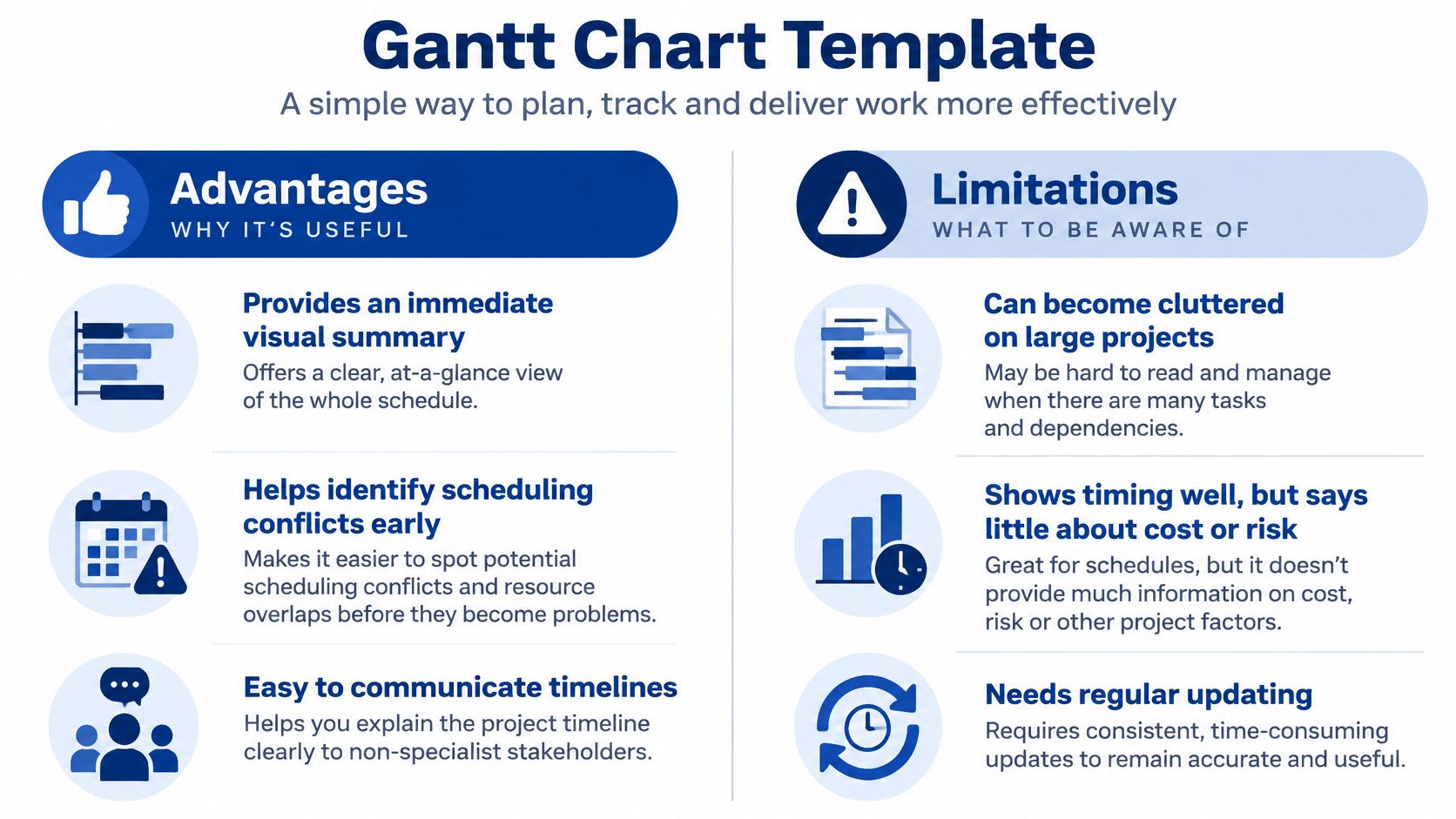
A Gantt chart maps tasks against a timeline using horizontal bars, with fields for start dates, finish dates, durations and dependencies. Its real value isn't the coloured bars. It's the ability to show how a delay affects subsequent work.
For a construction project, foundations, framing and electrical installation need explicit sequencing. For a software release, development, testing and deployment need coordinated windows, even when some activities run in parallel.
Make dependencies credible
The task list should come from the work breakdown structure, rather than being invented while drawing the chart. Each activity needs an owner, realistic duration and dependency logic that the delivery team has checked.
- Preserve the baseline. Keep the approved schedule separate from the current forecast so slippage remains visible.
- Check the critical path. Identify the dependency chain controlling the finish date and reassess it when durations change.
- Separate detail from oversight. Use workstream views for delivery teams and milestone views for sponsors.
Where it fails: manually coloured spreadsheets don't automatically calculate critical paths or downstream effects. A chart also becomes misleading when the same specialist is scheduled for overlapping work without a capacity check.
The project manager should update actual progress before status meetings, then discuss exceptions. Moving every unfinished bar forward without explaining the variance hides the problem rather than managing it.
2. Project Charter Template
A project can have an enthusiastic team and still lack permission to spend money or make decisions. The project charter establishes that authority during initiation, naming the sponsor, project manager, objectives and boundaries.
Ireland's public-service project management resources include charter, business-case, initiation, execution and review templates, positioning documents within a governance lifecycle rather than as isolated forms. That distinction matters: the charter authorises delivery, while the business case explains why the investment is justified.
Establish authority before detail
For a government digital service, the charter should confirm the policy objective, budget boundary and accountable sponsor before procurement begins. For an internal process improvement, it should identify the operational outcome and the manager authorised to resolve competing priorities.
Useful fields include:
- Purpose and success measures. Define the problem and the evidence that would demonstrate improvement.
- Scope boundaries. Record deliverables and explicit exclusions.
- Authority and constraints. Name decision-makers, funding assumptions, deadlines and approval requirements.
Where it fails: vague objectives allow different stakeholders to approve different interpretations of the same project. A sponsor's signature doesn't resolve ambiguity if the document promises only better efficiency or improved collaboration.
Keep the charter short enough for decision-makers to read. The sponsor should approve it before detailed planning, and material changes should follow formal approval rather than quiet edits to the original document.
3. Work Breakdown Structure (WBS) Template
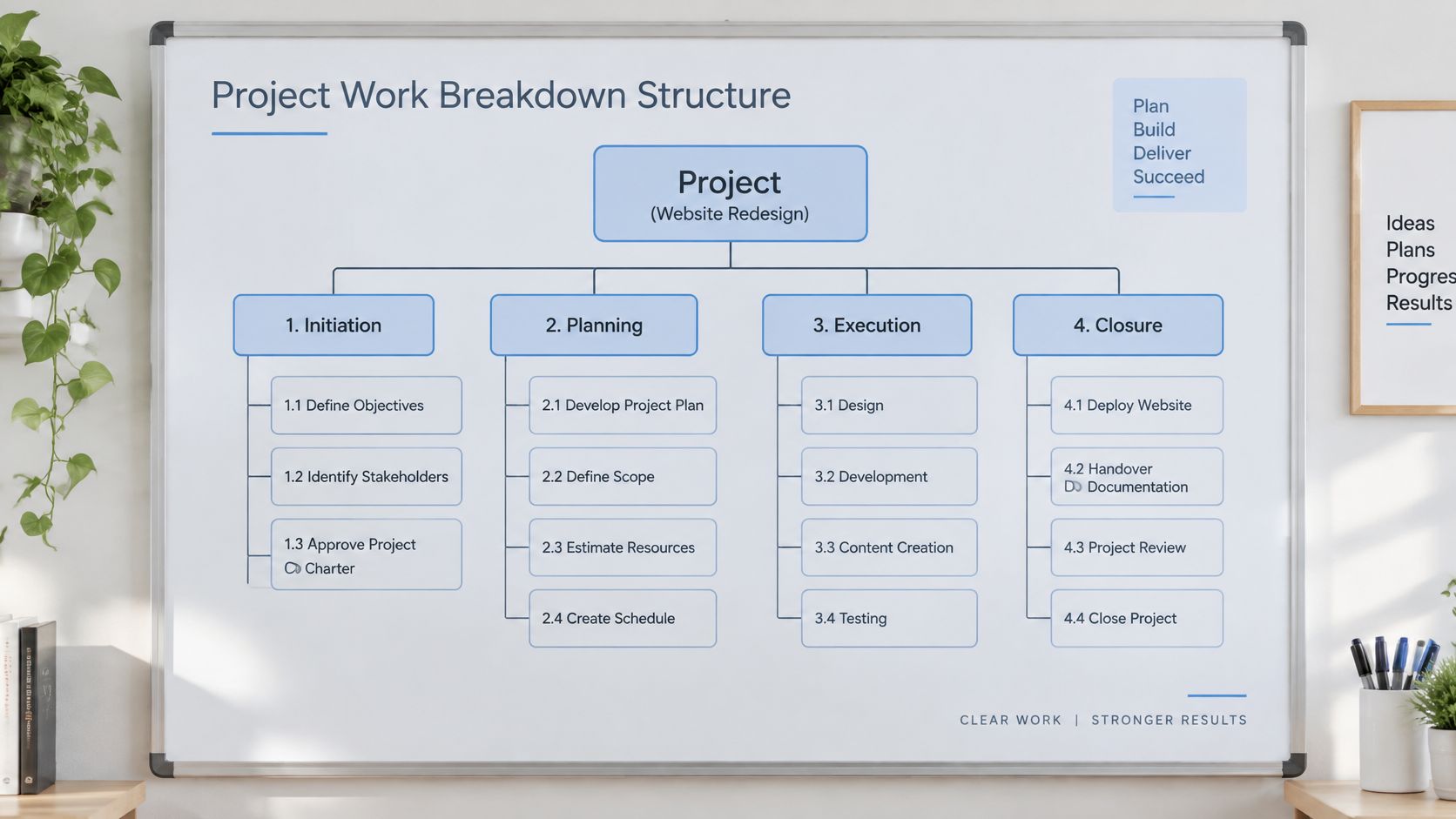
Before a team decides when work will happen, it needs agreement on what must be delivered. A work breakdown structure decomposes the full scope into deliverables and manageable work packages, providing the foundation for estimates, schedules and ownership.
For a website redesign, useful branches might include content, design, platform configuration and migration. Each branch then breaks into outputs that someone can estimate, produce and accept.
Define outputs, not just activities
A task labelled work on content says little about completion. An approved content inventory or migrated help centre gives the team something concrete to estimate and verify.
The template should assign each work package a stable identifier and link to a WBS dictionary describing its boundaries, owner, acceptance conditions and assumptions. The people doing the work should help define those entries.
Scope discipline: Every parent deliverable should be fully represented by its children, with no missing work and no unrelated additions.
Where it fails: excessive decomposition creates an administrative burden without improving control. Conversely, broad labels such as implementation can conceal testing, training and handover work.
The right stopping point is a package that can be estimated and accepted without ambiguity. Dates belong in the schedule; the WBS should remain the reference for scope, with changes assessed before new work enters the delivery plan.
4. RACI Matrix Template
The developer has finished, legal hasn't approved and marketing assumes the launch is authorised. A RACI matrix helps prevent that gap by separating delivery work from accountability and consultation.
Its labels mean Responsible for doing the work, Accountable for the outcome, Consulted before decisions and Informed about progress or results. Rows should represent meaningful deliverables or decisions, not every minor action.
Clarify decisions, not organisational status
For a cross-functional product launch, engineering might produce the release package while a named product leader accepts it. Legal may need consultation on customer terms without becoming the approver for every technical decision.
- Name the accountable individual. Avoid shared accountability that leaves everyone able to defer.
- Agree assignments together. The sponsor and contributors should confirm responsibilities before execution.
- Review at transitions. Accountability may move from a delivery lead to an operational owner during handover.
Where it fails: teams often confuse consultation with permission. When everyone becomes Consulted, routine decisions can acquire an unnecessary approval queue.
The matrix should specify which decisions require formal approval and which need advice only. Named deputies and escalation routes also matter when an accountable person is unavailable.
A RACI doesn't prove that someone has enough time or authority to fulfil the role. The project manager still needs to check capacity, resolve conflicting assignments and align the matrix with the stakeholder engagement plan.
5. Risk Register Template
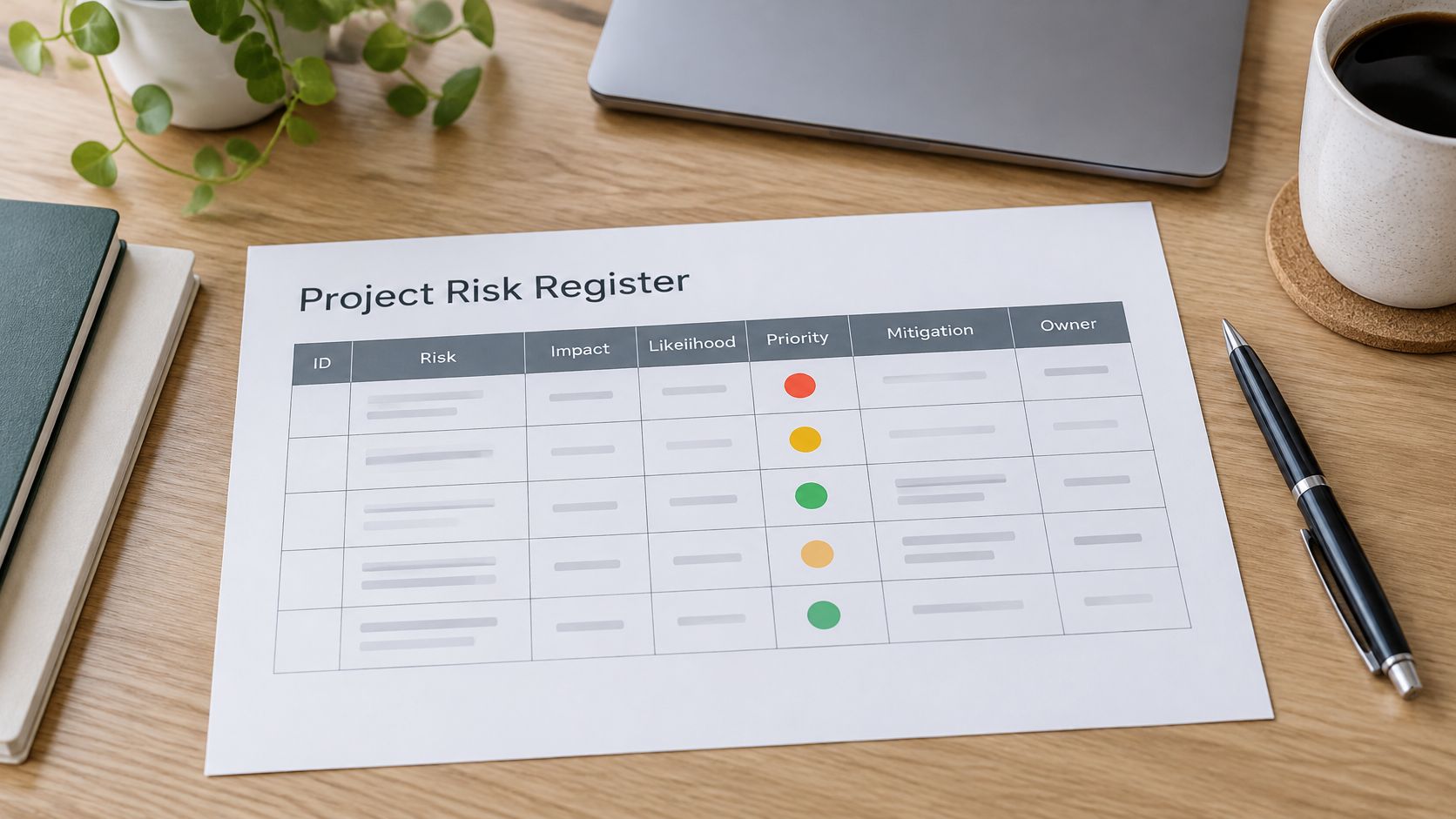
A risk register is useful only when somebody acts before the uncertain event becomes a current problem. Its core fields are risk description, likelihood, impact, owner, response, trigger and status, supported by a consistent scoring method.
For an IT migration, data loss and poor user adoption need different responses. Backup restoration tests address the former; representative user testing and training address the latter.
Turn concerns into responses
A useful description connects cause, event and consequence: because a supplier's specification remains unapproved, equipment procurement may start late, delaying installation. That wording gives the owner something to investigate.
- Assign a response owner. Someone must organise mitigation, not merely maintain the row.
- Record warning triggers. Define the evidence that requires escalation or contingency action.
- Review exposure. Reassess likelihood and impact after mitigation rather than leaving the original score unchanged.
Where it fails: elaborate scoring can suggest precision that the team doesn't possess. A high-impact risk shouldn't disappear from discussion because an uncertain probability produced a modest score.
Risk reviews should concentrate on changing exposure, overdue responses and decisions requiring sponsor support. Risks that materialise should link to the issue log; expired risks should be archived.
Understanding identification, analysis and response planning matters more than choosing colours, which makes structured risk management learning relevant to using the register properly.
6. Kanban Board Template
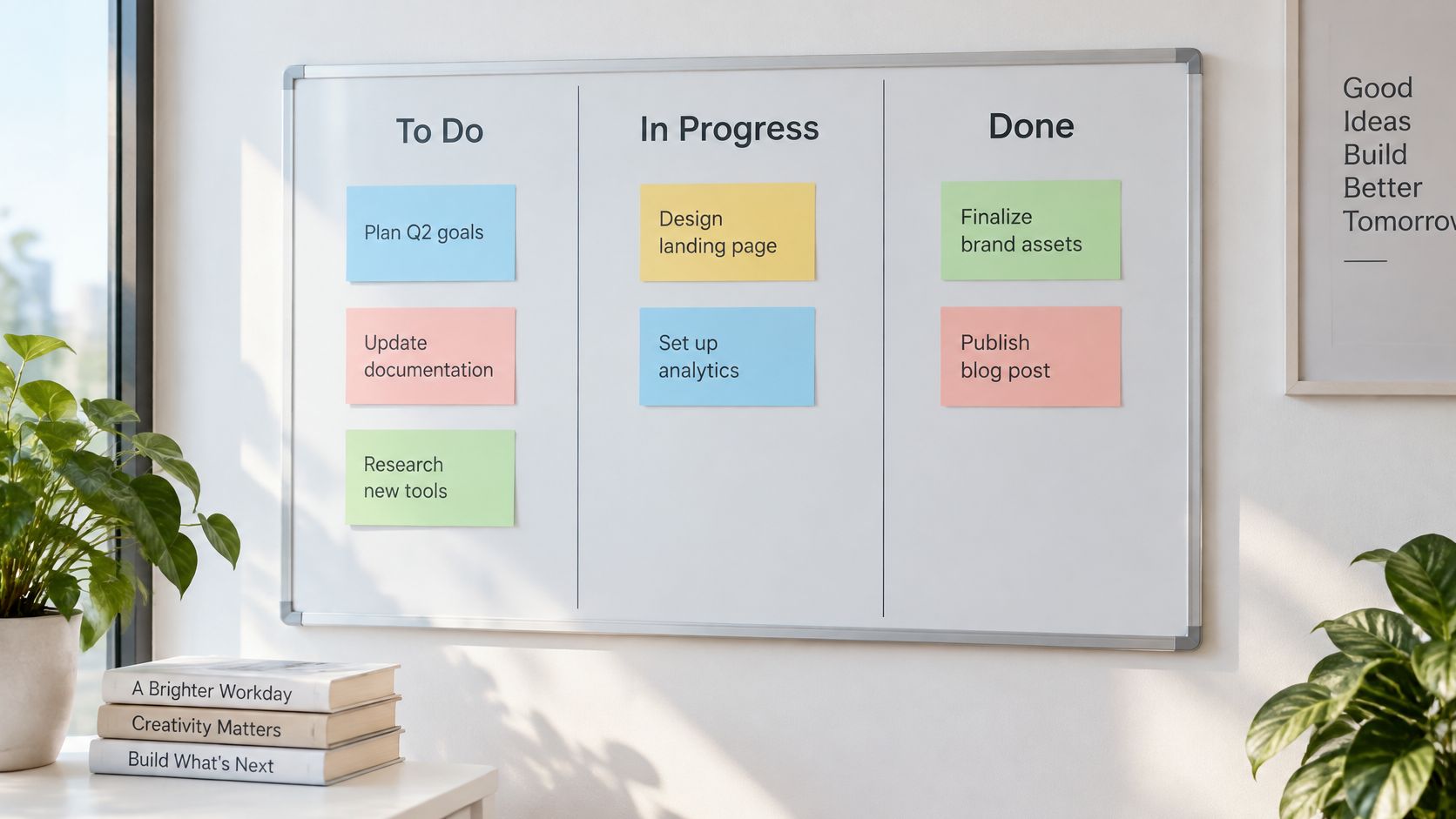
A Kanban board suits work that arrives continuously: support requests, maintenance tasks and operational improvements. Cards move through workflow columns such as To Do, In Progress, Review and Done, making queues and blocked work visible.
For a software support team, the board can distinguish unresolved incidents from items awaiting customer confirmation. That's more useful than a single list where started work and completed work look alike.
Control starts, not just finishes
Each card should show an owner, current status, acceptance conditions and any blocker. Columns should reflect the team's actual process, including review or external approval where work waits.
Work-in-progress limits are the operating discipline. When a column reaches its agreed limit, the team should help finish existing work rather than automatically starting another item.
A board covered in active cards may show overcommitment, not productivity.
Where it fails: a digital board can become a task warehouse when old cards remain open and urgent requests bypass the workflow. Hidden work makes both capacity and priority unreliable.
A short daily review should focus on blocked items, ageing work and what can finish next. Cycle-time trends can support forecasting, but the team needs consistent start and finish definitions.
Kanban doesn't replace project authorisation or milestone coordination. A fixed-date rollout may need a charter and Gantt chart alongside the board.
7. Project Status Report Template
The sponsor needs exceptions and decisions, not a diary of activity. A project status report should summarise progress against approved scope, schedule and budget, then identify risks, issues, upcoming milestones and required action.
For a public-service digital project, the most important entry might be a request to release a specialist from another department. A report that describes the resource shortage without requesting a decision leaves the sponsor guessing.
Make the report actionable
The opening should state overall health and explain any deterioration. Supporting fields should distinguish actual performance, the latest forecast and the approved baseline.
- Show variance. Explain what changed, why it changed and the expected consequence.
- Request a decision. Name the decision-maker, required response date and effect of delay.
- Link to evidence. Reference the schedule, cost tracker or issue record instead of copying inconsistent figures.
Where it fails: teams sometimes keep a project green because recovery remains theoretically possible. Status should reflect agreed tolerances and credible recovery plans, not optimism.
Automation needs controls too: 83% of respondents said the processes needed to govern AI use weren't yet in place in PMI Ireland's survey of project professionals.
AI-generated summaries therefore need source attribution and human review. Automated text shouldn't alter approved commitments or replace the project manager's explanation of uncertainty.
8. Product Backlog Template for Scrum
When requirements are uncertain, pretending to know every task at initiation creates fragile plans. A product backlog provides an ordered view of the work needed to improve a product, with detail increasing as items approach delivery.
In Scrum, the product owner is accountable for effective backlog management. Developers select work for a sprint through planning with the product owner, rather than receiving an assigned task list.
Keep the top usable
For a digital public service, backlog items might address eligibility checks, application submission and accessible confirmation messages. Each should describe the intended outcome and the conditions under which the team can accept it.
The template needs fields for value, acceptance criteria, dependencies, estimates where useful and links to supporting evidence. Not every item must use a user-story format.
- Order by value and risk. Arrival date alone isn't a useful priority rule.
- Refine near-term work. Clarify the top items before sprint planning.
- Connect to release expectations. Provide delivery forecasts without presenting uncertain scope as a fixed promise.
Where it fails: an oversized backlog accumulates obsolete requests and contradictory priorities. Regular removal matters as much as adding detail.
A backlog also doesn't make every project suitable for Scrum. The distinction between Agile and Waterfall methodologies helps teams decide where adaptive planning is useful and where fixed dependencies require stronger upfront coordination.
9. Stakeholder Register Template
A technically correct solution can still face resistance if affected people learn about it too late. The stakeholder register records who affects or is affected by the project, their interests, influence, expectations and engagement needs.
Ireland's analysis of digitalisation and the workforce identifies influencing stakeholders and colleagues across organisational silos as capabilities effective digital project managers need. Contact details alone won't support that work.
Plan engagement around impact
For an IT rollout, frontline users may have limited formal authority but substantial knowledge of operational failure points. Department heads may control resources, while service users can reveal accessibility or usability problems.
The register should connect each stakeholder group to an engagement purpose, communication channel, relationship owner and next action. Guidance on identifying and engaging key stakeholders supports that distinction between recording names and managing relationships.
Where it fails: a power-and-interest grid can encourage teams to overlook people with low organisational power. Influence isn't the same as exposure to change, so both deserve attention.
- Tailor engagement. Use demonstrations for users, decision briefings for sponsors and technical reviews for specialists.
- Record commitments. Capture promised follow-up and who owns it.
- Protect sensitive information. Keep entries factual, relevant and appropriately restricted.
The register should change when roles, project impacts or stakeholder concerns change. It should also align with the RACI without forcing every interested party into a delivery responsibility.
10. Project Closure and Lessons Learned Template
Launch isn't the same as closure. A closure template confirms deliverable acceptance, the final cost and schedule position, outstanding obligations, operational ownership and the release of project resources.
For a software launch, unresolved support arrangements can matter more than whether deployment succeeded. For an infrastructure project, acceptance should cover handover information and operating responsibilities as well as physical completion.
Close the obligations
Irish construction reporting highlights stronger experience in early-stage digital activities than in operations and information integration, according to the Build Digital survey findings. Closure documents should therefore confirm the usability and ownership of information, not merely that files were delivered.
Useful acceptance evidence includes approved deliverables, training records, operating instructions, access arrangements and a named owner for residual issues. The sponsor should formally accept closure before the team is released.
Make learning reusable: A lesson needs a specific change, an owner and somewhere it will be applied.
Where it fails: retrospective notes such as improve communication don't tell the next team what to do differently. A stronger recommendation identifies the missed approval, its consequence and the checkpoint needed to prevent recurrence.
Hold the review while details remain fresh, and include delivery contributors alongside decision-makers. Store lessons in a searchable shared location and use them to update templates.
Benefits that emerge after delivery need an operational owner and review arrangement. Project closure shouldn't imply that every promised outcome has already been achieved.
The 10 templates compared
| Template | Lifecycle Phase | Best For | Key Limitation |
|---|---|---|---|
| Gantt Chart Template | Planning and execution | Visualising task timelines, dependencies, and milestones | Can become cluttered on large projects |
| Project Charter Template | Initiation | Authorising a project and aligning stakeholders on its purpose | Early estimates may be inaccurate |
| Work Breakdown Structure (WBS) Template | Planning | Decomposing project scope into manageable deliverables | Does not show task sequence or dependencies |
| RACI Matrix Template | Planning and execution | Clarifying roles and accountability across teams | Can oversimplify complex governance |
| Risk Register Template | Throughout the project | Tracking risks, owners, and planned responses | Requires regular review to stay useful |
| Kanban Board Template | Execution | Managing continuous workflows and making bottlenecks visible | Limited support for long-term scheduling |
| Project Status Report Template | Monitoring and controlling | Reporting progress, risks, and decisions to stakeholders | Can become a box-ticking exercise |
| Product Backlog Template for Scrum | Planning and execution | Prioritising and refining work in adaptive projects | Budgets and final delivery dates can be harder to forecast |
| Stakeholder Register Template | Initiation and throughout the project | Planning stakeholder engagement and communications | Influence assessments can be subjective |
| Project Closure and Lessons Learned Template | Closure | Confirming completion and capturing lessons for future projects | Lessons may be recorded but not acted upon |
Building Your Template Kit and the Skills Behind It
The right template kit follows the project's decisions, not the size of the template library. A small internal improvement may begin with a short charter, a shared action board and a compact risk log. More structure becomes worthwhile when dependencies, stakeholder interests or approval requirements become harder to coordinate.
For an organisation-wide system migration, initiation should establish purpose, authority and investment justification. The stakeholder register identifies affected groups, while the WBS defines deliverables and acceptance boundaries before the team builds its schedule.
Sequence the documents around delivery
Once scope is credible, the Gantt chart can expose dependencies and the RACI can clarify decisions. During execution, the team can use a Kanban board or Scrum backlog according to how work is managed, while the status report summarises exceptions for the sponsor.
- Start with control needs. Select templates that address unclear scope, uncertain ownership, delivery dependencies or material risk.
- Maintain shared identifiers. Connect deliverables, tasks, risks and decisions without repeatedly copying descriptions.
- Define update responsibilities. Give every live document an owner, review rhythm and escalation rule.
- Retire duplication. Different views should draw on consistent information rather than require competing updates.
Templates can share a workbook or collaboration space without losing their distinct purposes. A small team doesn't need separate files to demonstrate formality, but it still needs clear approval records and a reliable current version.
The need for management capability is substantial: 32% of Irish enterprises identify management skills among their most important skills needs for organisational development, according to the OECD Skills Strategy Ireland. Completing forms isn't a substitute for learning how to estimate work, negotiate priorities, manage uncertainty and challenge unrealistic commitments.
Develop the judgement behind the fields
The European Institute of Leadership and Management offers self-paced online Project Management programmes for developing that lifecycle knowledge. Its Mini-MBA in Project Management covers initiation through closure, while the Programme Certificate in Project Management is aimed at current project managers, team leaders and people moving into project management roles.
Certificate verification and LinkedIn integration provide ways to document completed learning. These support the presentation of professional development; they don't replace evidence of applying the knowledge.
The practical takeaway is straightforward: begin with a manageable kit, maintain it through real review conversations and improve it after closure. A template earns its place when the team uses it to make a better decision, not when every field contains text.
The European Institute of Leadership and Management offers self-paced online programmes that develop the lifecycle knowledge behind project management templates. Visit European Institute of Leadership and Management to explore its Project Management learning pathways and choose a programme suited to current responsibilities or a move into project leadership.