Agile Project Management When Plans Must Change
The most repeated advice about agile delivery is that every team should sprint and that a plan is the thing you're supposed to abandon. Neither survives contact with an Irish or north-west European organisation that has a funding gate in the last quarter, a procurement rule it didn't write, and one regulatory file that must be signed before anything ships.
What predicts whether iterative delivery helps isn't the number of ceremonies a team performs. It's whether somebody drew the boundary correctly: which decisions get to move every fortnight, and which ones are fixed by the funding agreement, the statute or the safety case. Put that line in the wrong place and you get the worst of both worlds, an agile team that isn't allowed to change scope and a predictive plan pretending to certainty it doesn't have.
The walkthrough below starts with where agile sits beside waterfall in European practice, treats the four values as observable behaviours rather than wall posters, compares five delivery approaches on the constraints that decide between them, then goes through a fortnight of real work, a regulated workflow, and the staffing check that belongs before anyone renames a meeting.
Table of Contents
- Agile Project Management Beside Waterfall
- Values That Let the Plan Move
- Scrum Kanban AgilePM and Hybrid Compared
- Roles That Keep a Backlog Honest
- How a Two Week Cycle Runs
- When Regulation or Public Money Stays Fixed
- Pick the Method Before You Rename Meetings
Agile Project Management Beside Waterfall
Agile project management did not retire the plan. European practice shows the two running alongside each other, and the published figures are unembarrassed about it.
Grant Thornton Ireland's summary of State of Agile and European delivery practice reports that PMI's Europe edition of its 2021 Pulse of the Profession surveyed 716 project professionals in October and November 2020, inside a global study of 3,950. In the referenced comparison, waterfall still accounts for 44%, with agile and hybrid named as the other principal approaches. Organisations the report calls "gymnastic enterprises", those designed to respond quickly to disruption, were more likely than traditional enterprises to use the full spread of methods rather than settling on one.
Team-level adoption has climbed alongside that spread. The same Ireland-focused summary reports that the proportion of respondents saying all or almost all of their teams were agile rose from 8% in 2016 to 25% in 2018, a 17-percentage-point increase. Read the two findings together and the picture is clear: more teams iterate, and those teams still work inside organisations that hold budgets, stage gates and audit obligations.
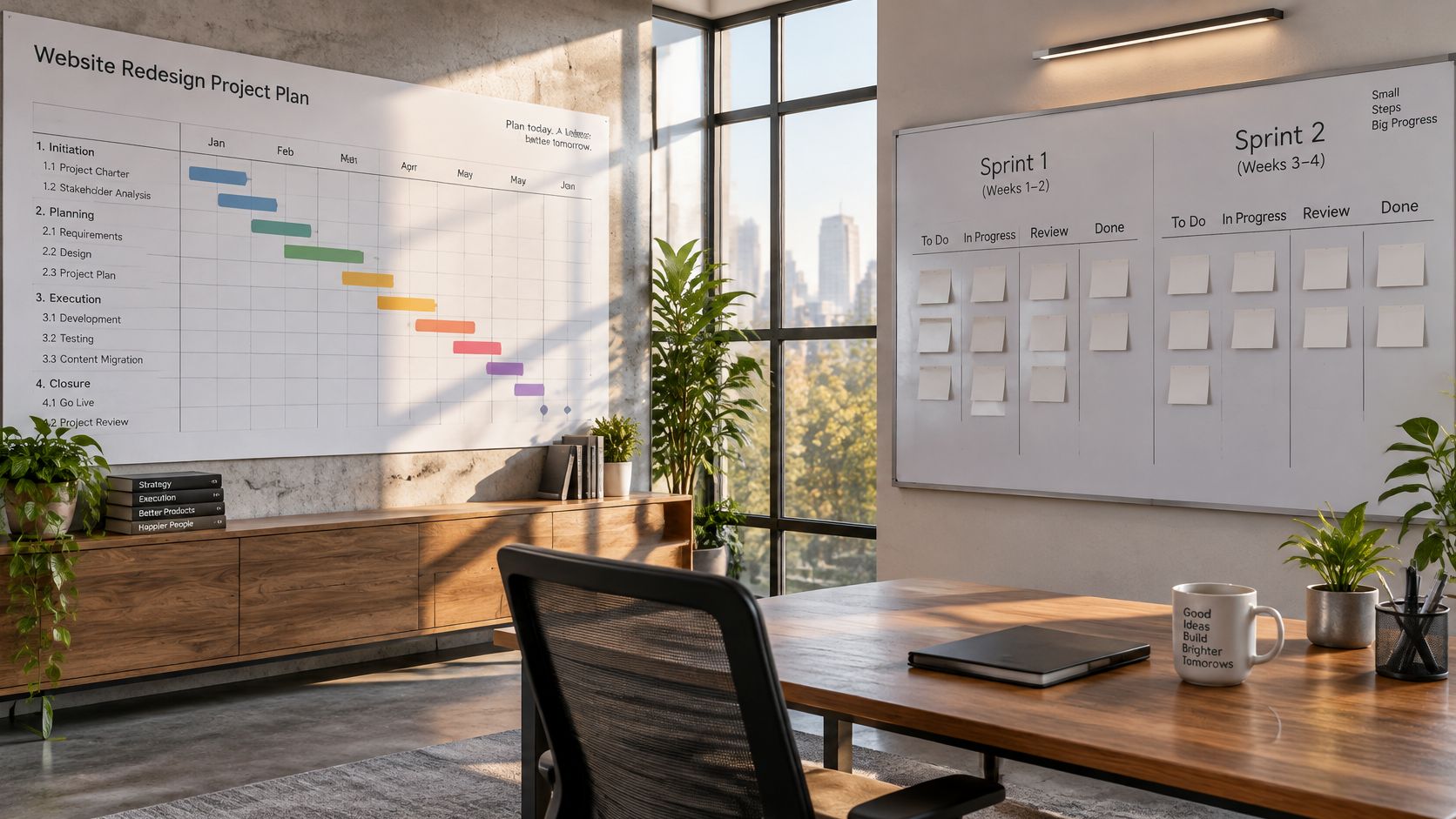
Strip the labels away and the practice is a loop with three moves. Deliver a usable slice of the outcome. Inspect it with the people who fund it or use it. Change the next slice while the business case still holds. Everything else, the boards, the stand-ups, the story points, exists to make those three moves reliable.
Tooling matters less than where the decisions sit. Two briefs look similar on paper and behave very differently once the work starts:
- Predictive brief: scope is settled first, then the date and cost are calculated from it. Change arrives later as a variation with a price attached.
- Adaptive brief: the date or the budget is fixed first, and scope is ordered by value and risk, so the cheapest thing to drop is also the least valuable.
The first protects the plan. The second protects the outcome. A team running an adaptive brief inside an organisation that signed a predictive contract will iterate diligently and change nothing, because every adjustment still lands as a variation somebody has to approve.
Values That Let the Plan Move
The 2001 Agile Manifesto is four preferences, not four prohibitions. That distinction decides whether a European programme can hold a fixed contract and still iterate.
Research published through Springer on the history and practice of agile development traces iterative and incremental practice back before the 1970s and shows Rapid Application Development feeding into the Dynamic Systems Development Method, DSDM, which gained substantial use in the United Kingdom, the Netherlands, Sweden and Denmark. The manifesto itself arrived in 2001, when 17 software professionals published it. North-west Europe was already delivering in short cycles long before the document formalised the idea.
The values are best read as a concept map rather than a creed, with people and conversation at the centre.
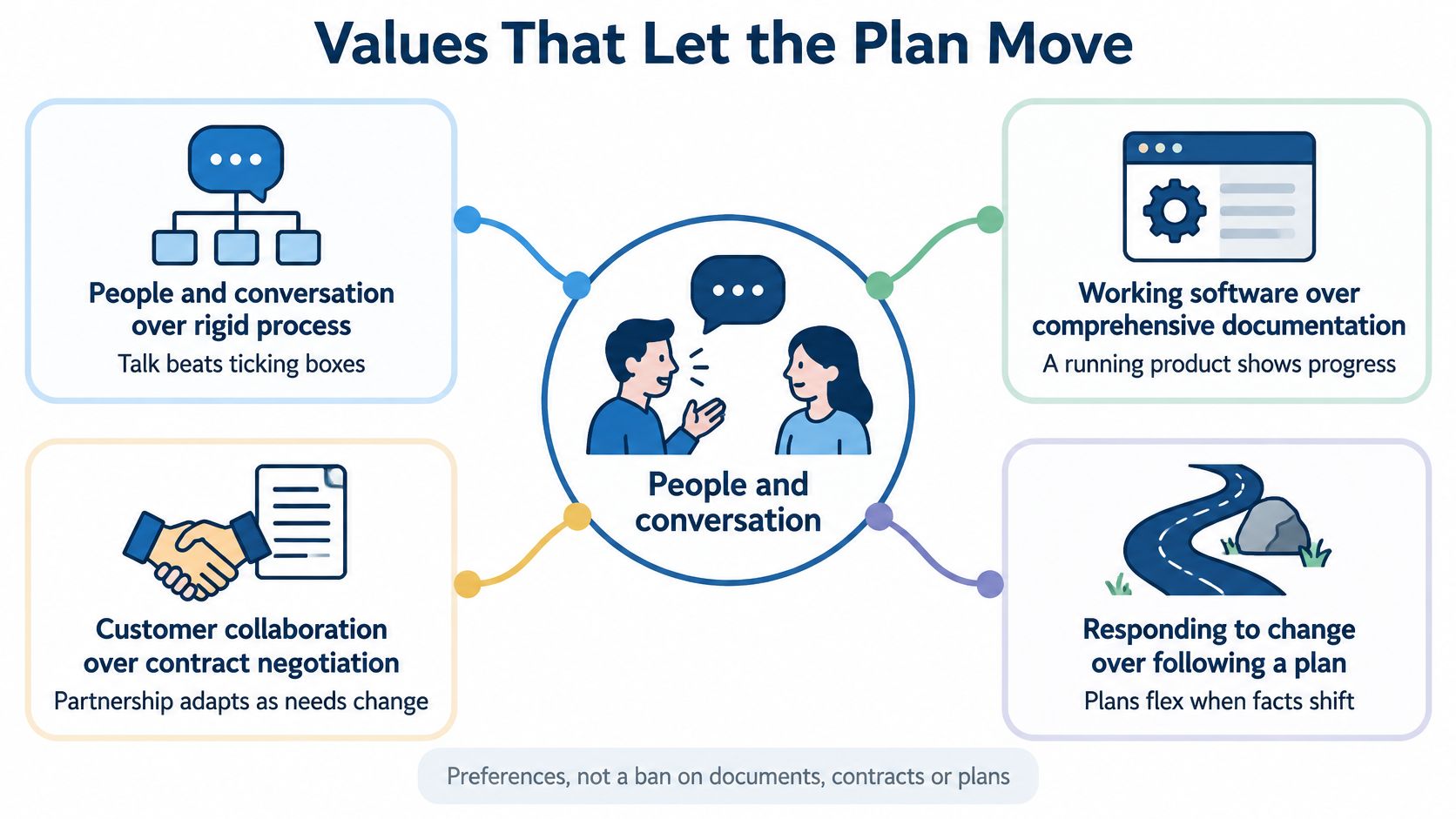
In everyday words: people and conversation count for more than rigid process; a working increment counts for more than a thick specification; collaboration with the customer counts for more than arguing over the contract; responding to change counts for more than defending a stale plan. The word doing the work is over. The items on the right still exist, and they matter most precisely when money, safety or procurement is involved.
For a manager, the twelve principles collapse into four behaviours you can observe in a room.
- Something usable ships early and often, not one big reveal at the end of the year.
- A change that still serves the goal gets accepted, including late, and the backlog records why.
- The people doing the work estimate it, and they talk often enough that blockers surface the same week.
- The pace holds for twelve months, and the team reflects on its own working agreements rather than waiting for a review.
Change the backlog, not the promise you made about risk, budget or safety.
Think of a city bus rather than a charter coach. The bus runs to a timetable and can still divert around roadworks. The coach has one locked destination and no route to spare, which makes it the wrong vehicle for a corridor that has to stay open. Moving from team-level iteration to a structure that can absorb it is covered in this guide to building an agile organisation for fast-changing markets.
Scrum Kanban AgilePM and Hybrid Compared
Decide the approach before teaching any ceremony. The table is the decision, and the paragraphs after it show how to read the rows.
| Approach | Use it when | Cadence | Control kept outside the team | Minimum roles |
|---|---|---|---|---|
| Scrum | Goal known, solution still emerging, team can protect a sprint | 1 to 4 weeks, often 2 | Product goal and release budget | Product owner, scrum master, developers |
| Kanban | Uneven demand, support or operations | Continuous flow with a work-in-progress limit | Policies and service levels | Flow lead and requesters |
| AgilePM or DSDM | Deadline or cost fixed, scope may flex, sponsors need a visible case | Timeboxes inside a project lifecycle | Business case, foundations, end-of-timebox review | Business sponsor, business visionary, project manager, team leader, solution developer |
| Hybrid | Audit, procurement or safety gates must stay fixed | Iterations inside stage gates | Funding, procurement, risk records, stage approval | Project manager plus a product owner for the package |
| Predictive waterfall | Requirements and design can be settled before build | Phases in sequence | Baseline scope, schedule and cost | Project manager, sponsor, specialists |
What each row is really protecting
Scrum protects a promise: for one to four weeks, the team's attention isn't up for grabs. It only works where a stable, cross-functional group exists and someone with authority can hold the line against drive-by requests. Where that authority is missing, the sprint becomes a two-week status cycle with extra meetings.
Kanban protects continuous flow. It suits support queues, small change requests and operations work where demand arrives unevenly and a fortnightly reset would be artificial. A work-in-progress limit does the job a sprint commitment does in Scrum: it stops the team starting more than it can finish.
AgilePM, built on DSDM, protects the business case and the deadline. Scope flexes inside timeboxes while sponsors keep sight of foundations and a formal review at the end of each timebox. DSDM has a long record of use in UK public-sector projects, so its governance language arrives already half-translated for Irish and British sponsors.
Hybrid protects the gates. Procurement, funding, safety and audit stay where the organisation put them, and work packages iterate underneath. Hybrid is a sound design when gates are fixed by statute or funding terms, and it is the common shape in public-sector delivery.
Predictive delivery is still correct when requirements, design and the compliance file can be settled before build. Some infrastructure packages fit this row because rework after irreversible construction is the dominant risk.
Three questions that pick the row
- Is the solution still uncertain? If yes, you need iteration somewhere, at team level or work-package level.
- Must the date or the cost stay fixed? If yes, scope has to be the flexible variable, which points to AgilePM, hybrid or a tightly ordered backlog.
- Must an auditor see a decision record? If yes, the record gets designed into the cycle itself.
When the answers pull in different directions, the fixed element wins the argument. A project answering yes to all three lands on the hybrid row, because it needs iteration, a bounded cost and a visible record at the same time. Renaming a weekly progress meeting a stand-up changes none of that. Only a change in decision rights moves a project to the Scrum row.
Roles That Keep a Backlog Honest
Each role is easiest to define by the decision it owns, because titles travel badly between organisations. Get the decisions right and the labels can be whatever the local HR system already uses.
Product owner
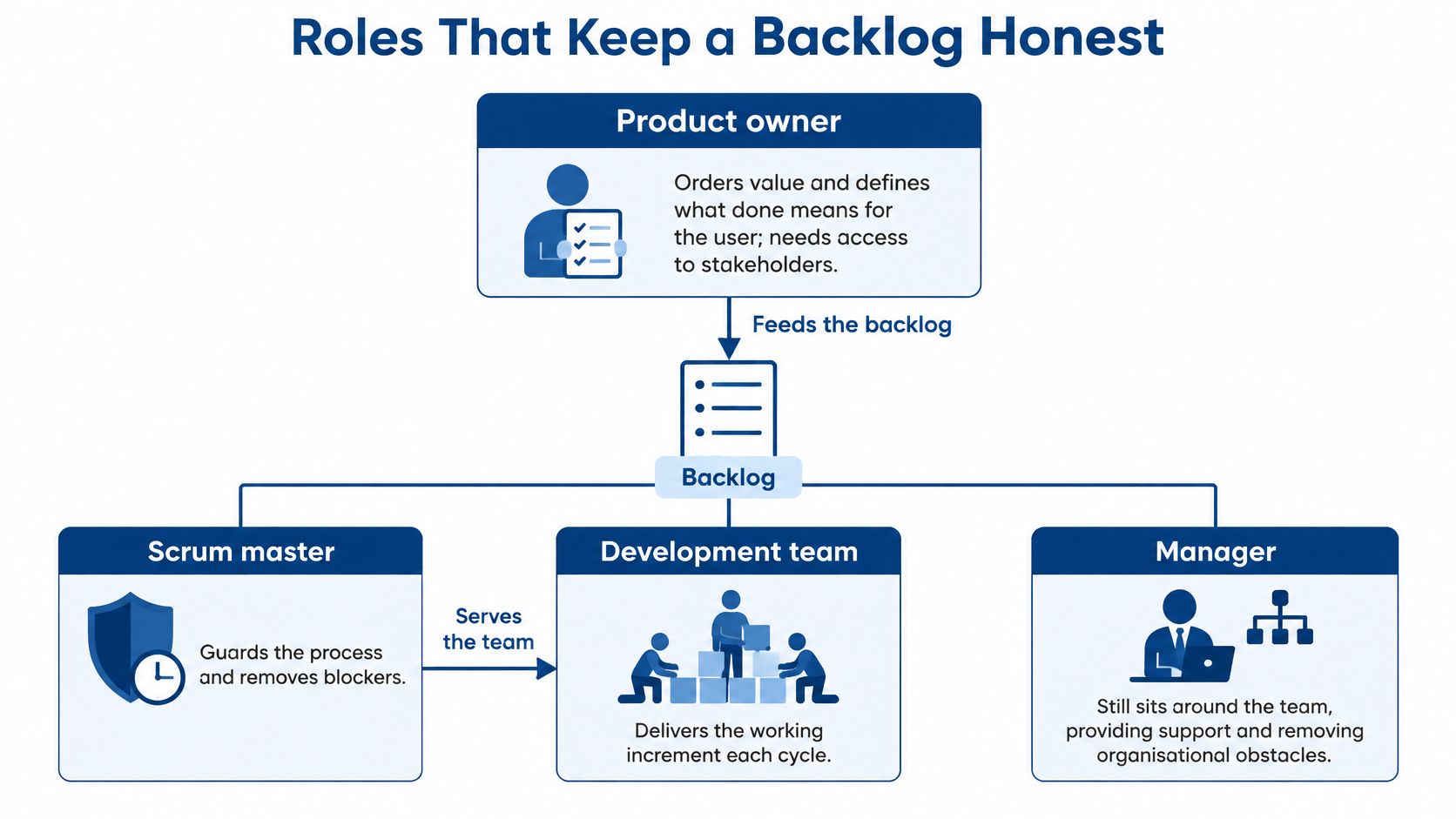
Owns what gets built and in what order, and defines what done means from the user's side. Two things make the role real: direct access to the people who use or fund the work, and the authority to say no to new scope mid-cycle. A product owner who has to queue for a steering committee to reprioritise isn't holding the decision, they're relaying it.
Developers and the scrum master
Developers covers everyone who creates the increment, whatever their job title: designers, analysts, testers, engineers. They estimate, design, build and test, and they keep quality inside the cycle rather than handing defects to a later phase.
The scrum master coaches the process and clears obstacles. Not a renamed project manager who assigns tasks, and not a minute-taker. The test is simple: if the scrum master spends the week chasing status updates for a report, nobody is guarding the process.
A visual reminder of who feeds the backlog and who serves the team.
The sponsor and the manager who stays
A sponsor or business visionary still owns why the money is being spent, and that ownership doesn't transfer to the team. Where a classic project manager remains, the useful work is suppliers, dependencies, risk and the stage gate, not moving cards across a board. This split is where most hybrid efforts fail: two people both believe they own priority.
Readiness test: if nobody in the team can refuse new scope during a cycle, the organisation has bought extra meetings, not these roles.
On a team of three to five, one person can combine product ownership with subject-matter expertise. They shouldn't also be the only developer, because priority and build collapse into one diary and the backlog starts reflecting whoever shouted last. Roles and reporting lines across a delivery function are set out in this overview of key project management roles and responsibilities.
A light time sketch for a two-week cycle: a few hours of backlog refinement spread across the fortnight, a daily coordination under fifteen minutes, a review of about an hour, and a retrospective of forty-five to sixty minutes. If the calendar shows more ceremony than that, something is being reported rather than decided.
How a Two Week Cycle Runs
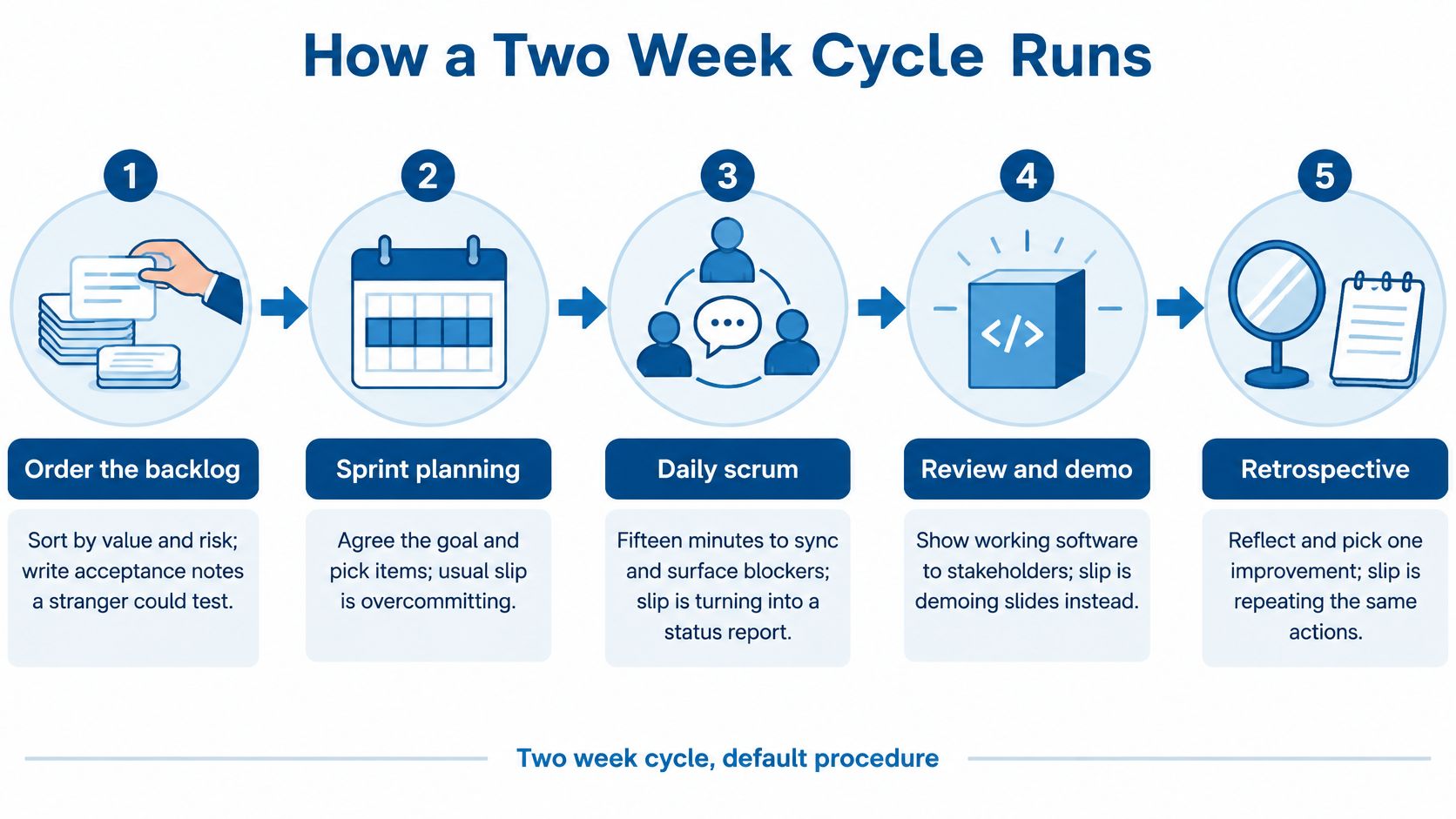
One two-week Scrum cycle is the default procedure. Each step below carries its reason and the slip that usually appears within the first month.
- Order the backlog by value and risk. Write acceptance notes a stranger could test without asking a question. Slip: items written so vaguely that "done" becomes a negotiation at the review.
- Agree the sprint goal in one sentence at planning. Pull only what the team believes it can finish, not what the sponsor hopes it can finish. Slip: overcommitting in the first week and dropping the goal by the second.
- Meet for about fifteen minutes each day to expose blockers, not to recite what everyone already knows. Slip: it becomes a status report delivered upward.
- Build a slice that could be shown, including the test or evidence that slice needs. Slip: building the part that's interesting and leaving the evidence for later.
- Demonstrate at the review to the people who use or fund the work, and change the backlog from what they saw. Slip: presenting slides about the work instead of the work.
- Change one working agreement in the retrospective. One, applied, beats a catalogue of complaints filed and forgotten.
What good interaction looks like off-site
An Ireland- and UK-based empirical study of 48 software-development teams across 46 small and medium-sized enterprises tested what builds shared tacit knowledge. Interaction quality had the stronger contribution, while transactive memory, the team's awareness of who knows what, did not mediate the relationship. In plain terms, talking well beat knowing who to ask.
That has an operational consequence for distributed teams in Irish and UK SMEs, where nobody can count on overhearing a decision. Keep work visible. Route a technical call to the person who holds that dependency. Then check whether the conversation resolved a dependency or exposed a risk. Ceremonies designed for substantive exchange do that. Ceremonies designed for reporting don't, and weak interaction shows up as duplicated work and a team that can't adapt inside its own iteration.
Kanban needs a coda rather than a second procedure. Replenish only when capacity frees up, cap the number of items in progress, and stop pretending a fortnight is a natural unit for a queue that arrives hourly. The discipline is the cap, not the calendar.
Three smells tell you the cycle has gone hollow. A stand-up that reports status, a review where no decision is taken, and a retrospective that changes nothing. Any one of them means the team is performing the ritual for an audience rather than using it to steer. The habits that keep delivery steady between cycles are covered in this lesson on project execution and control.
When Regulation or Public Money Stays Fixed
Three settings cover most of the regulated work in Ireland, and each draws the line between what iterates and what stays fixed in a different place.
Medical-device software
Irish medical-device software research published in the Journal of Software: Evolution and Process surveyed developers and found that approximately half still used a plan-driven software-development lifecycle. The perceived barriers were possible conflict with regulatory requirements, insufficient risk-management coverage and inadequate upfront planning.
The important part is the conclusion. Those barriers were primarily internal, especially stakeholder buy-in, rather than external constraints that made iteration incompatible with regulated development. So the design response is to build compliance evidence into the iteration itself:
- Define regulatory and safety acceptance criteria before implementation starts.
- Keep traceability from requirement through test and approval.
- Review risk controls inside every iteration, as a standing agenda item rather than an annual audit.
That addresses the exact failures practitioners named: ambiguous accountability, incomplete risk documentation, and the assumption that adaptive planning removes the need for early architectural or regulatory analysis.
Public projects and public money
Ireland's Department of Public Expenditure, NDP Delivery and Reform publishes project-management resources and Agile templates, which sets the expectation plainly: iteration runs inside the formal project frame. Demonstrations happen at work-package level. Procurement, stage approval, budget accountability and audit stay at fixed gates. Those gates work like canal locks: traffic keeps moving, but only through scheduled openings.
| Setting | Keep iterative | Keep fixed | Fails if you ignore the split |
|---|---|---|---|
| Medical-device software | Build and test cycles | Safety criteria, traceability, risk controls | Missing regulatory evidence |
| Irish public or NDP-style project | Work packages and prototypes | Procurement, stage approval, budget accountability | No audit trail or uncontrolled spend |
| Roads, greenways, active travel | Design options and stakeholder reviews | Consents, safety, contract sum | Rework after irreversible build |
| SME internal tool | Backlog order and sprint goal | Data protection and a commercial deadline if cash is tight | Endless discovery |
| Operations or support queue | Priority and flow | Policy and service levels | Local speed that breaks controls |
A small internal tool inside a private company can sit close to pure Scrum, because there is no statutory file to sign and the worst outcome is a wasted fortnight. A public-facing system in a controlled sector cannot borrow that freedom, and pretending otherwise is how teams end up rebuilding evidence retrospectively at the end of a release.
Business-case question: if this requirement changes next month, what record would an auditor need to see? Write the answer down before the first timebox opens.
That question is the same one a sponsor asks when approving spend, which is why the business case belongs inside the delivery cycle. Agile governance in these settings means short delivery cycles plus formal decision records, verification evidence and periodic compliance gates. The iteration keeps moving. The evidence is designed in from the start.
Pick the Method Before You Rename Meetings
Four decisions, in order, settle most of this.
1. Choose the row that matches the constraints. Uncertainty, whether the date or cost is fixed, and whether an auditor needs a decision record. Those three answers point to Scrum, Kanban, AgilePM, hybrid or predictive. The mapping depends only on the three answers.
2. Check capacity before changing vocabulary. Ireland's specialist pipeline is tight. Approximately 168,800 digital specialists were employed in 2025, demand is projected to exceed 215,000 by 2030 under the baseline scenario, and the annual gap could reach about 5,500 specialists, or as many as 7,700 in a high-growth case, according to the Department of Enterprise, Tourism and Employment report on digital-specialist demand. A thinly staffed team gains more from shrinking the method than from inventing a product owner, a scrum master and a delivery lead for a five-person project. One person combines product ownership with subject expertise, the team caps its own work in progress, and reviews stay short but real.
3. Judge the trial on decisions before velocity. Five measures tell you whether agile project management is improving outcomes rather than adding meetings: how long a decision takes from request to answer, what benefits have been realised, how many cross-team dependencies got cleared, how reliable the forecasts turned out, and whether stakeholders would recommend the process. Story points measure estimation consistency. The separate question is whether the organisation is getting value faster, and the five measures above answer it.
4. Close the capability gap through training, which tooling cannot supply. Where the shortfall is management skill across the lifecycle, a new board adds governance without adding competence. The Programme Certificate in Project Management is aimed at current project managers, team leaders and people moving into a project management role, which is the population that has to hold the boundary between iterating and staying fixed.
Then do the smallest possible thing this week. Pick the row. Name the person who can refuse scope during a cycle. Only after those two are settled, open the first timebox.
The European Institute of Leadership and Management teaches project delivery as a lifecycle discipline rather than a ceremony checklist, which is the mindset this boundary drawing demands. Its self-paced online programmes let managers study around existing responsibilities, and the Mini-MBA in Project Management covers the full project management lifecycle, from initiation to closure. The institute is a certified member of the CPD Certification Service, so visit European Institute of Leadership and Management to compare the project management pathways and start with the one that matches the constraints in front of you.