
How to Value a Business: Methods, Numbers and Next Steps
The most popular advice on how to value a business is also the most misleading. Owners are told to pick a multiple, apply it to last year's profit, and call the result a price. That shortcut ignores the three adjustments that move the answer: normalised profit, net debt, and the form of the sale after tax.
A buyer doesn't pay for a headline profit figure. A buyer pays for profit that will repeat under new ownership, converted into cash after the reinvestment the business needs, and adjusted for the debts and surplus cash sitting on the balance sheet. Two firms with identical turnover can be worth very different amounts, and the same firm can leave its owner with very different proceeds depending on whether it's sold as assets, shares, or a family transfer.
Table of Contents
- Choose the Valuation Method That Fits Your Business
- Normalise Earnings Before Applying Any Multiple
- How to Apply an Earnings Multiple
- Cross-Check With Cash-Flow and Asset Methods
- From Enterprise Value to Equity Value
- Special Cases Like Family Transfers and Share Sales
- Confirm Your Valuation Before You Act
Choose the Valuation Method That Fits Your Business
No single method is the answer for every company. The right starting point depends on whether profit is repeatable, whether the business mainly owns assets, and whether future cash flow can be forecast with any credibility. Most sensible valuations reconcile two methods rather than relying on one, because a second method exposes weak assumptions in the first.
An accountancy practice with contracted monthly fees and stable margins suits an earnings multiple. A property holding company with little trading activity doesn't, because its value sits in bricks and land rather than in trading profit. A loss making business usually can't support an earnings approach at all, since there's no maintainable profit to multiply, so it falls back on asset value or on a forecast that has to prove a turnaround.
What Each Method Actually Measures
| Method | Best suited to | Key inputs | What the result tells you |
|---|---|---|---|
| Earnings multiple | Profitable trading firms with stable profits | Normalised EBITDA and a sector multiple | Value implied by repeatable profit |
| Discounted cash flow | Growing firms with forecastable cash flow | Five-year cash forecast, discount rate and terminal value | Value of future cash, highly sensitive to assumptions |
| Asset-based | Asset-heavy firms, holding companies and loss-making businesses | Net asset value adjusted to market value | A floor value for what the business owns after debt |
| Market comparables | Firms where recent comparable sales exist | Recent transaction multiples for similar businesses | The price buyers have actually paid for similar firms |
The earnings multiple is the workhorse for profitable private companies, because it's quick and it's how buyers screen opportunities. Its weakness is obvious, namely that a poor profit figure or a borrowed multiple produces a poor answer very efficiently. Discounted cash flow handles growth better, but small changes to growth, margins, or the discount rate swing the result widely, so it rewards honest forecasting and punishes optimism.
The asset-based method restates each asset and liability at market value and deducts what's owed. That gives a floor, not usually a trading value, and it's the sensible anchor for a firm whose profit is thin or negative. Market comparables sound authoritative, yet private transaction evidence is patchy and rarely like for like, so comparables work best as a check on an earnings based figure rather than as a replacement for it.
Information Needed Before Choosing
An owner should assemble the evidence before arguing about methods. Without it, any method becomes guesswork.
- Three years of filed accounts: Buyers read the trend, not just the latest year, and they look for profit that appears once and then disappears.
- Current-year management accounts: Filed accounts can be nearly a year old, so recent trading either supports or undermines the story.
- A debt schedule: Every loan, overdraft, hire-purchase balance, and director loan needs a balance and a repayment date.
- A fixed-asset register: Book values rarely match market values, particularly for property, vehicles, and plant.
- Signed contracts with recurring revenue: Contracted income is worth more than hoped for repeat orders, and the paperwork proves which is which.
Practical rule: If profit is repeatable, start with earnings. If it isn't, start with assets or a forecast, and use the other method as a check.
That rule keeps the valuation honest. A profitable firm valued only on assets is probably understated, while a struggling firm valued only on an optimistic forecast is probably flattered. Reconciling two routes, and explaining any gap between them, produces a range an owner can defend to a buyer, a lender, or Revenue.
Normalise Earnings Before Applying Any Multiple
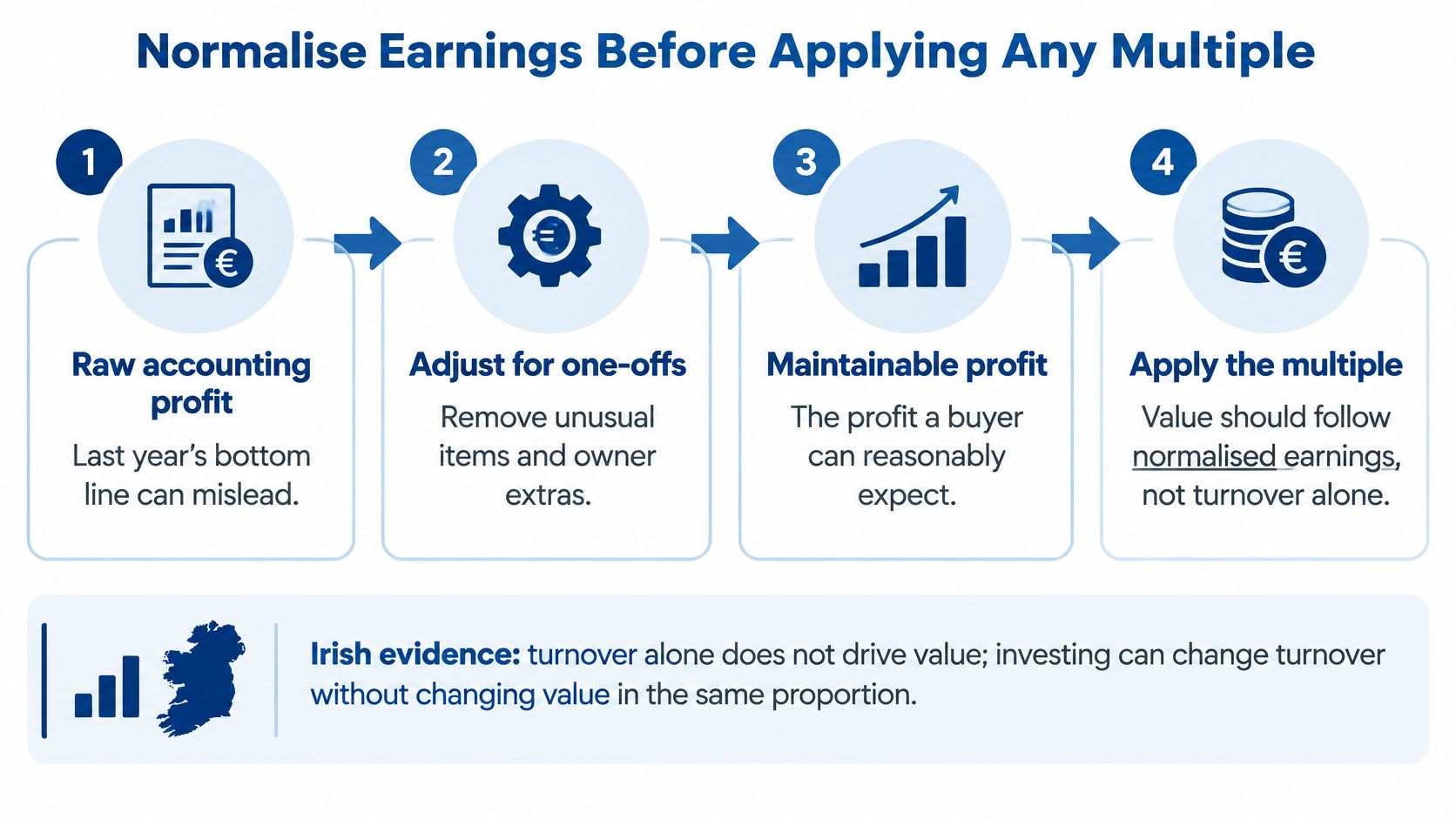
Raw accounting profit is the wrong starting point. It reflects how the current owner chose to run and reward the business, not what a new owner can expect to earn. Buyers pay for maintainable profit, so the first job is to strip out anything that won't repeat or that belongs to the owner personally rather than to the trade.
Turnover alone doesn't settle the question either. Central Bank of Ireland research on the drivers of SME investment found investing firms had average turnover of €5,272,772, compared with €3,698,784 for non-investing firms, yet average profit margins were 25% for investing SMEs and 27% for non-investing SMEs. Bigger, faster growing firms didn't automatically show fatter margins, which underlines why growth, reinvestment, and cash generation have to be examined alongside margin.
The Normalisation Steps in Order
- Start from EBITDA or operating profit for three years and the current year. A single year hides trends, and buyers will average or weight the years if performance has been uneven. A clear grasp of key financial statements and ratios makes this comparison far easier to follow.
- Add back genuine one-off costs. A legal dispute, a one-time refit, or an exceptional bad debt write-off shouldn't depress the value of the ongoing trade, provided the item will not recur.
- Correct owner-specific items. A director paid below market rate inflates profit, and one paid above it understates profit. The same applies to family members on the payroll, personal vehicles, and private expenses run through the company.
- Remove temporary benefits. Unusually cheap supplier terms, a one-off grant, or borrowing costs that are about to rise all flatter current profit in ways a buyer won't inherit.
- Test whether revenue is repeatable. Income from a single contract that expires next year isn't the same as income spread across hundreds of customers, and the valuation should say so.
- Deduct capital expenditure and working-capital needs to reach distributable cash. Profit that must be poured straight back into equipment or stock isn't available to the owner, however healthy it looks on paper.
- Record net debt separately. Debt belongs in the bridge to equity value, not buried inside the earnings figure.
A Worked Example
Say a firm reports accounting profit of €320,000. A legal bill of €60,000 from a settled dispute is added back, because it won't recur. The managing director, however, takes a salary €30,000 below the market rate for the replacement manager a buyer would need, so that amount comes off. The result is maintainable EBITDA of €350,000.
That figure is more defensible than either the raw profit or a version where every awkward cost has been added back. Owners who add back costs while ignoring an underpaid director present a number that collapses at the first serious question. Buyers challenge optimistic add backs first, then owner remuneration, then any revenue described as recurring without contracts to prove it.
A buyer doesn't dispute that costs were incurred. A buyer disputes whether those costs, or that income, will happen again next year.
Normalisation is therefore an evidence exercise. Each adjustment needs a document, a contract, or a market comparison behind it. Adjustments that can't be evidenced should be dropped, because they'll be dropped anyway during due diligence, usually at a point where trust has already been damaged.
How to Apply an Earnings Multiple
Applying a multiple is mechanical. Choosing a defensible multiple is where the judgement sits, and it's where most amateur valuations go wrong. Owners tend to borrow a multiple from a larger, faster growing business and apply it to unadjusted profit, which flatters the result twice over.
An Eight Step Procedure
- Take the normalised EBITDA. Don't substitute the accounting profit, because the buyer certainly won't.
- Confirm the business is profitable enough for an earnings multiple. A loss making firm needs the asset or cash-flow route instead, since multiplying a negative number produces nonsense.
- Select several comparable Irish businesses. Similar sector, similar size, and similar recurring revenue matter more than geographic convenience.
- Start from a screening benchmark. Irish business-brokerage benchmarks indicate a median EV/EBITDA multiple of approximately 4.0x, with a reported interquartile range of 3.0x–5.2x.
- Adjust down for risk. High customer churn, dependence on paid marketing, founder reliance, and weak differentiation all reduce what a buyer will pay for each euro of profit.
- Adjust up for quality. Documented retention, organic customer acquisition, proprietary processes, low delivery costs, and income spread across several services support a stronger multiple.
- Cross-check against revenue. The same benchmark set gives an EV/revenue median of about 0.9x, with a 0.65x–1.2x interquartile range.
- Reconcile both results into one range. Where the two routes disagree materially, the disagreement itself is information about margin quality.
| Multiple | Median | Interquartile range | How to use it |
|---|---|---|---|
| EV/EBITDA | 4.0x | 3.0x to 5.2x | Primary earnings-based screen for profitable firms |
| EV/revenue | 0.9x | 0.65x to 1.2x | Cross-check only; unreliable for low-margin firms |
What the Numbers Produce
Using maintainable EBITDA of €350,000, the arithmetic is straightforward. At 3.0x, enterprise value is €1,050,000. At 4.0x, it's €1,400,000, and at 5.2x, it's €1,820,000. That's a spread of €770,000 driven entirely by the choice of multiple, which is precisely why an unexplained multiple is so dangerous.
These benchmarks are screening points, not a definitive answer for any individual firm. Business mix, profitability, growth, customer concentration, and transaction size all affect comparability. A small firm dependent on its founder, with revenue concentrated in three clients, doesn't deserve the top of the range because the top exists.
Revenue multiples need particular caution. A heavily discounted, low-margin model can generate impressive looking sales while producing little distributable cash, so applying a revenue multiple overstates cash generation. If the revenue based figure sits well above the earnings based figure, the likely explanation is thin margins rather than hidden value, and the earnings figure should lead.
The output at this stage is enterprise value, meaning the value of the operating business before debt and cash are dealt with. It isn't the amount the owner receives. Confusing the two is the commonest reason owners think a fair offer is an insult.
Cross-Check With Cash-Flow and Asset Methods
An earnings figure that stands alone hasn't been tested. Two checks sit beside it, and each answers a different question.
The Two Checks
The asset-based check restates every asset and liability at market value, deducts debt and debt-like items, and treats the result as a floor. It matters most for a loss making or property holding company, where the trade earns little but the balance sheet holds real value. If the earnings value falls below the asset floor, a buyer may be better off buying the assets than the business.
The discounted cash flow check forecasts five years of free cash flow from the normalised figures, using retention, contribution margin, and reinvestment needs. Reading the statement of cash flows alongside the profit and loss account shows whether forecast profit turns into cash. The discount rate should reflect the specific risk of this business, then a terminal value is added based on the final year's cash flow.
Building Survival Risk Into the Forecast
Long range forecasts deserve more scepticism than next year's numbers. The Central Statistics Office Business in Ireland 2024 release reports that 13,633 of 26,910 enterprises born in 2019 were still active in 2024, a five-year survival rate of 50.7%. Earlier CSO business demography findings show the two-year survival rate fell from 72.3% for enterprises born in 2018 to 63.5% for those born in 2021.
Those figures don't create a multiple. They do justify applying greater risk to later forecast years and to terminal value, rather than one flat discount across the whole period. Say a firm with €350,000 of normalised EBITDA produces a discounted cash flow value well above its earnings value. The probable cause is optimistic growth or understated reinvestment, and those assumptions should be revisited before any range is chosen.
From Enterprise Value to Equity Value
The multiple prices the operating business. Equity value is the figure left for the owners once net debt, surplus cash, and the tax that follows from the form of the sale have been applied. Ireland makes that gap hard to wave away. The OECD Financing SMEs and Entrepreneurs 2026 report on Ireland states that SMEs represented 99.8% of all active Irish enterprises in 2023, that total SME bank debt declined from €18.4 billion in the first quarter of 2023 to €17.7 billion in the first quarter of 2025, that gross new lending to core SMEs reached €4.4 billion in 2024, and that 74% of Irish SMEs that did not apply for credit said they had sufficient internal funds.
Those patterns change the adjustments, not the multiple. Where retained earnings fund the trade and bank debt is modest, owner financing, undistributed profit, and unusually low debt costs have to come out of headline profit before a buyer will treat the earnings as maintainable. Reading the balance sheet is how you split cash the business needs to trade from cash a buyer will pay for, and how you catch balances that behave like debt under another label.

Walking the Bridge
- Subtract bank debt and overdrafts: These are repaid or assumed at completion, and either way they reduce what equity is worth.
- Subtract hire-purchase and lease balances: Equipment that looks owned often carries a balance that behaves exactly like debt.
- Subtract director loans and unpaid tax: Amounts owed to directors, Revenue, or other creditors are debt-like items, whatever label they carry.
- Add surplus cash: Only cash above what the business needs for payroll, suppliers, and working capital counts. Cash required to trade next month is not surplus.
Take the base-case enterprise value of €1,400,000. Deduct €400,000 of debt and add €150,000 of surplus cash. Equity value is €1,150,000. The €250,000 gap comes from debt and surplus cash.
The form of the sale moves the cheque again. On a share sale the buyer takes the company with that debt and that cash, so equity value is the start of the owner's proceeds, before tax on the shares. On an asset sale the debt often stays behind in the company, and tax on the disposal can sit between enterprise value and cash the owner can take out. I would run both routes from the same enterprise value and show the after-tax cash under each, rather than defend one headline multiple.
Sensitivity to Assumptions
| Scenario | Normalised EBITDA | EV/EBITDA multiple | Enterprise value |
|---|---|---|---|
| Conservative | €300,000 | 3.0x | €900,000 |
| Base case | €350,000 | 4.0x | €1,400,000 |
| Upside | €400,000 | 5.2x | €2,080,000 |
A 0.5x movement in the multiple on €350,000 of EBITDA shifts enterprise value by €175,000. A casually chosen multiple, or a profit figure that still contains owner financing, carries a price tag a buyer will challenge. Each assumption needs a written justification.
The owner's test: If the equity figure would not clear the debt and still leave the proceeds the owner needs, revisit the assumptions before anyone makes an offer.
Three scenarios, built from the same bridge, change the negotiation. The argument becomes which normalised profit, which net debt, and which sale structure both sides can evidence.
Special Cases Like Family Transfers and Share Sales
Many owners assume a lower value is safer when a business passes to family. In Ireland, that assumption can backfire. A valuation for a gift, inheritance, or family transfer usually serves a tax purpose, namely establishing the value of relevant business property for Capital Acquisitions Tax, and Revenue expects market value rather than a convenient figure.
Revenue guidance on Business Relief states that Business Relief can reduce the taxable value of qualifying business property by 90%, but eligibility depends on conditions covering the type of business, ownership, assets, and continued operation. That relief is generous, and it's conditional. Failing a condition can cost far more than any saving achieved by shaving the headline value.
Separations That Have to Be Made
- Operating assets from surplus or investment assets: Cash piled up beyond trading needs, or an investment property held inside the company, may not qualify in the same way as trading assets.
- Enterprise value from the transferred interest: A minority holding in a private company isn't worth a simple slice of the whole, because a buyer of that slice gains no control.
- Qualifying activity from excluded businesses and excepted assets: Revenue guidance recognises transfers of sole-trader businesses, partnership interests, and unquoted company shares, while requiring attention to excluded businesses and "excepted assets".
The valuation standard for gifts and inheritances is open-market value on the valuation date. For unquoted shares, that assumes a prudent prospective purchaser with access to the information such a purchaser might reasonably require, including financial statements, liabilities, assets, and trading prospects. It's the price a willing buyer would pay a willing seller, not the price the family would prefer to write down.
Because unquoted shares have no observable market price, each non arm's length disposal needs its own documented valuation. A management estimate, unsupported by method or evidence, is unlikely to establish market value if the figure is later examined. The paperwork matters as much as the arithmetic.
An unsupported discount can create more tax exposure than a carefully documented market-value assessment.
Professional tax advice becomes necessary in several recurring situations. Those include a share transfer between family members, a company holding significant surplus assets, a business that has recently restructured, and any valuation that will be reviewed by Revenue. Continuity requirements also need checking, because relief can depend on the business continuing in qualifying form after the transfer.
Owners planning succession should therefore commission the valuation with the tax position in mind from the outset. Retrofitting evidence after a transfer has completed is slow, expensive, and sometimes impossible.
Confirm Your Valuation Before You Act
A headline price isn't what an owner keeps. The same business, sold five different ways, can produce five different net results once tax, timing, and payment risk are counted. Comparing offers on price alone is how owners accept the worst deal on the table.
Five Routes Worth Modelling
- Asset sale: The buyer picks up selected assets and goodwill. Tax can arise in the company and again when proceeds are extracted, so after-tax cash needs calculating at both levels.
- Share sale: The buyer takes the company whole, including its history. Proceeds usually land with the shareholder directly, but warranties and retention amounts can hold money back.
- Management buyout: Payment often depends on the business's own future cash flow and on lender appetite, which affects both price and certainty.
- Family transfer: Tax relief may be available, yet eligibility, valuation evidence, and continuity conditions decide the outcome.
- Share-for-share restructuring: Consideration arrives partly as shares rather than cash, which changes both tax timing and risk.
On that last route, Revenue guidance on transferring a business to a company for shares and cash confirms the capital gain is apportioned, so the share element can generally defer the charge while the cash element is chargeable immediately, subject to statutory conditions. Legal form, not just operating performance, moves the final number.
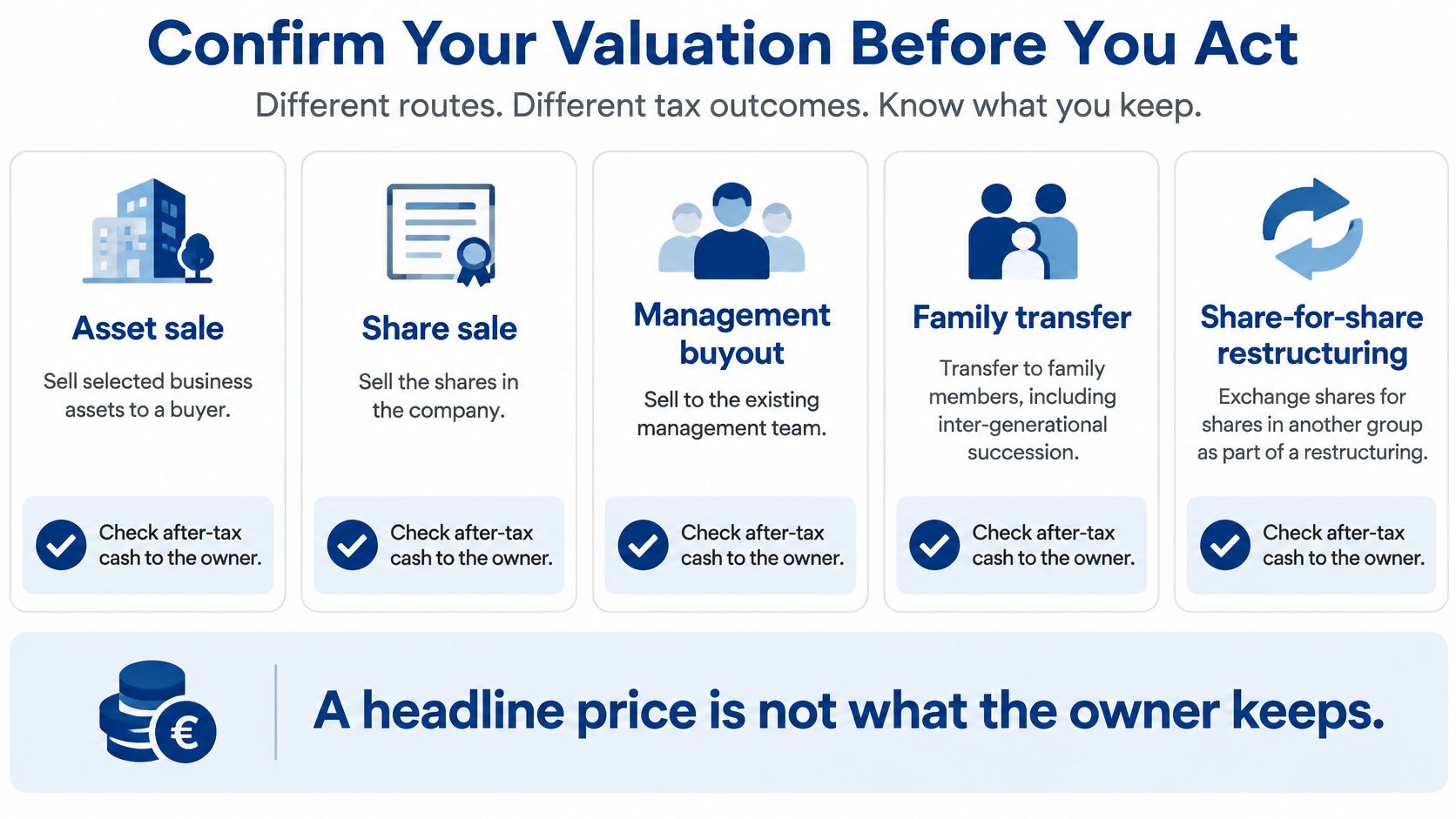
For each route, an owner should check after-tax proceeds, how much arrives in cash at completion, how much is deferred, and how much sits in an earn-out that may never be paid. Debt assumed by the buyer and working-capital adjustments at completion also shift the result, sometimes by more than the negotiating effort spent on price. Framing the decision properly, in the way a structured case for a decision is built in what is a business case, keeps those variables visible.
A Final Checklist
- Write down the method, assumptions, and evidence for each. An undocumented valuation cannot be defended.
- Model at least three EBITDA and multiple scenarios. A single figure hides how fragile the answer is.
- Calculate net proceeds for each sale structure. Tax and timing belong inside the comparison, not after it.
- Check how much of the price depends on future performance. Deferred and contingent money should be valued at less than cash on completion.
- Ask an accountant to review the tax position. Reliefs and conditions are specific, and generic guidance is not a substitute.
- Compare the result with the value needed. Retirement plans, debt clearance, and family commitments set a real threshold.
The sensible next step is a review with a chartered accountant before any offer is invited or accepted. That review tests the normalisation, the multiple, the bridge to equity value, and the net proceeds under each structure, while there's still time to fix weaknesses rather than explain them under pressure.
Owners who want to read these numbers with more confidence can build that grounding through European Institute of Leadership and Management, which offers self-paced online study in accounting principles, financial concepts, and financial management for business owners and managers. Working through its accounting and Mini-MBA Financial Management material gives owners the vocabulary and statement reading skills needed to question a valuation, test an accountant's assumptions, and negotiate from evidence rather than hope.