Online Finance Courses: How to Choose the Right One

According to the Central Statistics Office adult education release, 34% of Irish internet users completed an online course in 2024, a 9 percentage point rise on 2023, and the split ran 38% of male users against 30% of female users. Digital study is already how many adults pick up work knowledge.
That growth doesn't mean every finance offer deserves the fee. Online finance courses are easy to market as flexible, career-ready and job-focused. Treat those three words as claims to discount until a syllabus shows modules, numbers and a credential you can verify. A short video series can look like a course. A long reading list can look like depth. Neither is skill until you can use the numbers at work.
Pick the course type that matches the next decision you have to make, then compare syllabi inside that type. If the provider doesn't publish how long the course takes, mark duration as unknown and ask before you pay.
Table of Contents
- Online Finance Courses at a Glance
- Finance Topics a Good Course Must Cover
- Self-Paced, Live or Blended Formats Compared
- Certificates and Credentials Explained
- Which Course Fits Your Role and Career Stage
- How to Compare Two Courses Side by Side
- Confirm Your Course Before You Enrol
Online Finance Courses at a Glance
Online finance courses come in three types, and each one suits a different goal. Start here, not with a homepage banner. Comparing types first cuts a large catalogue down to a shortlist you can finish.
| Course type | Scope | Best for | Credential shown |
|---|---|---|---|
| Single-subject certificate course | One subject, such as Accounting Principles (six modules) | Filling one skill gap or testing a subject | Course certificate |
| Mini-MBA programme | Several linked courses within one discipline, such as Financial Management | Broad management knowledge before a career step | Mini-MBA certificate after completing six courses |
| Programme certificate | Courses grouped around the practical duties of one discipline | Preparing for a defined role, such as a financial management post | Programme certificate |
What each type is for
A single-subject certificate course covers one area, such as accounting, investment fundamentals or financial concepts. It suits someone filling one gap, or testing whether the subject is worth a longer commitment. Scope is narrow, time is shorter, and the award is a course certificate for that subject alone.
A Mini-MBA programme joins several linked courses inside one discipline, such as financial management or business administration. It suits a learner who needs broad management knowledge before a promotion, a move into a new function, or a first leadership post. The credential appears only after the set of courses is complete, so the commitment is the whole set, not the first enrolment.
A programme certificate groups courses around the practical duties of one discipline, such as running a financial function or reading financial practice in a business. It suits someone preparing for a defined role rather than sampling topics. The award is a programme certificate, which signals a cluster of related study, not a single lesson.
The rule before you read on
Match the type to the next decision at work. A gap in reading statements points to one subject. A step into management points to breadth. A named post points to the duties of that post. Only then compare individual courses inside the chosen type.
Scope, time and the credential all change with the type. Course length isn't always published. Treat a blank duration as unknown, and get it in writing from the provider. A pretty certificate doesn't repair a mismatch between the course and the job in front of you.
Finance Topics a Good Course Must Cover
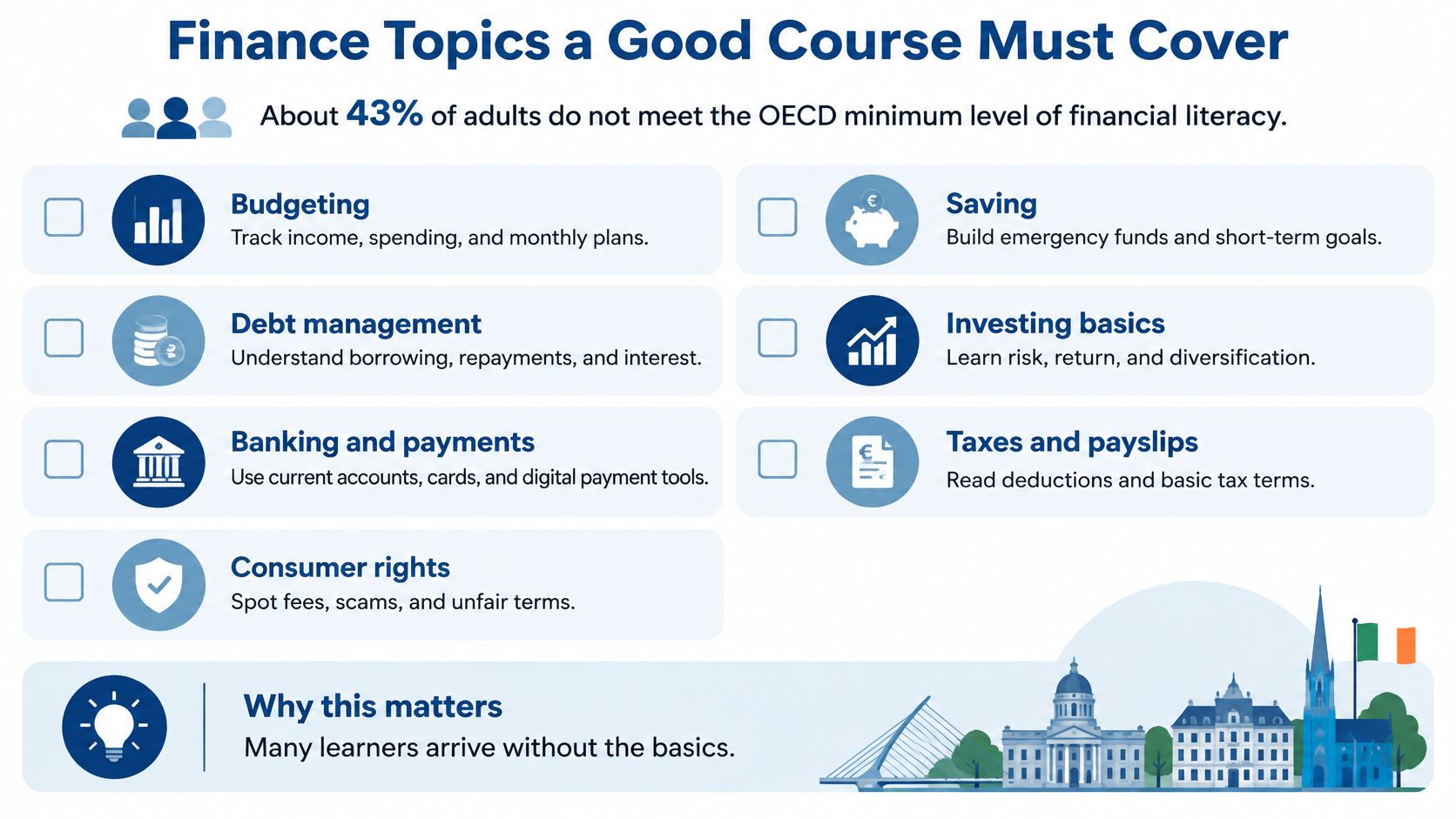
Ireland's Department of Finance reports that about 57% of adults meet the OECD minimum level of financial literacy, so about 43% do not. 44% of Irish adults were reported not to hold the minimum digital financial literacy needed to manage their finances. Follow-up research points the same way: self-rated knowledge of investment products is low, investors themselves rate their own understanding modestly, and younger adults score below middle-aged groups on literacy measures.
Many learners therefore arrive without the basics. A good syllabus has to build them, not assume them.
The syllabus test
Open the syllabus and look for three things on every topic: a named module or lesson, a worked example with numbers, and an outcome verb such as interpret, analyse, calculate or create. "Understand" and "be aware of" are awareness language. They don't prove you can do the work.
| Topic | What to look for | Outcome verb to look for |
|---|---|---|
| Budgeting and forecasting | Named module with a worked numerical example | Create |
| Reading income statements, balance sheets and cash flow | Lessons using real statement examples | Interpret |
| Interest and inflation | Numerical examples on savings and debt | Calculate |
| Investment fundamentals and product risk | Comparison of product risk with case work | Analyse |
| Risk management | Scenario exercise on financial risk | Analyse |
| Long-term financial planning | Case study building a plan over several years | Create |
| Spreadsheet or software tools | Hands-on exercise with an analysis tool | Create |
Use the table as a pass/fail check, not a wish list. A topic that appears in the marketing copy but has no named module fails. A module with no worked numbers fails. An outline full of "understand" and "awareness" fails. One strong row does not rescue six weak ones.
A strong accounting syllabus states that learners will interpret and analyse financial statements, create and manage budgets and forecasts, perform variance analysis, and work with accounting software. That is the standard to copy when you read any other outline. A practical walk-through of key financial statements and ratios shows the kind of statement work the second row demands.
An investment-focused course may cover fewer of these topics in more depth. That suits an investor. A broad introductory programme suits someone building general literacy. Both can be right. A finance course with no numbers, no case work and no tools is likely to deliver awareness, not skill. Skip it.
Self-Paced, Live or Blended Formats Compared
Most online finance courses run fully online, so you study without travelling to a classroom. Convenience matters only if the format is one you will finish.
| Format | Pacing | Support to expect | Watch for |
|---|---|---|---|
| Self-paced online | Learner sets the schedule | Online support, recorded lessons, learner account | Completion depends on self-discipline; check progress tracking |
| Live instructor-led virtual | Fixed session times | Real-time questions with an instructor | Clashes with work hours; needs stable broadband |
| Blended | Self-paced modules plus scheduled live clinics | Both recorded and live support | Confirm live sessions are recorded for missed dates |
What the participation figures actually say
The CSO Adult Education Survey found that 48% of adults aged 25–69 who took non-formal education in 2022 did so completely online, that only 42% of respondents whose education moved online rated the experience Excellent or Good, that satisfaction stood at 61% among part-time learners against 29% among full-time learners, and that 47% of respondents who rated their home broadband Poor also rated their online education Poor or Very poor.
Read those numbers together. Fully digital study is already a normal route for adult learning, and quality is the weak point. Part-time learners cope far better than full-time ones, so a working professional should pick the format built for stolen hours, and a weak home connection argues against any live-only timetable.
Three checks before you enrol
European Institute of Leadership and Management offers self-paced courses that are 100% online, with online support rather than a campus timetable. Judge any offer like it against three tests.
- Phone use: Open a sample lesson on the phone you carry. If slides and quizzes break, you won't study on a commute.
- Downloads: Readings and worksheets should save for offline use, with a low-bandwidth option for video.
- Support without a clock: Questions need an answer that doesn't depend on you attending a fixed hour.
A format is good only if you can finish it in the hours you really have each week.
Progress indicators carry extra weight on a self-paced path, because nobody else takes a register. If you want habits that keep an online study week on track, read the practical advice in five tips for succeeding in an online learning environment before you commit. Choose live clinics when you can attend them. Choose blended study when missed sessions are recorded. Otherwise you have paid for a class you cannot reach.
Certificates and Credentials Explained
A certificate is evidence that you finished something. It isn't automatically a recognised qualification, and it isn't a university degree unless an awarding body says so. Treat marketing that blurs those lines as a reason to slow down, not a reason to trust the logo.
| Credential | What it proves | Requirement | How to check |
|---|---|---|---|
| Course completion certificate | Completion of one course | Finish the course | Ask the provider for a verification route |
| Programme certificate | Completion of a set of linked courses | Finish every course in the programme | Check verification and profile display options |
| Mini-MBA certificate | Broad study across management topics | Complete six courses within one programme | Check verification and profile display options |
| Accredited national qualification | Assessment against a national standard | Meet the awarding body's requirements | Check the awarding body's register |
How a Mini-MBA award is earned
The rule is simple and easy for a sales page to soften. To earn the Mini-MBA certificate, a learner must complete six courses within one specific programme. Finishing one popular subject doesn't earn you the broader award. Budget time and money for all six before you treat the Mini-MBA title as yours.
What to verify before you pay
European Institute of Leadership and Management provides certificate verification and a route to add certificates to a LinkedIn profile. Use that kind of check on any provider.
- Verification: There should be a way for an employer to confirm the award, not only a PDF you can edit.
- Profile display: You should be able to show the credential on a professional profile without inventing a qualification title.
- What is printed: The certificate should show the course title, the completion date and the provider's name.
The provider's own pages don't establish that its certificates or Mini-MBA programmes are university degrees. Don't assume a non-degree certificate meets a degree requirement, a licence, or entry to another course. Ask the employer or the professional body whether that exact award counts for a promotion or a regulated step.
Put three questions to the provider before you pay: what is the award, how is it verified, and who recognises it? If any answer is vague, the credential is a completion record, and you should price it as that.
Which Course Fits Your Role and Career Stage
People aren't studying for the sake of study. The Central Statistics Office household digital consumer behaviour release reports that 64% of people who undertook online learning said the purpose was professional or work-related, compared with 35% for formal education and 38% for private purposes. Judge a finance course against a job task. Those figures cover online courses broadly, not finance courses alone, so they show appetite for work-related online learning, not demand for one subject.
The right course answers the next decision you face, not the broadest course on the page.
Five work decisions
A career changer moving into finance should prioritise an accounting course with statement reading, budgeting and software exercises. Skip an investment-only course. You can't brief a manager on a product if you can't read the statements behind it.
A business owner should prioritise financial concepts plus a financial management programme. Cash flow and budgets drive the weekly decisions, and investment theory won't tell you whether next month's wages clear. A plain guide to financial management for non-financial managers is the right kind of starting point for that role.
Someone who prepares management reports should prioritise budgeting, variance analysis and accounting software. Skip general investment content. Your next decision is why actual spend missed the forecast, not which fund to hold.
A private investor should prioritise investment fundamentals and product risk, and accept fewer topics in more depth. You need to compare risk, return and the product in front of you. A wide literacy survey won't change a buy or sell choice.
A professional building general literacy should prioritise a broad introductory programme covering budgeting, interest, inflation and long-term planning. Depth in one product can wait until the basics stop failing you.
In each case the filter is the same. If the module list doesn't touch the decision you will make this month, it is the wrong course, however complete the brochure looks.
How to Compare Two Courses Side by Side
Use one procedure every time, so the louder landing page doesn't win. Put both courses into the same grid: goal, modules, outcome verbs, assessment, format, credential, total cost.
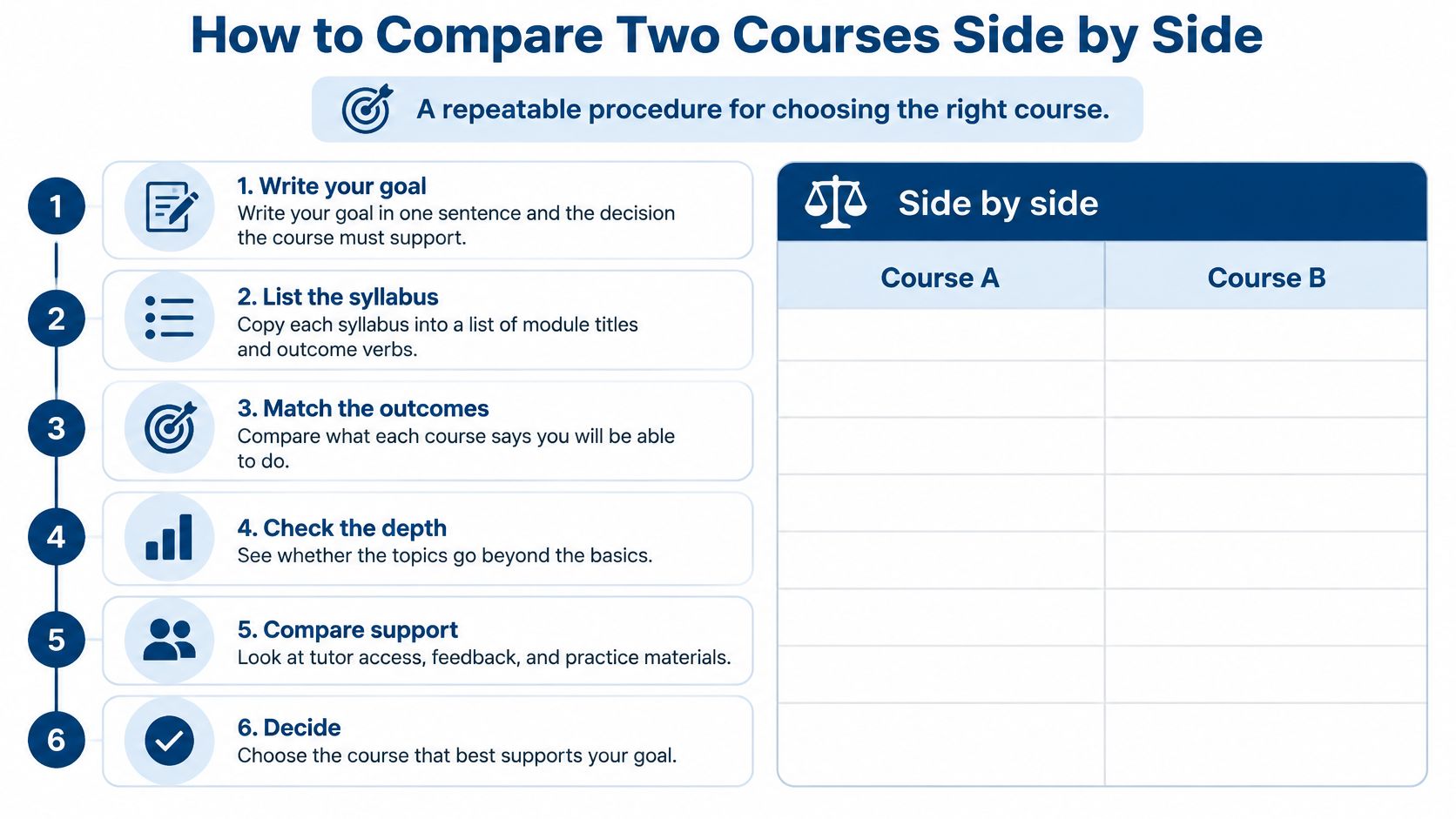
- Write the goal in one sentence, plus the decision the course must support. A vague aim ("get better at finance") lets every course look relevant.
- Copy each syllabus into a list of module titles and outcome verbs. If there is no syllabus, stop. You can't compare a promise.
- Match each module to the topic checklist and count the gaps. A missing tool exercise is a gap even when the topic name appears.
- Run the same outcome-verb check used on the syllabus; weak verbs lose marks here.
- Check the assessment. A multiple-choice quiz shows recall. A case study, spreadsheet exercise or scenario task shows use.
- Check format against your weekly hours, the device you will use, and your broadband. A live slot you can't attend belongs in the fail column.
- Check the credential: what it is, how it is verified, and whether your employer or professional body recognises it.
- Compare the full cost of the credential, not only the first course. Multiply the single-course fee by the number of courses the award requires. If the provider doesn't publish a fee or a duration, enter unknown and ask. Don't guess.
Example: Course A teaches budgeting and ends with a spreadsheet task. Course B lists budgeting inside a lecture-only module. Course A takes that line, even if Course B has more module titles.
Red flags
- No published syllabus: You are buying a title, not a curriculum.
- No named subject matter and no named instructor: Nobody is accountable for the content.
- Guaranteed jobs: A course can't promise employment. Treat that line as marketing, and discount the rest of the page with it.
- Recognition implied but never named: "Industry respected" means little until the body or employer is identified.
Choose the course that closes your most important gap, even when its syllabus is narrower. Unused breadth adds pages, while the better buy is the course that lets you produce the budget, the variance note or the risk comparison.
Confirm Your Course Before You Enrol
Start with one single-subject certificate course that closes the gap you found on the topic checklist. Move to a multi-course programme only when the next role demands breadth. Paying for six courses before you have finished one is how people collect half-started accounts.
European Institute of Leadership and Management shows that split clearly. Its individual certificate courses are listed at €15.00 each, all self-paced, fully online and backed by online support. Its Mini-MBA in Financial Management covers financial concepts, accounting principles, investment fundamentals, economics and international business, and earning that programme certificate means completing six courses within the programme. At the listed fee, the full pathway works out to €90 in course costs, so price the credential before you price the first subject. The Accounting Principles course runs six modules and suits business owners, students of business or finance, professionals switching into accounting or finance, and anyone who needs the financial side of an organisation. The syllabus section above already lays out its modules and outcomes, so check them against your gap there. It is a sensible first course when statements and budgets are the gap. Choose something else when the decision in front of you is an investment product.
Apply the eight-step comparison from the previous section to your two finalists, and leave any missing fee, duration or recognition answer marked unknown until the provider puts it in writing.
European Institute of Leadership and Management offers self-paced online certificate courses, Mini-MBA programmes and programme certificates in financial management, accounting and related business subjects. If you are choosing among online finance courses, compare a single-subject certificate against the broader financial pathway before you commit. Visit the European Institute of Leadership and Management to review the catalogue and match a course to the decision you need to make next.