Leadership Skills in the Workplace: What Managers Need
Leadership is a bigger capability gap in Irish organisations than technology. In the CIPD's HR Practices in Ireland report, 36% of respondents named leadership and influencing skills as their organisation's top capability gap, against 13% who chose technology design, programming and artificial intelligence. The scarce resource isn't another dashboard or another tool. It's the person expected to make a team work through the change the tool creates.
That gap is often misdiagnosed. Organisations book a course, run a workshop, hand out a competency framework, and six months later the same behaviours are missing. The reason usually isn't that managers failed to understand delegation or feedback. It's that their working conditions make those behaviours impossible to sustain: too many direct reports, no protected time, no written rule on the new tool everyone is already using, no clarity on who decides what.
So this guide separates two things that get bundled together under leadership skills in the workplace. Some gaps are skill gaps, where a manager needs a behaviour explained, practised and observed. Others are system gaps, where the manager already knows the behaviour and the structure punishes it. The first can be trained in weeks. The second needs span of control, decision rights and written policy fixed first.
Table of Contents
- The Core Leadership Skills Every Team Relies On
- Why Leadership Skills Decide Team Performance
- How to Build Coaching and Delegation Habits
- Leading Through Digital and AI-Driven Change
- How Conflict, Influence and Messaging Play Out at Work
- When Skill Gaps Are Really System Gaps
- Start Building Your Leadership Skills Plan
The Core Leadership Skills Every Team Relies On
Workplace leadership rests on a small set of observable behaviours rather than on personality. That distinction matters for anyone responsible for developing managers, because behaviours can be described, practised and seen by other people. Personality profiles, by contrast, give you nothing a colleague can verify in a Tuesday meeting.
The table below sets out the seven skills that carry most of the day-to-day load, what each looks like in ordinary work, and the signal that tells a manager or a team it is landing.
| Skill | What it looks like day to day | Sign it is working |
|---|---|---|
| Communication and strategic messaging | Explaining priorities and the reasons behind them in plain language | Teams can repeat the priority and the reason without prompting |
| Delegation | Handing over a defined task with an outcome, a decision limit and a check-in date | The task is finished without the manager redoing it |
| Coaching and feedback | Asking questions that help a person find their own answer, then giving specific feedback on behaviour | The person proposes solutions before being told them |
| Conflict resolution | Addressing disagreements early, separating the people from the problem | Disputes are resolved within the team rather than escalated |
| Decision-making under uncertainty | Making a reasoned call with incomplete data and stating the review point | Decisions are revisited on schedule rather than reopened repeatedly |
| Change management and adoption | Explaining what changes, why, and what support is available at each stage | Staff use the new process without reverting after a month |
| Influencing across teams | Building support with peers and senior stakeholders before a proposal is formally made | Proposals pass review with fewer late objections |
These rows are drawn from how Irish employer research assesses supervisors: delegation, feedback quality, conflict resolution, coaching and decision-making under uncertainty. In the government-commissioned Leading the Way study led by TU Dublin, around three-quarters of managers recognised the need for effective leadership, people-management and frontline-supervisory skills to achieve organisational goals, yet only 43% identified becoming a more effective organisational leader as the most important skill they personally needed to develop. That gap between valuing leadership in general and owning it personally is exactly why the signs column matters. It forces the question "is this behaviour visible in my team this week?" rather than "do I agree leadership is important?"
Why These Seven and Not a Personality Profile
Each skill is a set of repeatable moves that can be observed and counted. A delegated task either finishes without rescue or it doesn't. Feedback either gives someone something they can act on within a week or it's a mood. That is why these behaviours survive scrutiny in an appraisal conversation and "strong leader" doesn't.
For technology-heavy teams, the list needs two additions. CIPD Ireland's 2026 benchmarking adds digital literacy, risk governance and ethical judgement to the core set, because a manager now has to decide what work a tool may touch, who checks the output, and what gets escalated. Those are judgement skills, and they belong on the same list as coaching rather than in a separate "digital" programme.
Underneath all of it sits emotional regulation, which is what makes a calm conversation possible when a disagreement is heating up. The article on how emotional intelligence shapes successful leaders covers that groundwork in more depth, and it pairs well with this list if feedback conversations are where things break down.
One caution before you start. Every behaviour in the table assumes the manager has the time and authority to perform it. Coaching needs protected one-to-one time, delegation needs real decision rights to hand over, and adoption of a new tool needs a written rule the team can follow. Where those conditions are missing, the skill gap is really a system gap, and no amount of practice will hold.
The first action is deliberately small. Pick the two skills where team results are weakest, not the two that feel most comfortable. Write one sentence for each describing the behaviour that would show improvement, in terms someone else could observe. If the sentence can't be observed by a colleague, it's still a personality description.
Why Leadership Skills Decide Team Performance
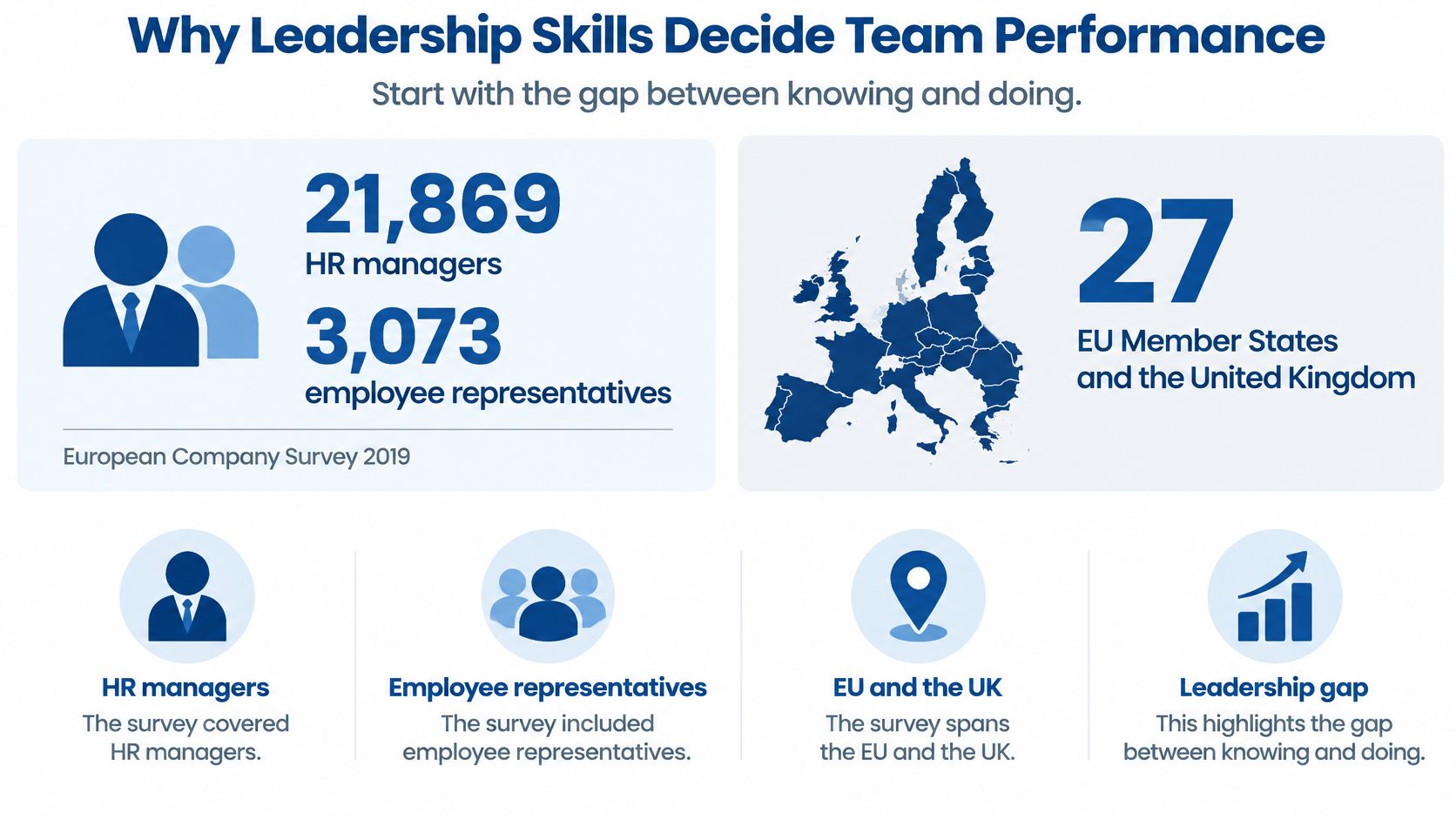
The gap between knowing and doing is measurable. The European Working Conditions Survey 2024 overview report, which collected information from 21,869 HR managers and 3,073 employee representatives across the 27 EU Member States and the United Kingdom, found that 96% of managers agreed training is important for employees to perform their current jobs. Only 9% of workplaces provided training and learning opportunities to most employees.
That 96 to 9 spread is the whole problem in one line. Managers believe in development, yet few deliver it at scale. Eurofound's wider evidence points the same way: only around one in five managers successfully realizes the potential of their employees, according to the European Working Conditions Survey 2024 overview report.
Leadership creates value when managers turn training into participation, autonomy and development. A title only helps when it comes with decisions people can influence and work they can shape. Training that never converts into discretion is a cost with no return.
The long view sharpens the point. The European Working Conditions Survey 2024 overview report found that over roughly the past 25 years, workers' access to training and skills development improved, while their ability to influence collective work processes and apply their own ideas declined. Europe got better at teaching people and worse at letting them use what they learned.
Three Checks to Run on Your Own Team
Before booking anything, run these three questions against the team as it currently operates.
- Who decides routine work? Name the person who decides how a recurring task gets done. If the answer is always the manager, autonomy is theoretical.
- Who has been trained in the last year? List names, not percentages. A short list usually explains a lot about who gets the interesting work.
- Who has a say in changing a process? Ask who was consulted the last time a workflow changed. If the answer is nobody below manager level, the team has training without voice.
Practical rule: if training investment doesn't change who decides, who speaks and who adapts the process, it hasn't bought capability. It has bought attendance.
How to Build Coaching and Delegation Habits
Delegation fails more often from vagueness than from reluctance. The manager hands over a task in a corridor, the person guesses at the standard, the manager takes it back in week two, and everyone learns that delegated work is temporary. The sequence below breaks that loop, and each step exists for a reason worth knowing.
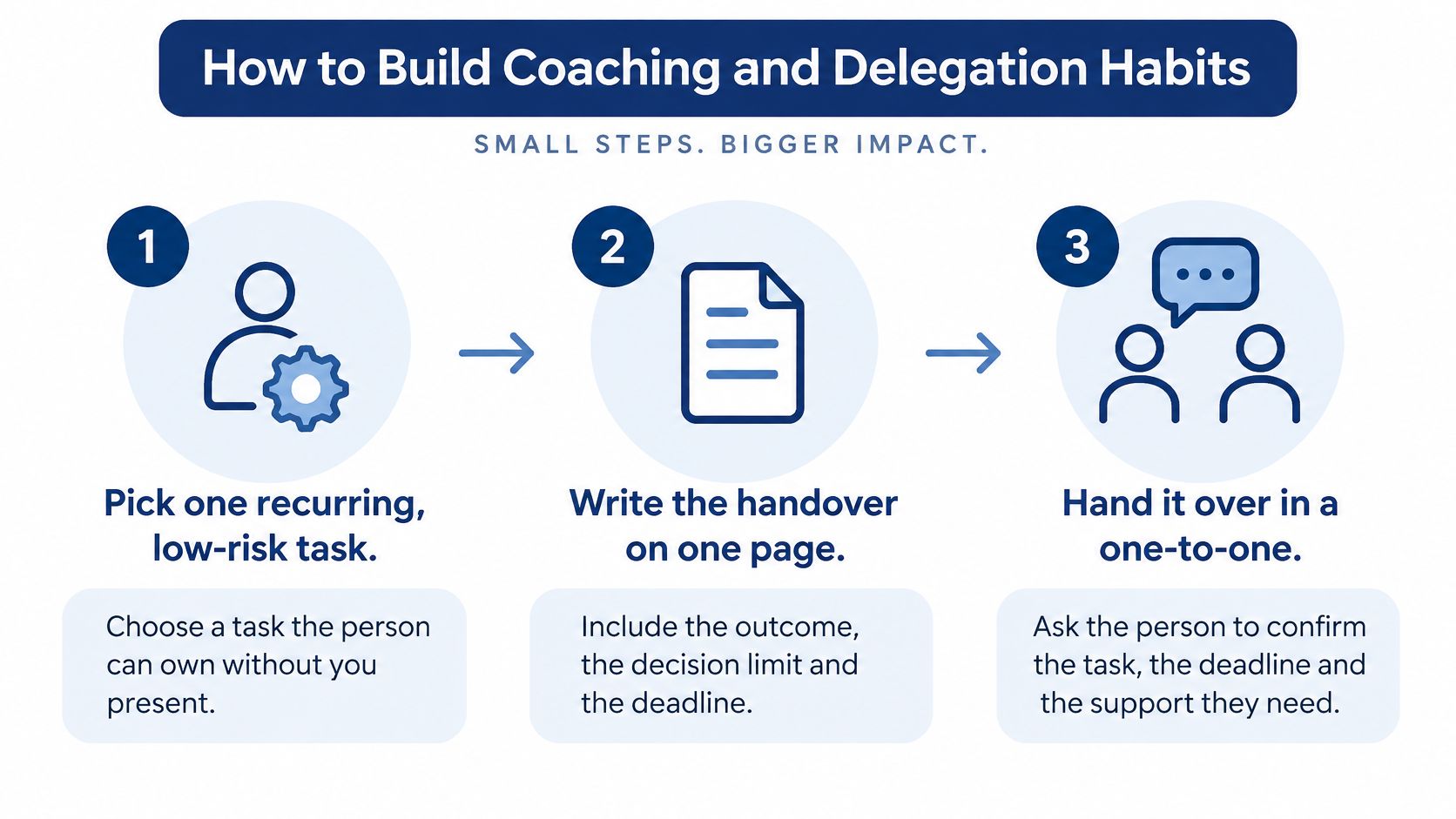
- Pick one recurring, low-risk task the person can own without the manager present. Low risk matters because the first cycle is about building trust on both sides, and a high-stakes task gives neither party room to learn.
- Write the handover on one page. Set out the outcome, the decision limit and the deadline. The decision limit is the part managers skip, and it's the part that causes most escalations: without it, the person stops at every judgement call.
- Hand it over in a one-to-one and ask for the plan back in their own words. Restating catches misunderstanding in thirty seconds, before it becomes a week of wrong work.
- Agree a check-in date and one clear signal that means help is needed. A named trigger, such as a supplier missing a date or a cost exceeding the agreed limit, removes the guesswork about when to escalate.
- At each check-in, ask rather than answer. What have you tried, what is blocking you, what would you do next. The common slip here is answering the question for them, which converts a coaching conversation back into instruction and teaches dependence.
- Give feedback within two working days, describing one observable behaviour and its effect. Fast, specific feedback is usable; delayed feedback arrives after the person has already settled on their own explanation.
- Widen the task only after two successful rounds. The slip to avoid is handing over a bigger task as a reward for one good week, then withdrawing it when a problem appears. Taking a task back at the first difficulty teaches the team that delegation is a phase, not a change.
The mechanics of the handover carry more weight than the intention behind it, and the principles of effective delegation sets out how to define the outcome and the decision limit so the first cycle doesn't collapse.
What Done Looks Like After Four Weeks
Judge the cycle on two signals. The person initiates at least one decision without asking first, and the manager spends measurably less time on that task than before. If neither has happened, the fault usually sits in step two or step five: either the decision limit was never written down, or the check-ins turned into the manager solving the problem.
Coaching isn't a meeting type. It's the decision to ask one more question before giving the answer you already have.
Leading Through Digital and AI-Driven Change
CIPD Ireland's 2026 benchmarking found that 91% of organisations experienced some form of skills shortage in HR Practices in Ireland 2026, with leadership and influencing skills affecting 22% of organisations in HR Practices in Ireland 2026. More telling, only 19% said their leadership team was fully equipped to lead in a digitalised or AI-enabled environment in HR Practices in Ireland 2026, while 57% said this was not currently the case in HR Practices in Ireland 2026. The AI conversation in most organisations is running ahead of the leadership capability behind it.

That 19 against 57 split explains why so many rollouts stall after the licence purchase. Adoption depends less on whether staff can operate a tool and more on whether a manager can translate it into an operating model, set responsible-use controls, redesign the surrounding workflow and manage the resistance that follows. The capabilities involved are digital literacy, strategic communication, risk governance, ethical judgement and change management, and they only work in combination.
| Indicator | Reported baseline | What it means for a manager |
|---|---|---|
| Organisations reporting some form of skills shortage | 91% | Assume gaps exist in your own team and plan around them |
| Leadership and influencing skills among the shortage | 22% of organisations | Influencing is a capability gap, not a personality trait |
| Leaders fully equipped to lead in a digitalised or AI-enabled environment | 19% | Most leaders are learning this in real time |
| Leaders not currently equipped for digital or AI-enabled work | 57% | Ask for the specific support you lack before a rollout |
| Organisations with clear guidance on staff AI use | 44% | Written acceptable-use rules are the exception, so agree them locally |
| Organisations providing AI training | 33% | Coverage is thin; pair any tool rollout with team-level training |
Those baselines change the order of operations. With clear AI-use guidance reported by only 44% of organisations and AI training by only 33%, a standalone soft-skills course on leading change solves very little. Leadership development has to sit alongside governance and upskilling, because the manager's real task is deciding what the tool may touch, who checks the output, and how a member of staff raises a concern.
AI and automation implications for European leadership looks at the wider organisational side of that shift.
The Test to Run This Month
Ask the team, individually and without warning, to explain the current rule on using AI for client or confidential work. Note where the answers differ. Divergence is the finding: it means the rule exists in someone's head rather than in writing, and every person is improvising their own version.
Then ask two follow-up questions. Who decides when a use case is unclear, and has any workflow been redesigned around the tool rather than having the tool bolted onto it. If nobody can name the decision-maker, that's a system gap, and no amount of training will close it.
How Conflict, Influence and Messaging Play Out at Work
Three short composite examples show how these skills look in motion. They're illustrations of typical patterns, not case studies.
Conflict resolution. Two team members both claim ownership of the same handover, and the disagreement has moved from the task to the person. The manager meets them together rather than separately, separates the people from the problem, agrees a written split of duties with dates, and confirms it at the next team meeting so the agreement is public. The result to watch for is disputes that stop arriving on her desk: resolution moving inside the team rather than upward.
Influencing across teams. A manager needs a peer team to adopt a shared reporting format. She speaks to that team's lead before the formal proposal exists, brings one worked example showing the effort saved, and asks for a two-week trial rather than permanent adoption. The signal is fewer late objections at the review, because the objections were handled in a corridor rather than in the meeting.
Communication and strategic messaging. A leader has to explain why a popular process is being retired. She states the priority, the reason and what replaces it in three sentences, then asks two people to repeat it back. If they can't, the message was a broadcast, not communication.
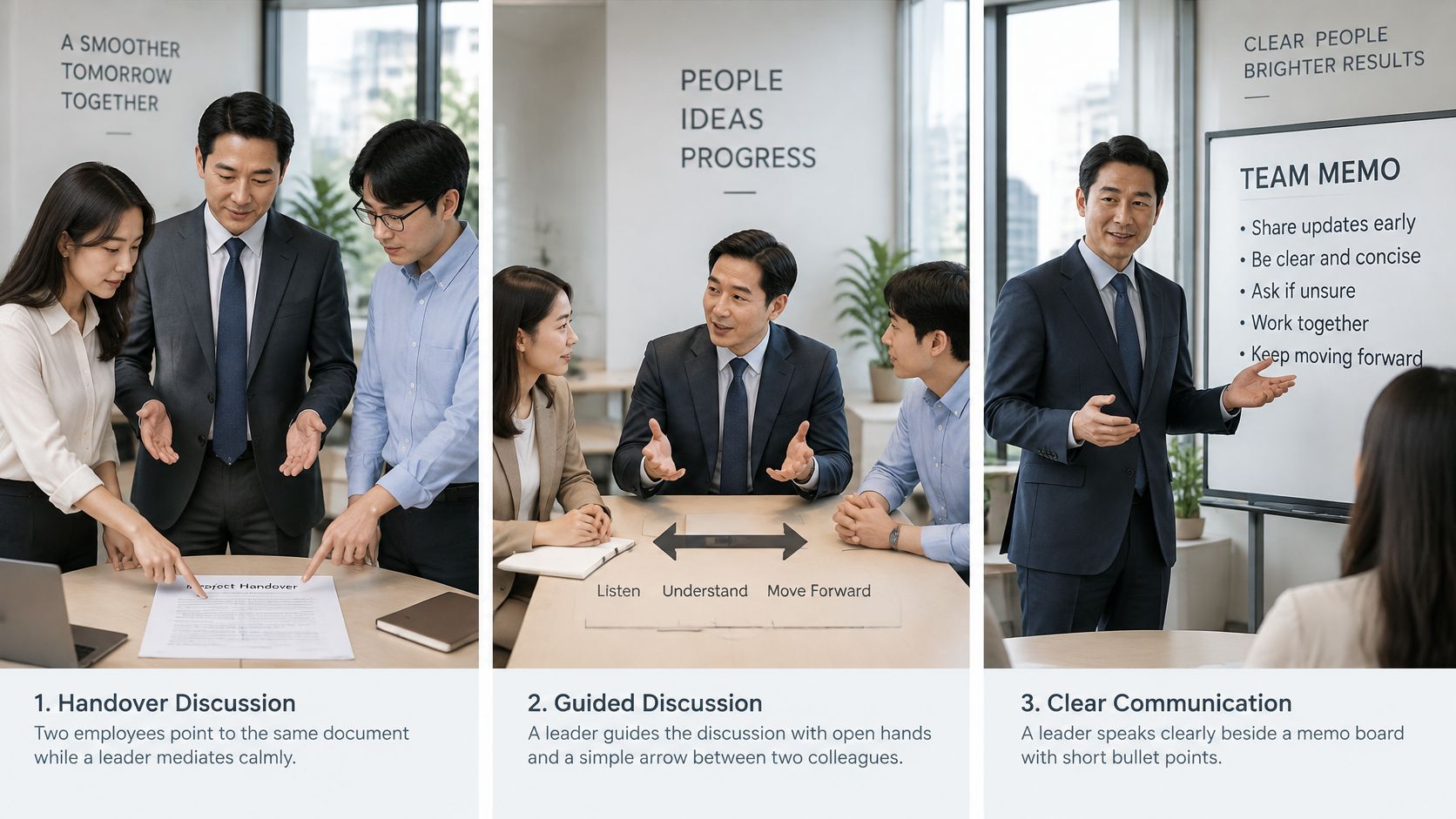
The pattern across all three: the work happens before the formal moment. The conversation precedes the meeting, the written split precedes the dispute escalating, the reason precedes the resistance.
The mistake that links the three is treating the formal event as the work. Describing a change without its reason, or winning an argument instead of reaching an agreement, produces compliance that lasts until the manager stops watching. More on handling disagreement early is covered in these conflict management tips for leaders.
When Skill Gaps Are Really System Gaps
CIPD Ireland's 2026 research identifies insufficient line-manager capability and capacity as the top constraint on HR impact for 61% of respondents, as reported in this Irish Times analysis of what makes a great manager. The pairing of those two words matters. Capability is a knowledge problem, and capacity is an arithmetic problem, and they respond to different remedies.
The table below sorts the symptoms. Use it before interpreting any training result.
| Symptom | Likely cause | First check |
|---|---|---|
| Manager has been trained in coaching but rarely holds one-to-ones | Capacity: too many direct reports or heavy admin | Review span of control and weekly calendar hours |
| Feedback is delayed or avoided | Skill gap in giving specific feedback | Observe one feedback conversation and note the behaviour named |
| Decisions stall between teams | Unclear decision rights | Map who decides what for the five most common decisions |
| Managers skip team meetings during busy periods | Operational firefighting with no protected time | Run a meeting audit on hours spent on reactive work |
| Staff use AI tools without clear rules | Missing policy rather than missing skill | Check whether written AI-use guidance exists and is known |
| New managers revert to doing the work | Lack of support after promotion | Check what structured support exists in the first 90 days |
Two rows deserve a closer read. The stalled-decisions row is rarely about confidence. Teams wait because nobody has written down who owns which call, so every decision escalates to whoever shouts loudest in the meeting. The AI row is similar: people adopt tools faster than policy catches up, and blaming individual judgement misses that no written guidance exists to follow.
Four Diagnostics to Run Before Booking Training
A manager workload review lists every recurring commitment and the hours it consumes, which usually exposes the arithmetic problem. A team-size analysis checks whether spans of control match the complexity of the work rather than a historical headcount. A meeting audit separates reactive attendance from deliberate management time. An employee-feedback measure tests whether the team experiences the behaviours the manager believes they're delivering.
Run all four in that order. The workload review is cheapest and often answers the question on its own: if coaching hours cannot fit inside the week as it currently exists, the fix is a reallocation of work, and only then does further training have somewhere to land.
Start Building Your Leadership Skills Plan
A ninety-day plan works better than an annual ambition, because it produces evidence before the budget conversation happens. Take the two weakest skills you identified earlier, named as observable behaviours, and build the plan around them alone.
Weeks 1 and 2 are for a baseline. Ask three team members and one peer what they see you do now and what would change for them. Their answers are the measurement, and they're more honest than a self-assessment. Write down the exact words they use, because you'll compare against them in week twelve.
Weeks 3 to 6 are for practice. Run the coaching and delegation cycle on one recurring task: hand it off with a clear outcome, hold one coaching conversation a week, and resist taking the task back when it wobbles. Log one line per week on what was tried and what happened. Keep the log short enough that it survives a busy Friday.
Week 4 brings a system check. If the skill is understood and still not applied, work through one row of the diagnostic table before booking anything.
Weeks 7 to 12 are for the review. Go through the logs with the team, keep the two behaviours that produced a visible change, and drop the rest. Drop them without negotiation. Every behaviour you keep costs attention, so a plan that keeps everything teaches nothing about priorities. Then start a third skill with the same cycle.
Choosing a Development Route
Structured learning earns its place when a manager lacks a framework, not when they lack time. The European Institute of Leadership and Management's Programme Certificate in Leadership is designed for aspiring leaders, current managers and executives looking to refine their leadership capabilities. Its Mini-MBA in Leadership Programme is designed to teach skills to lead teams, manage organisations, drive innovation and manage change in a dynamic business environment, and the institute is a certified member of the CPD Certification Service.
Compare any course against the table before committing. The two questions worth asking are whether it builds the behaviours the team needs, and whether the conditions at work allow those behaviours to be used afterwards. A course that answers yes to the first and no to the second is a good course in a badly designed job.
The European Institute of Leadership and Management delivers its programmes in a self-paced online format that fits around a working week, and completing a course adds a certificate you can use to showcase your new business skills and boost your employment profile on LinkedIn. Its Programme Certificate in Leadership is built for aspiring leaders, current managers and executives refining how they lead, and its Mini-MBA in Leadership Programme covers leading teams, managing organisations, driving innovation and navigating change. Visit European Institute of Leadership and Management to compare the pathways against the two skills you identified as weakest.