Leadership in the Workplace: Skills, Styles and Habits

Monday morning. A team leader opens a laptop to 38 unread messages, a deadline that moved on Friday afternoon, and two people asking whether the restructure rumour is true. The job description said "manage a small team". It said nothing about deciding which of four competing priorities gets dropped, explaining a budget cut that wasn't their decision, or rebuilding trust after a promise slipped twice.
That gap between the job description and the actual work is where many first-time managers stall. And here's the uncomfortable part: the people around you can already see the difference. Leadership in the workplace shows up as a set of routines, observable habits that either produce clarity, trust and follow-through, or produce confusion, silence and quiet departures. Titles get handed out once. Routines get built daily, and your team reads them the way a sailor reads weather, signal by signal.
That reading is good news. Because these routines are visible, they're also learnable. You can watch for them, practise them, and measure their effect on the people you lead. The rest of this piece examines how.
Table of Contents
- What Workplace Leadership Means and Why It Matters
- Leadership Styles and When Each One Fits
- Core Leadership Skills and the Mistakes That Blunt Them
- How Leaders Communicate Clearly With Their Teams
- Leading Without a Title and Handling Difficult Conversations
- How to Build Your Leadership Capability Next
What Workplace Leadership Means and Why It Matters
Leadership is the work of setting direction and helping people deliver it. Management keeps that direction running: schedules, standards, budgets, and the daily rhythm of tasks and handovers. On a small team the same person often does both jobs in one afternoon. A tidy calendar does not make the direction clear, and a clear direction still fails if nobody owns the handover.
Where the title ends and the work begins
Anyone who shapes how colleagues think, decide or act is practising leadership. A junior analyst who reframes a stalled problem so the team stops arguing is leading. A manager who forwards an email with no context is only passing paper, whatever the org chart says.
Employees can measure this because they live with it every day. The 2017 Civil Service Employee Engagement Survey recorded a leadership score of 55%, a five-percentage-point improvement on 2015, while 29% of civil-service employees believed their organisation as a whole was not managed well, and 25% lacked confidence in decisions made by senior managers. The same survey identified leadership as a key driver of both engagement and commitment to the organisation.
Read those figures as a verdict on routines people can see. They judge whether the place is managed competently and whether decisions hold up. The title matters less than that verdict.
A higher score can still sit beside a large group who do not trust how the organisation is run. Treat that split as a capacity check. Engagement and commitment move when decisions are explained, owned, and fitted to a workload the team can carry. They stall when the manager has no room to follow through, because the week people work does not match the score on the survey.
The test worth applying first: when did a decision on your team last get explained well, with the evidence, the trade-offs and the name of whoever owns it? If the answer takes more than a few seconds to find, that's the gap to work on.
Leadership Styles and When Each One Fits
Six styles cover most of what a manager needs. Each carries a cost when it becomes the only setting available.
| Style | Best used when | Main risk |
|---|---|---|
| Directive | Urgent deadlines, safety issues or new hires | Team disengages if it becomes the default |
| Coaching | Developing skills and long-term growth | Slow when speed is essential |
| Participative | Shaping solutions to complex problems | Decisions drag without a clear final call |
| Transformational | Change programmes and new strategy | Vision outpaces operational detail |
| Servant | Removing blockers and supporting wellbeing | Accountability blurs if unbalanced |
| Hands-off | Experienced, self-directed teams | Gaps go unnoticed until deadlines slip |
These styles are modes rather than personality types, and effective managers switch between them within the same week. A driving instructor takes the wheel in heavy traffic and hands it back on an empty road. The skill sits in reading the traffic correctly: what the moment calls for, and whether the person in front of you can currently handle the version with less supervision. Someone competent at a task still needs direction on day one of an unfamiliar version of it.
Three situations and the style each one calls for
A new hire in their first month. Directive, unapologetically. Step-by-step guidance for the first fortnight, a named owner for every question in week one, a short daily check-in, then a deliberate taper as competence appears. The mistake is staying directive into month four, which trains dependence and then gets blamed on the new starter.
A senior specialist who knows more about the subject than the manager. Give a clear outcome, the constraints, the definition of done and the check-in date, then get out of the way. Coaching questions work better than instructions here, because the person usually has the answer and needs a decision boundary rather than a tutorial.
A team facing restructuring. Transformational leadership earns its place when the destination is uncertain, provided it arrives paired with visible milestones. A shared vision without a date, a decision log and a weekly update on what has and hasn't been settled reads as reassurance, and reassurance ages badly. The distinction between transformational and transactional leadership matters less than whether the vision is attached to something people can check.
How to spot a style that has become a default
Overused directive leadership produces a passive team. Nobody proposes anything, because proposing has historically been corrected. Hands-off leadership looks mature until the first missed deadline reveals that two people were stuck for three weeks. Participative leadership without a final call turns every decision into a forum. Servant leadership, unbalanced, ends with a manager absorbing every problem and no one owning the outcome.
The fix is rarely a new style. It is noticing, in a quiet moment, which single setting you have been using on everyone.
Before any important conversation, answer three questions: how experienced is this person with this specific task, how urgent is the decision, and how much ownership should they carry afterwards? The answers pick the style for you.
Core Leadership Skills and the Mistakes That Blunt Them
Skills get tested in ordinary weeks, not at offsites. The table below describes what each one looks like on a Tuesday afternoon.
| Skill | What it looks like day to day | Warning sign |
|---|---|---|
| Clear direction | Team can name its top three priorities | Staff unsure what matters this week |
| Decision quality | Leader explains evidence, trade-offs and ownership | Decisions reversed without explanation |
| Communication | Context shared before deadlines and changes | Important news reaches the team through rumour |
| Trust and follow-through | Commitments completed or renegotiated openly | Repeated missed promises |
| Coaching | Specific feedback given through regular one-to-ones | Feedback only at annual review |
| Accountability | Named owners and documented follow-up on actions | Issues fall between roles |
The pattern behind the rows matters more than the rows. A team lead who publishes three priorities every Monday is doing clear direction. A manager who explains the trade-offs behind a budget cut, including what was protected and what wasn't, is doing decision quality. A supervisor who answers every concern raised, even when the answer is "not yet," is doing follow-through. None of that requires charisma. All of it requires a routine that survives a busy week.
Where management practice turns into output
Management routines are not administrative decoration. Stronger managers set explicit production targets, monitor performance with formal indicators, and link results to corrective action. Across EU-27 firms, World Bank Enterprise Survey research on management practices associates a 10-percentage-point increase in the management score with roughly a 26% increase in productivity, measured as sales per employee.
That's an aggregate association, not a promise to any single firm. Treat it as a reason to measure before and after an intervention rather than as a guarantee. Track sales or value added per employee, cycle time, rework, absence, turnover and delivery reliability. Then check the infrastructure underneath those numbers: does every team have current objectives, a review cadence, named owners for corrective actions, and at least one recent example of a decision that changed because performance data demanded it? If the last answer is no, the rest of the measurement is decoration.
The same skills, applied too hard
The mistakes below usually come from good intentions without a brake. Each one starts as a strength, and the damage begins at the point where nobody sets a limit on it.
Leading by title alone erodes trust through inconsistent follow-through. The fix is unglamorous: keep a visible list of commitments and renegotiate them out loud when they slip.
Over-managing detail stops a team using its own judgement. Agree the outcome and the review points, then resist rewriting the work in between.
Avoiding hard conversations is the most common and the most expensive. Problems raised within days stay small. Problems raised at appraisal time arrive with a file attached.
Treating activity as progress fills dashboards with effort and leaves outcomes untouched. Measure against a small number of goals, not against how busy the week felt.
Inconsistent standards create perceived favouritism faster than almost anything else. Apply the same expectations to everyone and explain any exception out loud, because the team will notice it whether or not it's explained.
Ignoring workload is where good leadership meets a structural limit. CIPD's 2025 Ireland survey found that only 51% of organisations said wellbeing was increasingly on senior leaders' agendas, while 58% identified workload as contributing to employees' mental-health issues and 54% cited perceived lack of management support. Empathy doesn't offset a workload nobody has redesigned. A manager can run perfect one-to-ones and still burn out a team that carries one person too few, which is why workload design belongs in the same conversation as any skill in the table above.
Watch the signals, not the surveys: the same three people speaking in every meeting, requests stalling for days, and rising absence in one team are earlier warnings than any annual score.
Change shows up in those signals gradually. Expect weeks of consistent practice before anyone comments on the difference, and months before the team's numbers move. Pick the two skills your team would rate lowest, choose one action for the next fortnight, and let the evidence arrive. Emotional intelligence underpins much of this work, particularly the hard conversations, and it's worth understanding how emotional intelligence shapes successful leaders before assuming feedback will land the way it was intended.
How Leaders Communicate Clearly With Their Teams
Monday stand-up, twelve people, and "what are we doing this week?" produces four answers. The tasks were announced. The reasons were not. Communication decides both at once: whether people know what matters, and whether they trust the decision behind it. In many workplaces, groups fall short on the second, not the first.

A clear message works like a handover note with three layers, and the order matters.
What we're working towards: the two or three priorities that outrank everything else this month.
Why a decision was made: the evidence considered, the trade-offs accepted, and who owns the outcome.
What happens next: the date, the owner, and what people should do differently tomorrow.
Skip the middle layer and the other two stop working. People follow a decision they cannot explain, then withdraw effort from the next one. Gallup's Ireland country data reports that only 9% of employees were engaged in 2025, while 82% were not engaged and 9% were actively disengaged. That split shows up as teams finishing the assigned list and stopping there, because the reason for the work never became something they could repeat to a colleague.
An engagement figure on its own still misleads. If the workload was never redesigned, or the manager has no time to answer questions, low engagement is a capacity problem wearing a communication label.
A four-part leadership scorecard
Track these four signals rather than a single engagement number.
Strategic clarity: can employees state the team's top priorities without checking a slide? Ask five people separately and compare answers. Matching answers mean the priority update landed. Four versions mean it did not.
Decision quality: do leaders explain the evidence, the trade-offs and the owner? A decision note of five lines does more than a town hall, because people can reread it on a phone and argue with a specific line.
Execution reliability: are commitments completed or renegotiated in the open? Count them. The ratio tells you more than the sentiment.
Manager responsiveness: do issues raised by employees get documented follow-up? A response within two working days is a reasonable standard. Silence past that point teaches people to stop raising issues.
Three routines that carry the message
- A weekly priority update. Five lines every Monday: what matters this week, what changed, what's blocked. It takes ten minutes and prevents a week of misdirected effort. The trade-off is repetition. Say the same three priorities until the team can say them back.
- A written decision note whenever plans change. Evidence, trade-offs, owner, date. Short enough to read on a phone, specific enough to be argued with.
- A monthly open-question session. Questions collected in advance, answers given in the room, unresolved items logged with a name against them.
A usable decision note for a reporting change looks like this: "From 3 March, weekly figures go into the shared tracker only. Evidence: three teams entered the same numbers twice last month. Trade-off: one extra hour in week one, then the duplicate spreadsheet stops. Owner: operations lead. Tomorrow: stop emailing the Friday sheet." Anyone who disagrees can point at a line. A verbal announcement in a busy meeting cannot be checked later.
Segment pulse surveys by department, manager, tenure and work arrangement. Organisation-wide averages hide the local variance that drives resignations. Pair survey results with regretted attrition, absence, internal mobility, customer defects and project slippage. A high score next to rising absence in one team means the average is covering a manager who cannot keep up.
The mechanics of effective communication in the workplace are mostly cadence and repetition. Say it three times in three formats before assuming it landed.
Leading Without a Title and Handling Difficult Conversations
Two gaps appear in the first week of any leadership role, and neither is covered by a job description.
The first is influence without formal authority. Three levers are available to anyone. Credibility comes from delivering reliably on small commitments, which is why the person who never misses a handover gets heard in a meeting. A written case with evidence, a proposed fix and a named owner beats a verbal complaint every time. Allies are built before a decision is taken, not after, because lobbying a decision that has already been made reads as resistance.
Say a junior analyst wants a reporting process changed. The weak version is a complaint in a team meeting. The strong version is a one-page note: what the current process costs in hours per month, the proposed change, the owner, the date it could start. It goes to the two colleagues whose work it affects first, gets amended, and only then reaches the manager. By that point the decision is nearly made, and nobody has needed a title.
A five-step routine for the conversation being avoided
- State the observation in specific, dated terms. "The last three status reports arrived after the Thursday review" is a fact. "You're not engaged" is a character judgement and will end the conversation.
- Ask what happened, then wait out the first silence. The first answer is rarely the full story. Silence is a tool, not an awkward gap to fill.
- Agree what good looks like and what will change. Both sides leave with something concrete, not a shared mood.
- Name the support and the review date. What the person needs from the manager, and when both parties will check again.
- Record the outcome and follow up within two weeks. Unrecorded agreements dissolve, and a follow-up is what proves the conversation mattered.
Escalation comes only after two documented attempts, and it should be described to the person in advance. Avoidance, not conflict, is what lets a problem grow into a formal process. The same routine works for a peer as for a direct report, because the levers are identical: credibility, evidence, follow-through.
Context shared before a difficult conversation beats context defended inside it. That's also the core of practical conflict management techniques for leaders, which work best when they arrive early and in private.
How to Build Your Leadership Capability Next
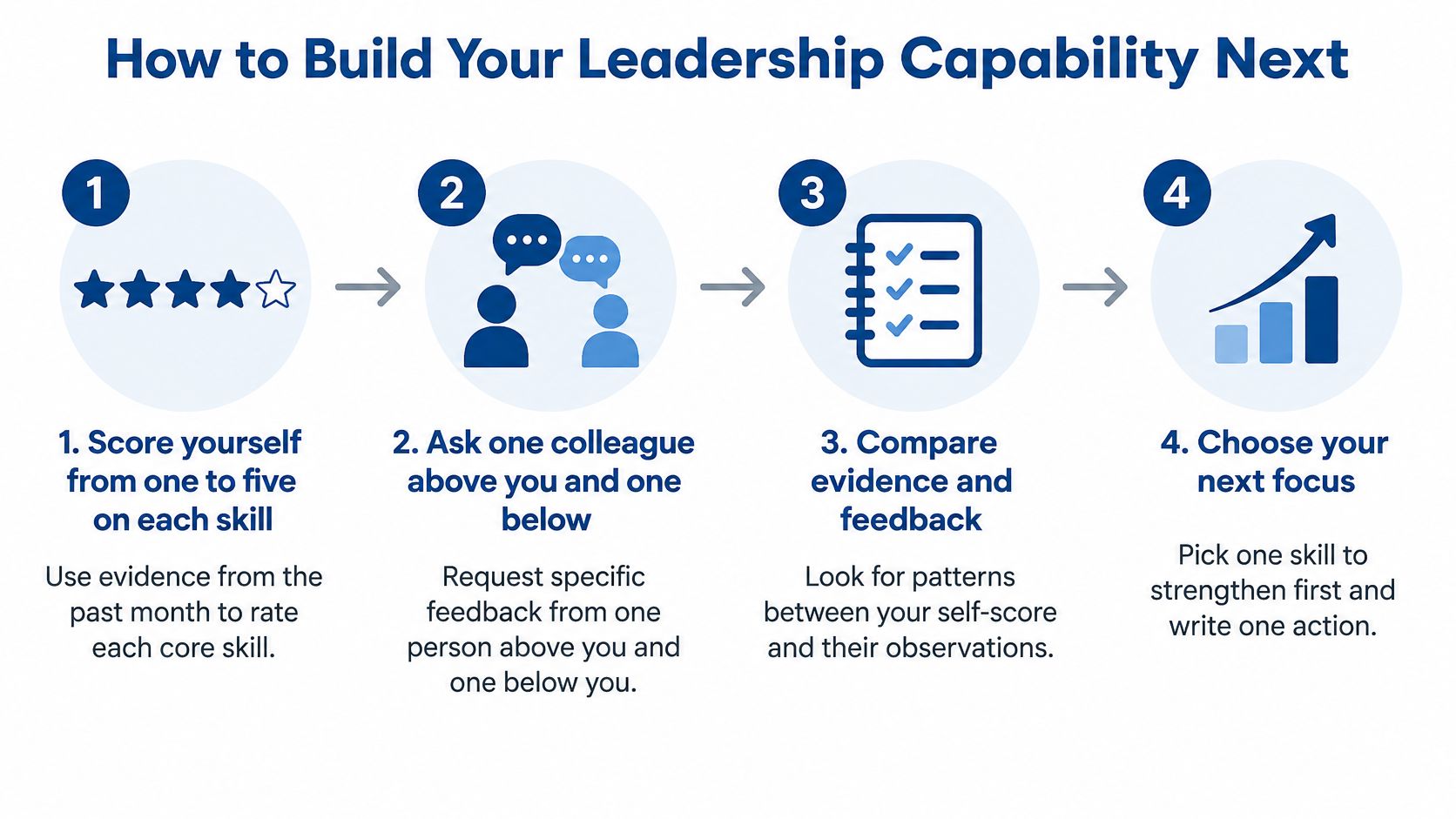
A six-step cycle works like a maintenance routine for a machine. You check the parts, ask the people who use it, adjust one thing, then test the result. Repeat it often enough, and leadership becomes a set of observable habits rather than a personality story.
- Score yourself from one to five on each skill in the core skills table. Every score needs evidence from the past month, not a general impression. If you can't name the evidence, the score is a guess.
- Ask one colleague above you and one below for specific feedback on a single behaviour. Not "how am I doing", but "when I changed the deadline last month, what did that look like from where you sat?"
- Choose one priority gap and set a measurable target for eight to twelve weeks. One gap, not four. A target such as "every team member can name our three priorities when asked" is testable.
- Practise the behaviour inside a routine you already have. Attach it to the weekly priority update or the monthly one-to-one, so it doesn't depend on finding extra time.
- Review the results with your team and record what changed. Ask them directly. The answer is the measurement.
- Repeat the cycle with the next gap. Two cycles a year is a realistic pace alongside a full job.
The cycle looks like this in practice.
Why structured study belongs in the plan
Self-directed practice has a limit, and it's usually breadth. Managers tend to practise what they already do well. That creates a neat but narrow loop. The organisational picture is mixed too. A government summary of the Expert Group on Future Skills Needs report Leading the Way states that 88% of firms consider developing management skills an important strategic priority, yet 49% do not have a formal budget for management and leadership development, according to the Department of Enterprise, Trade and Employment announcement. The DETE finding points to a practical gap: a manager waiting for employer funding has no clear route if the budget is absent.
Access to senior roles is also uneven. CSO governance data show women held 24.6% of board-director positions in 2023, up from about 21.8% in 2021, and 19.0% of chief executive officer roles, which makes deliberate capability building a route to widening access rather than a private hobby. This is about workload design and manager capacity as much as ambition. If the same few people are invited into visible projects, the same few people accumulate the evidence that leadership decisions rely on.
Self-paced study fits around the job. CSO figures on adult education show that 34% of internet users completed an online course in 2024, a nine-percentage-point rise on 2023, and that 64% of people who undertook online learning said at least some of it was for professional or work purposes. Treat that as a sign that learning can be built around existing responsibilities, not added as a separate career phase.
For a structured route, the Mini-MBA in Leadership teaches skills for leading teams, managing organisations, driving innovation and working through change. The Programme Certificate in Leadership is for aspiring leaders, current managers and executives refining their leadership capabilities. These are professional certificates rather than university degrees, and the institute is a certified member of the CPD Certification Service.
The honest choice: self-directed practice builds depth in what you already attempt. Structured training adds the areas you'd never think to practise. Managers who rely only on on-the-job practice need both, in that order.
Leadership development at the European Institute of Leadership and Management is built for people doing the job while learning it, with online certificate courses and programme certificates in leadership, strategy, project management and business administration that can be studied around existing responsibilities. If this article has surfaced a gap you'd rather close deliberately than by trial and error, the European Institute of Leadership and Management catalogue is a practical place to start, and completed certificates can be added to a LinkedIn profile to show what changed.