
Change Management Training: A Practical Guide for 2026
The new system is ready, the launch email has gone out, and the team has attended a demonstration. Yet a manager is still answering the same questions, colleagues are keeping their old records, and nobody seems certain who approves the next stage. The technology works. The working day doesn't.
Change management training helps managers close that gap. Its value lies less in the certificate awarded at the end than in what participants can do afterwards: explain a difficult decision, identify an overlooked group, coach a colleague and check whether a new routine works.
Table of Contents
- What Change Management Training Actually Covers
- Why Organisations Struggle Without Trained Change Leaders
- Who Benefits Most and What Each Role Needs
- How to Run a Change Using the Core Method
- Measuring Whether the Change Has Stuck
- Common Myths About Change Management Training
- Choose Your Next Step in Change Management Learning
What Change Management Training Actually Covers
Change management training teaches people how to plan, lead and sustain organisational change, whether that means a new system, a restructuring or a different way of working. It focuses on what people must understand, practise and continue doing.
A ferry timetable offers a useful analogy. The boat represents the technology, but the crew, passengers and port staff must learn new routines before the crossing works reliably. Buying the boat isn't the same as preparing everyone to operate the service.

Core components of change management training
| Component | What It Teaches | Typical Output |
|---|---|---|
| Change impact assessment | Identifies who is affected, how much, and where | Impact map by group |
| Stakeholder mapping | Shows who supports, resists or influences the change | Sponsor and influence grid |
| Communication planning | Sets message, audience, channel and timing | Dated communication calendar |
| Resistance diagnosis | Separates confusion, fear and genuine objections | Resistance log with responses |
| Manager coaching | Equips line managers to reinforce new routines | Coaching checklist for team huddles |
| Reinforcement and review | Keeps new behaviours in place after go-live | Adoption dashboard and review dates |
How the people plan fits the project plan
These activities sit beside project management, rather than replacing it. A project manager might arrange system testing and access permissions; a change leader checks whether supervisors can explain revised responsibilities and whether employees can complete their actual tasks.
Technical delivery and human adoption can run on different timelines. A platform may be available while employees still need supported practice, particularly when a familiar shortcut no longer works.
For example, replacing an expense form affects more than the employee submitting it. Approvers need decision rules, finance staff need exception procedures, and managers need to know how to handle delayed claims. Useful training makes those dependencies visible and gives participants practice resolving them.
Practical rule: If a change alters someone's daily work, that person needs suitable preparation or support from someone trained to provide it.
The important distinction is between knowing about change and being able to organise it. A participant should leave with usable working documents, not merely definitions copied into a notebook.
Why Organisations Struggle Without Trained Change Leaders
Consider a hypothetical company that launches new software on schedule. Months later, employees still maintain spreadsheets beside it, and the support team receives repeated questions about responsibilities rather than technical faults. The launch succeeded as an installation, but not as a transition.
A technical team can schedule configuration, testing and release. Managers have a different job: explaining why work must change, listening to objections and making the new routine practical under everyday pressure.

The scale of planned workforce development makes this capability relevant in Ireland. In 2025, 86% of organisations in Ireland reported plans to increase investment in reskilling and upskilling their existing workforce to support work alongside artificial intelligence, according to the CIPD's Ireland briefing on the World Economic Forum Future of Jobs Report.
What trained leaders do differently
Trained change leaders can reduce the risk of failed rollouts by checking readiness before launch. They ask whether staff have time to learn, whether supervisors understand exceptions and whether service commitments remain achievable during transition.
They support faster adoption by connecting instruction to real tasks. Rather than demonstrating every menu, they arrange practice around the work employees must complete, including what happens when something goes wrong.
They can also reduce avoidable resistance by involving affected colleagues before decisions become difficult to revise. This doesn't mean promising that everyone will like the change. It means distinguishing an uncomfortable adjustment from a genuine operational problem.
Warning signs that a team needs stronger change capability include:
- Repeated workarounds: Employees keep parallel records because the official process feels unreliable.
- Unclear ownership: Questions move between departments without anyone accepting responsibility.
- Rising errors after launches: Staff understand individual instructions but not how the whole process fits together.
Training won't repair an unusable system by itself. It should, however, equip leaders to recognise that problem and escalate it instead of blaming employees for poor adoption.
Who Benefits Most and What Each Role Needs
Depth and content should match the role: executives need different preparation from change champions. A practical test is to ask what each person must do differently during the transition, then train for that action.
Who needs change management training and why
| Role | Core Need | Example Scenario |
|---|---|---|
| Senior executives | Sponsorship and difficult trade-offs | Approving a delayed rollout to protect service levels |
| Middle managers | Translating decisions into team routines | Rewriting job expectations after a new system goes live |
| Project managers | Lifecycle planning and stakeholder engagement | Running a process redesign from initiation to closure |
| IT professionals | Explaining technical change in plain language | Preparing staff for a new platform they can operate in daily work |
| Change champions | Peer support and feedback collection | Answering colleagues' questions in regular drop-ins |
| Entrepreneurs and SME owners | Lighter, low-data planning | Introducing a new pricing or software process in a small firm |
| Young professionals | Understanding how change affects their role | Adapting to a reorganised team |
Managers and champions need different preparation
Managers connect organisational decisions to team expectations. A manager who can explain the reasons behind a difficult decision, acknowledge uncertainty and identify what remains unchanged gives colleagues a steadier basis for action.
Change champions need listening skills and clear escalation boundaries. They help peers and gather feedback, and when a problem sits outside their remit they pass it upward with enough detail for a decision. Training a champion to improvise policy answers creates a different problem than the one it solves.
Working adults can pursue this development alongside employment. The 2022 Adult Education Survey found that 48.3% of Irish adults aged 25–64 participated in adult learning, more than double the rate a decade earlier, although below Ireland's national 2030 target of 64.2%, as reported in Cedefop's Ireland country profile.
Learning also needs to be accessible. A National Skills Council report identifies basic literacy needs among 21% of adults, basic numeracy needs among 25%, and basic digital needs among 17%.
Population figures describe the wider context; they do not show what a given team needs. They do support offering clear explanations, practical demonstrations and private opportunities to ask for help, since a strategy briefing alone will miss people who struggle with the format itself.
In a small firm, an owner may cover several roles at once, so the deciding factor is the responsibility each person carries during the transition and which working routines will change under their watch. Afterwards, check the behaviour: a champion running the scheduled drop-ins and a manager revising job expectations are signs that the training held.
How to Run a Change Using the Core Method
Before planning activities, record a baseline for the work being changed. Useful measures include elapsed processing time, error rates or support-ticket volume, with a clear definition of what gets counted and where the record comes from.
For an invoice process, for example, the baseline might capture the time between receipt and approval. Without a consistent starting measure, later comparisons can confuse a genuine improvement with a different counting method.
Turn preparation into working actions
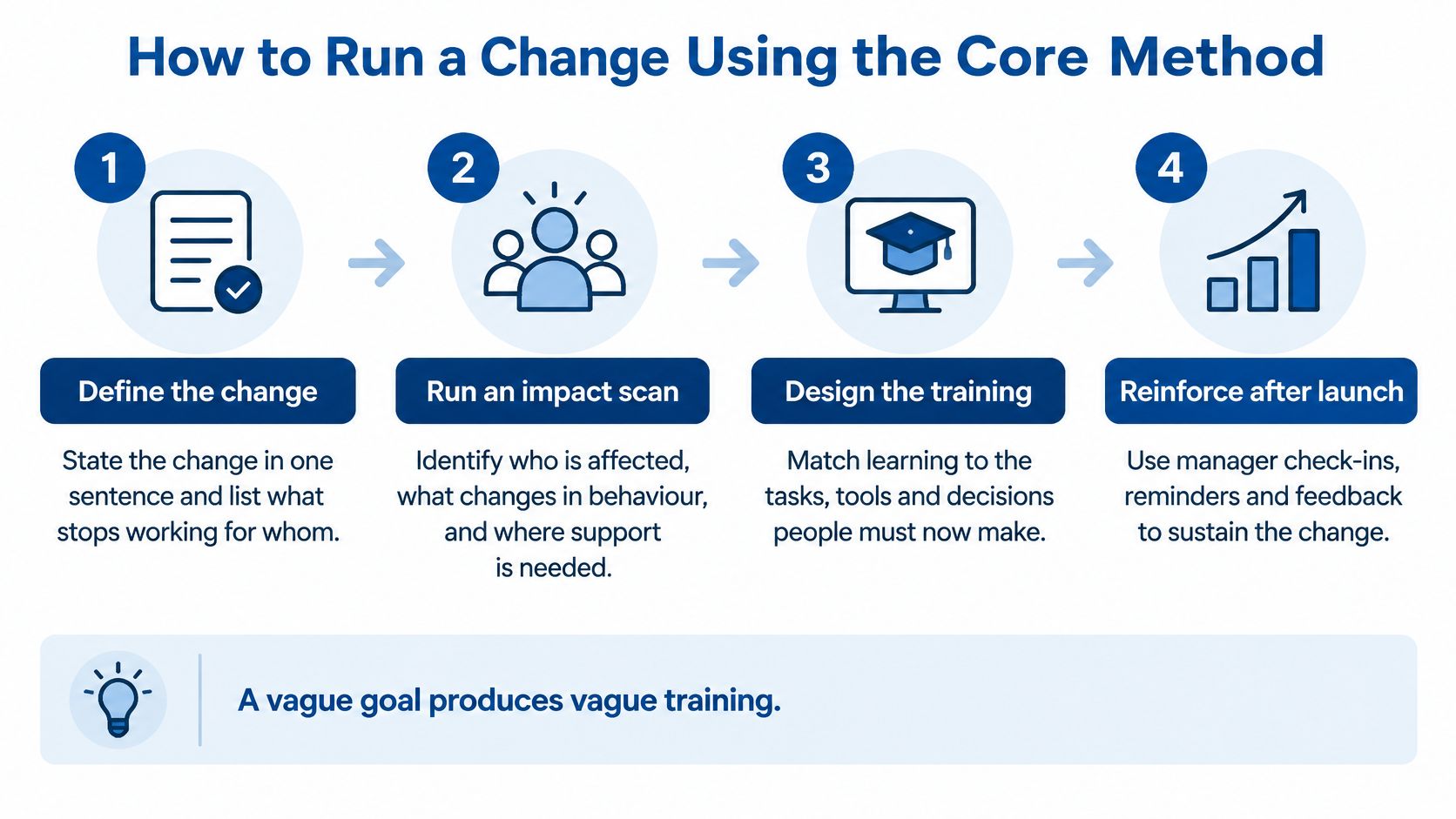
Define the change clearly. State the change in a sentence and identify which existing routines will stop working for which groups. Replacing a vague ambition such as improving efficiency with a specific task change prevents equally vague training.
Assess impact by group. Mark each role's change as low, medium or high, considering tasks, decisions, workload and required skills. A common mistake is rating impact by department size rather than by how different the working day will become.
Map influence and support. Identify who can authorise decisions, who colleagues listen to and which groups need a named sponsor. Practical stakeholder engagement and management means involving these people early, not producing a contact list after opposition appears.
Prepare communications before the announcement. Agree messages, audiences, channels, owners and dates, using plain language and hands-on guidance. Announcing the change before the sponsor has agreed the message creates avoidable confusion, especially where colleagues need additional literacy, numeracy or digital support.
Diagnose resistance before responding. Confusion calls for explanation, fear may require reassurance and practice, while a genuine objection may require redesign. Treating every concern as negativity can leave a valid service or safety problem unresolved.
Coach managers through real tasks. Have supervisors practise a team briefing, an individual conversation and an exception decision using realistic situations. Sending a presentation without checking whether managers can use it leaves them underprepared when colleagues ask difficult questions.
Reinforce after launch. A practical initial plan can cover the first three months through check-ins, peer help and recognition of useful new habits. The common slip is withdrawing support as soon as access is available, rather than adjusting it to the difficulties employees encounter.
Check for movement, not activity
Useful early signs include fewer repeated questions, less delay before an employee completes a task independently and continued use without repeated reminders. None should be interpreted alone: fewer questions may also mean employees have stopped asking.
A vague goal produces vague training. A clear task gives managers something concrete to teach, observe and improve.
The method works best as a repeatable working discipline. Documents should change when employees reveal a missed dependency, not remain fixed because someone approved the original version.
Measuring Whether the Change Has Stuck
A participant can pass every assessment and still change nothing back at work. Understanding a method on paper and applying it when a meeting becomes difficult or a deadline approaches are different skills, so evaluation has to follow people out of the course and into their working week.
Where roles themselves are shifting, that follow-through matters even more. The CIPD's HR Practices in Ireland 2025 report describes employers responding to skills shortages through measures including automation, and transitions like these are exactly where attendance figures mislead. When automation changes what a job involves, evaluation should track what happens to the work itself: who does it, how, and with what result.
A cooking teacher faces the same problem. The test is whether students still cook the dish at home months later without the recipe card, not whether they passed on the day.
Four levels of evaluating change management training
| Level | Key Question | Indicators |
|---|---|---|
| Capability | Can people use the new method? | Scenario assessment scores |
| Behaviour | Are managers applying it in meetings? | Observed stakeholder meetings and coaching logs |
| Adoption | Is the change in daily use? | Process compliance, system use, cycle time, support tickets |
| Experience | Do people trust the change? | Pulse survey results and turnover in affected teams |
A lightweight approach for limited data
A manager doesn't need an elaborate reporting system. A shared record can combine task observations, operational measures and brief employee feedback, provided definitions stay consistent with the baseline. The useful test for each measure is whether it captures the task being done the new way.
Logging into a system, for instance, doesn't establish meaningful adoption. Completing the intended task correctly, without maintaining an unofficial parallel process, offers stronger evidence.
Good training evaluation and metrics also distinguishes contribution from causation. Staffing changes, software fixes or seasonal demand may all affect results, so the evidence can support an assessment of training's contribution without proving that training caused every improvement.
High compliance can hide a poor experience if confident employees carry difficult work for everyone else.
Managers should therefore ask who absorbs the extra workload and whether less digitally confident colleagues feel excluded. Turnover and morale deserve attention, although staffing moves and seasonal pressure can explain both as easily as the change programme can.
Use reviews to make decisions
A practical review schedule is:
- At 30 days: Check whether first use is happening and decide whether coaching needs strengthening.
- At 90 days: Observe whether behaviour has shifted in meetings and decide whether reinforcement needs redesigning.
- At 180 days: Check whether the routine holds during ordinary pressures and decide whether to close the programme or extend support.
The timings are starting points to adapt to your own initiative. What makes each review count is the ending: an owner, a decision and an action. A dashboard circulated without discussion changes nothing.
Common Myths About Change Management Training
Myth: Change management is just communications. A clear announcement helps, but it can't resolve conflicting approval rules or give a supervisor the confidence to handle an exception. If staff receive polished messages while managers continue rewarding the old process, behaviour is unlikely to follow the announcement.
Myth: A certificate proves someone can lead change. A certificate records an educational achievement, not an automatic guarantee of workplace competence. Stronger practical evidence includes a usable stakeholder plan, a well-handled conversation and an appropriate response when implementation goes off course.
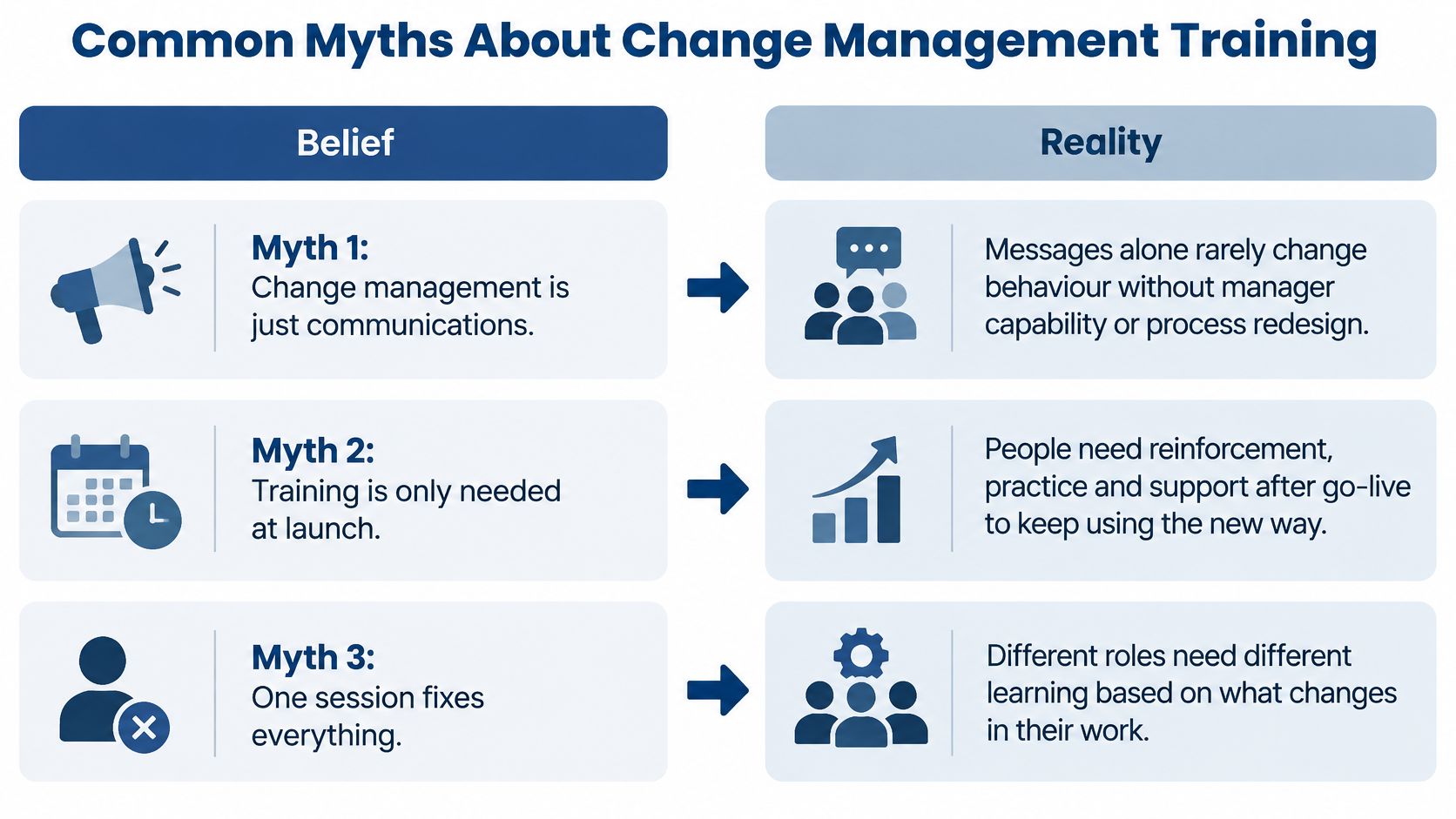
Myth: Change training is only for large firms. A small business can use a single-page impact map and a fortnightly check-in rather than a large programme office. The purpose is to make responsibilities and difficulties visible, not to reproduce corporate paperwork.
What training can and cannot deliver
The strengths are structure, attention to people and transferable skills. Participants can apply careful listening, task analysis and decision planning across different initiatives rather than memorising instructions for a particular launch.
The limits matter too. Results take time to become visible, sponsors must support difficult decisions, and separating training's effect from other influences can be challenging.
Practical learning about managing resistance to change should therefore include when to adjust the proposal itself. Staff shouldn't be coached to accept a process that creates an unresolved problem.
Neither a launch session nor a uniform course can meet every role's needs. Training works best when leaders also change their own behaviour, including the questions they ask, the decisions they explain and the work they recognise.
Choose Your Next Step in Change Management Learning
A manager facing change should start by listing the affected groups and the behaviour each group must adopt. Applying the core method to that live situation before the next team meeting creates a practical learning need, rather than a general intention to develop leadership skills.
Structured learning should then be assessed against tangible criteria:
- Applied work: A stakeholder plan or transition roadmap for a real initiative.
- Evaluation content: Baseline definitions, behavioural observation and scheduled review decisions.
- Practical commitment: Clear study requirements, total cost and opportunities to apply learning alongside work.
For historical context, the Eurofound summary of Ireland's 2006 employer-training survey reports that course participants averaged 3.2 days of training, while employers spent an average of €254 per employee. These provide a rough historical reference, not a current course-price or duration benchmark.
Judge the learning, not just the award
European Institute of Leadership and Management offers a Mini-MBA in Leadership Programme designed to develop skills in leading teams, managing organisations, driving innovation and navigating change; its Online Certificate Courses section lists 20 courses, including Change Management, Risk Management and Time Management. The institute is a certified member of CPD Certification Service, while prospective learners should still distinguish membership credentials from evidence of applied capability.
Longer-term development also depends on workplace opportunities to practise. The principles behind building a learning organisation that retains top talent provide a useful organisational lens for making professional learning part of everyday work.
European Institute of Leadership and Management offers online, self-paced Change Management learning and a Mini-MBA in Leadership for professionals developing organisational-change skills. Visit European Institute of Leadership and Management to explore the learning options and assess their fit against a live change initiative, practical assignments and workplace evaluation needs.