
Cash Flows Statement Explained: How to Read One
A business owner opens the year-end accounts, spots a healthy net profit at the bottom of the income statement, and then checks the company bank account to find barely enough money to cover Friday's payroll and the upcoming VAT bill. That gap between paper earnings and bankable money catches out managers at every stage of growth. Profit measures what a business earned on paper over a period, not what really landed in its bank account.
Understanding a cash flows statement removes that blind spot. In Ireland, liquidity pressure is not an abstract accounting topic: in 2024, 35% of Irish small businesses reported they couldn't continue trading beyond six months without additional funding, according to a Small Firms Association survey of 476 businesses conducted by Amárach. Treating the statement as a diagnostic sequence, reading operating, investing, and financing cash flows in order, shows whether a company funds itself through trading, asset sales, or borrowing, and reveals why even a climbing bank balance can mask underlying weakness.
Table of Contents
- The Three Sections of a Cash Flows Statement
- Who Must Prepare a Cash Flows Statement in Ireland
- Why Profit Is Not the Same as Cash
- How to Read Each Section and What the Pattern Means
- When a Rising Cash Balance Hides Weakness
- Read the Statement in Five Checks
The Three Sections of a Cash Flows Statement
A cash flows statement records how cash and cash equivalents moved into and out of a business during a reporting period, sorted under three clear headings. It works much like a household budget divided into three buckets. Monthly salary coming in and supermarket bills going out represent operating activities, buying or selling a family car represents investing activities, and taking out or repaying a bank loan represents financing activities.
Seeing those three buckets side by side turns raw bank activity into a coherent story. Alongside the income statement and balance sheet, it completes the core set of types of financial statements and their purpose, translating accrual accounting records back into real money.
What Each Section Captures
Under FRS 102 Section 7, entities reporting in the Republic of Ireland must group all cash movements into operating, investing, and financing activities. The standard also requires separate presentation of major classes of gross cash receipts and payments from investing and financing activities (unless net presentation is specifically permitted), separate disclosure of interest and dividends received and paid, and a formal reconciliation between the statement's cash totals and the amounts on the statement of financial position.
| Section | What it captures | Typical inflows | Typical outflows |
|---|---|---|---|
| Operating activities | Day-to-day trading and activities that are neither investing nor financing | Customer receipts, interest and dividends received | Supplier and payroll payments, tax paid |
| Investing activities | Purchase and disposal of long-term assets and investments | Sale of property, plant or equipment, repaid loans to others | Purchase of property, plant and equipment, acquisitions |
| Financing activities | Changes in equity and borrowings | New share capital, new loan drawdowns | Loan repayments, dividends paid, lease principal |
Not every Irish company has to publish this breakdown in its filed statutory accounts. As outlined in an Irish cash-flow reporting guide, FRS 102 paragraph 3.1B allows a qualifying small entity to omit the statement and related notes unless required by law, a statement of recommended practice, or another regulation. Under the Companies Act 2014 thresholds applying from 1 July 2024, a company generally qualifies as small by meeting at least two of three limits: turnover of no more than €15 million, a balance-sheet total of no more than €7.5 million, and an average workforce of no more than 50 employees.
Even when the statutory exemption applies, the mechanics of the statement remain just as valuable internally. Any reader picking up a published set of accounts can run a simple verification immediately to confirm the statement links cleanly to the rest of the financial pack.
First-day check: Find the net change in cash at the foot of the cash flows statement and verify that it matches the exact movement between the opening and closing cash balances on the statement of financial position across the same two dates.
Who Must Prepare a Cash Flows Statement in Ireland
Start with one question: which framework does the company report under? That single answer sorts every Irish entity into one of three positions. Companies preparing accounts under IFRS must include a cash flows statement. Medium-sized and large companies applying FRS 102 must include one. Qualifying small companies using FRS 102 Section 1A can legally omit it. Knowing which row applies saves directors and analysts from hunting for a page that a company was never required to file.
One piece of history still shapes current practice. As CPA Ireland's technical guidance on FRS 102 explains, FRS 102 made cash-flow reporting mandatory in the Republic of Ireland for accounting periods beginning on or after 1 January 2015, while companies preparing IFRS accounts follow IAS 7 under section 292 of the Companies Act 2014.
| Entity or case | Framework | Statement required? | Key condition |
|---|---|---|---|
| Companies applying IFRS | IAS 7 | Yes, as an integral part of the financial statements | Compliance with IFRS is required under section 292 of the Companies Act 2014 |
| Medium-sized and large companies applying FRS 102 | FRS 102 Section 7 | Yes | Applies to accounting periods beginning on or after 1 January 2015 for entities within scope |
| Small companies applying FRS 102 Section 1A | FRS 102 paragraph 3.1B | May be omitted | Unless required by law, a statement of recommended practice or other regulation |
| Any business for internal management | Not a statutory requirement | Recommended | Exemption affects statutory presentation only |
Read the third row carefully. "May be omitted" is a filing concession, not a judgement that cash information stops mattering, and the carve-out disappears the moment a law, a statement of recommended practice or another regulation demands the statement.
Why Small Companies Still Need Cash Reporting
Consider a hypothetical Irish food distributor with €12 million in annual turnover, a €6 million balance-sheet total, and 40 staff. Because this business sits beneath all three statutory small-company limits (and only needs to satisfy two of the three criteria), its directors can legally omit the cash flows statement when filing statutory accounts under FRS 102 Section 1A.
The exemption changes what the public sees. It does not change what the business needs. A household that stops writing down where money went each month still has to pay rent on Friday, and a small distributor that stops tracking operating cash still has to fund stock, wages and VAT on fixed dates. Banks and trade creditors know this, which is why they scrutinise cash generation whenever a firm seeks credit. In 2024, 20% of Irish SMEs surveyed applied for bank finance, and 37% of those seeking credit cited working-capital or cash-flow requirements as their primary reason, according to the Department of Finance SME Credit Demand Survey. For companies in that position, an internally prepared statement often becomes the document a lender asks for first, exemption or no exemption.
Why Profit Is Not the Same as Cash
A company can report strong profit all year and still miss a payroll run. The culprit is accrual accounting, which records revenue when a sale is earned and expenses when costs are incurred, regardless of when cash crosses the bank account.
The gap becomes obvious when you compare it to a household budget. A family may know a paycheque is owed and due at the end of the month, yet that knowledge does not buy groceries today. Businesses run on the same logic at larger scale, except their accounts count the paycheque as income the moment it is earned, not the moment it arrives.
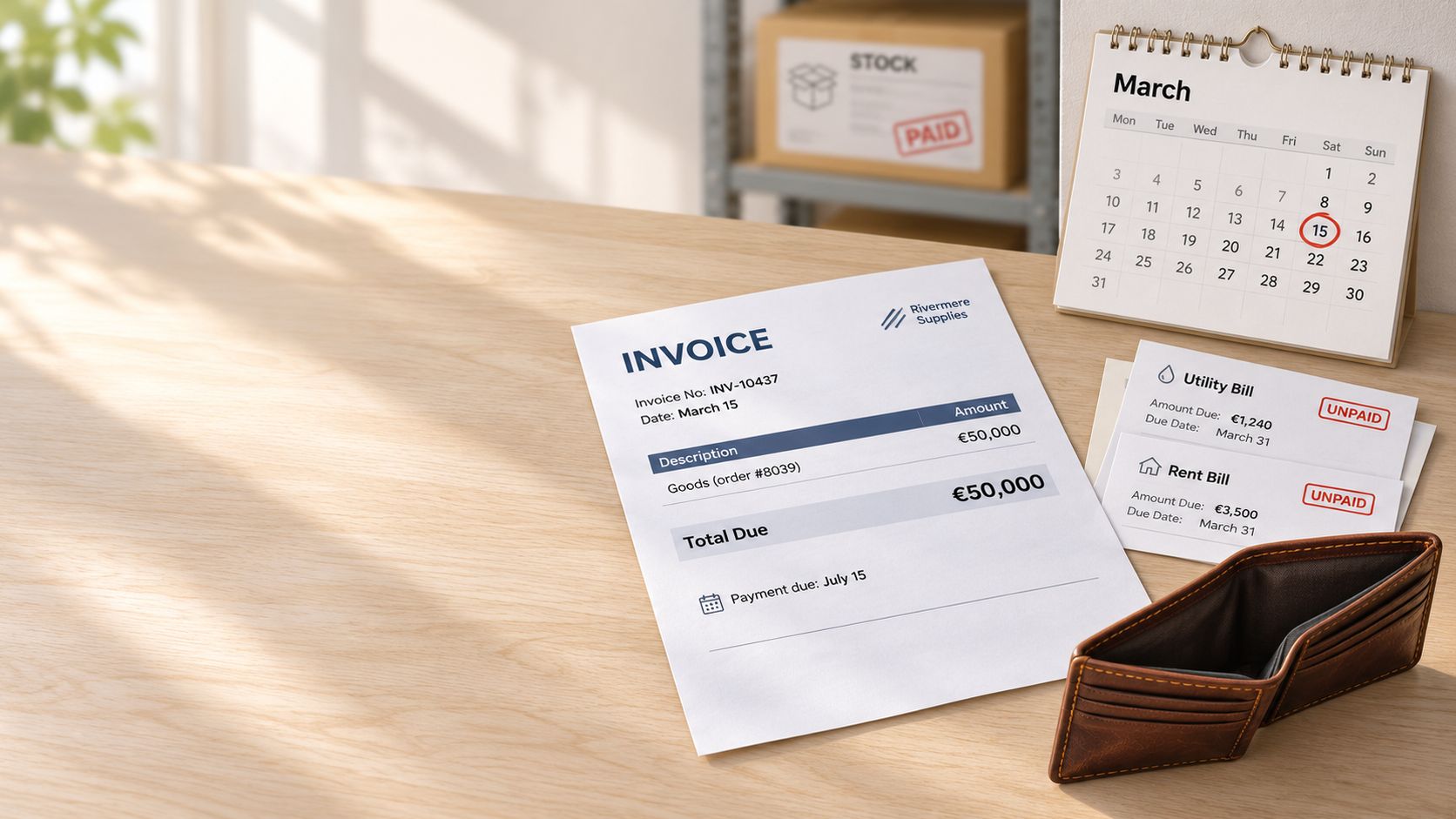
Say a wholesale trader invoices a retail customer €50,000 in March on generous credit terms and doesn't receive payment until July. In April, that same trader buys replacement stock on 30-day supplier terms and pays cash in May. The income statement celebrates a €50,000 sale in March, yet the company's bank account absorbs the stock outflow two months before the customer settles the invoice. Profit says March was a success. The bank balance says otherwise.
The desk below illustrates how uncollected invoices and immediate bills collide inside a profitable operation.
Under IAS 7 published by the IFRS Foundation, analysts must avoid treating accounting profit as a proxy for liquidity because depreciation, receivables growth, inventory accumulation, and supplier-payment timing can materially separate reported profit from operating cash generation. That timing gap sits at the centre of practical financial management for non-financial managers.
Direct Versus Indirect Operating Cash Flow
Both IAS 7 and FRS 102 allow two formats for presenting operating cash flows, arriving at the exact same operating total by different routes:
- Direct method: Lists major classes of gross cash receipts (actual cash collected from customers) and gross cash payments (actual cash paid to suppliers, staff, and tax authorities). It reads like a categorised bank summary, though it requires granular cash-tracking records.
- Indirect method: Starts from accounting profit or loss and works back to cash through specific adjustments. Depreciation is added back because it reduces paper profit without spending a single euro of cash; increases in trade receivables and inventory are deducted because unpaid invoices and unsold stock tie up cash; increases in trade payables are added because waiting longer to pay suppliers keeps cash in the bank temporarily.
The indirect reconciliation is the format managers most often encounter in published accounts, which makes it the practical starting point for reading any company's numbers. Learning to trace each adjustment from profit down to operating cash is the first diagnostic skill in reading a cash flows statement, because it reveals exactly where profit and liquidity parted ways.
That tracing exercise matters most when pressure builds. Deloitte's 2025 Irish insolvency data recorded 812 corporate insolvency appointments in Ireland in 2025, down 7% from 2024, yet still pinpointed rising operating costs, limited working-capital access, and difficulty repaying legacy COVID-related debt as acute pressures on SMEs. Reconciling profit to operating cash flow and translating it into a 13-week rolling cash forecast covering trade receivables, payroll, VAT and tax due dates, creditors, and debt service answers the question profit figures ignore: how much cash must stay reserved for obligations that don't appear as expenses in the current month?
If operating cash flow sits consistently below reported profit, find the balance sheet line absorbing the cash, usually growing customer receivables, rising stock levels, or tighter supplier payment terms.
How to Read Each Section and What the Pattern Means
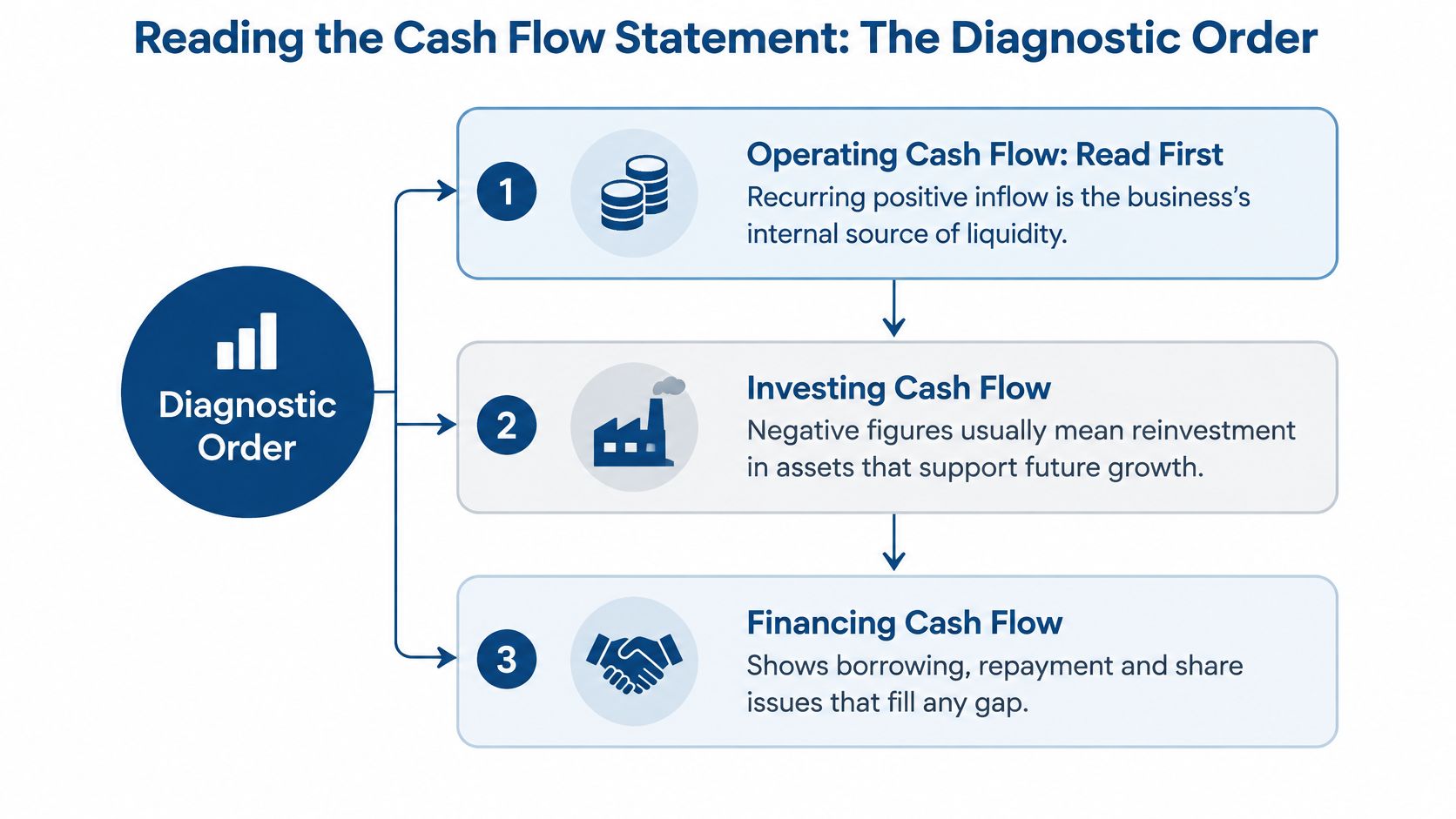
Reading a cash flows statement line by line from top to bottom without a plan can feel overwhelming. A disciplined diagnostic order cuts through the noise by testing the three sections in a fixed sequence: operating first, investing second, and financing third.
Start with operating cash flow, because recurring positive cash from core trading is the only self-sustaining source of liquidity. Move next to investing cash flow, where a negative number usually reflects capital spending on machinery, premises, or systems to support growth, while a positive number flags asset sales that require explanation. Look at financing cash flow last to see whether lenders or shareholders are injecting fresh funds to bridge a gap, or whether the company is strong enough to repay debt and pay dividends.
The diagram below maps that three-step sequence clearly.
Reading Sign Patterns Across All Three Sections
Once a reader notes whether each section is positive or negative, the combined three-sign pattern immediately points to the company's underlying financial posture and the exact follow-up question to ask.
| Operating | Investing | Financing | What it usually suggests |
|---|---|---|---|
| Positive | Negative | Negative | Trading funds investment and debt repayment; generally the strongest pattern. Ask whether the investment is sustainable. |
| Positive | Negative | Positive | Trading funds expansion, supplemented by new borrowing or equity. Ask whether the new funding is planned. |
| Negative | Negative | Positive | Cash is being consumed and outside funding keeps the business going. Ask how long the funding will last. |
| Positive | Positive | Negative | A mature business selling assets and repaying debt. Ask whether the asset sales are one-offs. |
| Negative | Positive | Positive | Asset sales and borrowing cover trading losses. Treat as a warning sign and check the going-concern position. |
Context matters because the exact same sign can carry opposite meanings. A negative investing figure from purchasing new production equipment usually signals deliberate expansion, whereas repeated positive investing inflows from selling vehicles, equipment, or property can mean a struggling business is selling off its productive future just to cover today's overheads.
Reviewing all three sections together also highlights debt headroom. The Central Bank of Ireland's SME Market Report identified working-capital purposes among new credit applications between March and October 2020 and found that many SME revolving-loan facilities held zero or only small undrawn balances. When borrowing headroom is already thin, a financing inflow can't easily rescue weak trading cash flows if customer payments slow down.
A single reporting year is also a weak basis for judgement because one major equipment upgrade or a lump-sum refinancing can distort the signs temporarily. Examining three consecutive years as part of broader financial statement analysis distinguishes one-off events from structural trends. The underlying principle is straightforward: a healthy company funds itself from operations, invests within its means, and uses outside financing to bridge planned, deliberate gaps.
When a Rising Cash Balance Hides Weakness
Many readers glance straight at the closing bank balance, see a higher number than last year, and conclude the business had a strong year. That instinct is dangerous. A company can push its closing cash balance upward while becoming financially weaker just by taking on new debt, delaying supplier payments past agreed terms, or liquidating essential assets.
The conceptual setup below separates cash generated by trading from liquidity supplied by bank loans and unpaid supplier invoices.

Recent Irish data shows why distinguishing internally generated cash from borrowed liquidity is critical. In the first half of 2026, Deloitte's Irish insolvency press release reported 429 insolvency appointments, up 5.4% from 407 in the first half of 2025, with court liquidations surging 69% and creditors' voluntary liquidations making up 68% of all cases. The same release notes that PwC recorded 444 Irish corporate insolvencies in the first half of 2026, broadly comparable with 436 a year earlier, while flagging persistent pressure from weak demand, tight margins, and cash-flow constraints. Meanwhile, The Irish Times reported in 2025, drawing on Department of Finance survey figures, that average outstanding Irish SME debt climbed to just under €444,000 in 2024, up from €369,000 in 2023. National totals can look deceptively flat while debt burdens and cash-flow strain intensify inside specific sectors.
Four Measures That Test Cash Quality
To look past a flattering closing bank balance, analysts test cash quality with four targeted calculations:
- Operating cash flow before financing: Isolates the cash produced purely by trading before any bank loans or shareholder injections mask the result.
- Free cash flow after capital expenditure: Deducts necessary spending on property, plant, and equipment from operating cash flow, revealing what surplus cash still remains to reduce debt or build a buffer.
- Debt-service coverage: Divides operating cash flow by total loan repayments and interest paid. A figure sliding toward or below 1.0 signals that day-to-day operations aren't comfortably covering scheduled debt commitments.
- Financing share of the cash increase: Compares net new borrowings and equity inflows against the total net rise in cash, exposing how much of the bank balance growth came from outside funders rather than customers.
Diagnostic test: "Is the cash balance improving because the business model works, or because the company is borrowing, delaying suppliers, or selling assets?"
Timing matters just as much as cash quality. Even a positive annual operating cash flow can hide a painful mid-year liquidity shortfall driven by seasonal trading troughs, annual insurance renewals, or concentrated tax dates, which is why annual accounts should always sit alongside a short-term rolling cash forecast.
Read the Statement in Five Checks
Turning theory into a repeatable habit doesn't require a degree in accountancy. Running five ordered checks takes less than ten minutes and surfaces the critical facts on any cash flows statement.
The five-step flow below summarises the full review sequence at a glance.
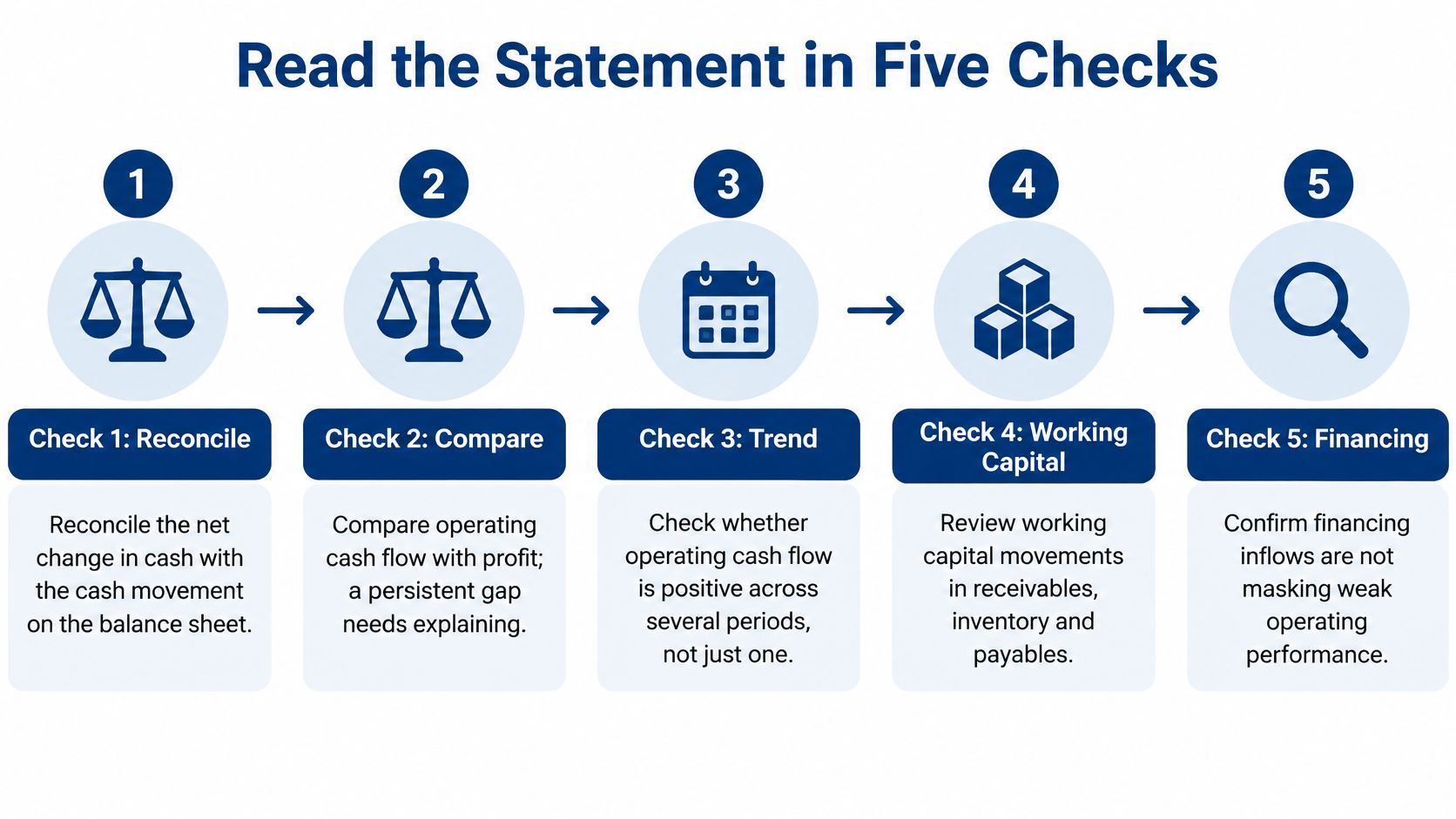
- Reconcile cash to the balance sheet: Confirm that the net change in cash on the cash flows statement matches the movement in cash balances on the statement of financial position.
- Compare operating cash flow with profit: Measure how much accounting profit converted into cash, because a persistent gap requires an explanation from working-capital lines.
- Scan investing cash flows: Separate routine capital spending from asset disposals, flagging any one-off property or equipment sales.
- Check financing cash flows: Review borrowing, debt repayments, dividends, and new equity, noting that if financing is the only positive section, outside funding is carrying the business.
- Match the pattern and write a question: Map the three signs to the pattern table and draft one concrete question for management.
Walking Illustrative Numbers Through the Five Checks
Seeing real figures move through the routine makes each step click. Suppose a hypothetical mid-sized manufacturer reports €400,000 in annual profit, €310,000 in operating cash flow, €(180,000) in capital expenditure, and a €120,000 loan drawdown, resulting in a €250,000 net increase in cash.
- Step 1 reconciles cleanly: The closing bank balance on the balance sheet rose by exactly €250,000 over the period, confirming the statement ties out.
- Step 2 measures profit-to-cash conversion: Dividing €310,000 by €400,000 shows 78% of reported profit turned into cash. That's solid, though the €90,000 gap still justifies checking whether customer receivables grew faster than sales or stock built up late in the year.
- Step 3 checks investing discipline: Capital spending of €180,000 is modest relative to operating cash flow and reflects active reinvestment without any asset sales inflating the bank balance.
- Step 4 exposes financing reliance: The €120,000 loan drawdown supplied 48% (nearly half) of the €250,000 net increase in cash. Without that loan, free cash flow still added €130,000 to cash reserves, so trading isn't broken, yet debt clearly amplified the headline increase.
- Step 5 identifies the pattern and question: Positive operating, negative investing, and positive financing give a Positive, Negative, Positive profile, pointing directly to one sharp question for management: what specific expansion project is the €120,000 loan funding, and when do principal repayments begin?
Combining these five checks with structured ratio analysis gives managers and analysts a clear view of solvency, liquidity, and working-capital efficiency across consecutive reporting periods.
Putting the Routine Into Practice
The fastest way to cement these habits is to pull two consecutive years of financial statements for a business of interest, first checking whether a small company includes a cash flows statement under statutory rules. Run the five checks in order and jot down three headline numbers: operating cash flow, operating cash flow as a percentage of profit, and financing's share of the total cash increase.
For learners who want structured, self-paced practice applying these techniques, the Accounting Principles course from European Institute of Leadership and Management covers six modules designed to help participants understand fundamental accounting concepts, interpret and analyse financial statements, conduct financial reporting, create and manage budgets and forecasts, perform variance and performance analysis, and familiarise themselves with commonly used accounting software and tools.
Keep one final distinction in view whenever reviewing company accounts. The cash flows statement provides an honest record of where cash came from and where it went in the past, while a rolling cash forecast shows whether the business can comfortably meet payroll, suppliers, and tax obligations next quarter.
European Institute of Leadership and Management offers self-paced online courses, programme certificates, and Mini-MBA pathways across accounting, financial management, and leadership for professionals and business owners building practical financial fluency. Developing confidence with financial statements, budgeting, and cash forecasting turns annual accounts into a reliable tool for everyday management decisions. Explore the full course catalogue and learning pathways at European Institute of Leadership and Management.