
What Is a Project Charter? Definition and Key Parts
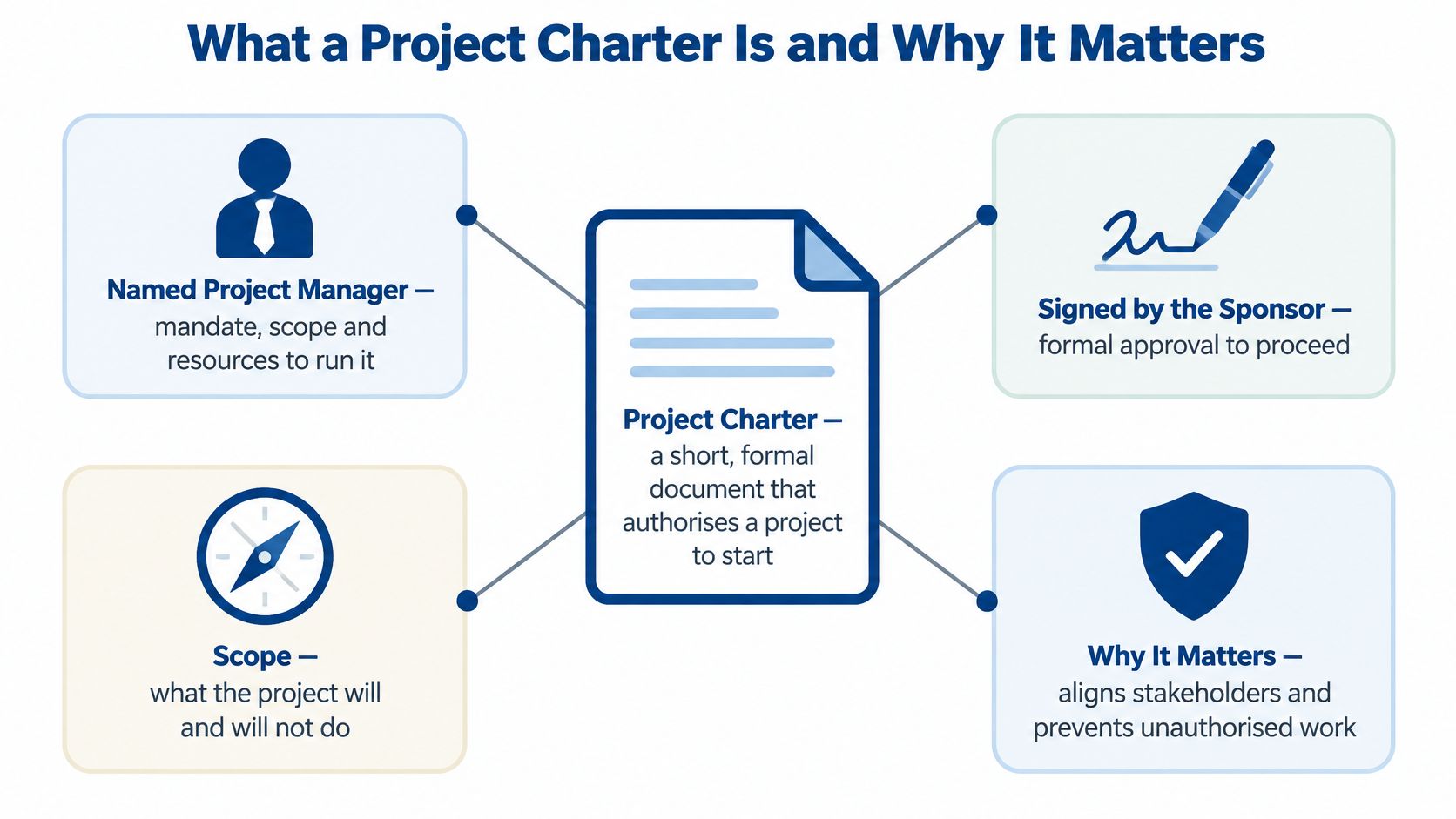
What turns a request into a project the organisation has agreed to run? Usually a single signed page. A project charter is a short, formal document that authorises work to begin and gives one named manager the mandate, scope and resources to deliver it.
In Irish public-sector capital work, that authorisation opens a governed approval chain in which projects above set cost thresholds need Government approval before they proceed.
A charter treated as a form signed at kick-off and filed away will let a project down. Irish public life offers the evidence: capital projects that drifted far beyond their original budgets, and one IT project abandoned outright, each a case where the authorisation had stopped describing the work and nobody sent it back for review.
Read properly, the charter is a decision gate. When cost, scope or schedule moves beyond the tolerances it set, the working response is to re-baseline it, seek re-authorisation, or stop the project altogether.
Table of Contents
- What a Project Charter Is and Why It Matters
- The Components Every Project Charter Contains
- Who Signs the Charter and What It Authorises
- How the Charter Fits the Project Lifecycle
- Project Charter, Business Case and Project Plan Compared
- A Worked Example from Irish Public Life
- When the Charter Stops Being True
- Get the Charter Signed Before Planning Begins
What a Project Charter Is and Why It Matters
Start with the moment before the document exists. A finance director asks an operations manager to sort out the invoice backlog before the quarter closes. Nothing is written down. Two developers are pulled off another job, a supplier is told a portal is on the way, and six weeks later somebody asks who agreed the deadline.
That request becomes a project at the point a named person with budget authority signs a page stating what it is for, what it covers, who runs it and how it will be watched. Everything before that signature is conversation.
A usable charter answers four questions in writing.
- Why it exists: the problem or obligation that justifies spending money now rather than next year.
- What it must deliver: outcomes in numbers and dates, not adjectives, plus the thing handed over at the end.
- Who decides: the sponsor, the project manager, and the line between the two.
- How it is controlled: the reporting rhythm, the escalation route and the tolerance band around cost and time.
Answer three and you have a proposal. Answer all four and you have a mandate.
Think of a building project. A builder can sketch an extension, price the materials and promise a finish date, but none of it makes the work legitimate until planning permission is granted and a contract is signed. The charter is that twin approval for a project. It turns an ambition into work the organisation has agreed to undertake, and it gives the person running it standing to ask for staff, money and time.
Size varies more than templates admit. A five-person software team can settle its charter in a 30-minute meeting and a single page. An Irish public-sector capital project may run to a dozen pages because it carries a governance section, an approval route and a project classification. Same document, different weight.
A charter that answers all four questions stays short. A charter that answers none of them grows long, because length is what people write instead of decisions.
The Components Every Project Charter Contains
Ireland's public-service governance model treats the charter as the formal initiation instrument that converts an approved need into an authorised project. The project management handbook sets out what it records: project background, measurable objectives and deliverables, outline scope, stakeholders, business requirements, risks, assumptions, constraints and dependencies (RACD), indicative cost and schedule, reporting controls, and project classification. Because those parameters are fixed before detailed planning, decision-makers get a common baseline for authorisation and the project manager gets boundaries for the scope, resource, risk and performance calls that follow.
Copy the structure into a template and fill it in.
| Component | What it records | Example entry |
|---|---|---|
| Background and business need | Why the project exists and the problem it solves | Manual invoice approvals take up to 14 days and delay supplier payments |
| Measurable objectives and deliverables | Outcomes with numbers and dates, plus what is handed over | Cut processing time to 3 days by 30 June 2026; one working invoice portal |
| Outline scope | What is inside and, explicitly, outside the project | In: invoice intake and approval. Out: payroll, supplier onboarding |
| Stakeholders and roles | Who is affected, who decides, who is consulted | Finance director as sponsor; accounts payable team as users; suppliers consulted on portal changes |
| Business requirements | The high-level needs the solution must meet | Audit trail on every approval; single sign-on with existing directory |
| Risks, assumptions, constraints and dependencies (RACD) | Known uncertainty, what is taken for granted and what limits the work | Dependency: finance system upgrade in March 2026. Assumption: two developers released |
| Indicative cost and schedule | A high-level figure with tolerance and target dates | €120,000 estimate with a 10% tolerance; portal live by 30 June 2026 |
| Governance and reporting controls | Meeting rhythm, reporting line and decision rights | Monthly steering group; weekly status note to sponsor; decisions logged in a register |
| Approval route and project classification | Who authorises, at what threshold, and how the project is classed | Sponsor approval up to €50,000; above that the finance committee; classified medium risk |
| Project manager appointment and authority | The named manager and what they can decide alone | Named manager can commit up to €10,000 and reassign team tasks; anything larger goes to the sponsor |
Order matters more than completeness
Fill purpose before scope, scope before cost, and cost before schedule. Each field constrains the next, so writing them out of order produces a schedule with no scope behind it and a budget with no boundary around it. The sequence also exposes weak thinking early. If the business need runs to three sentences and the deliverable list runs to a page, the project is really a wish with a timeline attached.
What to leave out
Detailed work breakdown structures, task-level schedules and the full risk register belong to the plan, not the charter. Including them slows sign-off, invites premature commitment to dates nobody has tested, and guarantees a rewrite within a month. Aim for a two-page ceiling on business projects. Public-sector templates run longer because they carry classification and approval fields, and those fields are worth the space.
Here is the test for every entry: each field should be answerable in a sentence, with the number or the rule stated plainly. Any field that needs a page is plan material. Move it, and the charter stays a decision document rather than a description of everything you intend to do.
Who Signs the Charter and What It Authorises
A charter is an authority contract before it is anything else. The sponsor or approving authority signs. The project manager drafts and owns the document but does not approve it, because self-approval authorises nothing that a delivery team can point to when priorities shift.
Irish project-management guidance places the charter at the start of the lifecycle, before substantial planning, and uses it to support formal acceptance, resource commitment and the assignment of the project manager. The fields that turn a document into a mandate are specific: the sponsoring authority, the project manager's responsibility and authority, a high-level cost estimate, approval requirements, initial resources, intended outcomes and stakeholder expectations. Each one creates traceability, so a later change can be tested against an authorised baseline and a deviation in cost, time, scope or benefits travels through the reporting structure rather than being settled in a corridor.
The rule worth enforcing: no detailed scheduling, no procurement, no solution development until the sponsor has signed and dated the charter.
The failure this prevents is common and expensive. A team dives into solution design before anyone agreed who owns decisions, where scope ends, which staff are pre-assigned and what approval thresholds apply. It resurfaces months later as unpaid change requests, missed dates and a sponsor who does not recognise the project they apparently approved.
Clarity on the division of responsibility between sponsor and project manager is what makes the signature mean something. The sponsor holds budget and the decision to stop. The manager holds delivery, the day-to-day calls and the duty to escalate.
Put a version number and a date on the signed document. That single habit converts the charter from a nice opening gesture into a reference point: version 1.2 dated 14 March is the baseline, and anything that changes cost, scope or the definition of done needs a matching update approved by the same person.
How the Charter Fits the Project Lifecycle
The charter is the first document in a chain that every later artefact depends on. Ireland's Department of Public Expenditure, NDP Delivery and Reform publishes project-management templates for small and medium projects running from Project Charter to Project Business Case, Communications Plan, Stakeholder Engagement Plan, Decision Register, Execution Plan, Progress Report and Post-Project Completion Review. Every one of them assumes the charter already exists.
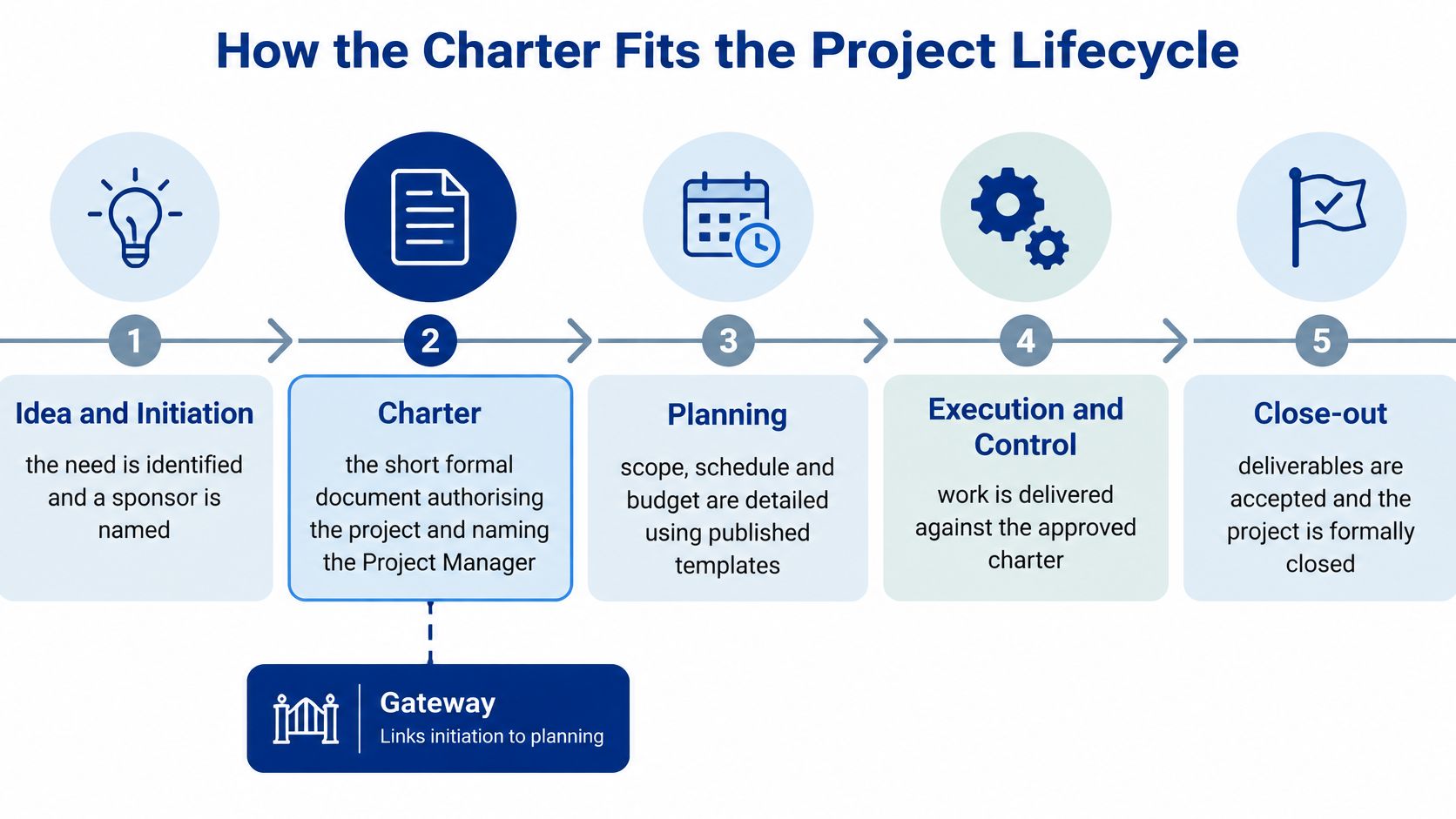
That order answers the question new project managers ask most often at initiation: why write a charter when the planning has not been done yet. Because the charter is what opens the gate to planning. Without it there is no route to design approval, no basis for procurement and no authorisation to release budget. It functions as a decision gate, and each later gate in the lifecycle is a point where the work can be re-authorised, re-baselined or stopped against what the charter originally settled.
Transport Infrastructure Ireland's project management guidelines for capital work show the same gate logic at national scale, dividing project development and delivery into eight phases, each with defined processes, approvals and deliverables, and requiring Government approval for projects costing more than €100 million. They also identify the Approving Authority as ultimately responsible for the project.
Two consequences follow for a charter of any size. First, communication channels must be established at initiation, which is why a stakeholder section belongs in the charter even though the full engagement plan is written later. Second, the higher the approval thresholds above the project, the more precisely the charter must state who can say yes at each level.
The chain runs idea, initiation, charter, planning, execution and close-out. Skip the third link and the fourth has nothing to hang from. Building the schedule, sequencing the work and assigning effort then belongs in creating a project plan, which is a different document with a different job.
Project Charter, Business Case and Project Plan Compared
Most of the confusion about the charter comes from three documents being confused for one another. They answer different questions, are written at different moments, and are owned by different people.
| Document | Written when | Question it answers | Owner |
|---|---|---|---|
| Project charter | At initiation, before substantial planning | Why does this exist, what must it deliver, who decides, how is it controlled | Project sponsor |
| Business case | Before or alongside the charter | Is this investment worth making compared with the alternatives | Sponsor with finance |
| Project plan | After the charter is signed | How, when and by whom will the work be done, task by task | Project manager |
| Risk register | After sign-off, maintained throughout delivery | What could go wrong, who owns each risk, what is the response | Project manager and risk owners |
| Benefits realisation plan | After sign-off, before delivery ends | How and when will the promised benefits be measured | Sponsor or benefits owner |
| Stage or gate review report | At each approval gate | Is the project still justified and within tolerance | Approving authority |
The business case argues whether the money should be spent at all. The charter records that the decision has been taken and names who answers for it. The plan describes the work. Two habitual mix-ups follow from blurring them.
The first is a charter stuffed with a work breakdown structure. It turns a decision document into a task list, slows the signature, and locks in detail that nobody has tested. The second is a plan written before scope was agreed, which commits the organisation to work it never authorised. Both cost rework the moment a date or a boundary moves.
One-line test for any paragraph: if it would change when a task slips, it belongs in the plan.
Irish governance expectations reinforce the distinction. The 2025–2026 Governance Framework defines governance as the system of principles and processes through which organisations are directed and controlled, and requires governance, assurance and control arrangements for public investment. A charter is where those arrangements become visible on a single page, recording purpose, decision-making authority, accountability, controls and escalation routes so that delivery stays connected to organisational oversight. Anyone weighing up what a business case is and how it differs will find the same logic: the case recommends, the charter authorises, the plan executes.
A Worked Example from Irish Public Life
Real charters are easier to copy than templates. Ireland's Department of Agriculture, Food and the Marine prepared the Project Woodland Charter in March 2021 to create a shared understanding of the project's nature, purpose, organisation and resourcing.
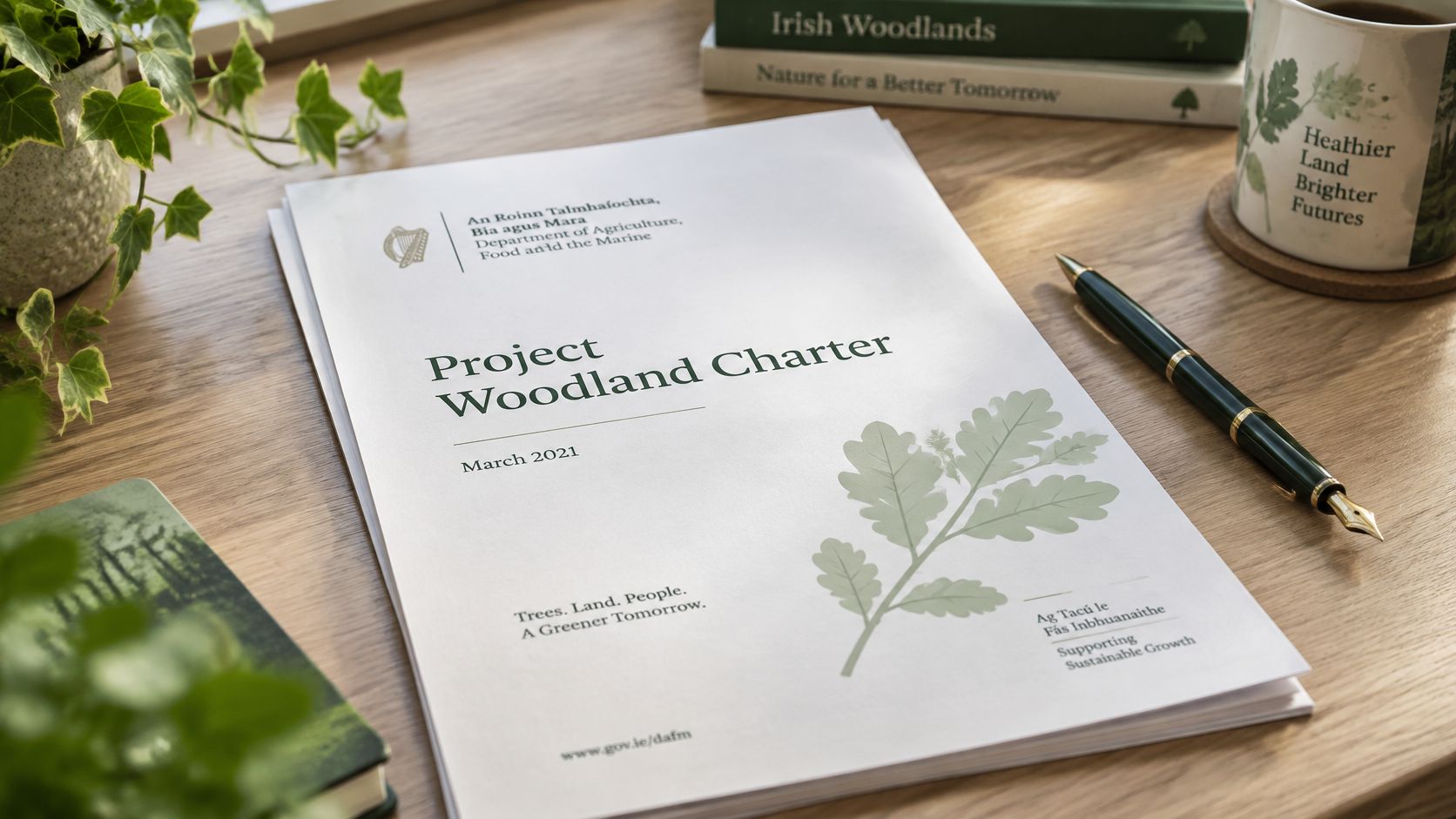
The document defined objectives, deliverables, responsibilities, governance arrangements, progress monitoring and reporting. It also set a framework for risk management, quality assurance, oversight and responding to evidence-based recommendations. Two parts of that framework deserve a second look: the approval route for changes and the reporting controls, both of which in-house charters tend to settle late or leave out.
What makes it a good model is the separation of control from execution. Ultimate authority rested with the Project Board, exercised through the Project Sponsor and Project Manager, while the project plan covered intended work, outputs, schedules, activities, milestones and deliverables. Scope, accountability and reporting were settled before delivery began, and the charter stayed the agreement that converted a mandate into an authorised management structure.
Scale it down to fit the project. A five-person internal project needs one page: the four questions, a named sponsor with budget authority, three measurable objectives with dates, an explicit out-of-scope line, and a review date. That version takes an hour to draft and settles arguments that would otherwise surface in month three. The review date matters as much as the rest, because a charter that is never reopened becomes a filing exercise while the project drifts from what it authorised.
The forestry example was built for a multi-party national project, so its governance weight suits that scale. Read it for its structure and adapt the length to the project.
When the Charter Stops Being True
Sign-off starts the charter's useful life. A document that authorises spending on the strength of a forecast has to be reopened when the forecast stops holding, because the mandate it grants is only as honest as the assumptions underneath it.
| Trigger | Evidence to check | Action |
|---|---|---|
| Expected benefits no longer hold | Updated business case and demand forecast against the charter assumption | Re-baseline or recommend cancellation |
| Forecast cost past tolerance | Spend to date plus forecast against the charter estimate and its tolerance band | Return to the approving authority for re-authorisation |
| One risk above sponsor tolerance | Risk register showing a single risk rated above the agreed threshold | Escalate to sponsor, re-scope or pause delivery |
| Critical dependency slipping | Supplier, regulatory or funding milestones moving past the charter dates | Re-plan the gate and re-approve the schedule |
| Scope creeping beyond outline scope | Approved change requests straying outside the charter scope statement | Test each change against the authorised baseline before agreeing |
| Sponsor or manager leaving | Role vacant beyond the agreed notice period | Reconfirm accountability and authority before work continues |
The cost of leaving a stale charter untouched is documented. Irish Times coverage of the Central Bank audit reported weak demand forecasting, inadequate audit trails and major cost overruns, with nearly one in five key projects missing its deployment deadline and nine of 28 projects exceeding budget by a combined €6.1 million. An abandoned Arts Council IT project shows the same pattern at its sharpest: the stopping decision arrived only after substantial public money had already been spent.
Every one of those outcomes began as an approved project whose business case stayed untouched while delivery conditions changed around it. That is how a charter creates false confidence. The paperwork still says the benefits will arrive, so nobody reopens the question, and each monthly report measures progress against a baseline that stopped describing reality quarters ago.
Treat charter reviews as decision gates with evidence attached.
Schedule the review at every gate, minute the decision, and permit exactly four outcomes: continue, re-scope, re-authorise or stop. Re-authorisation goes back to whoever signed the charter, because the body that granted the mandate is the only one that can change it. Handling escalation well depends on project risk management and delivery uncertainty being built into the review rhythm from the start, so the escalation path exists before a supplier fails.
Get the Charter Signed Before Planning Begins
A signature that arrives after planning has started only records decisions nobody authorised. Get the order right.
- Name the sponsor and get written confirmation that they will sign, including the budget level they control.
- Draft one page answering the four questions: why the project exists, what it must deliver, who decides, how it is controlled.
- Write the out-of-scope list explicitly, because exclusions prevent more arguments than inclusions.
- State the cost estimate, its tolerance band and the approval thresholds above which the sponsor or a committee must be consulted.
- Agree a review date and adopt the trigger list above as standing agenda items at each gate.
- Obtain a dated, versioned signature before scheduling, procurement or development starts.
Each step closes a specific failure mode. An unsigned sponsor leaves the tolerances with no owner. A missing exclusion list lets every "obviously not included" assumption resurface as a dispute later. A signature without a date or version gives reviewers nothing to measure an overrun against.
When a charter is weak, the cause is often simple: whoever drafted it copied a template and inherited its gaps, because nobody had shown them what initiation must settle. The European Institute of Leadership and Management runs a Programme Certificate in Project Management aimed at current project managers, team leaders and people looking to move into a project management role, and a Mini-MBA in Project Management spanning the full project management lifecycle from initiation to closure. Courses are delivered fully online and self-paced.
A charter is the cheapest document a project will ever produce, and the one that decides whether the rest of the work has a mandate behind it. If initiation is the step nobody ever taught you, the project management pathway at European Institute of Leadership and Management is a reasonable place to start.