
What Is Residual Risk: Meaning, Examples and Assessment
The risk assessment comes back clean. Every control on the list has a tick beside it, the spreadsheet is signed, and the project is cleared to proceed. Then someone in the meeting asks the question the document doesn't answer: so what are we still exposed to?
That question is the whole subject of residual risk, and it's where a lot of risk work falls apart. Teams learn to score a risk before controls, then treat the post-control number as a formality, a smaller figure in a different column. But the smaller figure is the one the organisation carries. It's the one that needs an owner, a threshold, a date and evidence, or it becomes a number nobody is accountable for.
What follows builds the idea from the ground up: what residual risk is, how it's calculated, why controls never take it to zero, who decides whether what's left is acceptable, and how to record that decision so it survives a board review, an audit or a bad week.
Table of Contents
- What Residual Risk Means in Plain Terms
- How Residual Risk Is Worked Out After Controls
- Why Controls Never Take Risk to Zero
- Deciding Whether Residual Risk Is Acceptable
- Recording Residual Risk in a Register
- Residual Risk in Irish Workplaces and Cyber Security
- Reviewing Residual Risk Before Your Next Sign-Off
What Residual Risk Means in Plain Terms
A house with a deadlock on the front door and a monitored alarm is harder to burgle than the same house with neither. Fit both and the chance of a break-in falls. It doesn't fall to zero. Someone can still force a window, defeat the alarm, or slip in behind a distracted occupant. The exposure the house carried before any of that equipment went in is the inherent risk. The smaller exposure that remains once the lock and alarm are fitted and working is the residual risk.
Most risk decisions get made in the gap between those two. The European Commission's 2015 security rules define residual risk as the risk remaining after security measures are applied, because not all threats can be countered and not all vulnerabilities can be eliminated. Controls shrink the exposure but leave a residue that has to be managed. Formal frameworks describe that residue in consistent terms: the overall risk once existing mitigation measures, remaining vulnerabilities, the likelihood of the threat and its consequences are weighed together.
Two numbers describe the same activity, and they answer different questions.
Inherent risk compared with residual risk
| Aspect | Inherent risk | Residual risk |
|---|---|---|
| Definition | Risk before any controls are applied | Risk left after controls are applied |
| Question it answers | How serious could this be if untreated? | How much exposure remains now? |
| Typical level | Highest exposure, the untreated baseline | Lower than inherent, but normally above zero |
| Main use | Deciding whether controls are needed | Deciding whether remaining exposure is acceptable |
| Who reviews it | Risk owner during design or planning | Accountable senior manager who signs off acceptance |
The distinction earns its keep at decision time. A go or no-go call made on inherent risk is a call about a situation that no longer exists. What the organisation will live with is the residual figure, and that figure has to be assessed, compared with the risk appetite or a regulatory requirement, documented, and then either accepted, transferred or treated again. Installing controls marks the point where the work becomes a governance question: someone senior enough has to say out loud what's left, whether it sits inside tolerance, and when the answer gets looked at again.
How Residual Risk Is Worked Out After Controls
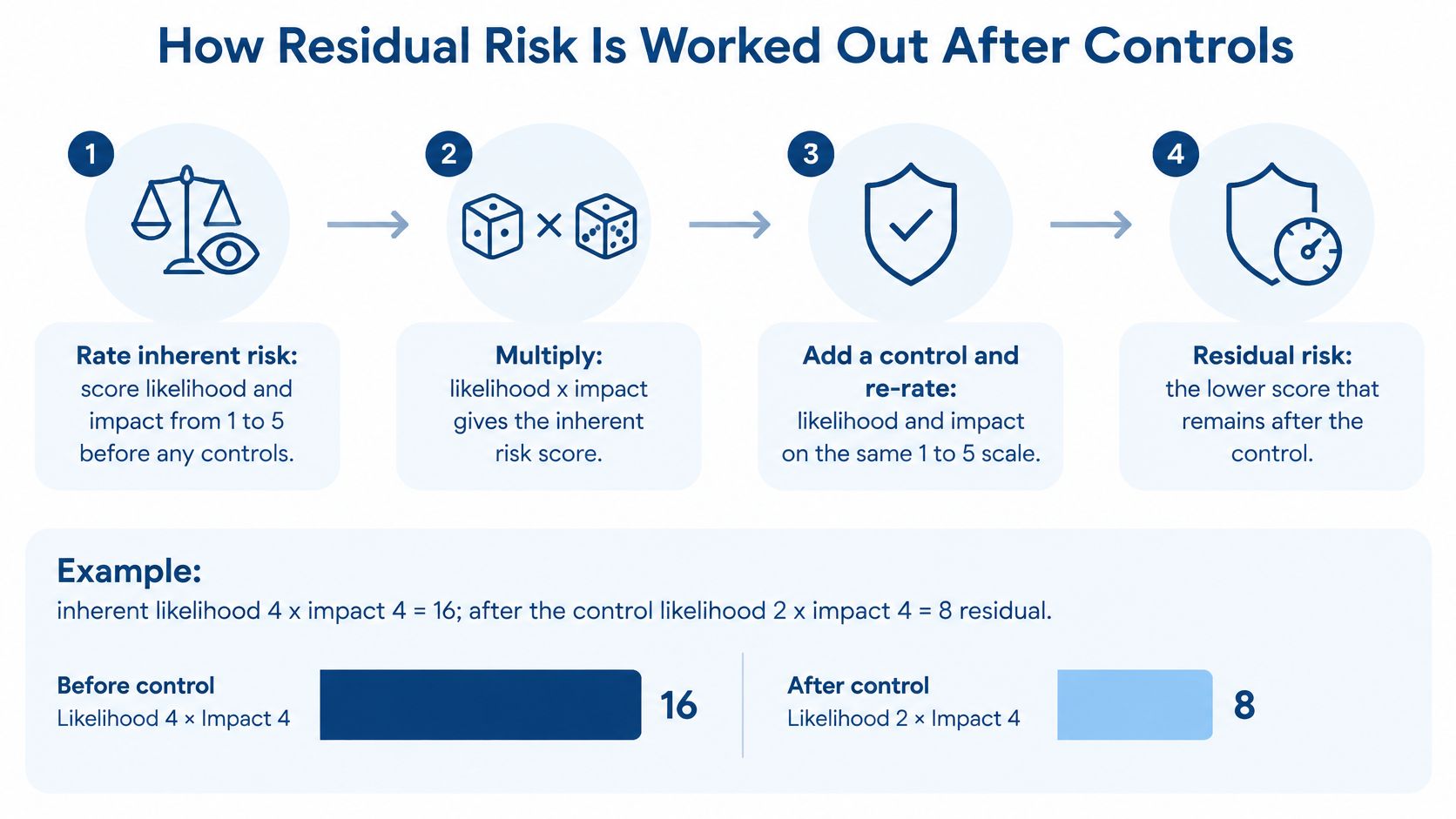
The mechanics are simple even when the judgement isn't. Most organisations rate likelihood and impact on a 1 to 5 scale, multiply the two, and then repeat the rating after each control is added. The scales need written descriptions for each level, so that a 4 means the same thing to a finance manager as it does to an operations lead. That discipline is what a structured risk probability and impact assessment teaches, and it's the difference between a defensible score and a guess with a number attached.
Here's the sequence in order.
- Name the threat and the asset. Be specific: not "cyber attack" but "ransomware encrypting the finance team's shared drive".
- Score the untreated risk. Rate likelihood and impact with no controls in place and multiply them.
- List the controls in operation. Not the ones on the roadmap, not the ones in a policy document. The ones with evidence behind them.
- Rescore likelihood and impact. Ask how the control changes each value separately, because a backup doesn't stop an attack happening, it shortens the recovery.
- Record the residual score and compare it with the tolerance set for that activity.
- Decide. Accept, transfer, treat further, or escalate to someone senior enough to own the answer.
Put numbers on one case. A finance laptop is exposed to ransomware. Untreated, likelihood is high at 4 and impact is severe at 5, so the inherent score is 20. Multifactor authentication makes a stolen password far less useful and tested backups shorten the outage, cutting likelihood to 2 and impact to 4, which brings the score to 8. Adding endpoint detection and response, the tooling that watches for suspicious behaviour on devices, plus staff training on phishing, takes impact down again to 3 and leaves a residual score of 6.
| Stage | Likelihood (1-5) | Impact (1-5) | Score |
|---|---|---|---|
| Inherent, no controls | 4 | 5 | 20 |
| After MFA and tested backups | 2 | 4 | 8 |
| Residual, after EDR and staff training | 2 | 3 | 6 |
Those figures are illustrative, and that matters. A score is only meaningful inside a rating scheme the organisation has defined and agreed, with bands and thresholds written down before anyone has a result they'd prefer.
The rule that matters: rescore on controls that have been tested, not controls that have been documented. A backup that has never been restored is an assumption, not a mitigation.
So the calculation gives you a number, and the number gives you a question. Residual risk should be lower than inherent risk, but whether the lower figure is fine depends entirely on the threshold set for that activity, and that's a governance question rather than an arithmetic one.
Why Controls Never Take Risk to Zero
It is 4:50pm on a Friday in a Dublin office. The lock works, the alarm is live, the backup ran overnight, and the employee finished the phishing module last month. They still click the link. A control lowers exposure. It does not cancel the threat, the human, or the clock.
Every control has a failure mode. A lock can be picked, an alarm can be ignored, a backup can fail to restore, and a trained person can still make the wrong click when they are tired. Conditions move as well: a process changes, a supplier is swapped, a new starter has not done the induction. Some threats sit outside your reach, in a third party's infrastructure or a regulator's timetable. What is left is not a rounding error. It is residual risk, and it still needs an owner, a tolerance threshold, a review date, and evidence.

Ireland's workplace figures show the same pattern on a national scale. The Health and Safety Authority's annual review of workplace injuries, illnesses and fatalities recorded 36 work-related fatalities and 10,441 non-fatal incidents in 2024, with non-fatal incidents 3% higher than in 2023 and 14% above the five-year average. Those incidents happened in workplaces that, in the main, already had safety policies, training, equipment, and supervision. Exposure remained anyway.
The hazard mix shows where the leftover risk concentrates. Manual handling was the most common trigger for non-fatal incidents. Vehicle-related events caused 10 deaths, heavy or falling objects caused six and falls from height caused five, and together those three categories accounted for 64% of all work-related deaths. Sector concentration is just as stark: agriculture, forestry and fishing accounted for 12 fatalities, more than one-third of all deaths, despite employing roughly 4% of the workforce. Guards, training, and procedures were already part of those sectors. The deaths are the exposure that the controls did not remove.
Three misconceptions do most of the damage here.
"The control is in place, so the risk is gone." A control lowers exposure, and how much it lowers it depends on whether it works on the day it is needed, not on whether it exists in a procedure. A hi-vis jacket makes a worker easier to see on a farm yard. It does not stop a vehicle, a falling bale, or a wet ladder.
"A low residual score means no further action." A low score still needs an owner, a review date, and a written reason for the number. Untended low scores are where drift hides: the supplier changes, the induction slips, and nobody notices because the last score looked comfortable.
"Residual risk is just the risk of doing nothing." Residual risk is the exposure that remains after you have acted. That is why it is smaller than the inherent figure, and why it is the figure you report, date, and assign to someone.
If that leftover exposure sits above the tolerance the organisation has already written down, the named owner cannot close the item. They bring evidence of what the control did, set a review date, and record the decision. Completion of a task is not the same as a measured reduction. That is why risk mitigation strategies are judged on measured effect rather than on a ticked box. You do not call the yard safe because the jacket was issued. You check who is still exposed, and you check it again before the next sign-off.
Deciding Whether Residual Risk Is Acceptable
Acceptance is a decision, not a default. Once a residual score exists, the owner has four routes: accept it and record why, transfer it through insurance or a supplier contract, treat it further with an additional control, or escalate it to someone with the authority to carry it.
European rules make clear that acceptance isn't a matter of personal comfort. European Commission guidance on the Cyber Resilience Act states that residual cybersecurity risk is an inherent outcome of risk assessment and treatment, since these risks cannot be entirely eliminated, yet it explicitly rejects the idea that manufacturers may accept any level of risk at their discretion. Products with digital elements may reach the EU market only when remaining risks have been sufficiently addressed through the required security measures, considering intended purpose and reasonably foreseeable use. The same guidance family requires trust-service providers to have their management bodies approve residual risks, with the treatment plan justifying each accepted risk in language a reader can follow.
Ireland's supervisory practice points the same way. The Central Bank of Ireland's ICT self-assessment framework expects regulated entities to identify, manage and monitor residual ICT risks that sit above tolerance, justify their acceptance, and review them regularly. National NIS2 guidance goes further, requiring residual risks to be either treated or formally accepted by risk owners, reported to senior management, and documented with who accepted the risk, why, when, and the conditions for review.
When the score sits above tolerance
Take the finance laptop with a residual score of 6 against an approved tolerance of 4 for that activity. The score can't be filed as acceptable and forgotten. The owner has to choose a response. The finance director might accept the risk for a limited period until the backup restore test is complete, with a review date of 31 March, provided the test is booked and someone is chasing it. If the restore test fails, the decision escalates rather than renews.
Four tests decide whether an above-tolerance acceptance holds up.
- Tolerance: does the residual score fall inside the approved threshold for this activity, or does it need a documented exception?
- Remediation date: is a fix scheduled, with a named person and a date, or is the plan to keep watching?
- Duty: does a legal, safety or contractual obligation attach to the exposure, which removes discretion entirely?
- Assumptions: have the claims behind the score been tested, or is the number resting on a control nobody has exercised?
A time-limited acceptance with a named owner and a review date is defensible governance. An indefinite tolerance with no owner is a control that never got fixed, wearing a signature.
The contrarian point deserves an airing. Adding controls isn't automatically the better answer. A proportionate, dated acceptance can be stronger governance than an expensive control whose effect nobody has measured, because it states plainly what is being carried and who is carrying it. That judgement, weighing exposure against cost and evidence, is exactly what decision making under risk and uncertainty trains managers to do.
Recording Residual Risk in a Register
Read one row of a residual-risk register: ransomware on the shared finance drive, rescored at likelihood 2 and impact 3, accepted by the finance director until the backup restore test completes, with a review on 31 March. A reader who was never in the room can see what could still happen, what was done about it, who carries it and when it comes up again. Each field earns its place. Leave one blank and every review meeting restarts from memory.
Fields in a residual-risk register entry
| Register field | What to record | Example entry |
|---|---|---|
| Hazard or threat | The risk being assessed in plain terms | Ransomware on shared finance drive |
| Controls in place | Each control and whether it is tested | MFA on email, daily offline backups restored quarterly |
| Post-control likelihood and impact | Rescored values with the reason | Likelihood 2, impact 3, score 6 |
| Exposed group and location | Who and where the remaining risk affects | Finance staff, Dublin office |
| Accountable owner | Named role, not a team | Finance director |
| Decision and rationale | Accept, transfer or treat further, with reasons | Accept until backup restore test is complete |
| Review trigger and date | Event or deadline that forces reassessment | Review 31 March or after any incident |
How far treatment has to go is set by guidance rather than preference. The Health and Safety Authority's chemical agents risk assessment guidance applies the ALARP principle: residual risk should be reduced to a level that is as low as reasonably practicable, so further reduction stops being required once the cost would be grossly disproportionate to the added safety benefit. The same guidance places personal protective equipment last in the control hierarchy, behind elimination, substitution, engineering controls and administrative controls, and it notes that residual exposure capable of harming workers may call for further measures such as health surveillance.
Two fields get left blank most often. The first is evidence: the test results, incident records and dates sitting behind the rescored values. An entry claiming quarterly backup restores should give the date of the last successful restore and the person who ran it; without that, the control column describes an intention rather than a tested safeguard. The second is location and affected group, because a single company-wide score hides real variation. Central Statistics Office figures on fatal workplace accidents put the 2024 rate at 1.2 per 100,000 workers for Irish workers against 0.4 per 100,000 for non-Irish workers, ranging from 2.6 in the South East to 0.5 in Dublin. Identical controls can leave materially different exposure in different places, so the register keeps the detail rather than averaging it away.
The European Institute of Leadership and Management risk management course works through this same sequence in its assessment material: score the risk, treat it, then record what remains with an owner and a date.
Residual Risk in Irish Workplaces and Cyber Security
Many firms treat cyber security as a project with an end date. Buy the tools, pass the audit, close the file. A new lock does not make a premises safe if the spare key is under the mat and nobody has agreed who checks the alarm. Whatever exposure is left after the controls is residual risk. It is still a governance decision: a named owner, a tolerance the business can live with, a review date, and evidence that each control works in practice.
The SME cyber-resilience state of the sector report, a 2025 assessment of 894 Irish enterprises across 11 sectors, found that 78% of SMEs fell into the low or very-low cyber-resilience categories and only 6% reached a high or very-high rating (microbusinesses 81% low or very low, medium-sized businesses 45%), while 63% of SMEs relied solely on the business owner for cyber-security responsibility, 11% lacked clarity about who held it, and 67% never provided training or did so only on an ad hoc basis.
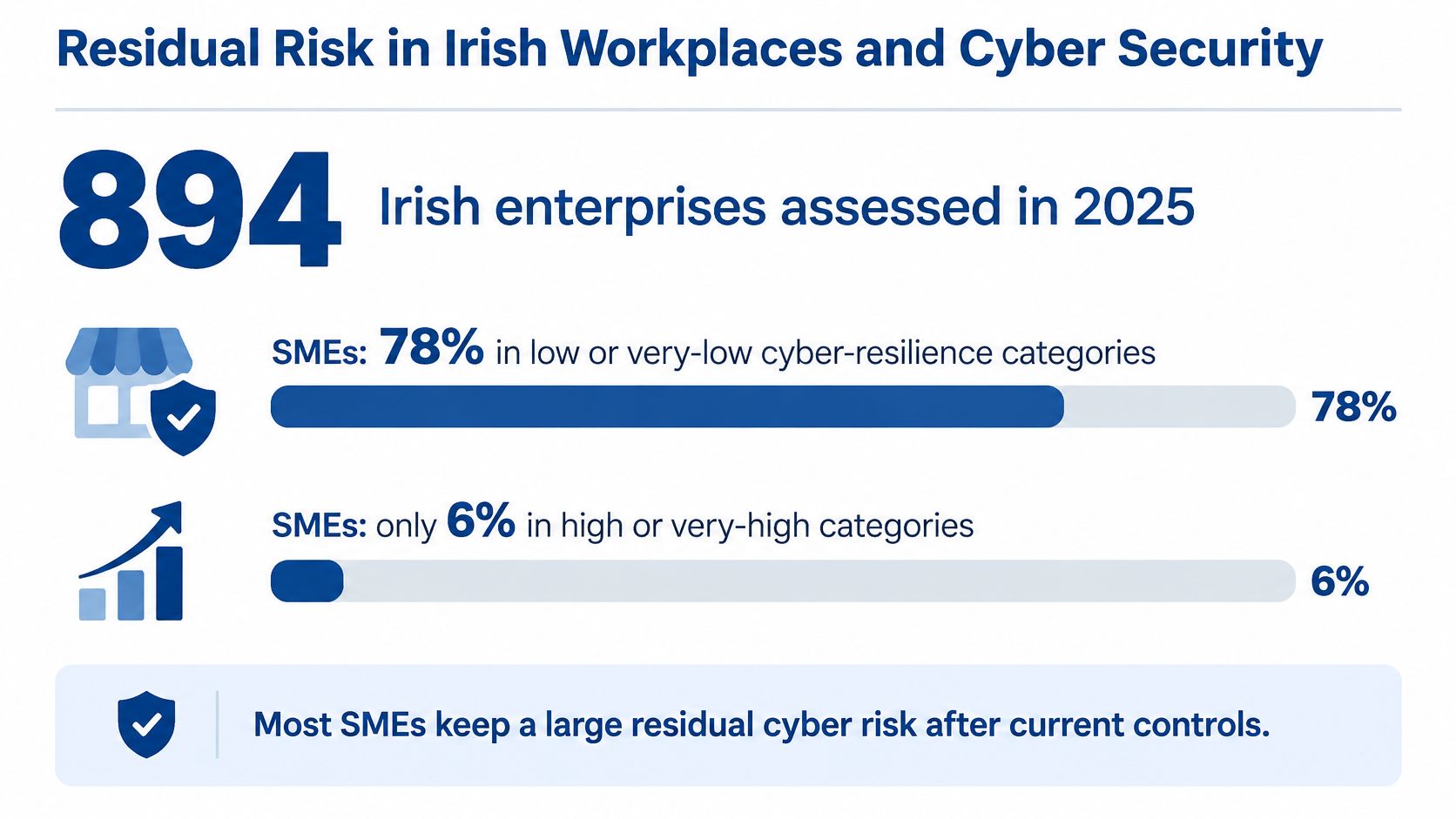
Those weak ratings come from specific gaps. The published analysis of that national assessment reports that 74% of SMEs had not implemented multifactor authentication, 69% operated without automated backup solutions and 87% had no tested business-continuity plan.
A password without multifactor authentication works like one key for the office, the payroll files and the customer records. Steal or reuse it, and access follows. Without automated backups, ransomware or a mistaken deletion is not only lost data. The outage length becomes the impact, because nothing is ready to restore the service. Without a tested continuity plan, recovery times stay assumptions until the day they are needed.
Ownership fails in the same way. If the only person responsible is the owner, that person is also the only one who can accept exposure above tolerance or set a date to bring it down. Where nobody is clear who holds the role, an incident has no one entitled to make that call. Staff who were never trained, or trained only now and then, keep opening routes the tools were bought to close.
The test is practical. Check that each control runs, then keep the proof: MFA coverage as a percentage, restoration-test results with dates, named incident roles, training completion, exercise outcomes. Exposure still above tolerance goes to that named owner with a deadline to reduce it, or with a written acceptance that states the tolerance, the review date and the evidence behind the score. Controls never clear the last of the risk. An unsigned gap is not acceptance. It is exposure nobody has decided to carry.
Reviewing Residual Risk Before Your Next Sign-Off
Before the next project, supplier or system goes live, five questions will tell you whether the sign-off is real. The Central Bank of Ireland's operational-resilience framework captures the logic well: express residual risk as the remaining likelihood and impact of service failure after controls, then test whether the resulting disruption stays within an approved impact tolerance.
- Is there an approved tolerance for this activity? A number nobody has agreed in advance can't be breached, which means it can't protect anyone.
- Is the score based on tested controls? Documented is not the same as working.
- Is a named person, not a team, accountable for anything above tolerance? Teams don't sign acceptance. People do.
- Is there a dated review, tied to events as well as the calendar? A failed test, a new supplier or an incident should force a rescore regardless of the date in the diary.
- Is the evidence for each rescored value attached? Without it, the register records an opinion.
Old answers expire. A new supplier, a regional or operational change, or an incident that exposes a control failing each invalidates a recent review, even one signed last month. Scenario tests, recovery-time performance, dependency mapping and control exceptions are the evidence that keeps the record honest.
A sign-off is defensible when the leftover exposure has been scored, compared with tolerance, and accepted by the person named in the register. Anything less is a signature on an untested assumption.
Risk decisions get easier once you can separate the exposure you started with from the exposure you're carrying, and harder once you realise that the second number needs an owner and a date. European Institute of Leadership and Management teaches that discipline through online, self-paced courses in risk management, project management and leadership, covering probability and impact assessment, choosing between reducing, transferring and accepting exposure, and monitoring whether what remains stays within tolerance. If this article has changed how you think about sign-off, working through one structured course is the quickest way to turn the idea into a habit. Visit European Institute of Leadership and Management to browse the catalogue.