
Risk Management in Project Management: A Practical Guide
The project looked healthy at kick-off. Then a supplier stopped confirming delivery dates, a dependent task stalled, and the team faced a delay that nobody had allowed for. The sponsor's question was predictable: why wasn't this risk visible before it became a problem?
Risk management in project management means turning uncertainty into decisions while the team still has options. Ireland's government spending review of major capital projects reported that 47.8% were delivered on budget or better, but only 0.5% were on budget, on time and on benefits. A useful risk register therefore protects more than the cost forecast. It helps the team decide what to change, when to act and which outcomes remain achievable.
Table of Contents
- The Four Stages of Project Risk Management
- How to Identify Risks Before They Surface
- How to Score Risks by Likelihood and Impact
- Choosing the Right Response for Each Risk
- Keeping the Risk Register Working Through the Project
- Where Risk Management Goes Wrong and What the Evidence Shows
- Start Your Risk Register on the Next Project
The Four Stages of Project Risk Management
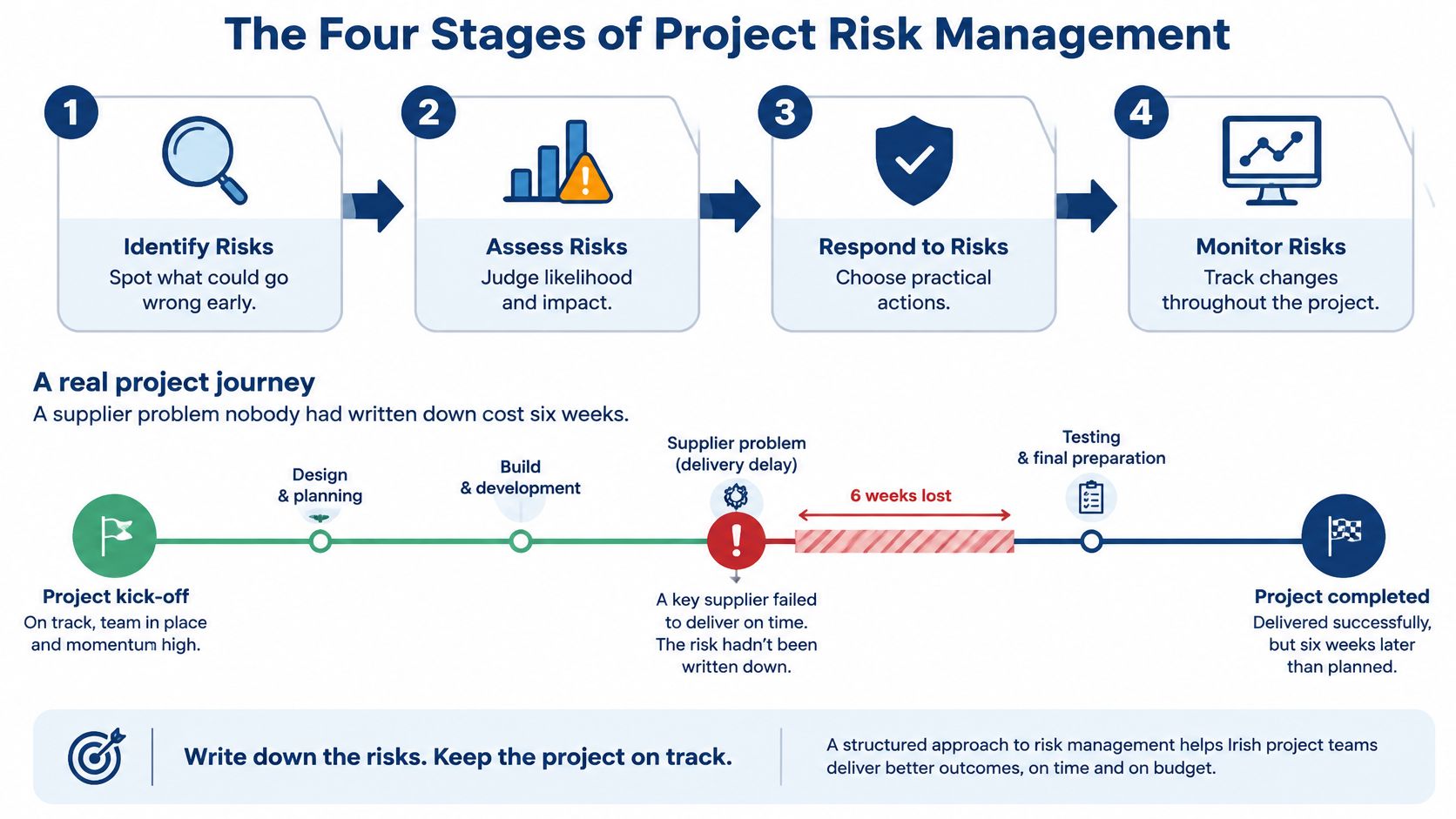
Consider a hypothetical project that loses six weeks because a supplier problem never reached the register. The failure isn't just missing paperwork. The team missed the chance to assess the dependency, secure an alternative and agree when intervention would become necessary.
Risk management is a continuous cycle, running from initiation to closure. Each stage should leave something usable in the project file, rather than a discussion that disappears after the meeting.
The four stages and what each produces
| Stage | Core question | Output |
|---|---|---|
| Identify | What could go wrong? | Risk list in the register |
| Assess | How likely is it, and how severe would it be? | Score for each risk |
| Respond | What will we do, and who owns it? | Chosen response and named owner |
| Monitor | Is the risk changing, and is the response working? | Updated register at every review |
Identification exposes uncertainty. Assessment establishes priorities, including potential effects on cost, schedule, quality and benefits. Response planning converts those priorities into funded actions, while monitoring checks whether the assumptions behind those actions still hold.
A ship's navigation provides a useful analogy. The crew checks the chart before sailing, adjusts course when conditions change and keeps watch throughout the voyage. An approved route doesn't remove the need to respond to deteriorating weather.
The same applies to an approved project baseline. A completed mitigation can reveal a different exposure, and a scope change can invalidate an earlier assessment.
Practical rule: A risk review should end with a decision, a confirmed action or an explicit decision to keep watching.
Risk management belongs inside existing governance. Delivery meetings should check actions and emerging signals; sponsor reviews should resolve exposure beyond the project manager's authority. A separate reporting exercise adds little if nobody changes the delivery plan.
How to Identify Risks Before They Surface
Start with the project's dependencies, not a blank spreadsheet. Scope and requirements, procurement and suppliers, budget and schedule assumptions, stakeholders and approvals, technology, and external conditions all provide useful starting points. Materials costs and labour availability matter because they can undermine a plan even when the internal team performs well.
A vague entry such as supplier risk is difficult to manage. A stronger entry describes the cause, uncertain event and consequence: because a specialist component has no approved substitute, supplier disruption could prevent installation and delay commissioning.
A structured identification workshop
- Bring delivery knowledge into the room. Include the delivery team and sponsor, with procurement, technical or operational representatives where their decisions affect the work.
- Review comparable projects. Examine the assumptions that failed, not just the final list of lessons.
- Walk through the work breakdown structure. Check handovers, approvals and dependencies task by task.
- Challenge each assumption. Ask what must remain true for the estimate or milestone to hold.
- Record opportunities too. Earlier access to a site or a reusable design may improve the outcome, but still needs assessment and ownership.
Choose risk identification tools and methods that expose different weaknesses. A workshop draws out delivery knowledge; an assumptions review challenges the baseline; dependency mapping reveals where apparently separate tasks share the same vulnerability.
Use an outside view to challenge optimism
Transport Infrastructure Ireland's reference-class forecasting guidelines report average international cost overruns of 26% for roads, 27% for bridges, 37% for tunnels and 38% for rail, with six to seven out of ten transport projects experiencing overruns.
Average international cost overruns by transport project type
| Project type | Average cost overrun | Planning implication |
|---|---|---|
| Roads | 26% | Set the reserve against comparable road outcomes, not the base estimate alone |
| Bridges | 27% | Test design assumptions against comparable bridge projects |
| Tunnels | 37% | Hold a larger reserve and review ground-condition assumptions at each gateway |
| Rail | 38% | Treat the base estimate as a starting point and update it as scope firms up |
These averages aren't automatic contingency percentages for an individual project. The practical method is to select a comparable reference class, examine observed outcomes and derive an appropriate uplift without double-counting existing allowances.
TII identifies bad luck or estimation error, optimism bias, and strategic misrepresentation as causes of overruns. Independent challenge matters because a confident estimate can still omit uncomfortable risks.
How to Score Risks by Likelihood and Impact
Scoring turns a risk list into a priority order. A practical starting model uses likelihood and impact scales from one to five, then multiplies the scores. This is a proposed working convention, not a universal standard, and the sponsor should approve its definitions before the team uses it.
Under this model, likelihood runs from rare to almost certain, while impact runs from minor to critical. Products of 1 to 4 are low, 5 to 9 medium, 10 to 16 high, and 17 or above severe.
Probability and impact scoring matrix
| Likelihood | Minor (1) | Moderate (2) | Major (3) | Severe (4) | Critical (5) |
|---|---|---|---|---|---|
| Rare (1) | 1 Low | 2 Low | 3 Low | 4 Low | 5 Medium |
| Unlikely (2) | 2 Low | 4 Low | 6 Medium | 8 Medium | 10 High |
| Possible (3) | 3 Low | 6 Medium | 9 Medium | 12 High | 15 High |
| Likely (4) | 4 Low | 8 Medium | 12 High | 16 High | 20 Severe |
| Almost certain (5) | 5 Medium | 10 High | 15 High | 20 Severe | 25 Severe |
For a hypothetical supplier missing a delivery milestone, likely (4) × major impact (3) = 12, a high rating. That result should prompt a response decision, not merely a red cell in a spreadsheet.
Define impact before debating scores
Impact must reflect the project's agreed tolerances for cost, schedule, quality, benefits and reputation. For example, a hypothetical two-week slip needs the same interpretation across the team, whether a planner or procurement lead assesses it.
Use the most material consequence rather than averaging a critical effect away. Keep separate notes where a risk could affect several objectives, and distinguish current exposure from the expected residual exposure after mitigation.
Before accepting a score, apply these checks:
- Consistency: Would another informed assessor reach a similar rating using the written definitions?
- Evidence: Does the judgement rest on supplier information, design maturity or another identifiable basis?
- Timing: Would the consequence become more serious if the event occurred closer to commissioning or handover?
Structured risk probability and impact assessment helps teams explain their judgements. It doesn't turn subjective estimates into precise probabilities.
A rare but catastrophic event may still require escalation regardless of its product score. The matrix supports judgement; it doesn't replace it, and scores should change when evidence or project conditions change.
Choosing the Right Response for Each Risk
Suppose the main contractor may become unable to complete the work. The project manager must decide whether to change the delivery approach, strengthen safeguards, transfer part of the financial exposure, or prepare for replacement. Writing "monitor contractor performance" is not an adequate response plan.
The options below address different parts of the exposure. Contingency is a fallback arrangement and can sit alongside avoidance, transfer, mitigation or acceptance.
Risk response options and when to use them
| Response | Use when | Example | Residual risk |
|---|---|---|---|
| Avoid | The exposure can be removed by changing scope or method | Drop an unproven technology from the delivery plan | None for that risk |
| Transfer | A third party can carry the cost more efficiently | Fixed-price contract backed by a performance bond | Supplier failure and disputes |
| Mitigate | Likelihood or impact can be reduced at reasonable cost | Early supplier engagement and design review | Reduced, but still present |
| Accept | The cost of response exceeds the exposure | Absorb a short weather delay within schedule float | Accepted and monitored |
| Contingency | A fallback is needed if a defined trigger occurs | Draw on the reserve if a key supplier misses milestone two | Exposure beyond the reserve and recovery capacity |
Avoidance removes the specified exposure, not every risk arising from the replacement approach. For the contractor example, mitigation could include financial due diligence and checks on critical subcontractors; contingency could include access to design records and a replacement procurement route.
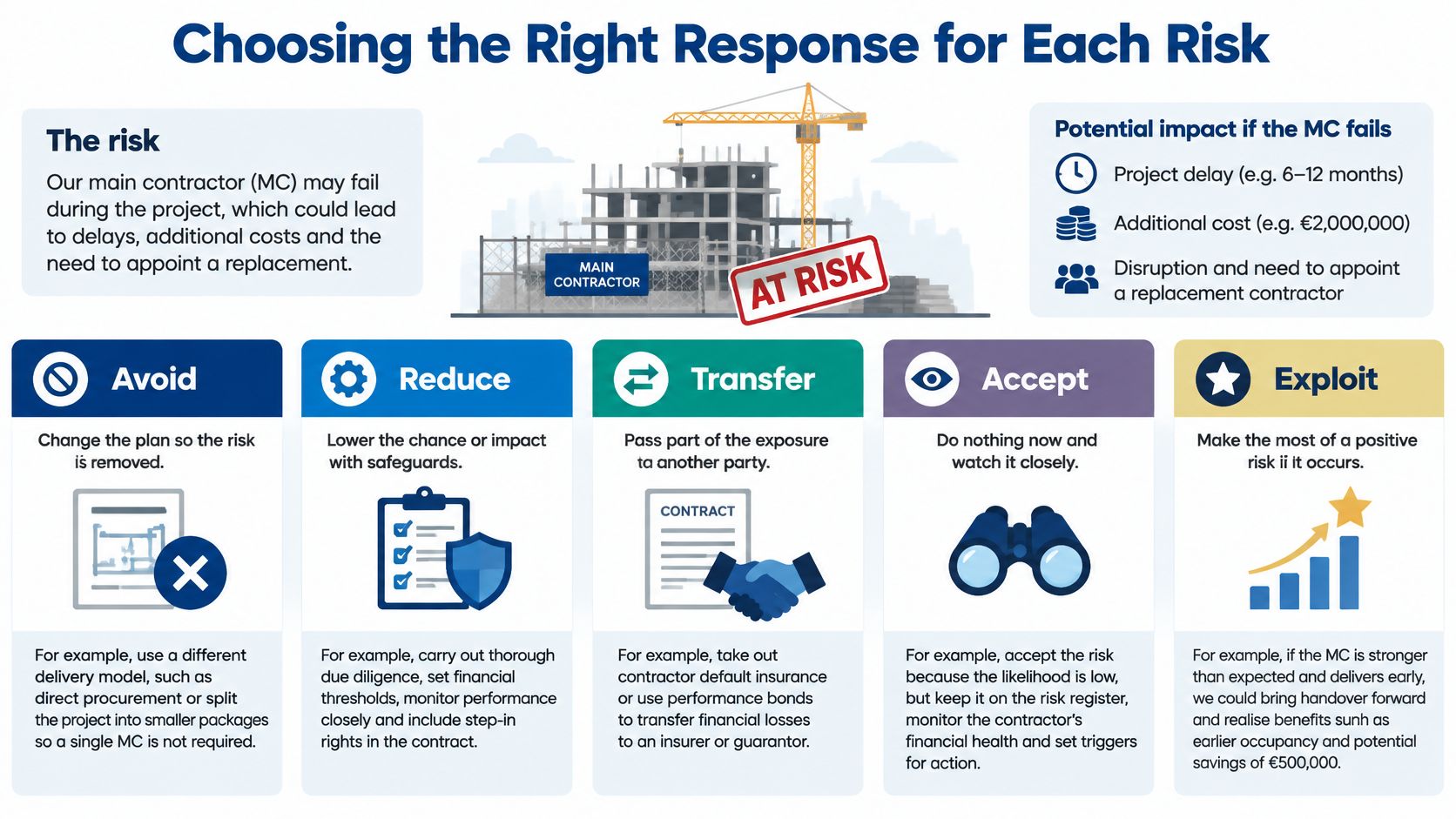
Exploit applies to positive uncertainty, such as securing an advantageous procurement opportunity. It isn't a substitute for planning a fallback against contractor failure.
Allocate volatility rather than hiding it
Irish construction-market commentary from Turner & Townsend describes material-cost increases of 8% to 25%, a 10% increase in insulation products, and growing supplier reluctance to commit to fixed pricing. Contract selection must address who can realistically carry that volatility.
A fixed price provides budget certainty only if the supplier can perform. Excessive transfer can produce inflated bids, disputes or financial distress; a performance bond may offset eligible losses but won't restore the programme automatically.
A signed contract allocates responsibility. It doesn't guarantee that the party carrying the risk has the capacity to absorb it.
Price-adjustment clauses can allocate defined input changes transparently. Two-stage tendering can improve cost visibility before final commitment, while negotiated shared-risk terms can distribute exposure that neither party can efficiently control alone.
For each selected response, record a named owner, an action deadline, residual exposure and any activation trigger. The register should also identify who may approve reserve use or a contractual change. Practical risk response strategies connect the commercial decision to the budget and delivery plan.
Keeping the Risk Register Working Through the Project
The risk register is the shared record of risks, assessments, responses and accountability. It should make the next decision easier, rather than force the sponsor to reconstruct the situation from meeting minutes.
Ireland's Public Service Project Management Handbook requires formal probability-and-impact assessment and recommends a register proportionate to project scale, reviewed at every project-team or governance meeting. It also recommends contingency plans with defined triggers.
A workable operating routine
- Record a complete entry. Include the description, possible impact, likelihood, mitigation action and responsible owner. Add assessment rationale, action status and residual exposure where these support decisions.
- Define the contingency trigger. State the observable event that activates the fallback and the person authorised to act.
- Review within existing meetings. Concentrate discussion on changed exposure, overdue actions and decisions needed, rather than reading every entry aloud.
- Close and refresh entries. Remove closed risks from the active view while retaining their history. Add risks from change requests, new dependencies and external signals.
- Escalate exceptions. Report material trigger breaches and exposure beyond delegated tolerances to the sponsor, with a recommended decision.
An owner coordinates the assessment and response; that person doesn't have to perform every action. Ownership should match authority and access to information, otherwise the entry creates accountability without the means to deliver.
The handbook's workflow connects early identification, communication and opportunity identification with assessment and prioritisation. Mitigation, preventative tasks and contingency planning then lead into recording and monitoring, including checks that assigned tasks were completed.
Keep the reason for each decision
Alongside the risk register, maintain a Decision Register. Transport Infrastructure Ireland's Project Management Guidelines require this within the Project Execution Plan for projects covered by approval bands beginning at €0.5 million, recording decisions, relevant dates and related issues.
This companion record explains why a team accepted exposure, changed procurement strategy or released contingency. Without it, a later reviewer may see the outcome but miss the assumptions behind the choice.
Effective risk monitoring throughout the project lifecycle leaves visible signs: entries change between reviews, owners provide evidence, triggers are checked and sponsors ask about specific risks by name. An unchanged register isn't proof of a stable project.
Where Risk Management Goes Wrong and What the Evidence Shows
Ireland's Comptroller and Auditor General review of higher-education capital projects examined ten projects with a combined build cost of €350 million: it found €67 million in cost overruns, average delays of 14 months, contractor replacement on three projects after the original contractors became financially unable to continue, and a €15.7 million net overrun, or 40%, on one project after contract termination and a performance-bond claim. It identified incomplete or ambiguous works requirements as a contributor to disputes, delays and increased costs.
Those findings challenge the assumption that procurement transfers delivery uncertainty out of the client's organisation. Unresolved requirements still need interpretation, and contractor replacement still requires mobilisation, coordination and time. A performance bond can recover money; it cannot recover the programme.
Three habits that undermine control
- Treating the register as a tick-box document. Detailed entries don't help if nobody checks actions or challenges unsupported closure.
- Relying on the initial workshop. Design development, procurement and handover create different exposures. An initiation-stage assessment can't represent them all.
- Ignoring external changes. Material costs, energy prices and skilled-labour shortages need a route into project decisions, not just market commentary circulated by email.
The practical procurement sequence is to identify the risk, describe it clearly in tender documents, evaluate how it will be managed and apply controls during execution. Requirements validation and supplier due diligence belong before commitment, when changes remain easier to make. Once the contract is signed, the client owns whatever the documents failed to allocate.
Filter external signals through project thresholds
Irish leaders' concerns extend beyond construction. A Deloitte Ireland risk survey found that 70% of surveyed Irish board and C-suite leaders identified strategic risk oversight and scenario planning as a critical board priority.
A project team needs an operating response, not a longer watchlist. For a critical material, track quotation validity and confirmed availability; escalate when either threatens the approved procurement date or remaining allowance.
More frequent identification isn't automatically better. Management attention should follow material changes in exposure, interdependence and time to impact.
Refresh scenarios when assumptions change, and stress-test linked effects on cost and schedule. Assign decision rights in advance so a breached threshold leads to action rather than another request for analysis.
Start Your Risk Register on the Next Project
A practical first week should produce decisions, not a polished template. A shared spreadsheet is sufficient when the team can control versions, assign actions and retain assessment history. Complexity should follow the project's needs, not precede them.
The following is a proposed starter routine, with workshop duration and risk count offered as working choices rather than prescribed standards.
A first-week plan
- Hold a 60-minute identification workshop. Bring the delivery team and sponsor together around requirements, suppliers, assumptions, approvals, technology and external dependencies. Capture specific causes and consequences rather than category labels.
- Score the top ten risks. Use the proposed five-point scales and agree impact tolerances in writing. Record uncertainty in the assessment instead of forcing artificial agreement.
- Make response decisions. Give every high or severe risk a chosen response and named owner. Write down contingency triggers, required resources and approval authority.
- Book the review habit. Add the register to every governance agenda and name the person responsible for updating it. Require owners to bring evidence of progress, not just a status colour.
A project manager should test whether the planned responses fit available time, money and authority. An action that depends on unapproved funding isn't ready to implement; it needs a sponsor decision and a deadline.
This routine suits a single project and can extend to a portfolio. At portfolio level, particular attention should go to shared suppliers, scarce specialists and approval dependencies, because separate project registers can conceal concentrated exposure.
Build the judgement behind the template
For structured development, the European Institute of Leadership and Management's Mini-MBA in Project Management covers the full lifecycle from initiation to closure. Its Online Certificate Courses section lists 20 courses, including Risk Management, Change Management and Time Management, offering focused study alongside broader project-management learning.
The immediate test remains practical: can the team explain the most important exposure, the action under way and the condition that would require a different decision? The register becomes useful through review, not completion.
European Institute of Leadership and Management offers lifecycle-wide project management study and focused certificate courses relevant to assessing and responding to uncertainty. Visit European Institute of Leadership and Management to explore the Mini-MBA in Project Management or Risk Management course, and pair that learning with a scheduled review of an active project risk register.