Management of Conflict: How to Handle Disagreement at Work
You've got two people on your team who've gone quiet with each other. Nothing dramatic happened. One of them questioned a deadline in a group chat, the other replied with a single word, and since then every handover has taken twice as long as it should.
You've already run through the options. Ignore it and hope it settles. Step in and risk making it bigger. Both feel wrong, because both are guesses. What's missing is a way of reading the situation before deciding what to do about it.
That's what management of conflict is: the deliberate handling of disagreement so it gets resolved, rather than suppressed or left to escalate. What follows builds it in order, from naming the type of conflict in front of you, through picking a response on purpose, to running the conversation and following through.
Table of Contents
- What Management of Conflict Means at Work
- Five Conflict Styles and When Each Works
- Choosing a Style for Real Situations
- What Irish Mediation Data Shows About Resolution
- Six Steps to Resolve a Disagreement and Mistakes to Avoid
- How Managed Conflict Strengthens Teams and Leadership
- Build Your Conflict Management Skills Now
What Management of Conflict Means at Work
Management of conflict is the deliberate handling of disagreement so it gets resolved constructively: named before it is answered, and answered in a way that fits the situation rather than the manager's mood. The skill is choosing a response on purpose. A manager who reacts the same way every time will get it wrong more often than not, because the right move depends on what the conflict is about.
Take two colleagues sequencing a shared project. One wants the client-facing work finished first so feedback arrives early. The other wants the underlying data verified first, so that feedback does not rest on figures still due to change.
Both are right about something.
Left alone, the standoff drifts: six weeks on, they are copying their manager into every email and the sequencing question has still never been decided. The space between a disagreement and its resolution is where the damage happens.
A conflict is a perceived clash of interests, goals, values or working methods. It does not have to be loud or personal to be real. A disagreement is narrower, and often healthy: two people testing each other's reasoning, reaching a better answer and getting back to work. Managing conflict means stopping the second from hardening into the first, and recognising which of the two is in the room.
The smoke alarm, not the fire
An alarm sounding does not mean the building is burning. It means something needs checking. Conflict does the same job. It signals that an owner is unclear, a priority was never agreed, or a process is failing. Silencing the alarm, which is what avoidance does in practice, leaves the cause untouched. A manager who says "let's just move on" has muted the signal, and the fault keeps running underneath.
Within a team, friction tends to surface in one of four places:
- Task conflict, about what should be done, such as which feature ships first.
- Process conflict, about how the work is organised and who signs off.
- Relationship conflict, rooted in personality, history or lost trust.
- Status or resource conflict, about who gets the budget, the credit or the headcount.
Each type calls for a different response, so classifying comes before reacting. The two ways managers get this wrong sit at opposite ends. One waits for a formal complaint before acting, by which point positions have hardened and the original question no longer matters. The other steps into every heated exchange, until the team learns that friction attracts a supervisor and starts hiding it. The workable middle is early, light contact that escalates only when the issue does not move.
Managed well, conflict leaves the work better than it found it, with the relationship intact enough to keep going.
Five Conflict Styles and When Each Works
People often describe their conflict style the way they describe their eye colour: fixed, inherited, not really up for discussion. That framing causes more damage than any single style. The Thomas-Kilmann model treats style as a choice, made on two dimensions. Assertiveness is how far you pursue your own concerns. Cooperativeness is how far you try to meet the other person's. Cross the two and five recognisable responses appear.
| Style | Assertiveness | Cooperativeness | Best used when |
|---|---|---|---|
| Competing | High | Low | A quick decision is needed, a safety or ethical issue is at stake, or you must act as the leader |
| Collaborating | High | High | Both sides' concerns are important and the relationship must last |
| Compromising | Medium | Medium | Time is limited, goals are moderately important, and both sides can give ground |
| Avoiding | Low | Low | The issue is trivial, emotions need to cool, or more information is needed before acting |
| Accommodating | Low | High | Preserving the relationship matters more than the issue, or you are willing to yield |
Each style buys something and each one charges for it.
- Competing is fast and decisive, and it burns trust when it becomes the default rather than the exception.
- Collaborating produces the most durable agreements, and it costs the most time and emotional energy.
- Compromising gets a workable answer quickly, and it leaves both parties partly unsatisfied.
- Avoiding buys room to think, and it lets issues fester when the delay has no end date.
- Accommodating protects a relationship at low stakes, and it builds resentment when one person always does the yielding.
None of the five is wrong in every case. The damage comes from repetition: the manager who avoids everything, the colleague who competes over what colour the slides should be.
Ask yourself which style you reach for first, and which one you use least. Then follow the pattern through. Someone whose default is avoiding and who never competes will find decisions drifting upward and problems arriving late. Someone who defaults to competing and never accommodates will find that people stop raising concerns early, because every raise becomes a contest.
Choosing a Style for Real Situations
Knowing five styles gives you vocabulary. Choosing one while your jaw is tight is judgement, and it comes from three quick reads: how urgent the issue is, how much the outcome matters to each person, and what the relationship can carry right now.
The three cases below show that judgement applied at different stakes.
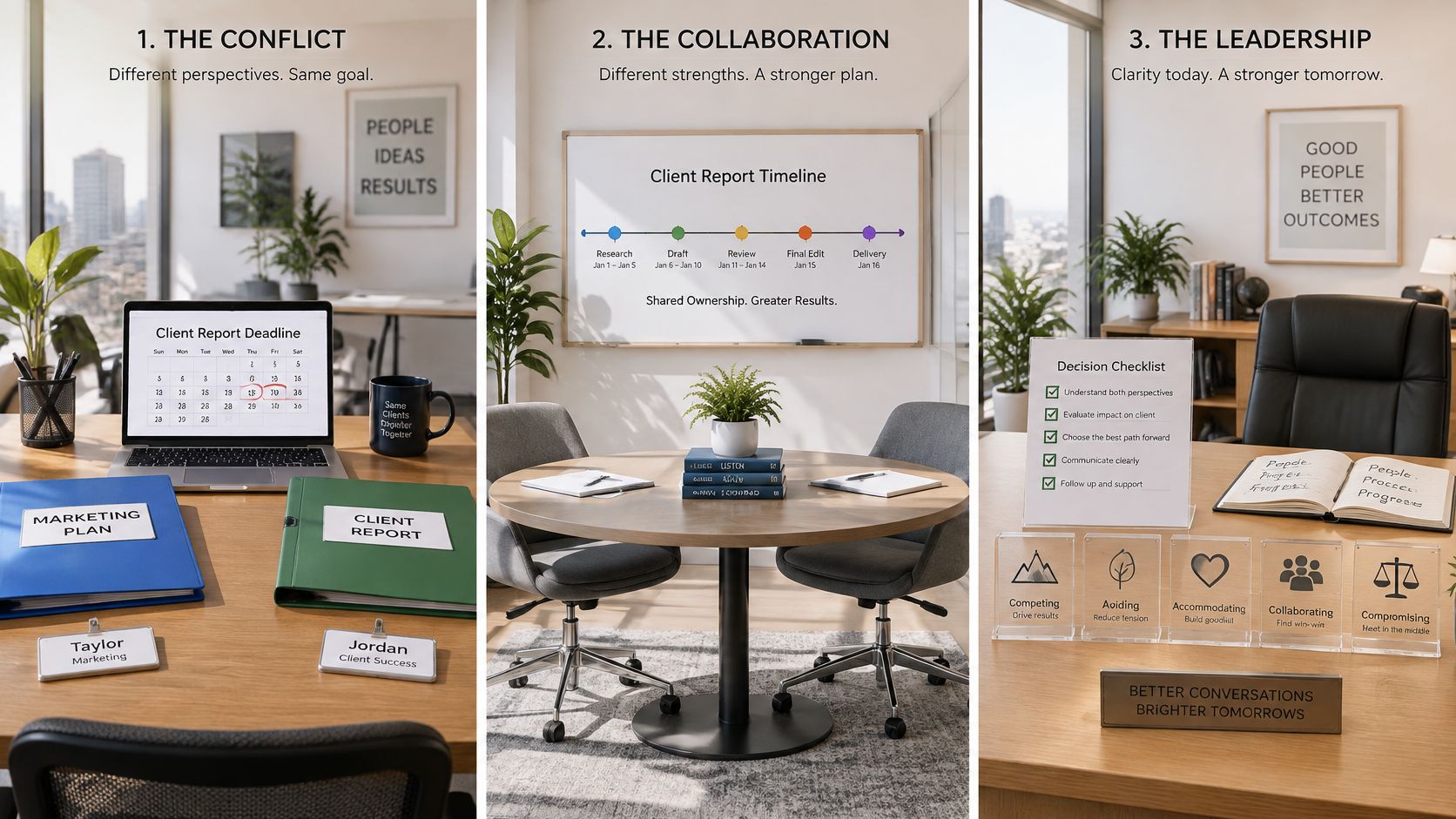
Three disagreements, three different answers
A disputed deadline. Two team members both believe they own the final version of a client report. Nobody defined ownership, so the conflict is about process. Collaborating fits, because both concerns can be met: one drafts, one approves, and a single named person holds the deadline. Competing settles it in a minute and leaves one person convinced the decision was political.
Slipping handovers. Someone's handovers have dropped since a hard personal period. Opening with accommodation, a lighter load for a fortnight and a shifted handover time, protects the relationship and keeps the work moving. Then set the expectation and restart the normal schedule. Accommodating without that second half turns a short kindness into a permanent arrangement nobody agreed to.
A shortcut past a safety check. On a site, a team member wants to skip a check to hit a deadline. Competing is the right call. The decision can't wait, the risk is serious, and consensus isn't the point. Say no plainly, explain why, and handle the deadline pressure separately.
Five questions before you respond
- How urgent is this? If the answer is needed within the hour, take speed and repair the relationship afterwards.
- How much does the outcome matter to each person? Where both have a lot at stake, collaboration earns its cost.
- Is the relationship worth more than this issue? If so, accommodating is rational, not weak.
- Is there a power imbalance? A junior person can't compete with a director, so a manager has to correct for that deliberately.
- Is a policy or legal duty involved? Then the style is largely fixed, and the conversation is about how, not whether.
Styles shift mid-conversation as information arrives, which is healthy. Say so out loud when you switch, so the change reads as new evidence rather than a retreat. The same trade-offs govern formal bargaining, covered in more depth in these negotiation skills for leaders.
What Irish Mediation Data Shows About Resolution
Workplace mediation is one of the few areas of people management with real numbers attached. Ireland's Workplace Relations Commission publishes them each year, and the pattern is instructive even if you never file a case. These are Irish figures, useful as context even where your own system differs.
Volume and outcomes don't move together. According to the WRC annual report 2024, the Commission recorded 894 pre-adjudication mediations that year, with 526 concluding in a resolution and an overall rate of 59%, while telephone mediation resolved 84% of the cases routed to it, against 53% face to face.
In 2025 the Commission ran 1,034 pre-adjudication mediations, a 16% increase, while the overall resolution rate slipped to 54%, with 574 cases resolved, as reported in the WRC annual report 2025.
| Measure | 2024 | 2025 |
|---|---|---|
| Pre-adjudication mediation sessions | 894 | 1,034 |
| Overall resolution rate | 59% | 54% |
| Resolved cases | 526 | 574 |
| Telephone resolution rate | 84% | 67.2% |
| In-person resolution rate | 53% | 48.7% |
| Virtual resolution rate | Not reported | 49.5% |
Volumes and overall rates come from the annual reports linked above; the format rates come from the WRC review of 1,000 mediation cases. The 2024 report did not publish a virtual figure.
Format looks decisive until the caveat lands. The review notes that telephone sessions are typically used for less complex disputes, so the higher telephone rate in both years is no proof that the format itself works better. The rates also move between years, which means no format rule is fixed. Choosing a channel is the same situational judgement as choosing a conflict style: what resolves a simple scheduling disagreement can under-serve a grievance between two senior colleagues.
A sound process ends in a signed agreement, which is what the session is for. Among resolved cases, 81.7% of settlement agreements were signed during the session, and 97.2% included financial compensation, according to the Ibec summary of the mediation review. Track two numbers in your own team, how many disputes enter a process and how many conclude by agreement, and route straightforward pay or scheduling issues to a faster channel while keeping complex, relationship-heavy cases in a fuller setting. The mechanics of a structured session sit in this lesson on conflict resolution and mediation.
Six Steps to Resolve a Disagreement and Mistakes to Avoid
A conversation that works follows a shape, though never a script. The steps below are the order that keeps a disagreement about the work rather than about the people.
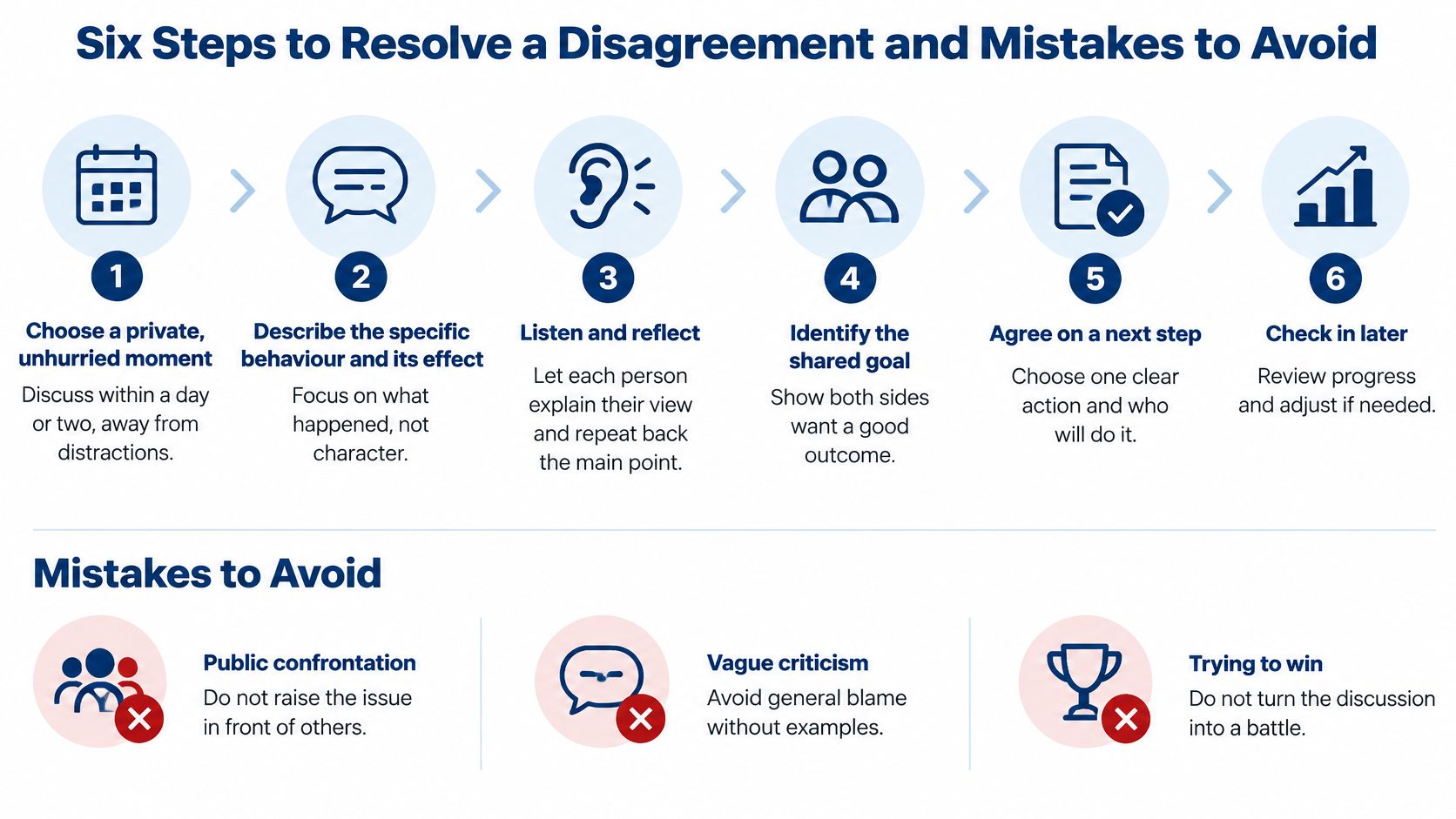
- Pick the moment, then describe the behaviour. Private, unhurried, within a day or two. "Tuesday's handover arrived at four without the stock figures, so the order went out late" is something a person can work with. "You're careless" isn't. Recent conversations are about behaviour; month-old ones become about character.
- Separate the person from the problem. Frame it as a shared issue, such as a handover gap that's costing both of you time. This puts you on the same side of the table and removes the need for anyone to defend their character.
- Listen for interests before proposing anything. Ask what made the task hard, then reflect the answer back before you respond. Most managers jump to a fix in under a minute and answer a question nobody asked. Listening is the step that gets skipped, and it rests on the habits set out in this guide to effective communication in the workplace.
- Agree the shared goal out loud. For example, a report delivered on time with the work split fairly between two people. A goal both parties have stated is the reference point every later option gets tested against.
- Generate at least three options, including one you wouldn't have proposed yourself. A rota change, a shared checklist, a fixed handover slot on a calendar. Testing each against the goal shows quickly which ones solve the actual problem.
- Confirm actions, owners and a dated follow-up in writing. Unwritten agreements drift within a fortnight because both people remember a slightly different version. A short message after the meeting settles it.
The conversation worked if both people can restate the agreement in matching words.
Four mistakes the steps don't fix
- Waiting for a formal grievance. By then the parties have positions, witnesses and a process. Raise the concern while it's still a chat.
- Mediating when you're a party. You can't be neutral about something you're inside. Ask a colleague from another team to run the conversation.
- Raising it in front of others. An audience turns a disagreement into a status contest, and the person loses face whether or not they concede. Take it somewhere private.
- Treating the symptom. A late report is the visible problem; unclear priorities are usually the cause. Ask what sits underneath before agreeing a fix.
How Managed Conflict Strengthens Teams and Leadership
A product team is arguing about launch scope two weeks before release. The argument is uncomfortable and it produces something: someone asks whether the reduced scope still triggers a regulatory review, and nobody in four planning meetings had raised it. The disagreement didn't create that risk. It surfaced the risk at the cheapest possible moment.
That's the first benefit. Better decisions come from challenge that arrives before the cost does. A team that never argues usually isn't aligned; it's unexamined.
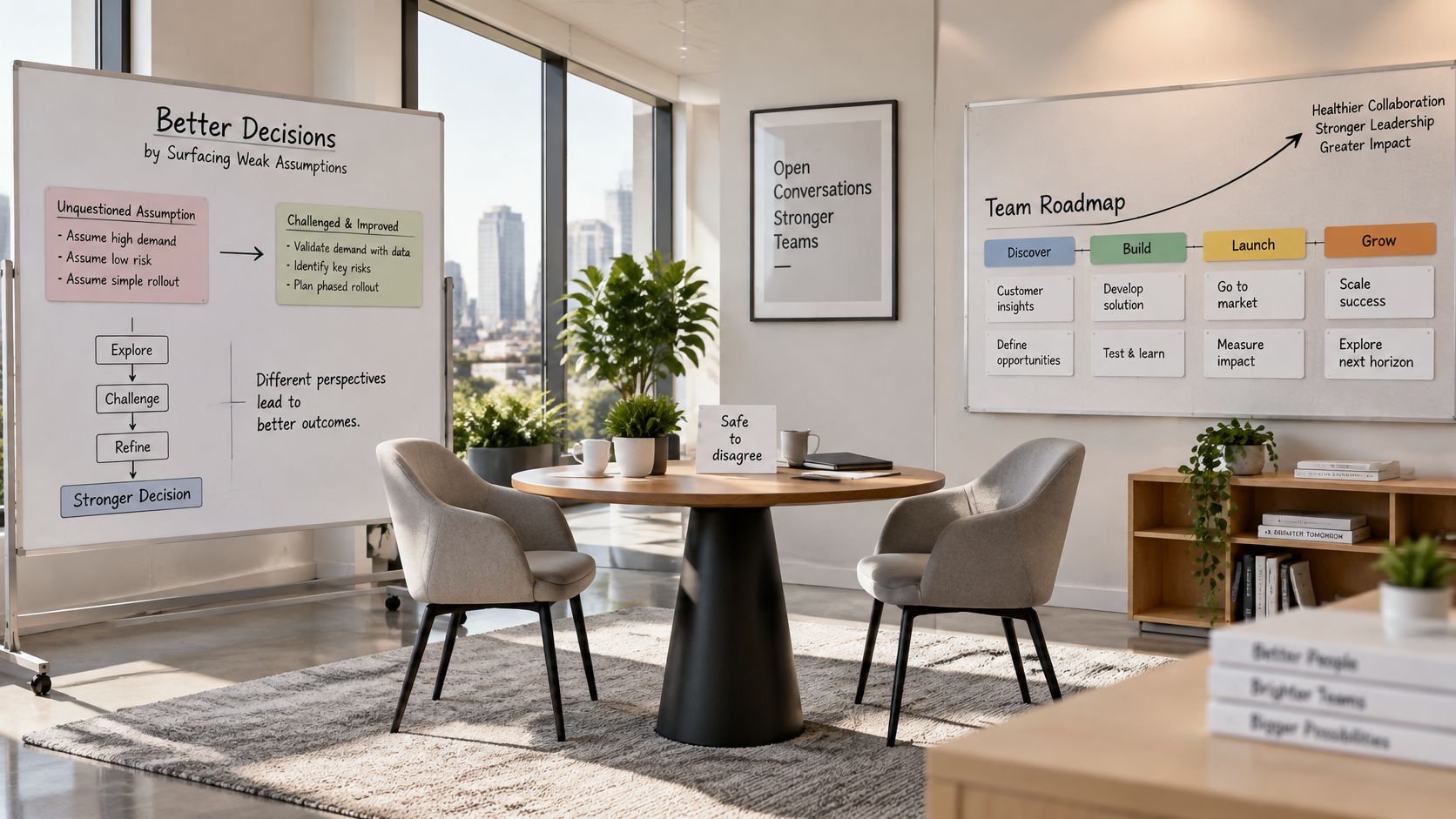
The second is trust. People learn what happens when they disagree: whether they get heard, whether it follows them into the next review, whether the manager's tone changes. Handled well once, that knowledge makes every later disagreement cheaper to raise. Teams only speak up where it feels safe, which is why psychological safety in the workplace and conflict management are the same project wearing two names.
Third, change moves faster. Resistance that stays in side conversations delays a rollout for months, because nobody can answer an objection they haven't heard. Resistance voiced in the room can be handled in an afternoon.
Leaders set the pattern by what they tolerate and how they behave in the first disagreement of the year. A manager who stays calm, lets both people explain, and then makes a clear decision teaches the team that disagreement is survivable. Poor handling costs engagement, produces quiet withdrawal and burns hours in corridor conversations that never reach a decision.
- Healthy conflict stays on the task. It uses evidence, names the decision to be made, and ends with one.
- Healthy conflict is time-boxed. It finishes, gets written down, and doesn't reappear next month.
- Destructive conflict moves to the person. It rehearses old grievances, widens to everything, and ends in withdrawal.
- Destructive conflict recruits allies. It moves into side chats and finds supporters, which is the point at which a manager has two factions rather than one problem.
Test your own team against these four signs this week. The pattern tells you more than any staff survey.
Build Your Conflict Management Skills Now
Pick one live disagreement this week and run the six-step conversation on it. Afterwards, write two lines for yourself: which style you used, and what came of it. That small log is how a style stops being a personality trait and becomes a choice. After a month of entries a pattern appears: you may compete every time a deadline is close, or accommodate whenever the other person outranks you. Naming that default is what lets you start choosing something else.
Four skills carry most of the load. Active listening builds through one drill: in your next meeting, state the other person's point back in a single sentence before you argue against it. Neutral facilitation means keeping your own view out of a dispute you are chairing, even when you hold a firm opinion on it. Writing clear agreements comes down to an owner and a date on every action. And regulating your own response matters because a raised voice ends the useful part of the conversation.
None of these needs talent. They need repetition.
A week from now, three checks should be answerable. Can you name the source of your last disagreement, task, process, relationship or status? Did you choose a style on purpose, or fall into your default? And is there a written record of what was agreed?
European Institute of Leadership and Management teaches these capabilities in a structured, self-paced format, from short online certificate courses in communication and problem solving through to Mini-MBA programmes that cover leading teams and managing change. The practical judgement described here is exactly what those programmes are built to develop, alongside the day-to-day practice of using it. Visit European Institute of Leadership and Management to browse the programmes and find the one that fits the role you're growing into.