Mini MBA Strategic Management


€594.00 Original price was: €594.00.€99.00Current price is: €99.00.
Welcome to the Mini-MBA in Strategic Management, a comprehensive professional development programme offered by the European Institute of Leadership and Management (EILM).
In today’s increasingly competitive, complex and rapidly evolving business environment, effective strategic management is essential for achieving organisational objectives, maintaining competitive advantage and ensuring sustainable business growth. Organisations across all sectors require professionals who can analyse changing market conditions, identify strategic opportunities, make informed decisions and translate long-term business objectives into practical actions.
The Mini-MBA in Strategic Management is designed to equip participants with a broad understanding of strategic management principles, leadership practices, economic concepts and essential business competencies that contribute to successful organisational performance.
Through an integrated and multidisciplinary approach, the programme explores six complementary areas of professional knowledge: leadership and teamwork, principles of economics, marketing essentials, problem-solving skills, communication skills and strategic management.
Participants will develop valuable insights into how organisations formulate strategies, evaluate competitive environments, manage business challenges, communicate strategic priorities and coordinate resources to achieve organisational objectives.
The programme also emphasises the importance of effective leadership, analytical thinking, stakeholder engagement and strategic decision-making in managing organisations within increasingly dynamic and interconnected markets.
Whether you are an experienced executive seeking to strengthen your strategic perspective, a middle manager preparing for greater leadership responsibilities, an entrepreneur developing business growth strategies or an aspiring professional interested in strategic business management, this programme provides a structured and accessible foundation for professional development.
By combining strategic management principles with economics, leadership, marketing, problem-solving and communication, the Mini-MBA in Strategic Management encourages participants to develop the analytical awareness, business understanding and managerial capabilities required to contribute effectively to organisational success.
Programme Format
- Delivery Method: 100% Online
- Learning Format: Flexible and Self-Paced
- Programme Structure: Six Specialised Courses
- Recommended Learning Hours: 30 Hours
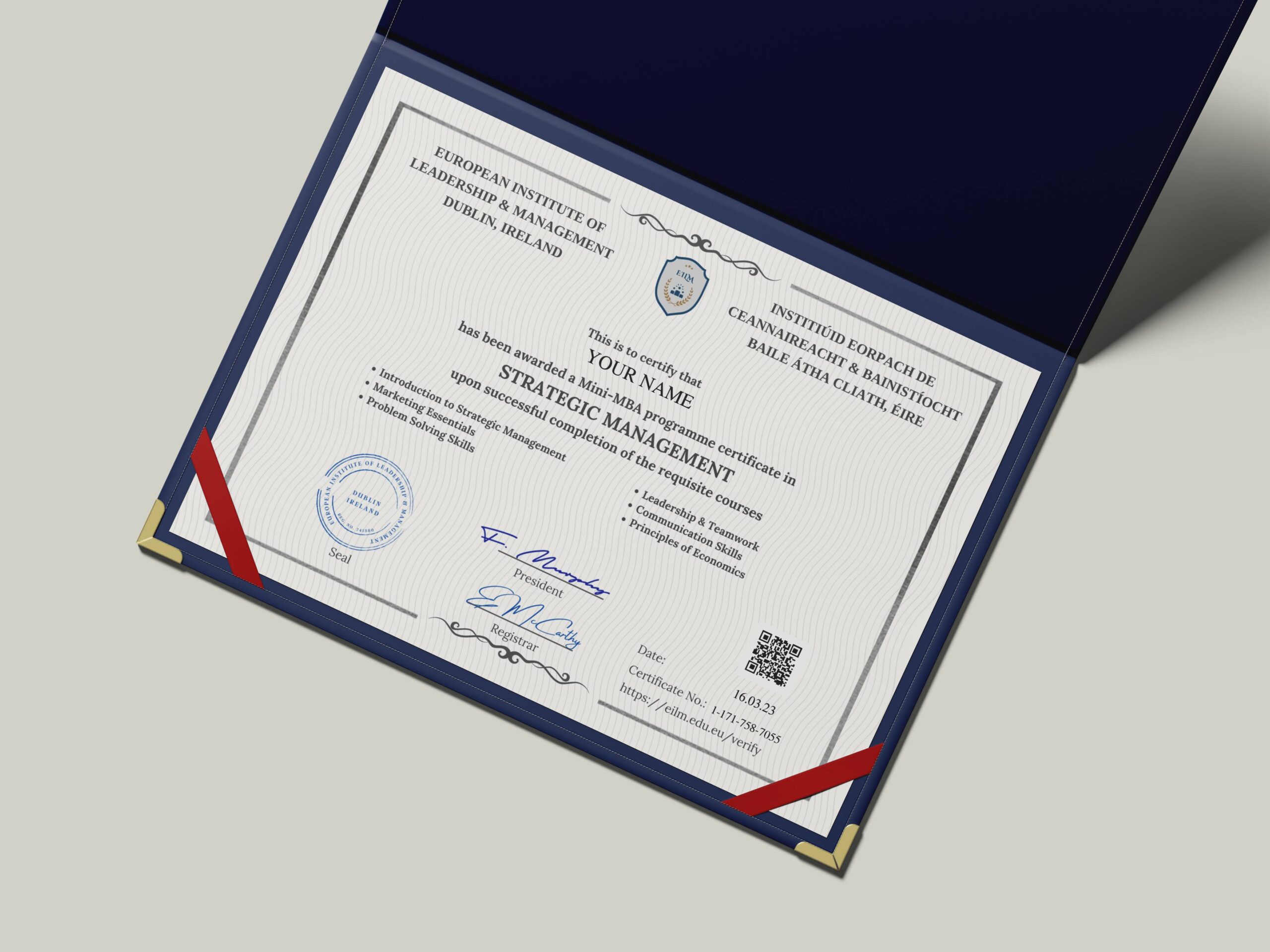
- Certification: Mini-MBA in Strategic Management Programme Certificate
- Awarding Institution: European Institute of Leadership and Management (EILM)
The flexible online learning format enables participants to progress through the programme at their own pace, making it particularly suitable for working professionals, managers, entrepreneurs and individuals seeking to strengthen their strategic management capabilities alongside existing professional and personal commitments.
Courses Included
1. Leadership and Teamwork
Develop the leadership capabilities and interpersonal skills required to guide teams, encourage collaboration and achieve organisational objectives effectively.
This course examines the fundamental principles of leadership and teamwork, exploring how different leadership approaches influence employee motivation, team performance and organisational effectiveness.
Participants will gain insights into team dynamics, communication, conflict resolution and collaborative decision-making, developing an understanding of how effective leaders create productive working environments and align team efforts with strategic priorities.
The course also considers the importance of adaptability, accountability and leadership judgement in managing diverse teams and responding to changing organisational requirements.
Key Learning Areas:
- Fundamental principles and theories of leadership
- Leadership styles and their organisational applications
- Team formation, development and group dynamics
- Building and managing high-performing teams
- Effective communication and interpersonal relationships
- Employee motivation, engagement and empowerment
- Conflict management and resolution strategies
- Delegation, accountability and responsibility
- Collaborative problem-solving and decision-making
- Managing diverse and multicultural teams
- Aligning team objectives with organisational strategy
- Leadership challenges in dynamic business environments
2. Principles of Economics
Develop a comprehensive understanding of the fundamental economic principles and market forces that influence business performance, competitive environments and strategic decision-making.
This course introduces participants to key concepts in microeconomics and macroeconomics, examining how individuals, businesses and governments make decisions in response to economic conditions and resource constraints.
Participants will explore supply and demand, market structures, economic growth, inflation, interest rates and government policies, gaining insights into how economic developments affect organisational strategy and commercial decision-making.
The course provides an economic foundation for understanding market behaviour, evaluating business opportunities and assessing the external factors that influence organisational competitiveness.
Key Learning Areas:
- Fundamental principles of microeconomics and macroeconomics
- Scarcity, opportunity cost and resource allocation
- Supply, demand and market equilibrium
- Consumer behaviour and business decision-making
- Market structures and competitive environments
- Pricing mechanisms and market efficiency
- Gross domestic product and economic growth
- Inflation, unemployment and economic cycles
- Interest rates and monetary policy
- Government expenditure, taxation and fiscal policy
- Economic indicators and business performance
- Applying economic analysis to strategic decision-making
3. Marketing Essentials
Gain a comprehensive understanding of the marketing principles, strategies and techniques that support organisational growth, competitive positioning and customer engagement.
This course explores how organisations identify market opportunities, understand customer requirements, develop products and services, and communicate value effectively to target audiences.
Participants will examine market research, consumer behaviour, market segmentation, branding and promotional strategies, gaining insights into how marketing contributes to broader business objectives and sustainable competitive advantage.
The course also considers the increasing importance of digital marketing, customer relationships and data-informed marketing decisions within modern business environments.
Key Learning Areas:
- Fundamental principles and concepts of marketing
- Market research and environmental analysis
- Consumer behaviour and customer needs
- Market segmentation, targeting and positioning
- Marketing strategy development and planning
- Product and service development
- Branding and competitive differentiation
- Pricing and distribution strategies
- Advertising, promotion and marketing communications
- Digital marketing and online communication channels
- Customer engagement and relationship management
- Aligning marketing activities with organisational strategy
4. Problem Solving Skills
Develop the analytical thinking, structured reasoning and practical problem-solving capabilities required to address complex organisational challenges and support effective strategic decision-making.
This course examines the principles and methodologies involved in identifying problems, evaluating alternative solutions and implementing appropriate corrective actions.
Participants will explore critical thinking, root cause analysis, creative problem-solving and decision-making techniques, gaining insights into how structured approaches can improve organisational performance and support continuous improvement.
The course also emphasises the importance of evidence-based reasoning, collaboration and professional judgement when addressing business challenges in uncertain or changing environments.
Key Learning Areas:
- Fundamental principles of problem-solving and critical thinking
- Identifying and defining organisational problems
- Root cause analysis and problem diagnosis
- Structured problem-solving methodologies
- Analytical thinking and logical reasoning
- Creative thinking and solution development
- Evaluating alternatives and decision-making
- Evidence-based problem-solving approaches
- Risk assessment and uncertainty in decision-making
- Collaborative problem-solving and teamwork
- Implementing and evaluating solutions
- Continuous improvement and organisational learning
5. Communication Skills
Develop the professional communication capabilities required to convey strategic objectives, influence stakeholders and support effective organisational relationships.
This course explores the principles of successful communication, examining how verbal, written, interpersonal and non-verbal communication contribute to leadership, management and business performance.
Participants will gain insights into persuasive communication, negotiation, active listening, professional presentations and stakeholder engagement, developing an understanding of how effective communication supports organisational coordination and strategic implementation.
The course also considers the importance of adapting communication approaches to different audiences, professional contexts and multicultural business environments.
Key Learning Areas:
- Fundamental principles of effective communication
- Verbal, non-verbal and written communication
- Professional and interpersonal communication skills
- Active listening and constructive feedback
- Persuasive communication and influencing techniques
- Negotiation and conflict resolution
- Stakeholder engagement and relationship management
- Business presentations and public speaking
- Strategic communication and organisational messaging
- Cross-cultural communication and professional awareness
- Communicating organisational objectives and change
- Developing effective communication strategies
6. Strategic Management
Develop a comprehensive understanding of the principles, frameworks and processes involved in formulating, implementing and evaluating effective organisational strategies.
This course brings together key concepts from economics, leadership, marketing, problem-solving and communication to provide an integrated understanding of strategic business management.
Participants will explore how organisations assess their internal capabilities, analyse external environments, establish strategic priorities and develop approaches to achieving sustainable competitive advantage.
The course places particular emphasis on strategic planning, competitive analysis, resource allocation, strategy implementation and performance evaluation, enabling participants to understand how strategic decisions influence organisational outcomes.
Key Learning Areas:
- Fundamental principles and concepts of strategic management
- Strategic vision, mission and organisational objectives
- Strategic planning and business strategy development
- Internal and external business environment analysis
- SWOT and PESTLE analysis
- Competitive analysis and industry positioning
- Strategy formulation and evaluation
- Corporate, business-level and functional strategies
- Resource allocation and strategic prioritisation
- Strategy implementation and organisational alignment
- Strategic performance measurement and evaluation
- Managing strategic change and organisational adaptation
- Sustainable competitive advantage and long-term business growth
Programme Learning Outcomes
Upon successful completion of the Mini-MBA in Strategic Management, participants will be able to:
- Understand Strategic Management Principles: Demonstrate a comprehensive understanding of the fundamental concepts, frameworks and processes involved in strategic planning, implementation and evaluation.
- Develop Leadership and Team Management Capabilities: Apply leadership principles that encourage collaboration, employee motivation, accountability and the achievement of organisational objectives.
- Interpret Economic Influences on Business Strategy: Explain how economic principles, market conditions, government policies and macroeconomic indicators influence organisational decision-making.
- Apply Marketing Principles to Strategic Planning: Understand how market research, customer behaviour, branding and competitive positioning contribute to the development of effective business strategies.
- Strengthen Analytical and Problem-Solving Skills: Apply structured approaches to identifying business challenges, evaluating alternatives and developing appropriate organisational solutions.
- Develop Effective Professional Communication: Understand how communication, negotiation, persuasion and stakeholder engagement contribute to leadership and successful strategic implementation.
- Analyse Competitive Business Environments: Apply fundamental strategic analysis frameworks to assess organisational capabilities, industry dynamics and external business conditions.
- Formulate Business Strategies: Understand how organisations establish strategic objectives, evaluate strategic alternatives and select appropriate approaches to achieving competitive advantage.
- Understand Strategy Implementation: Examine the processes involved in translating strategic plans into operational activities, allocating resources and aligning organisational capabilities with strategic priorities.
- Evaluate Strategic Performance: Identify approaches to monitoring organisational performance, assessing strategic outcomes and supporting continuous improvement.
- Respond to Changing Business Environments: Recognise the importance of organisational adaptability, innovation and informed decision-making in maintaining long-term competitiveness.
- Develop a Multidisciplinary Management Perspective: Integrate knowledge of leadership, economics, marketing, problem-solving, communication and strategic management to support effective organisational decision-making.
Who Should Enrol?
The Mini-MBA in Strategic Management is designed for individuals seeking to strengthen their strategic thinking, business management knowledge and understanding of organisational performance.
The programme is particularly relevant for:
- Business Leaders and Senior Executives seeking to enhance their strategic planning, organisational leadership and decision-making capabilities.
- Middle Managers and Department Heads responsible for implementing organisational strategies, managing teams and achieving business objectives.
- Aspiring Managers and Emerging Leaders preparing to undertake greater managerial and strategic responsibilities.
- Entrepreneurs and Business Owners interested in developing effective business strategies, identifying growth opportunities and improving organisational competitiveness.
- Business Development Professionals seeking to strengthen their understanding of market dynamics, competitive analysis and strategic growth.
- Marketing and Commercial Professionals interested in integrating marketing activities with broader organisational strategies.
- Project Managers and Operations Professionals seeking to develop a wider strategic perspective on organisational planning, resource allocation and performance management.
- Business Consultants and Advisers interested in expanding their knowledge of strategic analysis, organisational effectiveness and business planning.
- Human Resource and Administrative Professionals seeking to broaden their understanding of leadership, communication and strategic organisational management.
- Professionals Considering Career Progression or Transition who wish to strengthen their knowledge of strategic business management.
- Aspiring Professionals and Graduates seeking foundational knowledge of strategic management and complementary business disciplines.
- Individuals Committed to Continuous Professional Development who wish to expand their professional knowledge through flexible and accessible online learning.
Programme Certification
Upon successfully completing all six courses, participants will be awarded the Mini-MBA in Strategic Management Programme Certificate by the European Institute of Leadership and Management (EILM).
This certificate recognises the participant’s successful completion of a structured professional development programme covering six complementary disciplines of strategic management, leadership, economics, marketing, problem-solving and communication.
The programme provides an opportunity to demonstrate a commitment to continuous professional learning and the development of knowledge relevant to strategic planning, organisational leadership, business analysis and managerial decision-making.
The certificate may complement existing academic qualifications and professional experience by demonstrating additional learning in areas relevant to management, business strategy and organisational performance.
The Mini-MBA is a focused professional development programme and should not be confused with a full postgraduate Master of Business Administration (MBA) degree.
Why Choose This Programme?
The Mini-MBA in Strategic Management offers a flexible, accessible and focused approach to developing essential strategic management knowledge alongside fundamental leadership and business capabilities.
Effective strategic management requires more than the ability to formulate business plans. It involves understanding economic conditions, evaluating competitive environments, leading teams, solving organisational problems and communicating strategic priorities effectively.
By integrating six complementary disciplines, the programme provides participants with a multidisciplinary perspective on how organisations develop strategies, allocate resources, respond to market challenges and achieve sustainable business performance.
Key Benefits of the Programme:
- Comprehensive Strategic Management Knowledge: Develop an understanding of the essential principles and practices involved in formulating, implementing and evaluating business strategies.
- Multidisciplinary Learning: Explore six interconnected disciplines covering leadership, economics, marketing, problem-solving, communication and strategic management.
- Strategic Thinking and Business Analysis: Strengthen your knowledge of competitive analysis, business planning and organisational decision-making.
- Leadership and Team Management Development: Understand how effective leadership, collaboration and employee engagement contribute to organisational objectives.
- Economic and Market Awareness: Gain insights into how economic conditions, market structures and commercial developments influence strategic decisions.
- Marketing and Competitive Positioning: Develop an understanding of market research, customer behaviour, branding and marketing strategy.
- Problem-Solving and Decision-Making: Explore structured approaches to analysing business challenges, evaluating alternatives and implementing solutions.
- Professional Communication Skills: Strengthen your knowledge of negotiation, stakeholder engagement and strategic business communication.
- Flexible Online Learning: Study entirely online at your own pace, allowing you to balance professional development with existing commitments.
- Time-Efficient Learning: Explore essential strategic management concepts through a focused programme with 30 recommended learning hours.
- Accessible Professional Development: Benefit from a structured learning opportunity without the extensive time commitments typically associated with longer management education programmes.
- Programme Certification: Receive a certificate from the European Institute of Leadership and Management upon successful completion of the programme.
The Importance of Strategic Management in Modern Organisations
Strategic management plays a central role in determining how organisations establish long-term objectives, respond to competitive pressures, allocate resources and pursue sustainable growth.
In an increasingly interconnected and rapidly changing global economy, businesses must continually assess their operating environments, anticipate emerging challenges and adapt their strategies to changing market conditions.
Effective strategic management requires a combination of analytical thinking, economic understanding, leadership capabilities, commercial awareness and sound organisational judgement.
Economic knowledge provides insights into market behaviour, resource allocation and the broader conditions that influence business performance.
Marketing principles enable organisations to understand customer needs, identify market opportunities and develop competitive positions within their industries.
Leadership and teamwork support the coordination of organisational activities and encourage employees to work towards shared strategic objectives.
Problem-solving capabilities contribute to the identification and resolution of complex business challenges, while effective communication supports stakeholder engagement, organisational alignment and the successful implementation of strategic initiatives.
Strategic management integrates these disciplines by providing the frameworks and processes required to assess business environments, formulate strategic objectives, evaluate alternatives and monitor organisational performance.
The Mini-MBA in Strategic Management recognises these interconnected responsibilities by bringing together six complementary disciplines within a structured professional development programme.
Through this multidisciplinary approach, participants can develop a broader understanding of the factors that influence organisational strategy and the principles that contribute to effective business management and sustainable organisational performance.
Take the Next Step in Your Professional Development
Effective strategic management is more than planning for the future. It is about understanding the business environment, making informed decisions, aligning organisational resources and translating strategic objectives into meaningful results.
The Mini-MBA in Strategic Management provides an opportunity to strengthen your strategic knowledge, broaden your business perspective and develop a deeper understanding of the management principles that underpin organisational success.
Whether your ambition is to progress into a strategic management role, strengthen your existing leadership capabilities, develop a more structured approach to business planning or prepare for greater professional responsibilities, this programme offers a valuable foundation for continued learning and professional development.
Enrol in the Mini-MBA in Strategic Management and take an important step towards strengthening your strategic thinking, leadership knowledge and business management capabilities.