
How to Prepare an Income Statement: A Step-by-Step Guide
It's the week after your year end. The bank feed is downloaded, the sales invoices are in one folder, the supplier bills are in another, and a spreadsheet somewhere says the business made money, though the bank balance doesn't agree. Then someone mentions the annual return, and the question changes from "did we make a profit?" to "will these figures stand up when they're filed?"
That gap is where most small Irish companies come unstuck. Learning how to prepare an income statement isn't really about subtraction, it's about cut-off, classification and evidence. A statement can add up perfectly and still fail a tax reconciliation or a filing check, so the workflow below treats preparation, tax mapping and filing as one job rather than three.
Table of Contents
- Income Statement Layout at a Glance
- Irish Framework and Format Rules That Apply
- Gather Revenue and Expenses for the Period
- How to Build the Statement Step by Step
- Reconcile to Tax, Fix Common Errors and Map to iXBRL
- Check the Statement and File It on Time
Income Statement Layout at a Glance
Look at the finished page before gathering a single figure. In the European Union this isn't an optional management exercise: the CRO's financial statements requirements place the profit and loss account inside the statutory annual package, alongside the balance sheet and notes.
Take a hypothetical small Irish trading company with €120,000 of revenue, €48,000 of cost of sales, €41,000 of operating expenses and €2,400 of net finance costs, and assume for the example that the 12.5 per cent trading rate applies to all of its profit. That company's statement reads as follows.
| Line | Worked example (€) |
|---|---|
| Revenue | 120,000 |
| Cost of sales | 48,000 |
| Gross profit | 72,000 |
| Operating expenses | 41,000 |
| Operating profit | 31,000 |
| Finance costs, net | 2,400 |
| Profit before tax | 28,600 |
| Tax expense | 3,575 |
| Profit for the period | 25,025 |
Each line has one job, and the order isn't decorative:
- Revenue holds what the company earned from its trade in the period, net of credit notes, which is why it sits first.
- Cost of sales and gross profit isolate the direct cost of what was sold, so the margin on trading activity is visible before overheads muddy it.
- Operating expenses and operating profit capture the cost of running the business (payroll, rent, insurance, depreciation), giving the subtotal a lender or buyer looks at first.
- Finance costs, tax and profit for the period sit below operating profit because they reflect how the business is funded and taxed, not how well it trades.
The statement reads top to bottom, so every subtotal is only as good as the lines above it.
The income statement records performance over a period, not movements in a bank account, so every figure must relate to the same financial year.
Keep this layout open as the template for everything that follows.
Irish Framework and Format Rules That Apply
A set of accounts can be arithmetically perfect and still be rejected in Ireland because it sits on the wrong framework or uses a heading the prescribed format doesn't allow. So the framework question comes before any template: Irish companies report under IFRS, FRS 102, or FRS 105 for micro-entities, and the choice drives both the name of the statement and the headings you're permitted to use.
Irish legislation calls it a profit and loss account. Under section 291 of the Companies Act 2014, financial statements for a financial year comprise a balance sheet at the year-end date and a profit and loss account for that year, and they must give a true and fair view of the company's financial position and profit or loss. Section 274 defines it as a performance statement showing revenues, expenses, gains and losses earned or incurred during a period, and treats an IFRS income statement as the equivalent statement. The same rules require one of the prescribed formats, with items shown in the order and under the headings that format specifies, so lines can't be shuffled to suit a management preference.
| Framework | Typical users | Statement name | Format and timing note |
|---|---|---|---|
| IFRS | Companies that report under international standards | Statement of profit or loss | Treated as the equivalent of the profit and loss account under Companies Act 2014 section 274 |
| FRS 102 | Many Irish private companies | Single performance statement, or profit and loss account plus a statement of income and retained earnings | Adapted-format amendments apply to your statement once your reporting period begins on or after 1 January 2027, with early adoption permitted |
| FRS 105 | Micro-entities | Profit and loss account in the prescribed format | Amendments effective for accounting periods beginning on or after 1 January 2026 |
Why the transition dates matter for comparatives
FRS 102 permits either a single statement of income or a separate profit and loss account plus a statement of income, so two formats can both be compliant while looking nothing alike on the page. The EY Ireland financial reporting update reports that the Financial Reporting Council published amendments in February 2026 revising minimum presentation to include operating expenses, operating profit or loss, and profit or loss before financing and taxation. The FRS 105 changes apply to periods beginning on or after 1 January 2026, while the FRS 102 adapted-format changes bite only once your reporting period begins on or after 1 January 2027, with early adoption permitted.
A format change can shift subtotals while underlying profit stays identical. Restate the prior-year comparatives on the same basis and explain the change in the notes, otherwise the year-on-year movement you report is an artefact of presentation rather than performance. That classification discipline matters beyond the printed statement: the same line labels feed the iXBRL tags at filing, so a heading chosen carelessly here maps to the wrong taxonomy element later even when every figure is right. The framework logic behind these choices is set out in this lesson on accounting principles and reporting frameworks.
Gather Revenue and Expenses for the Period
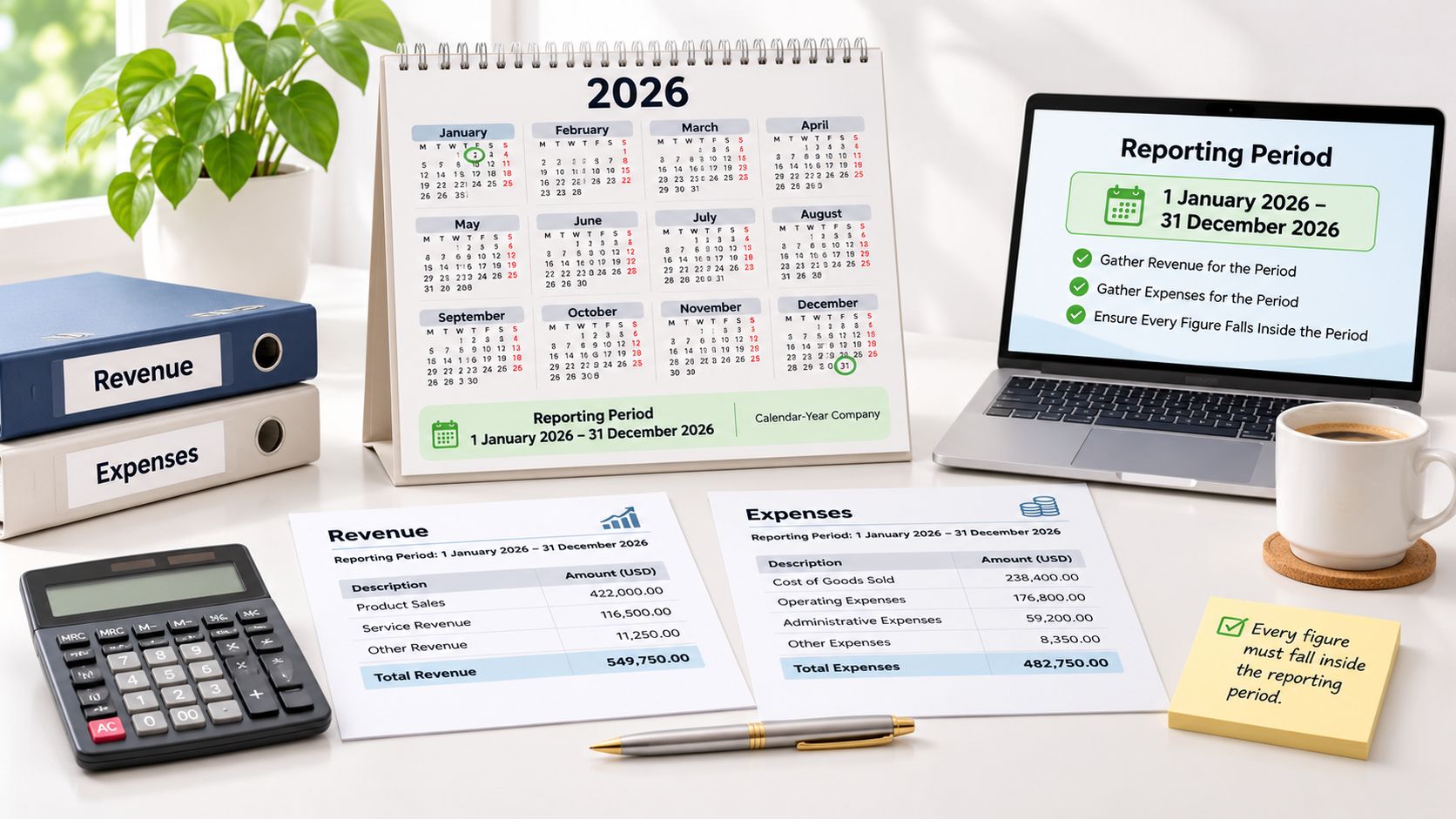
Fix the reporting period first, because every figure has to fall inside it. For a calendar-year company that means 1 January to 31 December 2026, and a company's first statement runs from the date of incorporation rather than a convenient quarter.
Pull the trial balance, then sort the income
Extract the trial balance from the ledger and split income into the categories you'll need later: product sales, service income, and any government-agency or other income that belongs under its own heading. Doing this now saves a reclassification exercise at filing time, when the ledger is supposed to be closed.
Run the cut-off test
Errors tend to cluster here, and they're rarely arithmetic:
- Unpaid sales still count: include invoices raised for work delivered in the period even if the customer pays in February.
- Advance receipts don't: money received in December for next year's service work is deferred, not revenue.
- Late supplier bills belong to the period: accrue the December electricity bill and any invoice dated in the period that arrived in January.
- Prepayments move forward: insurance or rent paid ahead sits in the period it covers, not the period it was paid.
- Depreciation gets booked: charge fixed assets for the year rather than leaving the asset cost untouched.
Practical rule: if you can't point to the invoice, contract or bill that puts an item in this financial year, it doesn't go in this financial year.
Keep the documents that link the figures
Irish Revenue requires businesses to retain linking documents, including receipts, purchase records, sales invoices, nominal ledgers and accounting books, that support income-tax, corporation-tax or capital-gains-tax calculations, as set out in its guidance on keeping records. For self-employed taxpayers, the annual return doesn't take full business accounts; it requires the "Extracts From Accounts" sections with separately reported income and expense categories, so the internal headings need to map onto Revenue's categories. Deductions may be available for expenses incurred in calculating business profit, but treatment depends on the expense and its connection with the trade.
Finish by agreeing total revenue to the sales ledger and bank receipts, allowing for opening and closing debtors. The double-entry discipline behind that agreement is covered in this lesson on double entry and transaction recording.
How to Build the Statement Step by Step
With the inputs assembled, the build itself is mechanical. Irish Revenue's notes for guidance on profits computed under generally accepted accounting practice confirm that profit includes all income and expense items recognised during the period, and that financial statements are subject to both accounting standards and Irish company law, so each step below ends in a check rather than a number alone.
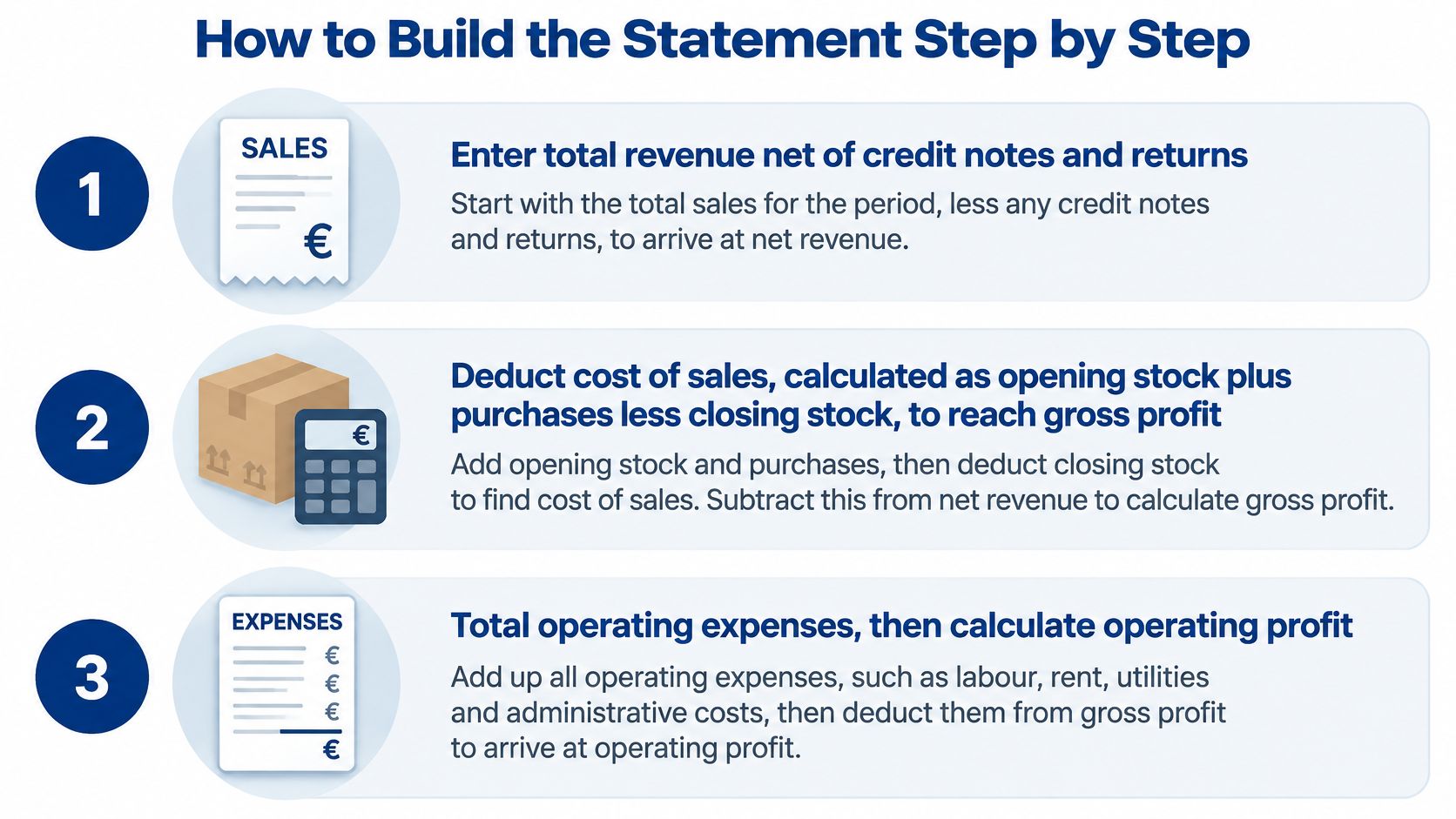
Enter total revenue net of credit notes and returns. In the worked example that's €120,000. The usual slip is netting off a credit note raised after year end that relates to a sale in the following period, which understates both years.
Deduct cost of sales to reach gross profit. Calculate it as opening stock plus purchases less closing stock, giving €48,000 and gross profit of €72,000. Counting closing stock twice (once in the stock adjustment and again as a balance-sheet-only entry) is the classic error here, and it inflates margin without changing cash.
Total operating expenses and deduct them. Wages, rent, insurance, marketing, professional fees and depreciation come to €41,000, leaving operating profit of €31,000. Depreciation belongs in this block, not in finance costs, and misplacing it flatters operating profit while leaving the bottom line untouched.
Add finance income and deduct finance costs. Loan interest and bank charges, net of any interest received, give €2,400 and profit before tax of €28,600. Keep bank charges and loan interest distinguishable in the ledger, because their tax treatment isn't identical.
Apply the tax charge for the period. Assuming the 12.5 per cent trading rate applies to the whole amount in this example, the charge is €3,575 and profit for the period is €25,025. Applying a rate to accounting profit before adjusting for timing differences and disallowable items produces a tax figure that won't survive the computation.
Cross-check every subtotal to the adjusted trial balance. Reconcile sales, receivables, purchases, payroll, accruals, prepayments, depreciation, provisions, finance costs and tax to supporting schedules, and make sure year-end accruals and provisions are evidenced and meet the recognition criteria. Stop only when profit for the period agrees with no unexplained difference.
Where the build quietly goes wrong
Two habits cause most rework. The first is treating the stock count as a formality, when the closing stock figure drives cost of sales and therefore gross profit, which is why the lesson on inventory and cost of sales is worth working through before a first year-end close. The second is posting a "miscellaneous" journal to balance the ledger. It clears the difference on the day and creates an unexplained heading that someone has to unpick during the tax reconciliation.
Reconcile to Tax, Fix Common Errors and Map to iXBRL
Accounting profit is the starting point of the corporation-tax computation, not the answer. Revenue's guidance on the basis of accounting and financial statement detail identifies turnover, government-agency receipts where applicable and other income as minimum categories for additional detail, and requires companies preparing accounts under the Companies Act 2014 to submit financial statements to Revenue in iXBRL format.
From accounting profit to taxable profit
Work down a short schedule and keep a supporting note against every line:
- Add back non-deductible expenses, such as entertaining and privately attributable costs, with the invoice reference beside each.
- Replace accounting depreciation with capital allowances, since the two rarely agree in any given year.
- Strip out exempt income and document timing differences separately, so the movement reverses cleanly next year.
Then lock the final ledger, map each income-statement line to the relevant iXBRL taxonomy, validate the tagged totals against the signed accounts, and reconcile turnover and other income to VAT returns, sales ledgers and bank receipts. A tagging error doesn't change profit, but it changes what Revenue receives.
Classification is the other trap. Investment income, rent, foreign-exchange gains or losses, dividends and interest don't belong inside turnover, and cash receipts aren't accounting revenue. Where consideration is materially deferred, FRS 102 requires the financing effect to be separated through present-value measurement and subsequent interest recognition, so booking the full invoice as current-period revenue misstates revenue and finance income together.
A technically correct income statement can still produce an incorrect tax return when classification and supporting evidence are weak.
Symptoms, causes and fixes
| Symptom | Likely cause | Fix |
|---|---|---|
| Profit far above the bank balance | Cash receipts used instead of invoiced revenue | Restate revenue on the accrual basis by invoice date |
| Profit far below expectation | Year-end accruals or period supplier invoices not recorded | Review the purchase ledger for the final weeks and accrue the costs |
| Subtotals change between years | Format or heading changed without restating comparatives | Restate prior-year comparatives on the same basis and note the change |
| Totals don't tie to the trial balance | Journal posted to the wrong heading or adjustment missed | Reconcile each line to the adjusted trial balance and correct the journal |
| Investment income or rent inside turnover | Misclassification of non-trading income | Move the amount to its own heading and recalculate revenue |
Have someone other than the preparer review unusual journals and year-end estimates, and retain an audit trail for every reclassification.
Check the Statement and File It on Time
A clean trial balance still fails if the filing period, package or evidence is wrong. The CRO's annual return leaflet states that financial statements must normally cover a period ending no more than nine months before the date to which the annual return is made up, that an annual return is required at least once every year whether the company is trading or not, and that a filing without the required statements or documents is incomplete. Statements that fail these requirements may be rejected.
For a first annual return requiring financial statements, the period runs from incorporation; afterwards it generally runs from the end of the last financial-statement period filed with the CRO.
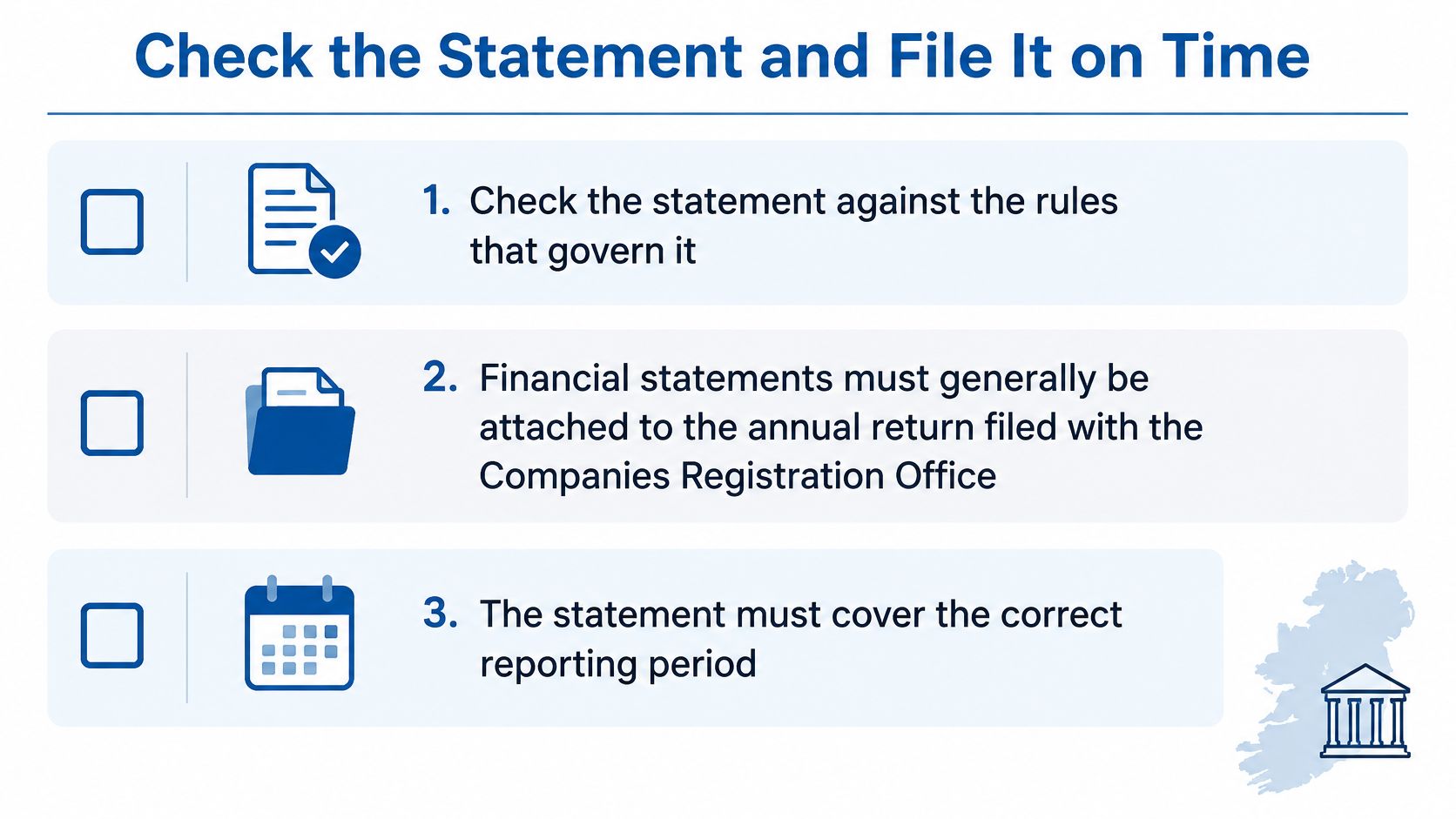
Before you sign off, run one analytical pass for movements that arithmetic will not catch. A common-size review, such as the approach in this lesson on comparative and common-size analysis, helps explain whether a margin moved because trading changed or because a line was posted under the wrong heading. Then work the checks in this order:
- Arithmetic: every subtotal ties to the adjusted trial balance.
- Presentation: headings, order and wording match the format selected for the year and are used consistently across the statement and notes.
- Package: profit and loss account, balance sheet, notes and directors' report are all present, and audit or a formally claimed exemption is confirmed.
- Tax and evidence: the reconciliation is signed off, unusual journals are reviewed by someone other than the preparer, and supporting records are retained.
This week, take last year's trial balance and draft the statement on the layout above, then work through the checklist line by line and note every figure you cannot evidence.
The European Institute of Leadership and Management offers self-paced online accounting and financial management courses, including the six-module Accounting Principles course currently priced at €15.00. Its stated outcomes cover interpreting and analysing financial statements, financial reporting and analysis, budgets and forecasts, and variance analysis, and it suits business owners as well as people moving into accounting or finance. Visit the European Institute of Leadership and Management to browse the accounting and financial management options and enrol.