
How to Improve Leadership Skills: A Practical 2026 Plan
Workforce skills, workforce diversity and managers' characteristics together explain about one-third of the labour-productivity gap between firms at the productivity frontier, the top 10% in their industries, and medium performers in the 40th to 60th percentiles, according to OECD analysis of skills strategies in the European Union. Managerial skills carry particular weight in that gap, including how well they combine with the skills employees already have.
That finding takes leadership out of the personality column. It's a set of behaviours staff can watch and rate: whether a manager respects people, hands over real decisions, gives feedback someone can act on, clears obstacles, supports learning and names good work out loud. Behaviours can be measured, practised and measured again, which is what separates development that works from development that's merely attended.
The method that holds up in busy workplaces is unglamorous and repeatable. It starts with a baseline from the people who report to you, turns that into a couple of objectives small enough to remember, puts the practice inside real work, and judges progress on evidence from other people rather than on how the course felt. Anyone working out how to improve leadership skills can run that loop without a big budget or a supportive HR function.
Table of Contents
- The Five-Step Plan to Improve Leadership Skills
- Getting an Honest Baseline From 360-Degree Feedback
- Turning Feedback Into Two or Three Clear Objectives
- Practising Core Skills Through Everyday Work
- Leading Well When Support Is Thin
- Leading Your Team Through AI Adoption
- Build a Routine and Start Measuring Progress This Month
The Five-Step Plan to Improve Leadership Skills
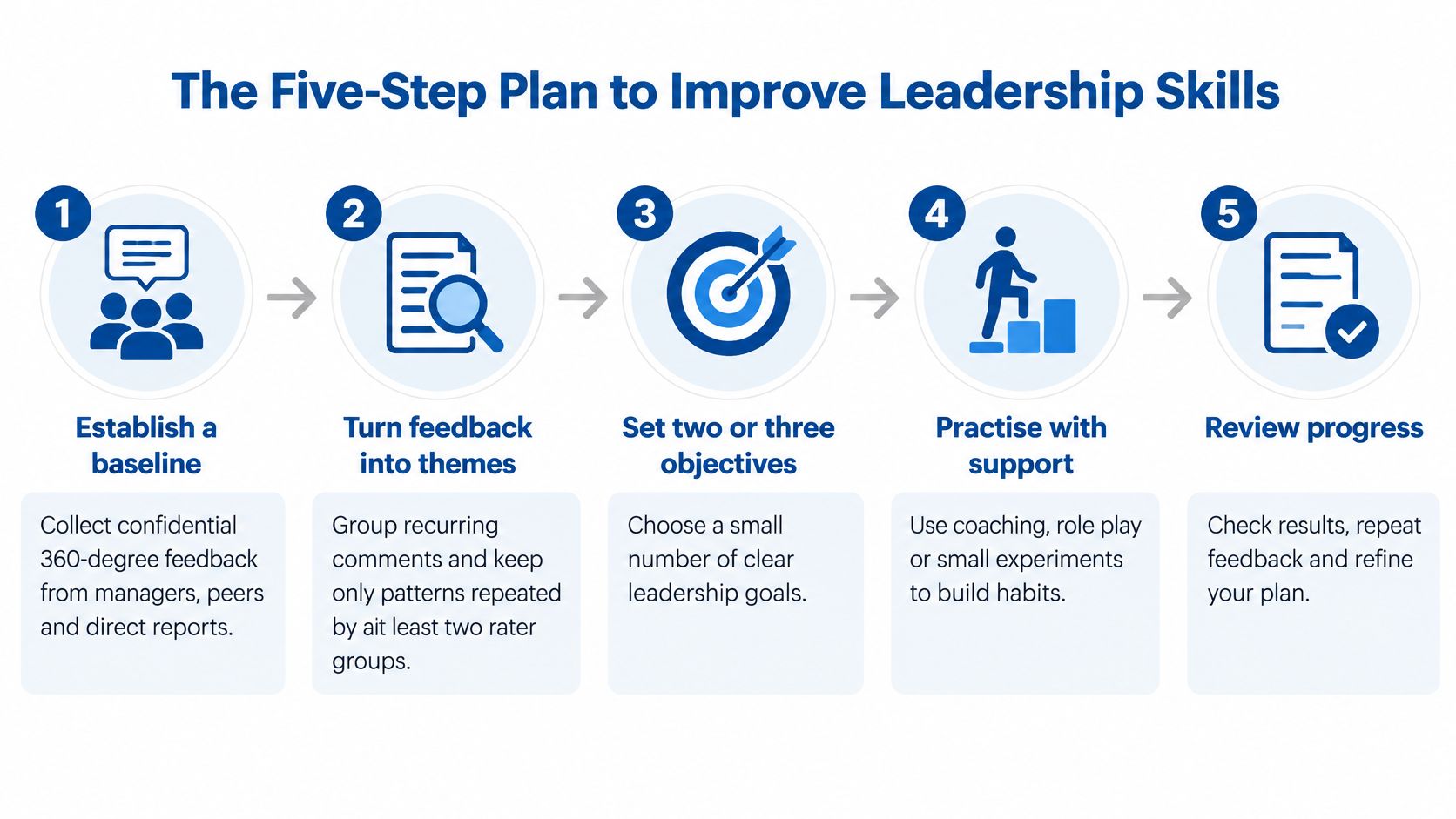
Five steps, each with a date in the diary, give a manager a plan a team can see changing.
- Establish the baseline. Collect confidential 360-degree feedback from managers, peers and direct reports. An objective chosen without it describes the leader you believe you are rather than the one your team experiences.
- Convert the feedback into two or three behaviourally defined objectives, such as "hold a weekly one-to-one where the team member sets the agenda". A wide aspiration can't be observed, and what can't be observed can't be rehearsed.
- Practise those behaviours in real work through delegated decisions, cross-functional projects and stretch assignments. A workshop tests rehearsal; a deadline on a Tuesday afternoon tests the behaviour itself.
- Reinforce the change with coaching, mentoring or action learning. Resolve fades after week one, and somebody who asks what happened keeps the account honest.
- Repeat the 360 and compare the new stakeholder ratings with team retention, delivery and engagement measures. Self-report is the least reliable rater in the room.
The cycle fits on one page, which is the point:
Budget roughly two to three hours of deliberate effort a month beyond normal work. This includes the 360 at each end of the cycle, an hour of coaching or reflection each month, and the rest inside work you'd be doing anyway.
An evaluation of an Irish civil-service leadership programme found that 93% of participants believed it improved their ability to support others, 86% reported stronger change-leadership skills, 73% stronger emotional intelligence and 71% greater leadership confidence, according to the public-service evaluation report. That report singled out 360-degree feedback as the practical starting point for changing delegation and enabling behaviours, and it was candid that many leadership benefits are difficult to quantify. Strong evidence for specific programmes remains limited, so treat headline percentages as participant perception and put the weight on repeated ratings plus operational numbers.
Where programmes usually fail: the stopping point. Attendance is logged, the satisfaction forms come back cheerful, and the second measurement never happens.
Write the five steps and their first dates into a planner before reading further. A date for the baseline 360, a date for choosing objectives, and a review date for the repeat measurement are enough to make the plan real rather than aspirational.
Getting an Honest Baseline From 360-Degree Feedback
A useful 360 starts with behaviours colleagues can recognise: giving feedback, helping work move forward and supporting development. Benchmarks provide context, but your team's experience deserves more attention than whether your score looks respectable beside an average.
The European Working Conditions Survey reports the following shares of EU28 employees who said their supervisor or immediate boss showed each behaviour:
| Leadership behaviour | Employees reporting it (EU28) |
|---|---|
| Respected them as people | 89% |
| Got people to work together | 73% |
| Provided useful feedback | 70% |
| Helped them get the job done | 66% |
| Encouraged and supported their development | 68% |
| Gave praise and recognition for good work | 71% |
These are employee assessments, used here as context for questioning your self-rating, rather than equivalent scores from your own 360.
Respect received more positive responses than practical help or development support. That gap does not establish why employees answered differently. It does give you a useful question: does your team experience the support you believe you provide?
Running a 360 that produces honest answers
- Eight to twelve raters across three groups. Invite your manager, peers and direct reports. Include people who regularly observe your work, rather than only colleagues likely to respond favourably.
- Anonymity, stated in writing. Explain that you will receive grouped themes without individual attribution. Arrange collection accordingly; do not promise anonymity while requesting identifiable answers.
- Observable behaviours, not traits. Ask about specific feedback, delegated decisions, conflict handling and recognition. For AI-related work, ask whether you clarify which decisions need human judgement and invite concerns about outputs.
- Self-rating first. Complete your ratings before reading others' responses, so the comparison captures your initial view.
- Frequency, not agreement. Use rarely, sometimes, usually and consistently. Ask respondents to ground their ratings in behaviour they have observed.
Keep the questions manageable when time and support are limited. A focused set that colleagues can answer thoughtfully is more useful than a lengthy form completed hurriedly.
Compare your self-rating with the grouped responses. A wide gap deserves investigation, especially when you rate yourself highly but colleagues describe missing support. Ask for concrete examples before deciding what the gap means.
Using the benchmark without treating it as a pass mark
The survey percentages and your frequency ratings measure different things. Do not convert them into a pass mark. In a small team, individual responses and a difficult quarter can shift the picture; read ratings alongside examples of what happened at work.
Keep the output to a single page. Three lowest-scoring behaviours, one highest.
Use the highest score to identify a behaviour worth preserving, not as proof that every harder change will succeed. Tie the findings to how work is reviewed: performance management best practices for leaders can help connect feedback with everyday management rather than another isolated form.
Turning Feedback Into Two or Three Clear Objectives
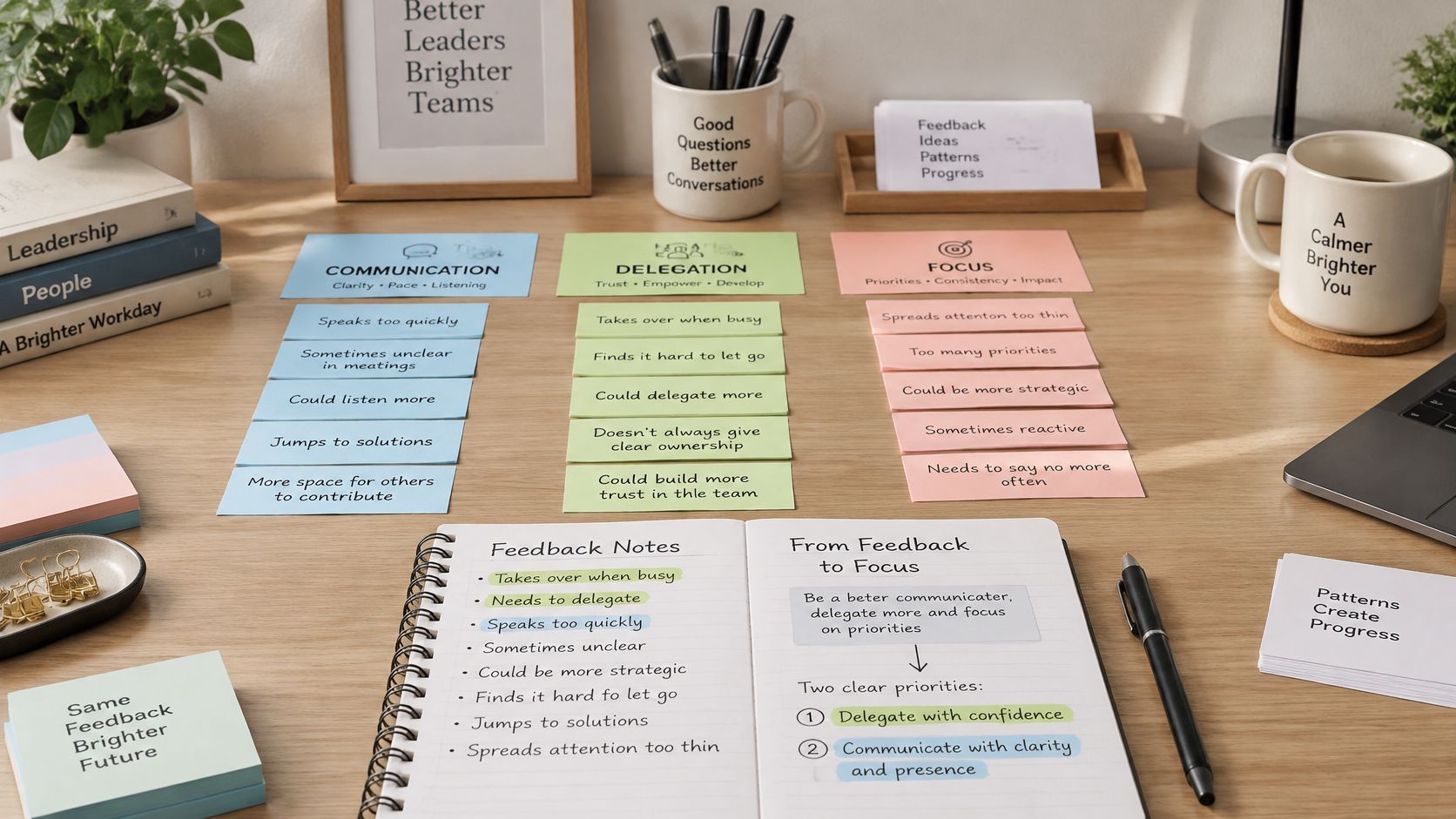
Feedback arrives as complaints, compliments and contradictions. The work is to find the sentences that repeat. Keep a theme only when it shows up across at least two rater groups. One direct report saying you take over under pressure might be that person's preference; direct reports and a peer saying it is a pattern.
Keep the working notes somewhere visible, because objectives filed away are objectives nobody practises:
Take a recurring comment such as "you take over when things get busy". A weak objective is be a better delegator. It commits to nothing anyone can see, and by Friday it has already expired.
A behavioural objective reads: For the next six weeks, hand one piece of client reporting to a team member each week, with a written handover and a 15-minute check-in on Friday. Every objective needs three parts.
- The observable behaviour. What a colleague would watch you do, not the quality you'd like to have.
- The frequency or context. Weekly, in every one-to-one, for the next six weeks. Frequency turns an intention into a countable event.
- The measure. How many handovers were completed, what the team member said about the handover, whether the client noticed.
A second example, this time about feedback quality: give one specific praise point and one specific improvement point in every weekly one-to-one. The measure is simple, a count of one-to-ones where both points were said out loud, and it's more useful than any general rating of "communication".
Three objectives is the ceiling. A fourth means none of them gets practised.
Before committing, ask one trusted colleague whether each objective is something they could watch you do. If they can't describe what they'd see, the objective isn't behavioural yet, whatever it says on the page. Then rewrite the top three themes into objectives and mark which ones can be measured within a month. Anything needing a year of data belongs in the second cycle.
Practising Core Skills Through Everyday Work
A stalled handover teaches more than a well-delivered slide. Leadership is observable workplace behaviour, so development has to show up in live decisions, conversations and delivery routines. Courses can frame the theory, but the test is what a colleague can see you do when work is busy and the answer is not tidy.
A useful principle is to weight development towards the job itself, with coaching and formal study playing narrower supporting roles. That principle only works if the “job” part is deliberate. Handing someone a vague responsibility and hoping for the best is activity, not practice.
| Source of development | Emphasis | How to apply it |
|---|---|---|
| Challenging work and management experience | Main emphasis | Delegate a real decision, lead a stretch project or take over a stalled process |
| Coaching or mentoring | Supporting emphasis | Meet a mentor or peer coach and bring one live situation |
| Formal coursework | Short, focused support | Use a short course to structure the theory, then apply it to a current problem |
Four skills, four ways to practise them
Delegation means handing over a decision, not just a task. Name the outcome, the limit of authority and the review date. A decision handed over badly becomes a task with extra steps, and the manager still carries the judgement.
Conflict management is the harder habit. Hold one difficult conversation and write the agreement down afterwards. how emotional intelligence shapes successful leaders matters here because the skill is naming the issue plainly instead of softening it into vagueness. The feedback that follows should describe what people saw, what changed and what still needs work. That is how emotional judgement becomes visible to the team rather than a private intention.
For strategic execution, lead one cross-functional project with a single named owner per workstream. Unowned work is a common reason a plan stalls at the first handover. A named owner should also have authority to remove small obstacles before they become a status meeting.
Recognition is the cheapest of the four and the most often skipped. Name one specific contribution in each team meeting, tied to what it changed. “Great work” teaches nobody what to repeat. “Good catch on the client data, it stopped us sending the wrong version” gives the team a behaviour to copy.
The workplace project method
Give each participant one project with a defined baseline, a target, an owner and a deadline. Say a team lead inherits a stalled customer-onboarding process. The baseline is fourteen days from signed contract to first live session, the target is nine, the weekly stand-up gets handed to a team member so the lead stops being the bottleneck, and the deadline is eight weeks with a halfway review. That single project practises delegation, obstacle removal and delivery measurement at once.
The project also creates feedback data. Ask the new owner what decision was unclear, ask the team where work still waited on the lead, and check whether the target moved. If it did not, change the system around the project rather than repeating the same effort with more pressure.
The pitfall is generic classroom content with no chance to apply it. Where coursework does fit, keep it short and structured enough to attach to a live problem. The Programme Certificate in Leadership at European Institute of Leadership and Management is designed for aspiring leaders, current managers and executives looking to refine their leadership capabilities. It earns its place only if the theory is applied within a fortnight to something the team can observe.
Three practices to start this month: hand one recurring report to a team member with a written handover, hold the difficult conversation you've been postponing and record the agreement, and name one specific contribution in every team meeting for four weeks.
Leading Well When Support Is Thin
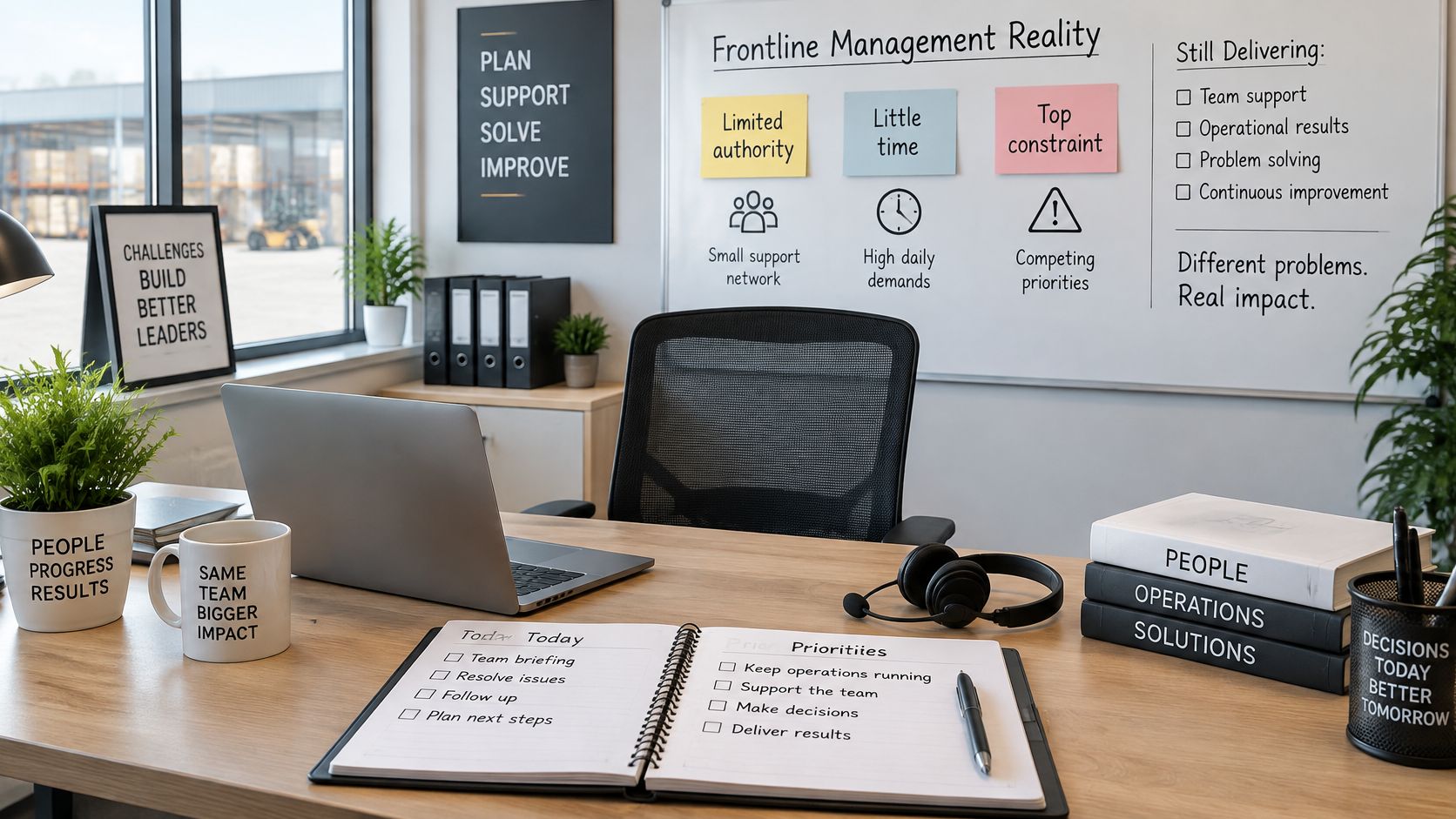
Frontline managers are rarely short of commitment. They're short of cover. In Ireland, insufficient line-manager capability and capacity was the top constraint for 61% of surveyed HR professionals, as reported in Irish Times coverage of research into what makes a good manager. The same coverage sets out a gap around AI: only 48% of workers said leadership expectations for AI use were clear, 51% viewed leadership as out of touch with employees, and just 40% had received enough AI training or guidance.
Those numbers point at a design problem, not a mindset deficiency. Treating leadership improvement as an attitude adjustment leaves workload, role clarity, upward influence and psychological safety untouched, and those are the levers a frontline manager can pull.
The first 90 days, with limited authority
- Days 1 to 30. Hold a one-to-one with every team member and ask one question: what gets in the way of your best work? Listen, don't fix, and keep a list.
- Days 31 to 60. Pick two changes that reduce workload or clarify roles, and confirm them with the team before acting. Two is the number that survives a busy month.
- Days 61 to 90. Publish the team's expectations in writing and review them together, so ambiguity becomes a document people can argue with rather than a mood.
Protect 30 minutes a week for development work and remove one low-value meeting from the diary to pay for it. For upward influence, bring a short brief: the problem, one option, a clear request. When senior leaders change direction, explain what's known, what isn't yet known, and the date of the next update. Silences get filled with rumour, and team resilience is built on that honesty rather than on slogans, which is the practical core of building resilient teams in times of uncertainty.
The question to take upstairs: which three decisions can I make without escalating? A vague answer tells you something about the role, not about you.
Leading Your Team Through AI Adoption
Enterprise adoption in Ireland has moved faster than most leadership development has. The share of enterprises with at least ten employees using AI rose from 8% in 2023 to 20% in 2025, according to a sectoral study on AI in enterprise in Ireland. That study also found AI-related skills in 3.7% of Irish job postings in 2025, up from approximately 2.3% in 2024.
Most guidance on how to improve leadership skills stops at communication, delegation and emotional intelligence. The gap sits one step further on. Managers now set rules for tools they don't fully understand, check work they didn't produce, and answer for the errors.
Four moves that build AI judgement
- Set acceptable-use rules. State which tools are permitted, which data must never be entered, and who approves exceptions. Rules written down are the difference between experimentation and leakage.
- Evaluate outputs. Agree a checking routine, so AI-drafted work is verified against its source before it leaves the team. If the output can't be checked against something the team trusts, it isn't ready to leave.
- Redesign workflows. Decide which tasks get a first draft from a tool, which decisions stay human, and where the review step sits in the process.
- Make accountable decisions when AI is wrong. Name the owner of each output, run a short review when an error reaches a client, and record what changed.
Technical proficiency alone doesn't make a manager useful here. The scarce capability is judgement: knowing when a task shouldn't be automated at all, spotting an output that's fluent and wrong, and choosing the moment to slow down instead of the moment to ship.
Protect trust by publishing the rules openly, because staff who don't know them will assume the worst. Review them monthly with the team so they keep pace with the tools in use. This is governance work, closer to how AI and automation reshape leadership expectations in Europe than to learning another application.
Build a Routine and Start Measuring Progress This Month
Add leadership capability to the risk register alongside the training plan. CIPD Ireland's 2025 survey of HR practices found leadership and influencing skills were the top future capability gap for 36% of respondents, with 31% naming leadership specifically as an area needing skills development. The exposure is sharpest where this article has focused: managers expected to steer AI adoption with limited support behind them.
The habit that makes a plan stick is small and weekly: 15 minutes on a Friday covering what you did, what changed and what to try next, plus a monthly session with a coach or a peer who'll challenge the account rather than agree with it. Put the review dates in the diary at the start, so the cycle runs on dates rather than intentions.
By the end of the first month, have these ready to look at:
- The Friday reflection notes, kept in one place so patterns are visible across the weeks.
- One dated example per objective: a decision handled differently, a harder conversation held, an output checked before it left the team.
- The repeated feedback round booked, with the same raters where possible so the comparison is clean.
- The organisational measures named in advance, so nobody picks flattering ones after the fact.
- The next round of objectives drafted before the current ones close.
Measure with two things side by side: repeat behavioural ratings and project measures such as delivery dates, retention and engagement. Course completion and self-report alone will flatter any programme. Organisational measures belong in the same review, and CSO's gender balance in business survey recorded women in 32.3% of senior-executive positions in large Irish enterprises in 2025, up from 30.4% in 2023, a shift that depends on succession and promotion systems rather than on any individual's development plan.
Where coursework carries the smaller share, use it to structure the theory and apply it within two weeks. A course that ends without application is a receipt, not a change.
Choose one workplace project, and book the first feedback conversation for this week. Every other item in the cycle follows from those two acts.
The European Institute of Leadership and Management teaches this kind of practical leadership development through self-paced online study, so it fits around a full-time job rather than competing with it. Its Programme Certificate in Leadership is designed for aspiring leaders, current managers and executives looking to refine their leadership capabilities, and the Mini-MBA in Leadership covers leading teams, managing organisations, driving innovation and navigating change; a Program Certificate is earned by completing four courses in a designated programme. Visit European Institute of Leadership and Management to see the programme options and pick the one that matches the project you've already chosen.