
Project Manager Salary in Ireland: 2026 Ranges Explained
A senior project manager's estimated gross salary in Ireland is 112.5% higher than a junior's, according to the 2026 CalculateSalary benchmark. That gap makes a single national average a poor starting point for judging an offer. Career stage matters, but so do the industry, project scope, employment arrangement and method behind the published figure.
A useful project manager salary comparison therefore starts with the role, not the headline average. It also separates annual gross pay from the amount available after tax, because an attractive advertised salary and a workable household budget aren't the same thing.
Table of Contents
- Project Manager Salary by Career Stage in Ireland
- What Actually Drives Project Manager Pay
- Why Location Changes What Project Managers Earn
- How Sector Shapes Project Manager Salaries
- What a Project Manager Really Takes Home
- Plan Your Next Move Towards a Higher Salary
Project Manager Salary by Career Stage in Ireland
At the junior end, the 2026 CalculateSalary benchmark quotes €40,000, while the SalaryExpert estimate quotes €60,823 for one to three years' experience. That gap reflects different career-stage definitions and estimation methods. CalculateSalary says it draws on official statistics, labour-market releases and employment datasets, although its figures remain market estimates rather than an official occupational wage series. SalaryExpert also reports an average bonus of €1,891. The rows below preserve each benchmark's published categories.
Irish project manager gross pay by career stage and source
| Career stage | Source | Annual gross pay | Monthly gross before tax | What the role usually owns |
|---|---|---|---|---|
| Junior | 2026 Ireland benchmark | €40,000 | €3,333 | Schedules, documents and task coordination |
| Entry-level, 1 to 3 years | SalaryExpert | €60,823 | Not published in this benchmark | Delivery of defined tasks and schedules |
| Average | 2026 Ireland benchmark | €62,000 | €5,167 | A defined project with a team and budget |
| Senior | 2026 Ireland benchmark | €85,000 | €7,083 | Multi-workstream delivery, stakeholders and risk |
| Senior, 8 or more years | SalaryExpert | €96,127 | Not published in this benchmark | Multi-workstream delivery, stakeholders and risk |
The monthly figures are gross amounts before tax, so they support salary planning rather than a household budget. Both sources place materially higher pay at the senior stage, but their early-career labels are not equivalent.
Do not merge the rows into one progression curve. SalaryExpert defines its early stage by years of experience, while the 2026 benchmark uses the broader label junior. Do not assume an experience-labelled estimate describes a vacancy either. The job description still has to establish whether the employer expects coordination, independent delivery or responsibility for substantial commercial and operational risk.
Turning a benchmark into pay evidence
Start by matching the vacancy to the benchmark's own definition. A role titled junior project manager may fit the coordination row, while a position requiring one to three years of independent delivery may sit closer to SalaryExpert's entry-level category.
The evidence record should then show what the practitioner can already handle. Useful proof includes on-time delivery, budget variance, stakeholder complexity and team leadership, with direct accountability separated from participation. Attending a budget review demonstrates exposure to the process; controlling the forecast and recommending corrective action demonstrates responsibility for it.
A project coordinator seeking a first delivery role might document responsibility for maintaining a schedule, then identify the missing evidence in cost control or change approval. A current manager seeking senior work could show how dependencies were resolved across teams and how risks were escalated or contained.
Wider ownership supports an upper-band salary argument when it is paired with dependable execution. The strongest case connects the career stage being claimed to outcomes the employer can verify.
What Actually Drives Project Manager Pay
Two Irish vacancies can both say “project manager” and still describe different jobs. In one, the hire controls a €2m budget, approves scope changes and answers for supplier overruns. In the other, the hire maintains the schedule, prepares status packs and escalates decisions upward. The matching salary should differ even if the years of experience are identical.
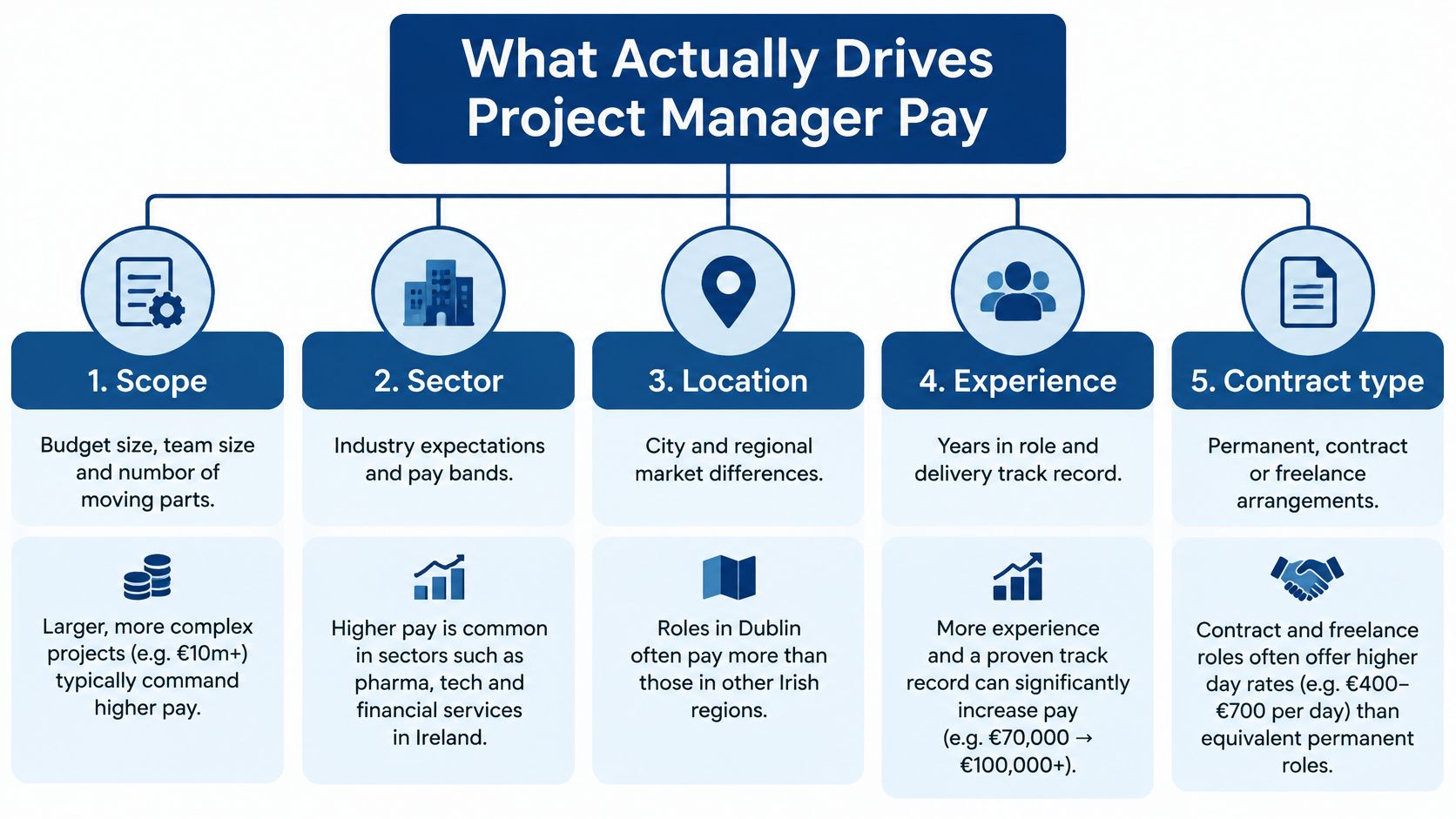
Pay follows the comparison group an employer uses. A title is a weak filter because it hides budget authority, decision rights, sector risk and whether the package is permanent salary or contractor revenue.
A working order for assessing a role
- Scope: what budget, team and workstreams the person controls directly.
- Delivery judgement: recovery actions, trade-offs and decisions the person can explain.
- Market context: sector risk, hiring location and remote policy set the peer group.
- Employment basis: permanent pay includes benefits and paid gaps that day-rate revenue does not.
- Credentials: they can support eligibility, while Irish benchmarks do not show a qualification alone causes higher pay.
The first two bullets decide where a role sits inside a band. The market-context bullets decide which band is relevant. The last two stop a candidate comparing a gross salary with a day rate, or treating a certificate as a substitute for accountability.
A practical test is to pick the three drivers most likely to move the target role and mark each as a strength, gap or unknown. If scope is the gap, the progression plan should seek ownership of a budget line, a supplier decision or a cross-team dependency. If market context is the gap, compare only roles with the same sector exposure and employment basis. A development lens such as the key traits of successful project managers can guide practice, but the salary case still rests on role weight and the terms of the package.
Why Location Changes What Project Managers Earn
Dublin pay cannot establish a national location premium on its own. A valid comparison would need similar roles, seniority, sectors and employment arrangements inside and outside the capital, and the published Irish figures do not provide that matched sample.
The complications start with how Dublin figures are built. Morgan McKinley's guide pairs a broad annual pay range for Dublin project managers with daily rates for contractors operating through their own limited companies. Because the annual and daily bases sit side by side in the same source, the Dublin range cannot be read as a clean permanent-salary benchmark, and converting between the two requires assumptions about billable days that the guide does not supply.
Headline pay figures for Ireland by source and basis
The Indeed Ireland salary page gives an Ireland-wide average of approximately €80,597, with a typical range of €60,281 to €107,760, based on 1,500 reported salaries.
| Source | Figure | Basis |
|---|---|---|
| Morgan McKinley | Dublin range concentrated in the lower half of the national typical band | Annual range published alongside contractor daily-rate wording |
| Ireland-wide estimate (Indeed) | €80,597 average; €60,281 to €107,760 typical range | 1,500 reported salaries |
| Jobted | National gross average in the high €50,000s; typical starting pay in the mid €40,000s | All-sector reported average |
| 2026 Ireland benchmark | Average in the low €60,000s | Career-stage level comparison |
| SalaryExpert | Entry-to-senior spread inside the national typical band, plus a modest average bonus | Experience-based estimates |
Each row answers a different question. A reported-salary sample, a broad occupational estimate and experience-specific estimates measure different populations, so disagreement between them is expected. The location-relevant finding sits in the first row: the published Dublin range falls inside the national distribution rather than clearly above it. Any apparent Dublin gap may therefore reflect the sector and seniority mix of vacancies concentrated in the capital, not geography itself.

Checks before using a location figure
- Employment status: Establish whether the figure describes permanent employment or contracting.
- Payment unit: Confirm whether it is an annual salary or a daily rate.
- Sample and role mix: Check whose pay was measured and whether seniority and sector are comparable.
- Package boundaries: Identify benefits, tax treatment, employment security and unpaid gaps between assignments.
The available benchmarks contain no matched non-Dublin sample, so regional differences remain unquantified. The defensible reading is narrower than the headlines suggest: the published figures show where Dublin vacancies are priced, and any genuine regional gap cannot be measured until comparable data outside the capital exists. Until then, a candidate based elsewhere should benchmark against the sector and seniority rows rather than assume an automatic discount.
How Sector Shapes Project Manager Salaries
Sector sets the comparison group before negotiation starts. A project manager coordinating routine internal work and one accountable for regulated delivery can share a title while facing different approval, technical and risk requirements, so the same occupation produces different pay by industry.
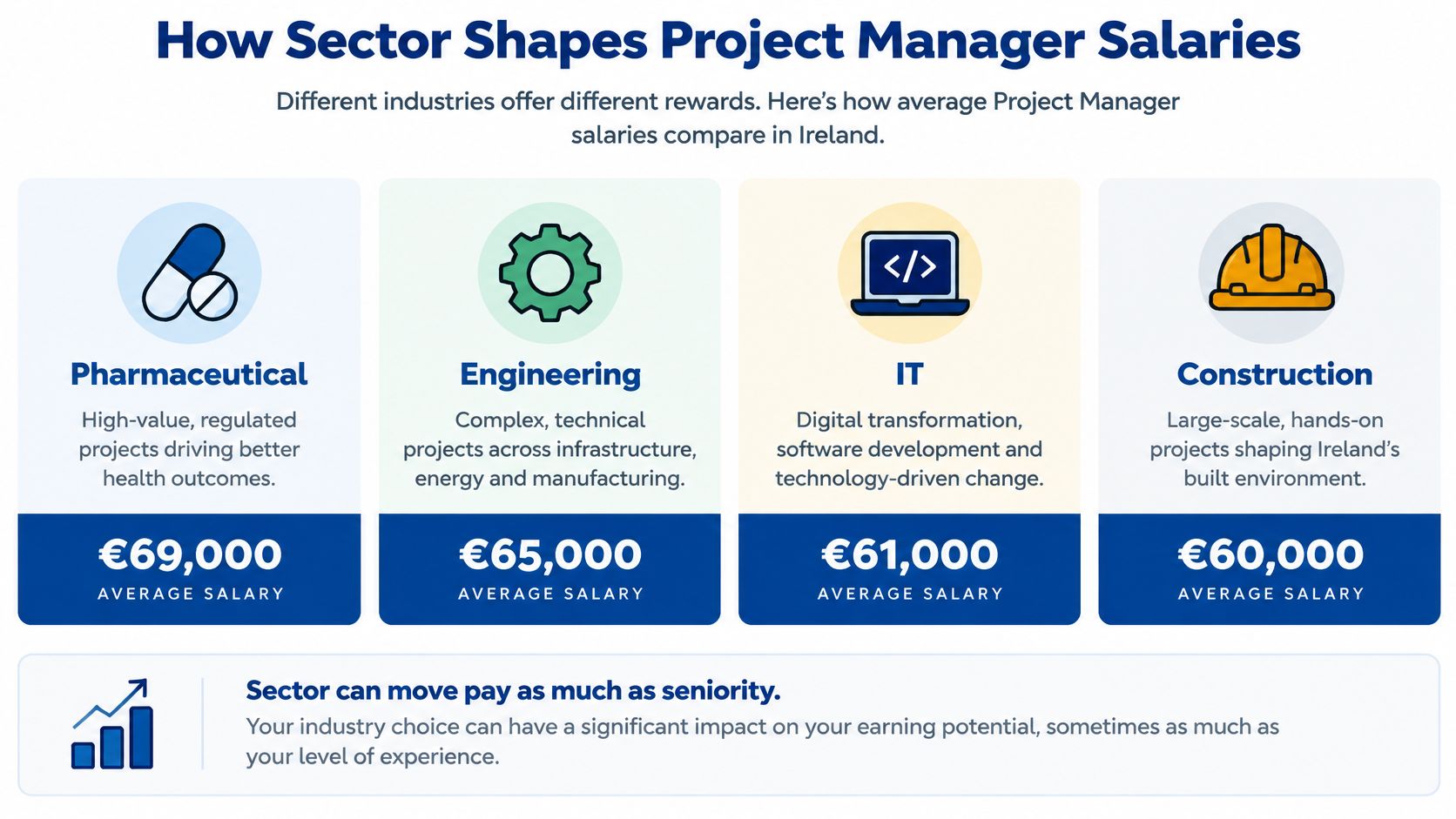
The values below are Jobted's reported Irish averages, shown as approximate annual gross pay.
Project manager average gross pay by sector in Ireland
| Sector | Approximate average gross pay | Why pay differs |
|---|---|---|
| Pharmaceutical | €69,000 | Regulated delivery with compliance and risk accountability |
| Engineering | €65,000 | Technical scope and delivery governance |
| IT | €61,000 | Technology delivery and vendor management |
| Construction | €59,000 | Site programme and contractor coordination |
| All sectors | €58,216 | Blended figure across all industries |
The responsibility labels explain why the comparison groups differ; they do not measure how much each duty adds to pay. These averages also mix experience levels, project sizes and employer types, so a sector figure is a starting benchmark rather than a personal target. The graphic rounds the construction value, so cite the table figure.
How industry and seniority combine
The Institute of Project Management's IT salary guide gives 2026 Irish IT ranges of €45,000 to €55,000 at entry level, €62,000 to €80,000 at mid level and €85,000 to €105,000 at senior level. Its senior ranges by sector are €92,000 to €120,000 in financial services, €90,000 to €115,000 in pharmaceuticals and life sciences, and €70,000 to €90,000 in the public sector.
Two conclusions follow. An industry average is a weak ceiling for an experienced specialist, because senior financial services and pharmaceutical roles sit well above the blended figure. A senior-sector range is equally weak as an entry expectation, since entry-level IT starts far below it.
Regulated pharmaceutical and engineering delivery combines governance with compliance, technical assurance, supplier management and risk accountability. An applicant moving into a higher-paying sector needs evidence of those capabilities in delivery history; stated interest carries little weight.
The closest role-and-industry match is a better negotiating reference than the largest available headline figure.
Technology scope also needs precise definition. Reading on how artificial intelligence is changing project management can surface emerging delivery questions, yet familiarity with a tool is not itself a pay case. The stronger argument shows responsibility for implementation, governance, adoption and measurable outcomes.
What a Project Manager Really Takes Home
Gross pay is the starting point for an offer comparison, not the amount available to spend. Two candidates on the same salary can still take home different amounts, because tax credits, pension contributions and personal circumstances all change the payroll result.
Gross to take-home pay on a €70,000 salary in Ireland
The IrishPAYE project-manager benchmark puts the 2026 typical gross salary at €70,000, within a stated €50,000 to €90,000 range, and calculates annual take-home pay of €50,201, roughly €4,183 a month, after €15,200 PAYE, €1,632.82 USC and €2,966.25 PRSI, an effective deduction rate of about 28.3%.
| Item | Annual amount |
|---|---|
| Gross salary | €70,000 |
| PAYE income tax | €15,200 |
| USC | €1,632.82 |
| PRSI | €2,966.25 |
| Take-home pay | €50,201 |
Each deduction works differently. PAYE is income tax collected through payroll, USC is a separate charge on income, and PRSI funds social insurance. Listing them separately explains why a monthly payslip cannot be derived by dividing gross salary by twelve.
Applying the example to an offer
The calculation is illustrative rather than a personalised payroll quotation, so a candidate should rerun it with their own credits, pension contribution and family circumstances before accepting a figure. Understanding payroll and tax compliance helps separate these deductions from the wider employment package, including discretionary payments that should never be counted as guaranteed income.
A pay rise doesn't translate euro-for-euro into disposable income. Take an extra €5,000 on the same salary, lifting gross pay to €75,000. At the benchmark's effective deduction rate of 28.3%, that rise would add about €3,585 a year, or roughly €299 a month, rather than the €417 a month the gross figure suggests. Because additional earnings are taxed at marginal rather than effective rates, the gain may be smaller still where the raise crosses a rate threshold. The practical test is to compare that net figure, not the headline increase, against the extra responsibility, travel and working-time commitments attached to the higher-paid role.
Offer check: Compare the additional take-home pay with the additional responsibility, travel and working-time commitments.
Plan Your Next Move Towards a Higher Salary
A credible salary target connects a suitable benchmark with evidence of readiness for the job. Choosing the highest published figure first, then searching for a justification, reverses that process.
A practical progression plan
Choose the relevant career stage. Match the current role to the benchmark's definition, recording the source and whether it describes coordination, independent project delivery or senior accountability.
Narrow the comparison. Select the closest sector and establish the employer's location and employment basis. An attractive range is useful only when the underlying work resembles the target vacancy.
Build a scope record. Document budget size, team size, workstreams, stakeholder count and on-time delivery. Separate responsibilities already held from those requiring supervised experience or a new assignment.
Evaluate the actual offer. Calculate take-home pay after PAYE, USC and PRSI, then assess the wider package. Preparation using practical negotiation techniques should connect the requested salary to responsibilities and delivery evidence.
What training can and cannot establish
The Institute of Project Management's certification coverage claims a 12% to 18% pay premium for practitioners holding IPMA Level B or an equivalent credential. That association doesn't establish causation: credentialed practitioners may also lead larger programmes, have more experience or work in higher-paying sectors.
An introductory course and an advanced professional credential therefore shouldn't be treated as interchangeable salary investments. Training can help close a knowledge gap or support eligibility; it doesn't guarantee placement in a higher band.
The European Institute of Leadership and Management's Programme Certificate in Project Management is aimed at current project managers, team leaders and people moving into the role. Its Mini-MBA in Project Management covers the full lifecycle from initiation to closure, making lifecycle knowledge a concrete consideration when selecting a learning pathway.
The next decision should be specific: select a target role and identify the single scope gap to close first.
The European Institute of Leadership and Management offers project-management learning pathways for people entering the profession and practitioners developing broader lifecycle knowledge. Readers can visit the European Institute of Leadership and Management to compare those options against a target role's requirements and choose study that addresses a defined capability gap.