
Conflict Within the Workplace: Causes, Costs and Fixes
There's a meeting in the calendar for Thursday that three people are dreading. Nothing has been said formally. The email chain that started it went quiet four days ago, one colleague has stopped copying another on project updates, and the manager who could settle it in twenty minutes is waiting for things to calm down.
That waiting is the most common failure in conflict within the workplace. Not cruelty, not incompetence, just a reasonable-sounding delay that lets a manageable disagreement harden into a grievance, an absence, or a resignation letter. Managers delay because they fear making it worse, because they've never been taught a route through it, and because the cost of waiting is invisible until it lands on a spreadsheet months later.
What follows is a working method: how to name the conflict correctly, how to find the driver behind it, what unresolved friction costs, why staff stay silent, and how to escalate and measure. It's built for the manager who has to deal with this on Monday morning, not for the HR conference stage.
Table of Contents
- Types of Workplace Conflict and the First Response Each Needs
- Resolving Conflict by Addressing the Root Cause
- Costs of Conflict for People and Performance
- Early Warning Signs and Why Staff Stay Silent
- Escalating Conflict and Measuring Whether It Has Eased
- Set Up a Conflict Response Plan Your Team Can Use
Types of Workplace Conflict and the First Response Each Needs
Two complaints can land on a manager's desk in the same week, sound almost identical, and need opposite responses. One is two engineers arguing over who owns a deliverable. The other is a senior engineer belittling a junior colleague in front of the team. Both get described as friction. Only the second one demands a formal route, and the first can harden into it if it is left alone.
Workplace conflict is a disagreement that has started to affect how people work together, trust one another or share tasks. That definition sets a threshold worth holding. A team that argues hard and then commits to a decision is doing its job, not sliding into conflict. The line is crossed when friction becomes repeated, personal or unresolved, and when people begin arranging their working behaviour around it.
The scale runs wider than any single team's experience suggests. The European Working Conditions Survey 2024 found that 17% of workers across the European Union had experienced adverse social behaviour at work during the reference period, as set out in a European Parliamentary Research Service briefing791465). That category covers psychological violence, harassment, threats and other abusive conduct, not merely a sharp exchange in a meeting room. Earlier measurement was narrower: an EU-OSHA review of the Fourth European Working Conditions Survey recorded low reported rates of bullying, harassment and unwanted sexual attention, largely because the questions themselves were narrower. The definitions widened because the problem turned out to be wider than the questions being asked.
Six types, six different first moves
Naming the type is the diagnostic step, because the type determines the route. A clash of working styles calls for a direct conversation. Repeated humiliation calls for safeguarding and a formal process. I treat each type as a piece of management information too: recurring task conflict reports a design flaw in how roles were drawn, while bullying reports a failure of supervision.
| Conflict type | Typical trigger | First response |
|---|---|---|
| Task and role conflict | Unclear responsibilities, overlapping deliverables | Clarify roles in writing and agree decision rights |
| Interpersonal clash | Different communication styles, repeated friction | One-to-one conversation focused on specific behaviour |
| Resource competition | Limited budget, headcount or time | Prioritise openly and review allocation with the team |
| Pay and reward dispute | Perceived unfair pay, promotion or workload | Check the criteria, explain the decision and review it with HR |
| Bullying or abusive conduct | Repeated humiliation, intimidation or exclusion | Safeguard the person and start a formal investigation |
| Discrimination or harassment | Unwanted conduct linked to a protected characteristic | Use the formal route with an impartial investigator |
Practical rule: name the type before you act. Offering mediation in response to a bullying complaint, or opening a formal investigation into a disagreement about deadlines, makes the situation harder to repair than it was.
Pay and reward disputes deserve a specific warning, because managers often try to resolve them through reassurance. Reassurance alone changes nothing about the underlying criteria. If the perception is that the criteria are unfair, the remedy is showing the criteria and then fixing them if they are indefensible.
The type also predicts whether the case will surface at all. Task and resource friction gets raised in meetings; humiliation and discrimination tend to stay silent until they arrive as a resignation or a sick note. What reaches a manager is the visible fraction, which is why a quiet team is weak evidence of a healthy one.
The negotiated end of this spectrum, from resource allocation to pay conversations, benefits from deliberate practice. Managers who want to sharpen that muscle before the next dispute lands will find useful groundwork in this guide to mastering the art of negotiation.
Resolving Conflict by Addressing the Root Cause
Most conflict training fails at the same point. It teaches people to stay calm, use neutral language and listen actively, then sends them back into the structure that produced the dispute. A manager who listens beautifully but never fixes an overlapping remit will be having the same conversation six weeks later, slightly more politely.
Diagnosis first: the fix comes from the cause, not from the tone of the conversation. Get the cause wrong and the agreement won't hold.
The six drivers behind most disputes
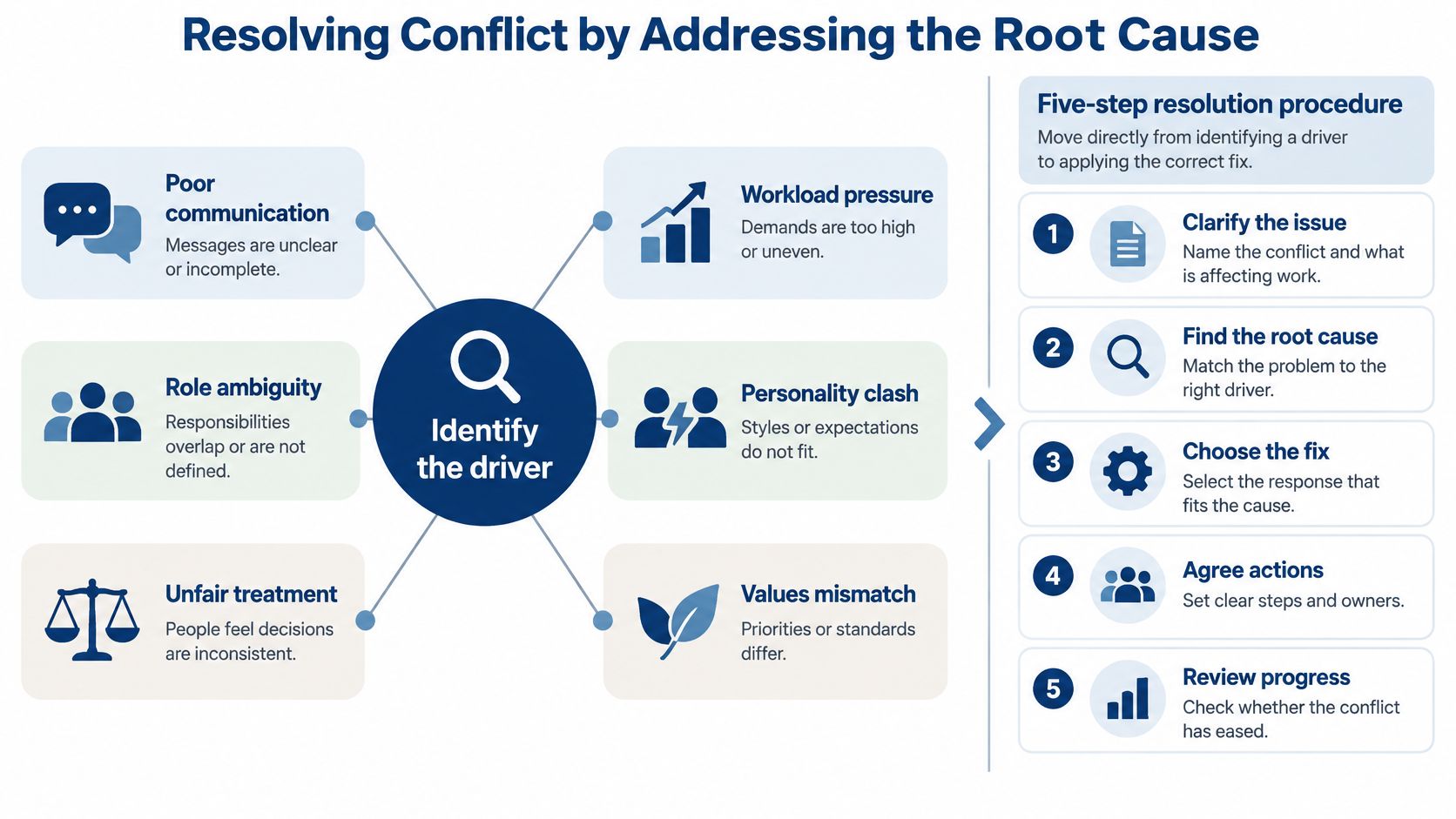
Disputes that reach a manager's desk cluster around six drivers. Each needs a different first move, and each move should be executed through the five-step method below rather than replaced by a general instruction to talk it through.
- Unclear roles. Two people believe they own the same decision, or neither does. Meet each separately first, ask both to describe their remit in writing, then agree decision rights in one document. This is a documentation task, not a mediation.
- Resource scarcity. Budget, headcount or time gets cut and nobody says how the remainder will be allocated. State the constraint openly, publish the criteria used to split it, and give the reasoning. Secrecy about allocation generates more resentment than the shortage itself.
- Information gaps. A decision was made elsewhere and never communicated, so people fill the vacuum with inference. Reconstruct the timeline in writing, separate what was agreed from what people assumed, then close the gap with one message to everyone affected.
- Differing working styles. One person needs a paper trail, another works from a phone call and a handshake. Hold a one-to-one about specific behaviour and its effect on handovers. Keep personality out of it.
- Opaque reward systems. Someone gets promoted and nobody understands why. Check the criteria applied, explain the decision to the people affected, and fix the criteria before the next round opens. This is a policy failure wearing a relationship costume.
- Inconsistent management. Two supervisors apply the same rule differently and the team notices within a fortnight. Escalate to the manager both supervisors report to. Coaching one of them individually won't fix a standards problem.
The five-step procedure that replaces guesswork
- Meet separately to gather facts. Ask what happened, who was involved and what each person expected. Take notes. A joint meeting at this stage rewards the more confident talker and teaches the quieter person to disengage.
- Separate agreed facts from interpretation, in writing. Two columns on one page. "The approval email was sent on Tuesday" is a fact. "She deliberately cut me out" is an interpretation, and it may be true, but it isn't established yet.
- Identify the underlying interests. Decision rights, fairness, recognition, workload, security. Interests explain positions, and positions are what people argue about when their interests are invisible.
- Agree specific behaviours with owners and timelines. Not "communicate better." Instead: the finance lead confirms approval by email within one working day, and the project manager copies the budget owner on any change. Named people, named dates.
- Confirm in writing with a review date. One page covering the facts agreed, the behaviours agreed, who owns each, and when everyone reconvenes. Diary the review before leaving the room.
A concept map helps when a manager is staring at an ambiguous complaint and can't see which part is cause and which is symptom.
An approval limit that took five conversations to find
Say a project manager and a finance lead have stopped speaking to each other after a project overspent. Each has escalated to their own head of department. The presenting complaint is disrespect in a meeting. Step one, meeting each separately, surfaces a different story: nobody has ever written down who can approve spend, at what level, or how quickly finance must respond.
Step two records what both agree on. The quotes were approved verbally. No written limit exists. Step three identifies the interest, which is decision rights rather than courtesy. Step four sets the protocol: a named approver, a threshold, and a one-working-day response window. Step five circulates the protocol, files it with the project documentation and books a 60-day review. The relationship usually recovers on its own once the ambiguity is gone, because the ambiguity was doing most of the damage.
Where the procedure slips
- Joint meetings too early. Bringing both parties together before the facts are clear turns a fact-finding exercise into a contest that someone has to win.
- Vague promises. "We'll communicate better going forward" is not an agreement. It has no owner, no behaviour and no date, so nothing changes and trust drops further.
- No written record. Six weeks later, each party remembers a different version. A single page removes the argument at almost no cost.
- Solving the person instead of the problem. Sending someone on a resilience course when the cause is a supervisor's inconsistency signals that the organisation has chosen a culprit rather than a fix.
Naming the gap correctly determines the whole response. Some conflicts need a conversation, some need a process change, and some need formal safeguarding. Managers who skip the diagnosis default to the conversation, because it's the only tool they were given.
The conversational side still matters and can be sharpened separately. This guide to effective communication in the workplace covers the listening and framing work that sits underneath any of these steps.
Costs of Conflict for People and Performance
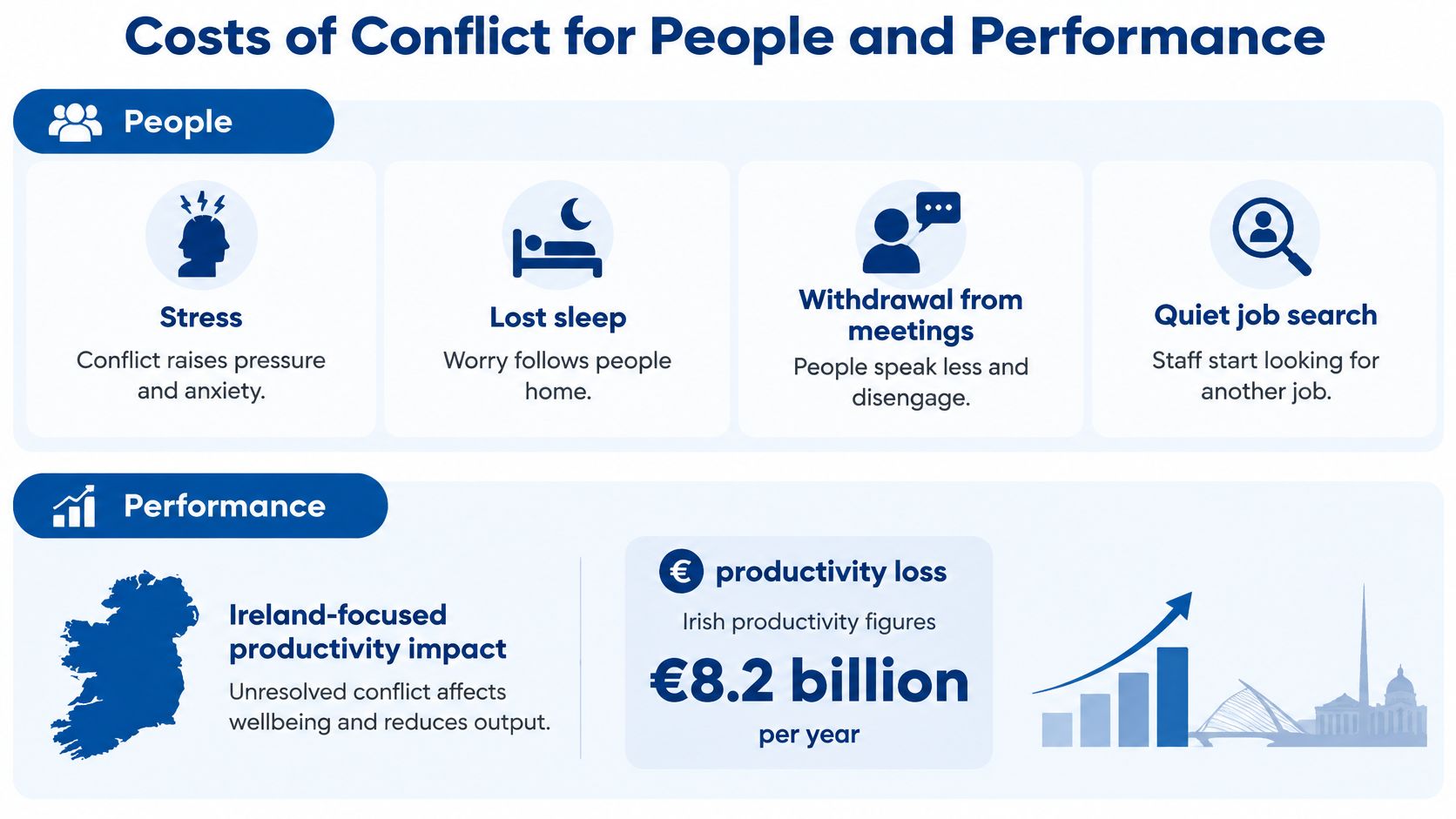
Before any figure reaches a spreadsheet, the cost lands on people. Someone loses sleep rehearsing a conversation. A capable colleague stops contributing in meetings because speaking up now carries a price. Another starts scanning job ads on a Sunday evening. None of that appears in an incident log, and all of it shows up in output.
Ireland measures the loss directly. A 2020 NUI Galway study, reported by The Irish Times, estimated the annual impact of bullying-related absenteeism across both sectors of the economy:
| Impact area | Metric | Annual estimate |
|---|---|---|
| Private sector absenteeism | Missed workdays due to bullying | 1.42 million days |
| Public sector absenteeism | Missed workdays due to bullying | 276,473 days |
| Total productivity loss | Combined private and public cost | €239.3 million |
| Private sector cost | Direct labour-capacity loss | €187.6 million |
| Public sector cost | Direct labour-capacity loss | €51.8 million |
The mechanism is straightforward: bullying and deteriorated management-employee relationships are associated with higher reported work-related stress, and absence converts that harm into lost labour capacity. Treat the figures as estimates. The operational conclusion holds whatever the decimal place: recurring interpersonal conflict belongs on the risk register alongside health and safety, with an owner and a review date.
The effects spread well past the two people involved. Decisions slow because colleagues route around each other. Work gets duplicated because information is withheld. Client service weakens when a team is distracted by an internal fight. Turnover rises, and each departure brings recruitment, induction and months of reduced output.
A team with three resignations in a year looks like a hiring problem until the exit interviews are read together. When the same supervisor appears in all three, and sickness absence in that team runs higher than the organisational average, the pattern is the finding. Clusters matter more than individual complaints, which is why a serious system logs incidents confidentially and reviews them for trends by team and manager. The log becomes a management instrument once it is read for patterns; filed and forgotten, it is just storage.
The cost rises the longer a dispute runs and the more people it draws in. Early intervention costs less than a late one. Engagement suffers well before anyone lodges a formal complaint, which is why employee engagement strategies that actually work tend to include a mechanism for surfacing friction early.
Early Warning Signs and Why Staff Stay Silent
Warning signs arrive long before formal complaints do. Meetings turn unusually quiet, or unusually formal. A colleague drops off a distribution list for reasons nobody explains. Complaints cluster in one team. Sickness absence creeps up in a reporting line where nothing has changed in the work itself.
| Warning sign | What it may indicate | Check next |
|---|---|---|
| Meetings become quiet or unusually formal | Avoidance or unspoken disagreement | Ask each person privately how work is going |
| Repeated complaints from one team | A shared cause such as a supervisor or workload | Review complaints for a common factor |
| Rising sickness absence | Stress from unresolved friction | Check absence by team and manager |
| A colleague is left out of messages or tasks | Exclusion, possibly bullying | Confirm who is involved and whether the conduct is repeated |
| Escalating tone or senior staff copied into emails | Breakdown in trust | Speak to both parties before the tone hardens |
| Resignations or leave requests without a clear reason | Possible unreported conflict | Hold a confidential stay conversation |
Visible conflict understates the underlying problem by a wide margin. A 2025 Irish workplace equality survey found that 75% of workers viewed bullying as a serious workplace issue and 72% had witnessed or personally experienced harassment, yet only 35% made a formal complaint. Among those surveyed, 30% had left a job because of bullying and 26% had considered it, according to Beale & Co's analysis. That is a reporting gap, not a skills gap, and it doesn't close by asking people to be more assertive.
The barriers are practical and predictable. Fear of career damage, particularly when the person being reported controls assignments or appraisals. Genuine uncertainty about what qualifies as bullying. Mistrust of internal procedures, often earned. And the plain difficulty of reporting a senior colleague to a process that the senior colleague appears to influence.
Reporting test: if a person can't predict what will happen after they raise a concern, they won't raise it. Predictability is what makes a process credible.
Ordinary conflict and bullying need to be kept apart. In an ordinary disagreement the parties are roughly balanced and facilitated problem-solving can work. Repeated conduct, humiliation, intimidation or power-based retaliation is a different category and needs safeguarding and a formal route, not a mediated conversation between uneven parties. In hybrid teams, the behaviour moves onto the screen as well: the survey identified online or virtual intimidation among reported behaviours, and exclusion from a channel is no less isolating than exclusion from a room.
The managerial action follows directly. Build bystander intervention, confidential escalation and anti-retaliation protection into the process, and hold managers accountable for using it. The foundations are set out in this guide to psychological safety in the workplace.
Escalating Conflict and Measuring Whether It Has Eased
A workable system has three tiers, and each case should be assigned to one of them explicitly rather than drifting upward by default.
- Manager-led clarification. Information, expectation-setting and role clarity. This resolves most task and role disputes, and it should be tried first because it's fastest and cheapest.
- Facilitated discussion or conciliation. An impartial third party, used when the working relationship is still repairable and the parties are broadly balanced. Useful where both people want to keep working together and the obstacle is process rather than conduct.
- Formal investigation or adjudication. Triggered by alleged discrimination, bullying, retaliation or an unresolved rights dispute. Some matters must never be mediated informally, and this is the tier that protects the organisation as much as the individual.

Escalate when there's no progress after two review meetings, when a second person is affected, or when a formal allegation arrives. Never push a case into informal mediation where there's a serious power imbalance or a hint of misconduct: the weaker party may agree to protect their position, and the agreement collapses later with interest.
Format choice is often made by habit. It shouldn't be. The Workplace Relations Commission's 2025 annual report shows 1,034 pre-adjudication mediations, the first year the Commission passed 1,000, with a 67.2% settlement rate for telephone mediation against 48.7% for in-person and 49.5% for virtual mediation. In-person remained the most common format at 70.9% of the 1,000 cases examined, with 18% by telephone and 11.1% remote. Case complexity differs by format, so this doesn't prove causation, but it does suggest entrenched parties may settle more readily at a distance than across a table.
For disputes involving whole workforces or representative bodies, conciliation operates at a different level again: the Commission reported an 85% success rate in resolving industrial-relations disputes in 2025, covering more than 700,000 workers, alongside over 64,000 information and advisory calls, according to the Department of Enterprise, Tourism and Employment announcement. Different tier, different tool.
Settlement alone is a weak measure of success. Track the recurrence rate, time to resolution, participant safety and whether agreed behaviours still hold three months later. Add one or two questions to the pulse survey about trust in the process. Then review open cases monthly, checking which tier each sits in and whether any has stalled.
Set Up a Conflict Response Plan Your Team Can Use
A plan fails when it lives on paper while every manager improvises their own version. Build the smallest artefact that changes behaviour first, then add a review cadence that turns each incident into a management signal rather than a private memory.
- Write a one-page conflict policy. Name the routes, the contacts, the expected timelines and the point at which a case escalates. Include a remote option for the discussion stage: cases often settle more readily at a distance than across a table. One page gets read; a thirty-page procedure gets filed.
- Train managers on the five-step procedure and the escalation triggers. Focus on the mechanics: separate meetings, facts versus interpretation, interests, agreed behaviours and written review.
- Open a confidential incident log and review it monthly. Look for clusters within one team or reporting line. A pattern of similar complaints is the escalation threshold that matters most, because it points at the system rather than the individuals.
- Run a quarterly team check-in. Two questions: is there friction you're working around, and do you trust the process if you raise something. Track the answers over time.
- Pilot with one team. Pick a team with visible friction, run the full cycle, measure recurrence and time to resolution, then extend the plan once the numbers move.
The log is what separates a response plan from a grievance inbox. Read monthly, it shows where conflict concentrates and which managers sit on problems until they harden. You cannot manage a pattern you never record.
Where managers need structured development alongside the plan, the European Institute of Leadership and Management offers relevant options. Its Mini-MBA in Leadership Programme is designed to teach skills to lead teams, manage organisations, drive innovation and handle change in a dynamic business environment, while the Programme Certificate in Professional Career Skills focuses on communication, leadership, time management, problem-solving and teamwork. Both are delivered online and self-paced, so a manager can study alongside a live caseload rather than step away from it.
The single first step this week is the incident log and one honest conversation with the manager whose team keeps producing the same complaint.