
Design Thinking Course: What You Learn and How It Works
The project meeting has reached an awkward point. A team has built what stakeholders approved, yet customers still struggle with the original problem. The manager now has to decide whether to commission another feature, change the process or investigate what people need.
A design thinking course should help learners make that decision with evidence. The useful question isn't how inspiring its workshops sound, but what participants will produce: interview notes, a clear problem statement, a prototype and a record of what happened when someone tried it.
Table of Contents
- The Five Stages a Design Thinking Course Covers
- How the Design Loop Works as a Cycle
- Ideation and Prototyping Without Wasting Time
- Testing Prototypes and Learning From Failure
- Where Design Thinking Is Used in Practice
- Checking a Course Before You Enrol
The Five Stages a Design Thinking Course Covers
Suppose a team spends six months building a feature that nobody uses. The development work may be competent, but the team has answered the wrong question. A design thinking course is designed to help prevent that mismatch by investigating people's needs before committing to a solution.
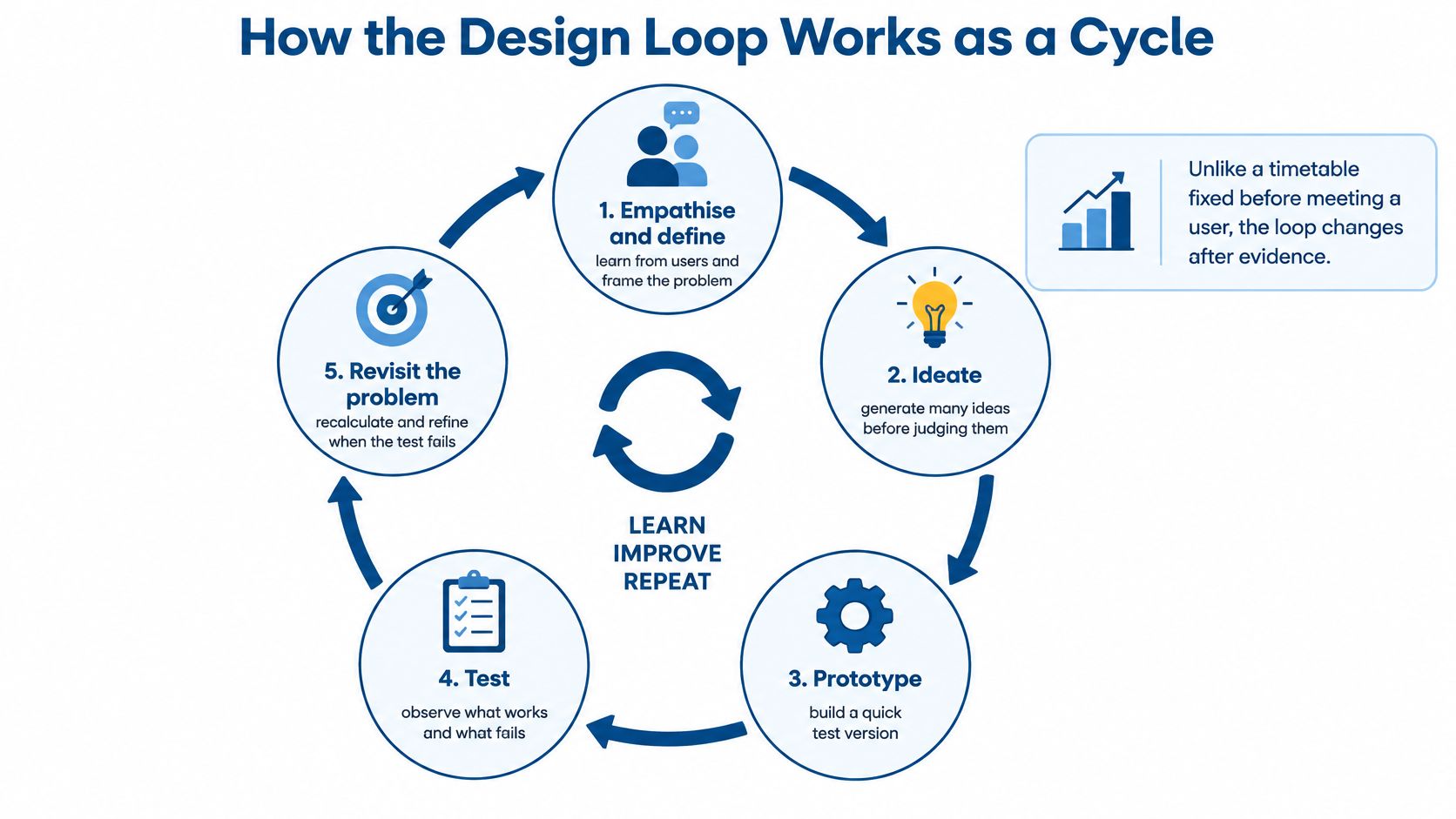
Design thinking is a structured way to solve problems by understanding the people affected, exploring possible responses and checking those responses in practice. Courses commonly organise the method into five stages, practised as a loop rather than completed like a checklist.
What each stage of a design thinking course covers
| Stage | Core question | What learners produce |
|---|---|---|
| Empathise | Who is this for and what do they struggle with? | Interview notes and observation logs |
| Define | What exactly is the problem? | A written problem statement and a shortlist of opportunity areas |
| Ideate | What could we try? | Twenty or more ideas, clustered and ranked |
| Prototype | What is the cheapest version we can build? | A paper sketch, mock-up or role-play script |
| Test | Does it work for real users? | A findings log linked to each assumption |
The artefacts matter because they make reasoning inspectable. Interview notes should separate what someone said or did from the learner's interpretation. A problem statement should identify the person, the difficulty and the circumstances, without prescribing an app or another preferred solution.
What learners should hand in
Consider an appointment service with frequent booking enquiries. A weak problem statement might demand a new booking portal; a stronger statement would describe customers struggling to identify an appointment that fits their availability. The second leaves room for improvements to information, scheduling or staff support.
Learning about customer research, user insights and problem identification helps establish that distinction before ideas become expensive commitments.
Portfolio test: Each submitted artefact should explain a decision, not merely show that an activity took place.
Most practical courses assess these artefacts rather than relying on a final exam alone, although assessment arrangements should be checked before enrolment. A useful starting exercise is to map a current workplace problem against the stages and identify the missing evidence. Teams often discover that they selected a solution before properly defining the problem.
How the Design Loop Works as a Cycle
Design thinking resembles satellite navigation more than a fixed timetable. When a route doesn't work, the team recalculates using new information rather than insisting on following a plan written before anyone met a user.
The destination begins with empathising and defining. Interview notes and observations establish what people are trying to accomplish, while the written problem sets a useful boundary. A feature already chosen by management isn't a substitute for either.
Following the evidence around the loop
During ideation, learners propose different routes before defending a favourite. The prototype then represents only enough of a possible solution to investigate the current uncertainty. Testing produces an observation that can support, challenge or overturn the assumption behind it.
The distinction matters when a test fails. A confusing button might justify revising a screen, but evidence that customers don't need the service should send the team back to the problem itself. Building a more polished version won't repair a mistaken understanding of the need.
Consider a hypothetical hotel team that assumes guests want faster check-in. Its first concept removes steps from the receptionist's screen, yet a service walkthrough reveals that guests mainly dislike repeating information already supplied during booking.
- Original assumption: Staff need to process the same questions faster.
- New interpretation: Guests need fewer repeated requests for information.
- Changed project: The team investigates information transfer between booking and reception instead of just accelerating the existing script.
The revised problem changes which departments should participate and which prototype would be useful. It might call for a sample arrival record and a staff handover exercise rather than new check-in software.
Balancing structure and imagination
The combination of analytical framing and creative experimentation reflects design thinking's roots in professional design practice, including competing rationalist and Romantic traditions described in the historical overview of design thinking.
A course covering digital innovation, experimentation and agile product development should help learners turn that balance into explicit revision decisions.
The useful question isn't whether the team has completed every stage. It's whether the current explanation still fits the evidence. Before authorising further development, a project leader should name the assumption on which the project rests and describe an observation that would disprove it.
Ideation and Prototyping Without Wasting Time
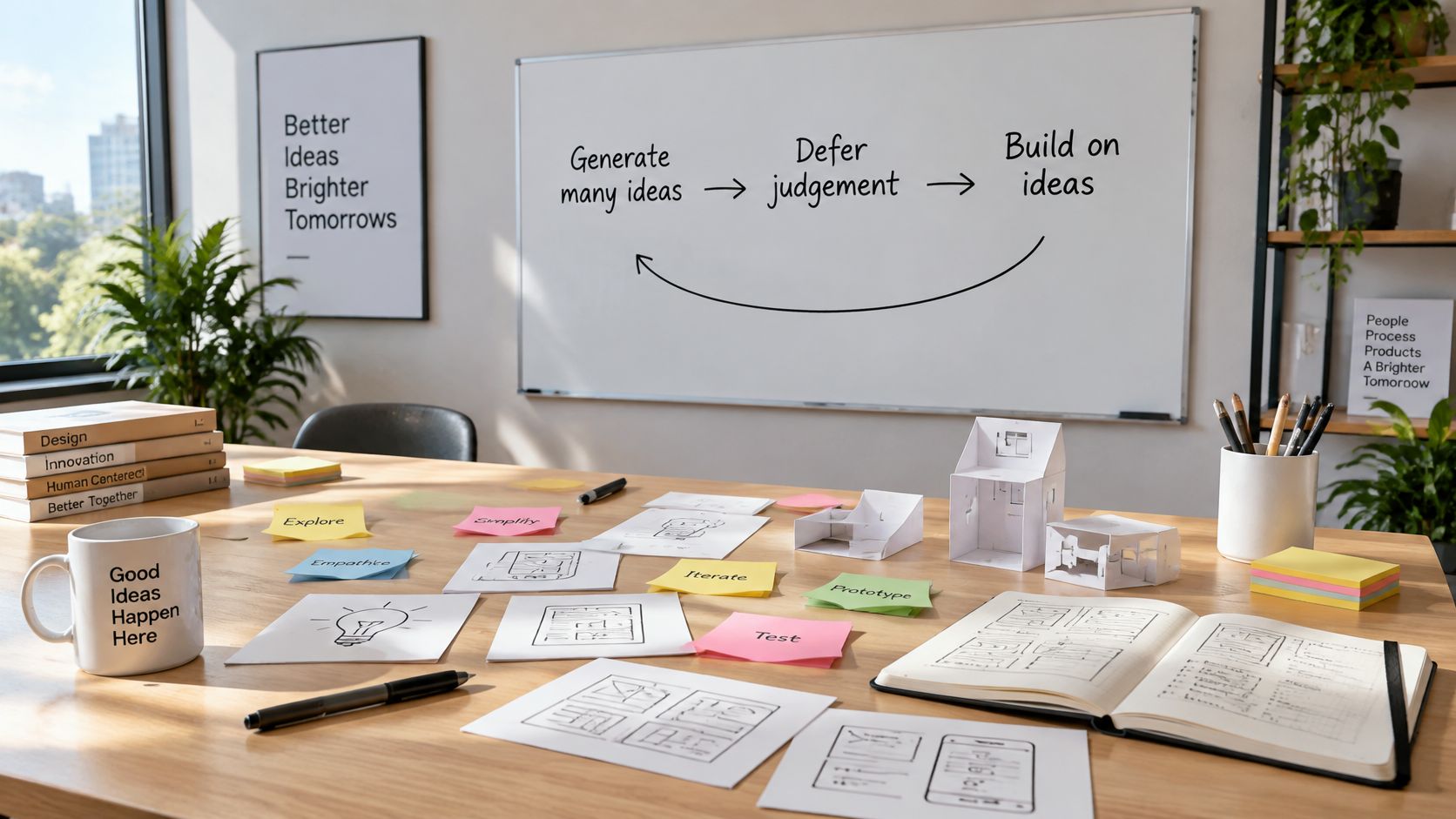
Ideation means generating alternatives before judging them. It isn't an invitation to hold an unstructured meeting until someone senior proposes an acceptable answer. Learners need a visible record of options and a reasoned way to select what deserves investigation.
A practical exercise can ask participants to generate twenty to thirty ideas, initially without criticism. Brief notes are enough: quantity matters more than presentation while the team is still exploring possibilities.
From options to a testable concept
A useful prompt turns the problem into a how might we question. For a delivery service, that might be how the firm could help customers choose a realistic delivery slot without overwhelming dispatch staff. The wording encourages alternatives without assuming that another software feature is necessary.
Participants can cluster related ideas on a wall, build on each other's suggestions and use dot voting to identify promising groups. Voting helps narrow the discussion, but it doesn't establish that an idea meets a genuine need. Selection should also consider user value, operational constraints and what remains uncertain.
Exercises in creativity, idea generation and customer co-creation should therefore produce a ranked concept shortlist with reasons, not a photograph of colourful notes.
Choosing the right prototype
A prototype is a question, not a product. Its level of detail should match the uncertainty being investigated. The following are illustrative planning allowances for course exercises, not guaranteed delivery times.
Prototype types, time and what each tests
| Prototype type | Time to build | What it tests |
|---|---|---|
| Paper sketch | About 30 minutes | Layout, order of steps and first reactions |
| Clickable mock-up | 1 to 2 days | Navigation and whether users complete a task |
| Role-play or service walkthrough | About 1 hour | Staff and customer handoffs |
| Working pilot | 2 to 6 weeks | Adoption, cost and measurable outcomes |
Suppose a logistics firm tests a delivery-slot concept through a whiteboard walkthrough before writing software. During an afternoon exercise, dispatch staff discover that the proposed choices conflict with the order in which vehicles are loaded. The team can investigate that constraint without maintaining a working booking system.
Choose the lowest-fidelity prototype that can answer the current question.
Polishing too early encourages attachment. A rough sketch is easy to change; an elaborate demonstration can become something its creators feel compelled to defend.
Testing Prototypes and Learning From Failure
Testing should reveal where an assumption breaks, not gather praise for a preferred concept. A participant saying that a prototype looks useful provides different evidence from that participant completing the intended task without assistance.
A course should teach learners to plan the observation before arranging the session. Otherwise, teams can finish an engaging conversation without knowing whether their central assumption survived.
A practical testing procedure
Write a testable assumption. An illustrative statement is that parents will book a slot online if they can see the expected wait time. This identifies a behaviour and a condition rather than a vague hope that customers will like the service.
Recruit suitable participants. For an initial learning exercise, a small group of five to eight people who match the intended users can expose practical obstacles. This isn't a statistically representative sample, and participants shouldn't be selected merely because they're convenient.
Give a task, not an opinion question. A parent might be asked to find and reserve a suitable appointment. Asking whether the booking page seems easy invites speculation rather than observable behaviour.
Observe without coaching. The facilitator should note hesitation, wrong selections and requests for clarification, intervening when consent, safety or serious distress requires it. Explaining the intended route too quickly conceals the very difficulty being investigated.
Record evidence against the assumption. The findings log should distinguish the expected behaviour, what happened, the context and the learner's interpretation. Notes should avoid unnecessary personal information, and recording should require permission.
Choose the next action. The team should keep, change or drop the idea and state what the next prototype will investigate. A finding without a resulting decision leaves the learning incomplete.
What counts as useful evidence
Ireland's Policy Framework for Design in Enterprise describes human-centred processes that replace premature commitment with a richer understanding of user experience. A well-designed course should translate that approach into an evidence chain: interview or observation material, a defined problem, prioritised opportunities, alternative concepts, prototypes and test findings.
Assessment should reward the quality of that chain. Useful criteria include the assumptions examined, the revisions prompted by feedback and the clarity of the connection between an observation and a decision.
Testing caution: Compliments aren't validation, and a colleague who knows the project may unconsciously fill gaps that a new user can't.
Leading questions create similar problems. Asking whether a prominent button would make booking easier suggests the desired answer; observing where someone looks for the booking action supplies more useful evidence.
Practical work on innovation experimentation, testing and customer validation should leave learners able to organise an independent session. A manageable challenge is a five-person test of one assumption during the coming week, ending with an updated prototype and a written decision.
Where Design Thinking Is Used in Practice
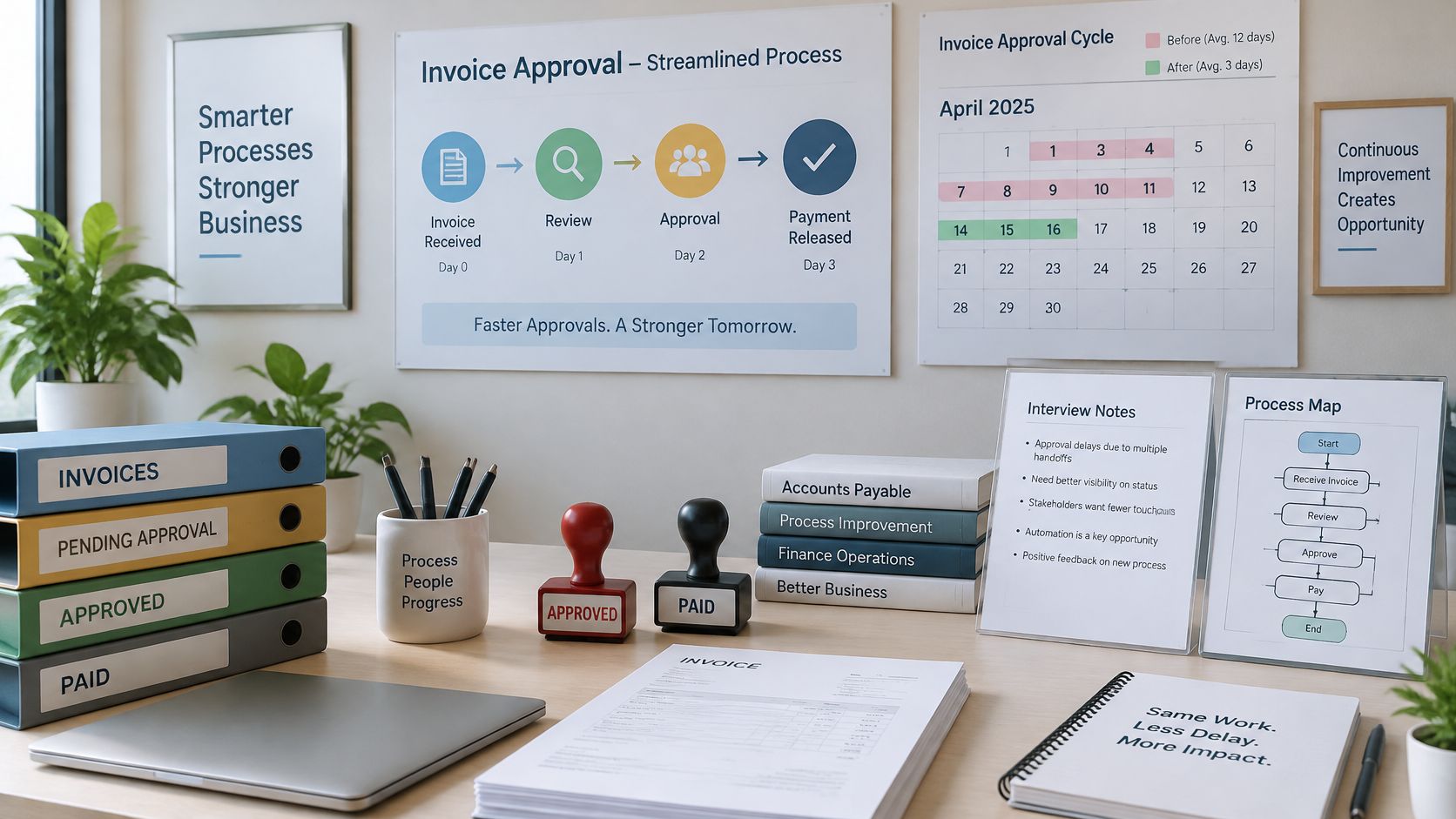
Suppose a finance team discovers that invoice approvals routinely stall for two weeks. Instead of immediately buying another system, it interviews the people involved and maps the route an invoice follows. A cross-functional group might discover that ambiguous ownership, rather than slow software, causes the delay.
The resulting prototype could be a revised approval route, tested with sample invoices before changes reach live payments. This is design thinking applied to an internal service, where the users include colleagues, approvers and suppliers.
Applications beyond product development
Eurostat's Community Innovation Survey found that 51.4% of EU enterprises conducted innovation activities during 2020–2022, and its definition encompasses business processes including logistics, accounting, administration, management and marketing, according to Eurostat's innovation statistics. That scope explains why the subject is relevant beyond specialist design teams.
Different settings call for different evidence:
- Public services: Staff could investigate why people visit a counter before redesigning forms, signage or appointment arrangements.
- Retail operations: A returns team could examine where customers and staff lose track of the next step.
- Software onboarding: New users could attempt a realistic first task while the team observes where instructions become unclear.
- Small-business pricing: A firm could test whether prospective customers understand its offer, exclusions and payment arrangements.
These applications suit managers, project leaders, entrepreneurs and policy analysts because each role involves interpreting needs and coordinating decisions. The deliverable might be a revised process, a service script or a clearer explanation, not necessarily a manufactured object.
Moving from activity to implementation
Innovation activity and the actual introduction of an innovation are different outcomes. A course should therefore require an implementation recommendation that identifies an owner, operational dependencies, costs to investigate and the conditions for continuing or stopping a pilot.
Design thinking doesn't replace technical expertise, budget or professional judgement. A team investigating automated decisions still needs people who can assess technical reliability, information handling and operational risk.
The approach is most useful when identifiable people experience a problem and the organisation has room to change its response. A practical relevance check is to identify two applications within a current role, then name who would use each proposed improvement and who could authorise it.
Checking a Course Before You Enrol
A strong syllabus makes the work visible before enrolment. Inspiring descriptions aren't enough if learners can't establish what they'll practise, submit and receive feedback on.
The comparison should focus on evidence of learning rather than the number of topics listed.
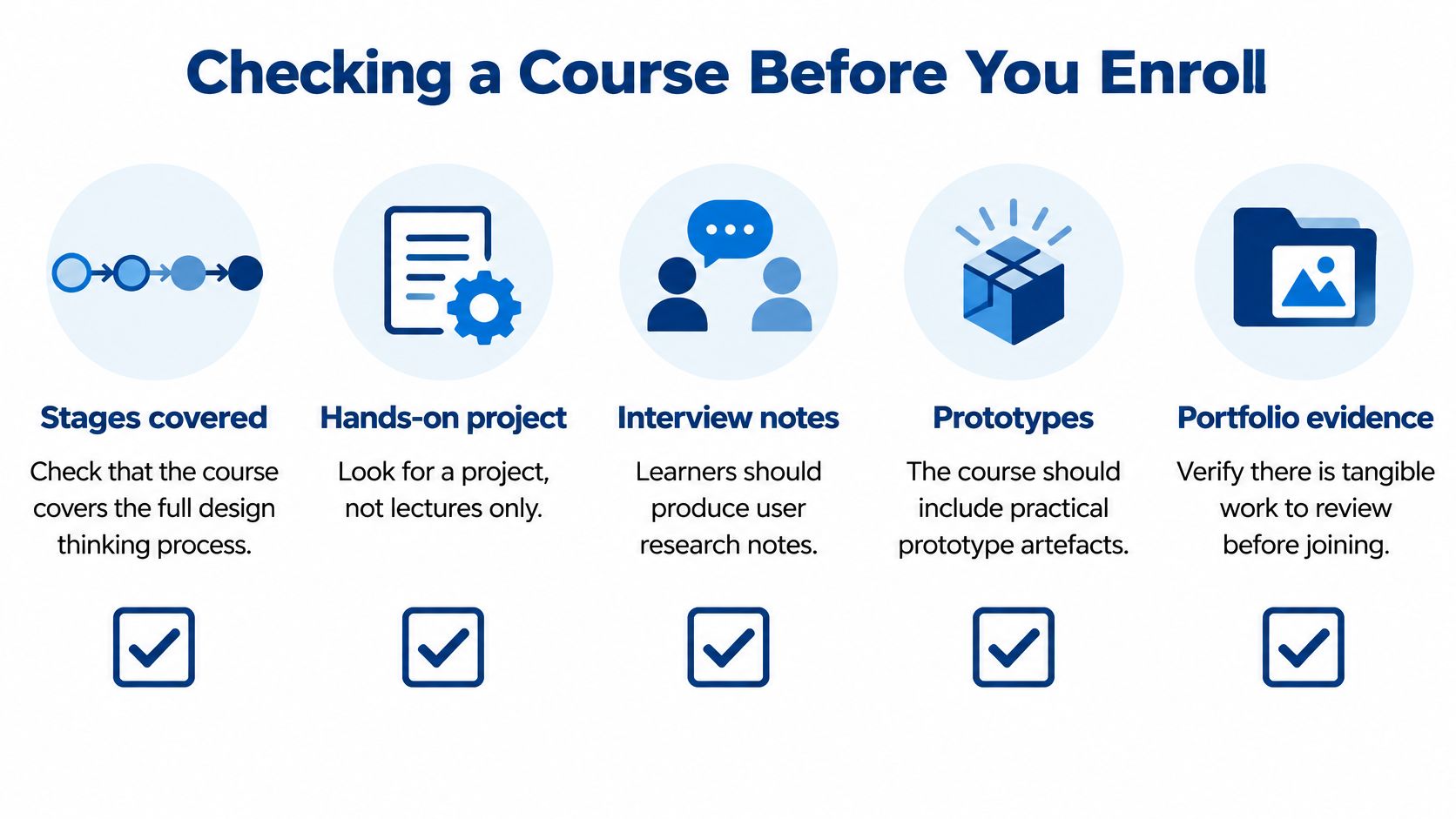
A practical enrolment checklist
- Stages and project work: The syllabus should connect the full process to a hands-on problem, rather than offer lectures without application.
- Named artefacts: Interview notes, a problem statement, prototypes and a findings log make expected submissions concrete.
- Manageable delivery: Self-paced study and mobile-friendly activities can help busy professionals fit learning around responsibilities.
- Accessible materials: Plain-language explanations, clear templates and alternatives to live group exercises support learners without a design background.
- Verifiable credentials: A certificate should provide a practical way to check completion, while remaining distinct from the quality of the learner's portfolio.
Accessibility deserves particular attention. The Education and Training Monitor's Ireland report reports adult-learning participation of 31% among adults with literacy needs, compared with 71% among adults with high literacy skills. Flexible delivery alone doesn't remove the need for understandable instructions and suitable support.
Matching the course to the intended outcome
The European Institute of Leadership and Management's Mini-MBA in Innovation Management covers ideation, design thinking, technology management and commercialisation. Its courses are online and self-paced, and each ends with a digital certificate carrying a unique ID and a QR code.
This pathway suits learners seeking broader innovation management skills. Those facts don't establish a particular project-assessment format, so prospective learners should compare syllabi before paying.
A useful next step is to write three questions about a workplace problem, compare two courses against the checklist and favour the course whose final project would provide credible evidence of practical capability.
The European Institute of Leadership and Management offers self-paced online learning, including a Mini-MBA in Innovation Management that places design thinking alongside ideation, technology management and commercialisation. Prospective learners can visit European Institute of Leadership and Management to examine the curriculum and assess how its coverage fits the workplace problem they want to investigate.