
EU AI Act Explained for Irish Organisations

14.9% of Irish enterprises used artificial intelligence in 2024, up from 8% in 2023, a rise of 6.9 percentage points. The figures appear in a statement by Minister Niamh Smyth. That growth came in the same year the EU AI Act entered into force.
For Irish organisations, the Act concerns tools already woven into routine work: recruiting software, course platforms, website chatbots and warehouse forecasting tools. These systems can affect people's opportunities and services, even where an organisation has no dedicated compliance officer.
The useful management question is practical: which existing tools are covered, which dates apply, and what records show how staff use them. A screen-first approach helps teams connect the rules to the systems they already use.
Table of Contents
- Why the EU AI Act Now Matters in Ireland
- The Four Risk Tiers and Their Duties
- Nine AI Practices Banned from February 2025
- The Phased Dates Irish Teams Must Track
- Provider and Deployer Duties in Practice
- When Hiring and Learning Tools Become High Risk
- Prove AI Literacy Without Training Everyone
Why the EU AI Act Now Matters in Ireland
The EU AI Act is a regulation rather than a directive, which means it applies directly in every member state without waiting for a national statute to be drafted and commenced. It reaches systems built in Dublin, licensed from Boston or trained anywhere at all, as long as the system is placed on the market in the Union or its output is used here.
Four roles carry the duties. A provider develops an AI system, or has one developed, and places it on the market under its own name or trademark. A deployer uses an AI system in the course of professional activity, which covers most organisations reading this. Importers and distributors sit in the supply chain between them and pick up lighter verification duties. Plenty of small organisations hold two roles at once. A training company can be the deployer of a recruitment screening tool and the provider of a chatbot it builds into its own learning platform.
The framework behaves like speed limits rather than a driving ban. Nobody stops the journey. The heavier the vehicle and the greater the chance of harm to people, the tighter the rules become and the more the operator has to demonstrate. A spam filter runs at the bottom of that scale. A system that decides who gets shortlisted for a job sits near the top.
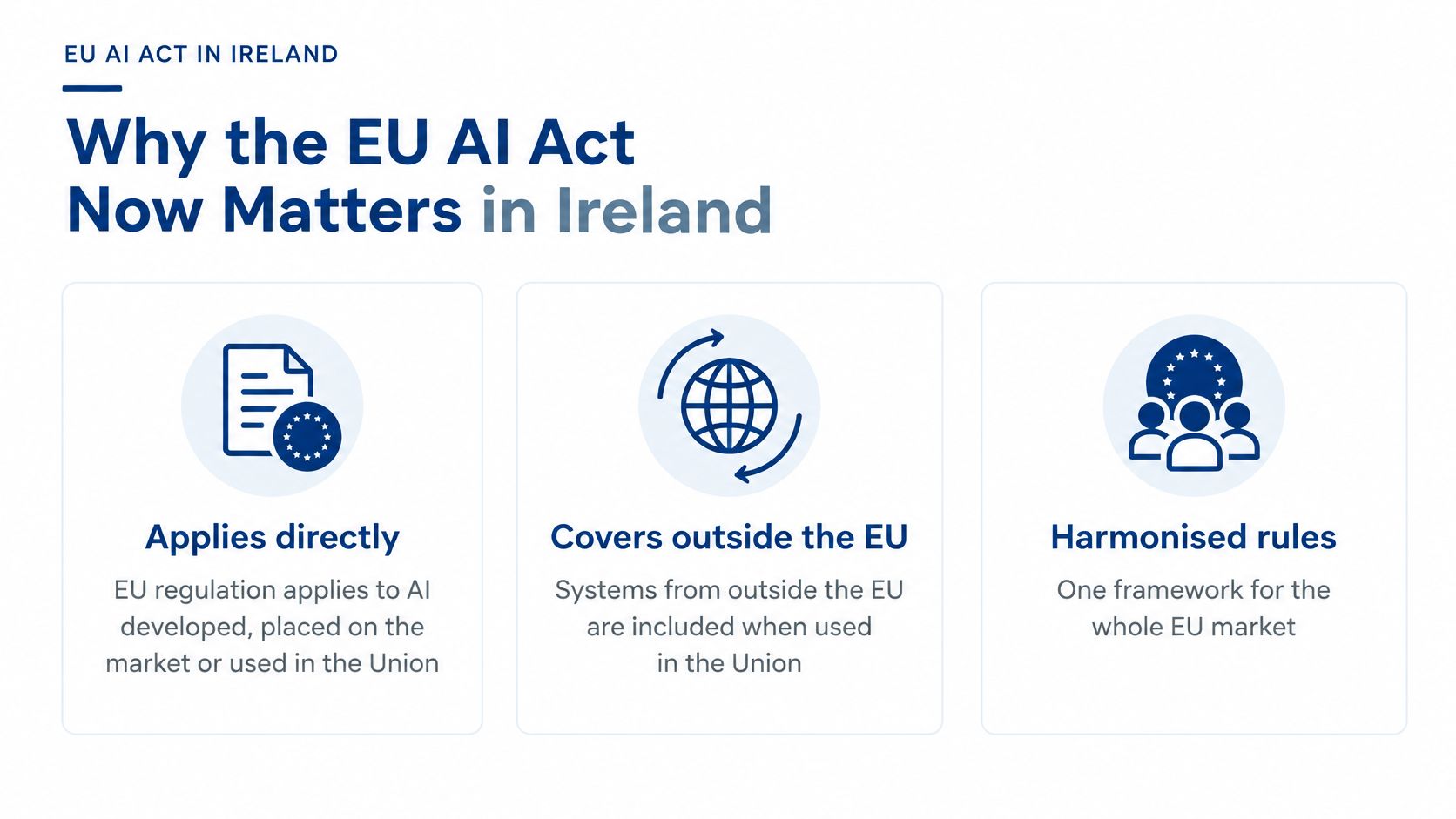
A regulation still needs national machinery underneath it. Someone has to investigate complaints, someone has to enforce, and someone has to set the penalty that makes the rest credible. That's why Irish institutions sit alongside the EU-wide rules rather than being replaced by them, and it's why the practical question of "who inspects this" has an Irish answer, not only a Brussels one.
For a manager, the work arrives in a fixed order, and doing it out of order wastes money:
- Banned practice check. Is the use on the list of prohibited practices at all? If yes, nothing else matters, because there's no compliance route for it.
- Risk tier. Which tier does the system fall into, and does it make or materially support a decision about a person?
- Applicable date. Which milestone governs this tool, and does it apply to the version in use today?
- Staff evidence. Who was trained, on what, when, and where is that recorded?
One more thread runs alongside all of this. AI governance rarely arrives alone, because the same tool inventory that classifies a system also feeds the data protection record a leader already keeps. Teams that treat the two as one exercise save themselves a second round of paperwork, which is the reasoning behind this material on decoding European data privacy laws for leaders.
The Four Risk Tiers and Their Duties
Classification comes before the compliance file. The tier determines which duties apply, so a wrong classification can mean either unnecessary work or missing safeguards.
| Tier | What it covers | Core duty |
|---|---|---|
| Unacceptable | Banned practices such as social scoring and workplace emotion recognition | Do not place on the market or use |
| High | Employment, education, credit, essential services and safety-related product AI | Risk management, data quality, logs, documentation and human oversight |
| Limited | Chatbots, deepfakes and other synthetic content | Transparency so people know they are interacting with AI |
| Minimal | Spam filters, forecasts and most internal productivity tools | No extra Act-specific duty; voluntary good practice only |
Unacceptable uses cannot be made acceptable by adding documentation. The organisation must stop the use or redesign the tool so it no longer performs the prohibited practice.
High risk requires a control file. It should cover a documented risk assessment and mitigation, representative and high-quality data, automatic logging, technical documentation, instructions for the deployer and effective human oversight. Each item should be dated and available to show how the system is managed.
One Irish picture per tier
- A recruiter ranking CVs. High risk, because the ranking shapes who reaches interview. The file needs a named human reviewer, a stated appeal route and logs showing what the tool recommended and what the reviewer did with it.
- A course platform scoring learners. High risk for the same reason: the score may shape access to a programme or affect a result. If it gates progression, decisions need oversight and traceability.
- A customer service chatbot. Limited risk, with transparency as the key duty. Tell the person they are talking to AI, and ensure the bot does not imply it is a named human colleague.
- A warehouse demand forecast. Minimal risk. It predicts pallets, not people, so it has no extra Act-specific duty beyond existing law. A formal conformity file for this use would add paperwork without addressing a relevant Act duty.
- A mood-scoring camera in a staff canteen. Unacceptable. Emotion recognition in the workplace is prohibited, and policy documents do not make the use permissible.
The effort should match the possible harm. A bicycle does not need a lorry's safety equipment, while a lorry needs effective brakes. In the same way, the Act scales obligations according to the risks a system can create, not how modern or expensive it looks.
When one product holds several systems
A single platform can contain a high-risk scoring module, a limited-risk chatbot and a minimal-risk reporting dashboard. Classify each function according to what it does. A vendor's description of the whole product may not identify the module that shapes an outcome.
Practical rule: classify by the decision the tool influences, not by the department that bought it or the vendor's marketing category.
Before buying a tool or switching on a feature already licensed, record its tier, the date of the assessment and the person responsible. Keep that entry current as the system's use changes. For a structured approach to assessment, mitigation and documentation, see this professional risk management training.
Nine AI Practices Banned from February 2025
The first live screen is a ban list, not a risk assessment, and it's already in force. The EU AI Act's prohibitions on nine categories of AI practice began applying on 2 February 2025, which makes this the one part of the framework where a wrong answer can't be fixed later with better paperwork, as the European Commission's regulatory framework for AI sets out.
| Practice | What is targeted | Screen question |
|---|---|---|
| Harmful manipulation | Deceptive techniques that distort behaviour and cause harm | Does the system push someone into a harmful decision they would not otherwise take? |
| Exploitation of vulnerabilities | Age, disability or socio-economic weakness | Does it target a vulnerable group to distort their behaviour? |
| Social scoring | Judging people from unrelated social behaviour | Does a score from one context affect rights in another? |
| Crime-risk prediction | Profiling a person as a future offender | Does it predict an individual offence risk without a human criminal assessment? |
| Untargeted facial scraping | Internet or CCTV images gathered to build face databases | Are faces collected at scale without a specific lawful purpose? |
| Workplace or education emotion recognition | Inferring emotions of workers or learners | Is emotion inferred in a workplace or educational setting? |
| Biometric categorisation | Inferring protected characteristics from biometrics | Does it deduce traits such as race, politics or sexual orientation? |
| Real-time remote biometric identification | Law-enforcement use in public spaces | Is live remote identification running in a publicly accessible space? |
| Non-consensual sexual or abuse imagery | Generating sexual deepfakes or child-sexual-abuse material | Could the system produce that material? |
Read the list closely and the specificity stands out. This isn't a vague prohibition on harmful AI. It names particular mechanisms, particular contexts and particular kinds of output, which means the analysis turns on how a system works rather than on how it's described in a sales deck.
Two false alarms worth clearing early
A sentiment dashboard built on customer reviews. This reads text for tone. It isn't inferring the emotional state of a worker or a learner in an employment or education setting, so the workplace emotion recognition prohibition doesn't catch it. Data protection, consumer law and honesty about what the dashboard can and can't detect still apply, but the ban list isn't the issue.
A consented identity check at a training centre. Verifying that the person sitting an exam matches the person enrolled is a specific, disclosed, purpose-limited check. Building a facial-recognition database by hoovering up images from the open web is a different activity entirely, and that's the one the list targets.
If a live or planned system matches a row above, don't open a high-risk file on it. Switch it off, withdraw the pilot or redesign it until the prohibited element is gone.
The temptation, especially in a busy organisation, is to treat the ban list as a warm-up exercise before the "real" compliance work starts. The sequence is the other way around. Clear the ban list first, because everything downstream assumes the use itself is lawful.
The Phased Dates Irish Teams Must Track
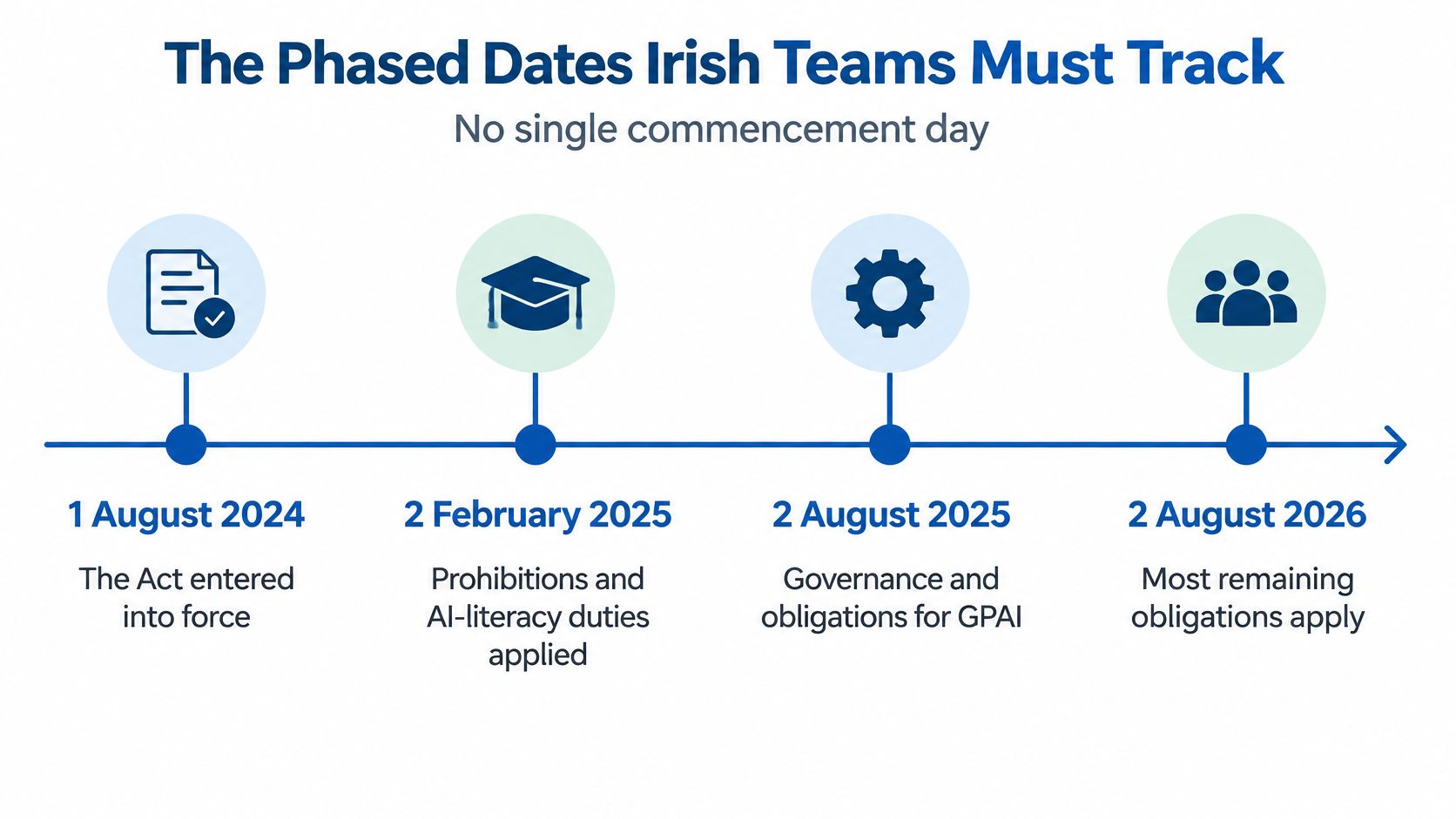
The EU AI Act has several start dates, not one. For Irish teams, the practical sequence is to check whether a use is prohibited, identify its risk tier, match it to the applicable date, then keep evidence of staff preparation and decisions.
| Milestone | Date | What starts |
|---|---|---|
| Entry into force | 1 August 2024 | The regulation enters into force |
| Prohibitions and AI literacy | 2 February 2025 | Prohibited practices and the AI literacy duty apply |
| Governance and general-purpose AI | 2 August 2025 | Governance rules and duties for general-purpose AI model providers apply; Ireland's deadline to designate authorities and set penalty rules |
| Transparency, enforcement and sandboxes | 2 August 2026 | Transparency rules and most enforcement provisions apply; member states must have an AI regulatory sandbox operational |
| Annex III high-risk systems | Scheduled to apply from 2 December 2027 | Obligations for listed high-risk uses, including employment and education |
| High-risk AI in regulated products | Scheduled to apply from 2 August 2028 | Obligations for high-risk AI embedded in products already regulated for safety |
The Department of Enterprise, Trade and Employment's EU AI Act publication describes the phased timetable, including the 2 August 2025 application date for governance provisions and duties for general-purpose AI model providers. It also sets out Ireland's deadline to designate competent authorities and legislate for penalties.
Ireland's first national step came early. On 31 October 2024, the Department of Enterprise, Trade and Employment published a list of nine Irish public authorities responsible for protecting fundamental rights in relation to high-risk AI systems, ahead of the 2 November 2024 deadline, as recorded on the department's EU AI Act page. The authorities' existing mandates covered affected areas; they were not created as standalone AI regulators. Further oversight powers were scheduled to apply from 2 August 2026.
Why 2026 is a preparation year even when a tool belongs to 2027
A team may see that its employment system falls under Annex III and assume there is nothing to do until December 2027. That leaves too little room to identify owners, gather information about the tool and prepare staff. The Irish Department of Enterprise, Trade and Employment's EU AI Act publication sets out the 2 August 2026 milestones, while Annex III obligations are scheduled to apply from 2 December 2027.
Start with a screen-first inventory: record the use, check the prohibited-practice rules, assign a risk tier, and attach the relevant date. Then work backwards from that date, keeping evidence of the classification, planned actions and staff preparation. A transparency task due in 2026 should not be left behind a longer product-related file scheduled for 2028.
Before quoting penalty levels in an internal paper, check the Irish rules that apply to the organisation and record when enforcement powers reach its area. A figure copied from a summary for another jurisdiction may give the team the wrong deadline or expectation.
Provider and Deployer Duties in Practice
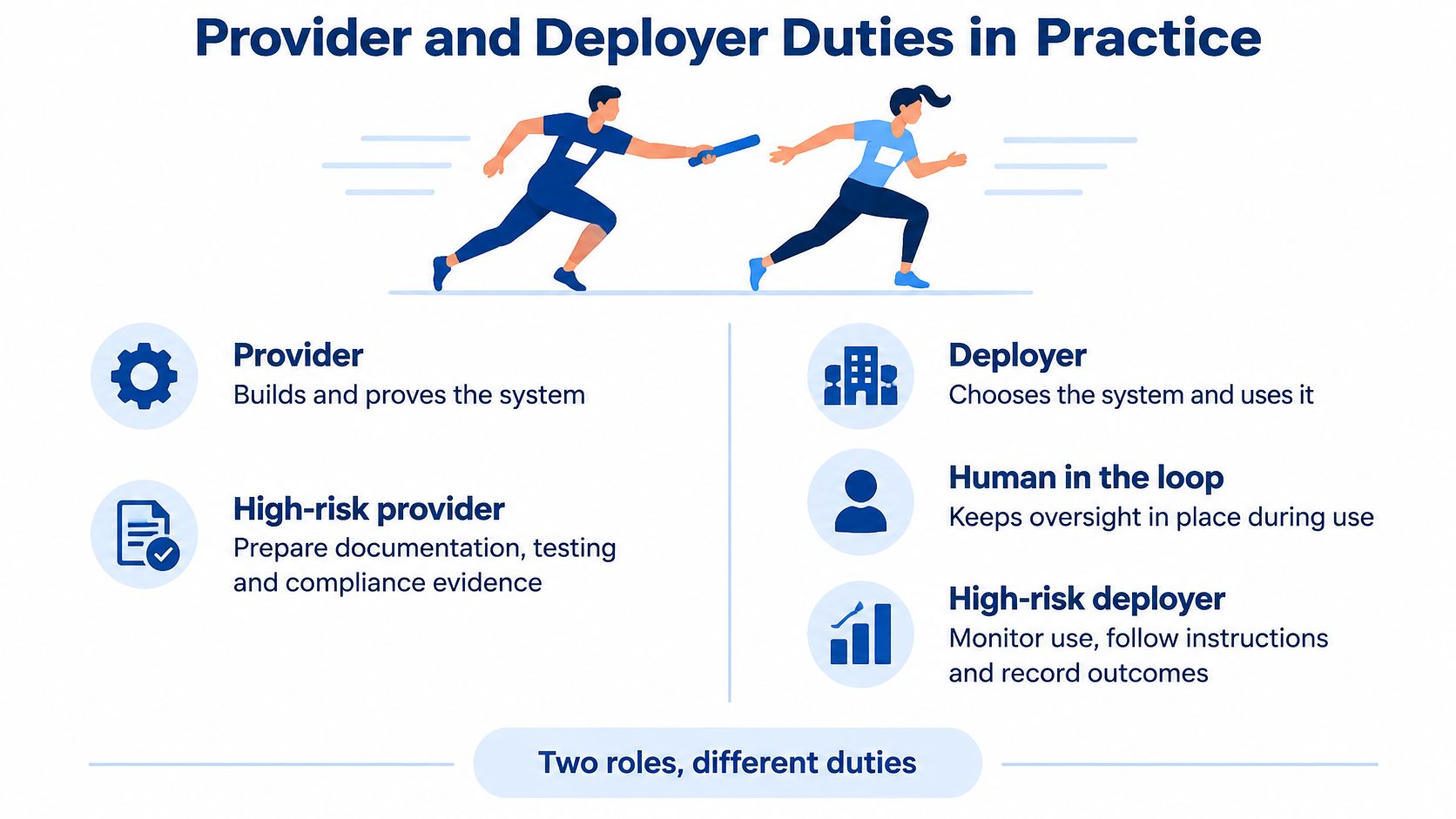
A provider builds an AI system and supplies evidence about how it is meant to work. A deployer selects it and uses it in an organisation. The handover matters: for example, a vendor may provide a log export that cannot be read or retained in a format the organisation can use for an audit. Agree what evidence will be supplied, in what format and when.
For high-risk systems, the provider prepares the required conformity documentation and supplies instructions for use. The risk tiers section explains the broader controls that apply. If the provider is outside the EU, an importer or authorised representative may also have responsibilities.
The deployer's day-to-day job is to follow the provider's instructions, keep required records, monitor the system for problems and report serious incidents or malfunctions to the provider and, where required, the authority.
Providers of general-purpose AI models have documentation and transparency duties of their own. Buyers should request the relevant information from the provider rather than try to recreate its model documentation internally.
The procurement questionnaire that does the work
Use these questions to request evidence in writing. File each response against the tool and record when it arrived. An unanswered question gives your team a specific gap to resolve before go-live.
| Vendor question | Evidence to request |
|---|---|
| What is the intended purpose? | Written purpose statement and scope limits |
| Which risk tier applies? | Classification rationale against the risk tier table |
| How was training data governed? | Data sources, representativeness and quality checks |
| What are the known limits? | Accuracy and failure-mode documentation |
| Can we access logs? | Log export format, retention period and a sample export |
| How is human oversight designed? | Oversight interface and override procedure |
| Who receives incident reports? | Named incident contact and response time |
Check the log export before signing. A dashboard may display activity without allowing staff to download a usable audit record. Ask for a sample export and confirm that your team can read and retain it.
For minimal-risk tools, use the same questions in a lighter way. A purpose statement and a description of known limits may be enough for an internal record. Keeping those answers makes it easier to spot when a tool is later used for a different purpose.
When Hiring and Learning Tools Become High Risk
Two Irish scenarios carry most of the risk in this area, and they're structurally identical even though they sit in different departments.
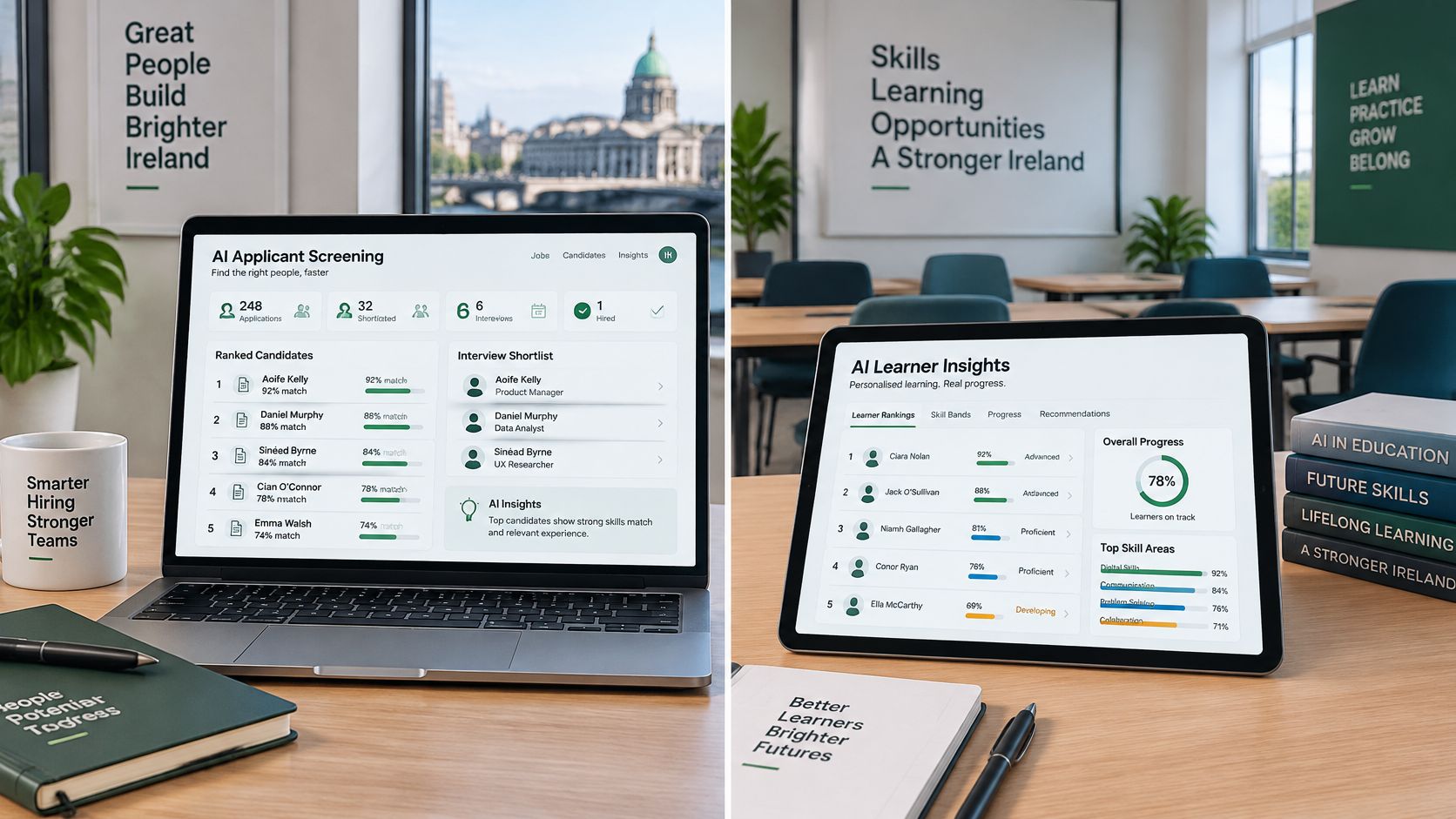
An employer uses AI to screen applicants, rank CVs or recommend who gets interviewed. A training provider uses AI to rank learners, score performance or decide who gets access to a programme. In both cases the tool shapes access to opportunity, so bias and opacity in the model become bias and opacity in someone's life.
The Irish Government identifies employment and education among the Act's specified high-risk use areas, with preparation pointed at August 2026, while Annex III application is scheduled for the later December 2027 milestone, as set out in the Government's roadmap for implementing the EU AI Act. The Act's answer to the risk is to move controls upstream, requiring governance and traceability before deployment instead of relying on remediation after a complaint.
The judgement call that sets the workload
The question that decides how much work a tool creates is whether it makes or materially supports a regulated decision. A system that automatically rejects candidates at stage one makes the decision. A system that surfaces a shortlist a recruiter then works through supports it, and it still needs oversight because the recruiter's attention is being steered.
Where the answer is yes, four things need to exist before go-live. An inventory entry naming the owner. A named human reviewer with the authority and time to disagree with the tool. An appeal route a candidate or learner can find and use. Retained operational logs showing the recommendation and the human response, side by side. Add the vendor evidence from the procurement table, particularly on data governance, accuracy, cybersecurity and conformity assessment.
The contrast case keeps the classification honest. A tutor chatbot that explains a concept, answers a follow-up and suggests a reading has no power to grant or refuse a place. It needs a transparency notice so the learner knows they're dealing with AI, and it should be explicitly barred from drifting into grading. A brief to the team, written down, is usually enough to hold that line. Once a "helpful assistant" starts suggesting marks, it's a scoring system with no controls around it.
Where confusion usually starts: managers assume the risk tier belongs to the vendor's product category. It belongs to the use. The same platform can be minimal risk in one workflow and high risk in another.
Fair hiring practice and AI governance overlap heavily here, because the same reviewer, appeal route and record-keeping discipline serve both. Teams that need the employment side in more depth will find it in this material on employee selection, interviewing and fair hiring, which covers the decision structure the oversight duty depends on.
Prove AI Literacy Without Training Everyone
A warehouse operative using an AI-enabled scanner needs different guidance from a manager choosing a CV-ranking tool. The EU AI Act requires providers and deployers to ensure staff have a sufficient level of AI literacy. What that means depends on people's knowledge, experience, training and the context in which they use AI, as the Government's guidance for organisations on the EU AI Act explains.
Start with the tools, then match learning to each role. List the AI systems in use and identify who develops, buys, deploys or oversees each one. For each group, set out what staff need to know: how to recognise an unsafe use, question a vendor's claim, handle personal data properly, identify when an automated decision needs human attention, and raise concerns before deployment.
Make the escalation route specific enough to use under pressure. For example, if a recruiter discovers that a CV-ranking tool is being used before approval, they should know which named person to contact and how to reach them. “Raise concerns with the AI governance lead” leaves room for delay. “Email the data protection officer and copy your head of function” gives staff a clear next step.
Irish survey findings suggest that organisations are working on AI training while awareness and confidence remain concerns. Without a source attached to the figures, the practical takeaway is to assess what each role needs rather than assume a general briefing is enough.
What counts as evidence
Keep records that show who received training, when it took place and what it covered. Retain the internal policy listing approved tools and procurement responsibilities, along with competency checks such as a short scenario quiz for managers approving a new AI tool. Record when each control was introduced.
These artefacts help answer three basic questions: who was trained, what risks the training covered, and when it happened. Slides shown once at an all-hands meeting cannot answer them on their own.
Set a training schedule that reflects the work. Review learning more often for roles with greater AI-related responsibilities, and update it when a new tool is approved or its risk classification changes. Managers building a workforce programme can explore learning, training and employee development through self-paced study in learning design, capability building and development planning.
The European Institute of Leadership and Management offers self-paced online certificate courses and Mini-MBA programmes in areas including risk management, leadership, organisational change and technology management. These subjects connect with the management work involved in classifying tools, setting controls and keeping training records. Explore the European Institute of Leadership and Management course list to find a programme relevant to your responsibilities.