
Budgets for Businesses: Types, Cycle and Controls

Can a business show a healthy profit on paper and still struggle to pay wages at the end of the month? It can, and it happens more often than many owners expect. Profit records when a sale is made. Cash depends on when a customer pays, when suppliers must be paid, and when payroll, tax and loan repayments leave the bank account. Well built budgets for businesses therefore do two jobs at once. They plan profit, and they map the timing of cash.
Table of Contents
- What a Business Budget Is and Why It Matters
- Budget Types and What Each One Covers
- How the Budget Cycle Works, Step by Step
- Budgeting Methods Compared
- Tracking Variance Before It Becomes a Problem
- Forecasting Cash When Customers Pay Late
- A Worked Example for a Small Design Studio
- Build Your First Budget This Quarter
What a Business Budget Is and Why It Matters
A business budget sets out expected income and planned spending for a defined period, usually one year broken into months. It is a reasoned estimate of what should happen if the plan is followed, rather than a record of what has already happened. That forward view is what separates a budget from the accounts: the accounts describe the past, while the budget describes the intended path.
A budget works like a route drawn on a map before a journey. The route is chosen in advance, the driver's actual position gets checked against it along the way, and a wrong turn prompts a correction rather than an abandoned trip. Many owners treat a budget as a strict spending cap and feel they have failed the moment a line moves. A budget is better understood as a forecast to steer by, one that gets checked and corrected as conditions change.

The Three Jobs a Budget Does
- Planning: Decisions about where money should go happen before it is spent, not after invoices arrive.
- Control: Comparing actual results with the plan flags problems early, while they are still small enough to fix.
- Communication: Managers and staff can see what they are responsible for, which limits confusion about who approved what.
Say a café expects €60,000 in sales over a year and plans €18,000 for staff costs. The owner now has a clear reference point. If wage spend rises well above that line without extra sales, profit gets squeezed, and the budget shows that squeeze in advance rather than at year end. Owners new to this discipline often benefit from grounding in financial management for non financial managers, since budgeting sits inside that wider skill set.
Scale explains why one average rarely fits every firm. The Central Statistics Office business costs release reported total costs of €761.2 billion in 2021 across manufacturing, construction, distribution and services, with services at 40.9% or €311.2 billion. A service firm and a manufacturer do not spend in the same pattern, so each budget has to reflect the cost structure of the business it serves.
A budget doesn't guarantee the destination. It makes drift visible early enough to correct it.
Any workable budget starts with three numbers: expected income, expected costs, and the cash held at the start of the period. The first two set the profit plan. The third turns that plan into a timing tool, because without the opening cash figure even an accurate profit plan can mislead about whether the bank balance will hold up month to month.
Budget Types and What Each One Covers
Different decisions need different budgets. The table below sets out the six types a business is most likely to use, what each covers, and the job each one does best.
| Budget type | What it covers | Typical time horizon | Main use |
|---|---|---|---|
| Operating budget | Day to day running costs such as payroll, rent, utilities, insurance and supplies | Monthly and annual | Monthly control of profit and costs |
| Capital budget | Long lived assets such as equipment, vehicles, premises and major software | Multi-year | Approving and timing large purchases |
| Cash-flow budget | Timing of money coming in and going out, including customer receipts and supplier payments | Weekly to monthly, often 13 weeks | Avoiding shortfalls and planning borrowing |
| Sales or revenue budget | Expected income by product, customer, channel or region | Monthly, quarterly and annual | Setting targets and sizing sales teams |
| Project budget | Costs for one defined project from start to close | Life of the project | Tracking spend against a fixed scope |
| Master budget | Combined operating, capital, cash and revenue plans in one set of statements | Annual, with monthly phasing | Board or owner approval of the full plan |
Choosing the Right Starting Point
Most small firms don't need all six on day one. An operating budget and a cash-flow budget usually come first, because together they answer the two everyday questions: is the business profitable, and can it pay its bills on time? Payroll, rent, utilities and supplies sit in the operating budget, while the dates money arrives and leaves sit in the cash-flow budget.
A capital budget becomes necessary when the firm buys something that lasts several years, such as equipment, a vehicle, premises or major software. Those purchases are too large and too infrequent to bury inside monthly running costs. A project budget suits work with a clear start and end date, such as refitting a premises or launching a new service, because spend can be tracked against a fixed scope.
The master budget pulls everything together into one planned profit and loss account, balance sheet and cash forecast for owners to approve. It's the single agreed version of the plan, not another separate guess.
The Double Counting Trap
One common slip deserves attention. Say a firm buys a machine outright. The purchase price belongs in the capital budget. Its depreciation, the way that cost is spread across the years it's used, belongs in the operating budget. Putting the full price in both places counts the same cost twice and makes profit look worse than it is.
Practical rule: Match the budget to the decision it supports, and check that each cost appears once in the master view.
How the Budget Cycle Works, Step by Step
A budget isn't written once and filed away. It runs in a cycle of planning, approval, monitoring and revision. The eight steps below show that cycle in order, with the usual slip named at each stage.
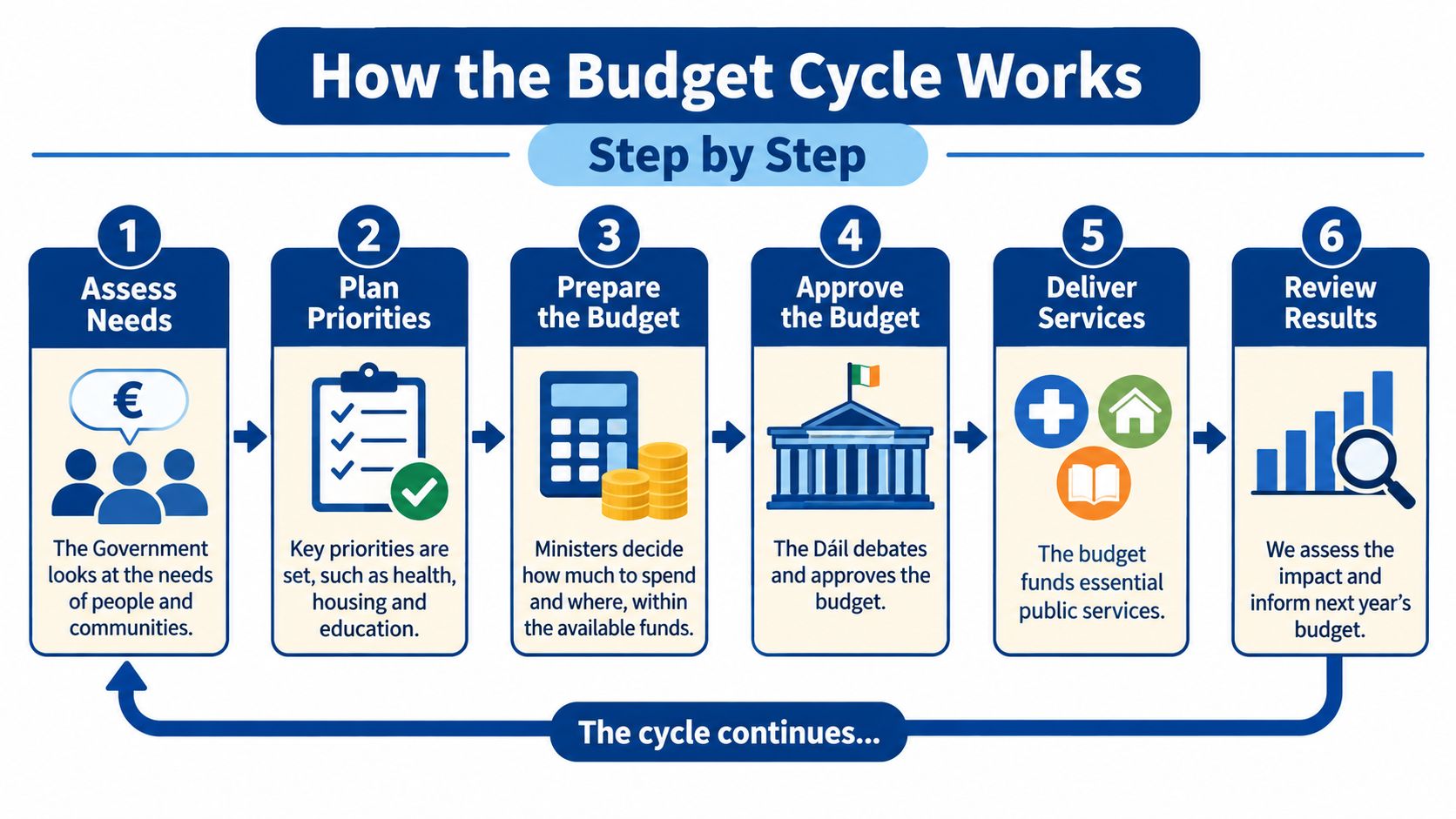
Steps One to Four
- Set goals first. Owners decide what the year should achieve and work out the revenue those goals require, because targets drive every cost decision that follows. The slip here is starting with costs and hoping revenue will somehow cover them.
- Pull last year's actual results. Figures by category and by month are the most reliable starting data available. Skipping this step means guessing at numbers the accounting records already hold.
- Forecast revenue by product or customer. Realistic conversion and renewal rates produce a defensible total. The slip is working backwards from a hoped for figure and treating optimism as a forecast.
- Estimate costs in three groups. Fixed costs such as rent and salaried payroll stay broadly steady, variable costs such as materials and commission move with activity, and one-off costs such as a new system occur once. Mixing these groups together hides which costs will rise when sales rise.
Labour deserves particular care at step four, since salary alone understates the true cost of an employee. The Central Statistics Office earnings and labour costs release reported that average hourly total labour costs increased 4.1% to €37.73 in Q2 2026, while average hourly other labour costs rose 5.7% to €5.77. Employer on-costs on top of pay are real money, and a budget built on salary only will miss them.
Steps Five to Eight
- Build a monthly draft and test it. Owners check whether the totals deliver the profit target. If they don't, costs get cut or re-phased before anyone signs off, not after money has been committed.
- Convert the plan into cash timing. Each line gets recorded when money arrives or leaves, since a profitable month can still be short of cash. The classic slip is assuming customers pay on the invoice date.
- Agree sign-off. The owner and each budget holder confirm who controls each line. Treating an unapproved draft as a spending commitment is the error to avoid here.
- Load, review and reforecast. The approved budget goes into the accounting system, gets reviewed monthly, and gets reforecast each quarter as real figures replace early estimates.
A finished budget looks modest on paper. There's a one page summary per department, showing the lines that manager controls, and one signed master budget for the whole business. Anything more elaborate usually means detail nobody will maintain.
Budgeting Methods Compared
The cycle explains when budgeting happens. The method explains how the numbers get built. Five approaches cover most situations a small or growing firm will meet.
| Method | How it starts | Main strength | Main weakness | Best fit |
|---|---|---|---|---|
| Incremental | Last year's actual costs plus or minus a set percentage | Quick to prepare | Carries forward old waste | Stable firms with predictable costs |
| Zero-based | Every cost justified from nil each cycle | Exposes unnecessary spend | Time-consuming | Firms with rising overheads |
| Activity-based | Costs assigned to the activities that drive them | Accurate product and service costing | Requires detailed cost data | Firms pricing many products or services |
| Rolling forecast | Twelve months ahead, updated each month or quarter | Responsive to change | Ongoing administrative effort | Volatile markets and growing firms |
| Flexible | Variable costs restated at actual activity levels | Like-for-like performance comparison | Needs clear cost behaviour data | Firms with large variable costs |
Reading the Trade Offs
Incremental budgeting is fast because it adjusts last year by a set percentage. That speed is also its flaw. If last year included a subscription nobody uses or an oversized contract, the new budget politely carries that waste forward and even increases it.
Zero-based budgeting takes the opposite approach. Every cost must be justified from nil, as if the activity were starting fresh. It suits firms whose overheads have crept up over several years, but it demands considerable time, so applying it to every line every year rarely survives contact with a busy owner's diary.
Activity-based budgeting ties costs to the activities that drive them, such as the number of orders processed or support calls handled. That produces more accurate product and service costing, which helps with pricing decisions. The catch is data. Without reliable records of those activity levels, the method produces precise looking numbers built on guesses. Owners weighing these options often find structured coverage of forecasting methods and techniques helpful before committing to one.
Rolling forecasts always look twelve months ahead and update monthly or quarterly, so the horizon never shrinks to nothing at year end. They suit volatile markets but add steady administrative work. Flexible budgets restate variable costs at actual activity levels, so managers compare like with like instead of blaming a cost line for a change in sales volume.
Many small firms start with incremental budgeting, apply a zero-based review to the largest costs only, and move to a rolling forecast once monthly reporting is reliable.
Tracking Variance Before It Becomes a Problem
A budget earns its keep after the period starts, when actual results arrive. The comparison between the two is called variance, calculated as actual minus budget. The arithmetic is simple. Reading the sign correctly is where readers often get confused.
Favourable and Unfavourable
For income lines, actual above budget is favourable, because the business earned more than planned. For cost lines, actual above budget is unfavourable, because the business spent more than planned. The same positive number therefore means opposite things depending on the type of line. That single point causes more misreading of budget reports than any other.
| Line | Budget | Actual | Variance | Reading |
|---|---|---|---|---|
| Revenue | €120,000 | €112,500 | −€7,500 | Unfavourable, investigate |
| Payroll | €50,000 | €50,000 | €0 | On plan |
| Marketing | €8,000 | €10,000 | +€2,000 | Unfavourable, investigate |
| Software subscriptions | €5,000 | €4,500 | −€500 | Favourable, check for missed renewals |
The figures above are illustrative, but the pattern is realistic. Revenue is €7,500 below plan, which needs an explanation before anything else. Marketing is 25 per cent over budget, a €2,000 overspend on an €8,000 line. Payroll sits exactly on plan, so it needs no attention this month.
The software row carries the subtler lesson. Spend is 10 per cent under budget, which looks like good control. It might instead mean a renewal was missed, a licence lapsed, or an invoice hasn't been recorded yet. An underspend can be a warning sign rather than a success, and treating every favourable variance as good news is a beginner's mistake.
Timing Variances and Permanent Variances
Not every variance needs the same response. A timing variance reverses on its own. An invoice expected in March that lands in April makes March look good and April look bad, yet nothing real has changed. A permanent variance reflects a genuine shift, such as a supplier's new contract price, and it won't reverse. Permanent variances need a reforecast so later months stop being compared against a plan that's no longer true.
A simple threshold keeps the review manageable for a small business. Investigate any line that differs by more than 5 per cent or €1,000, whichever is lower. Lines inside that band rarely repay the time spent chasing them.
Three actions close the loop each month:
- Explain the variance in writing: One or two sentences per flagged line, recorded while the reason is still fresh.
- Decide on a response: Correct the spending, or consciously accept it and note why.
- Update the forecast: Later reports then compare actuals against a plan that reflects what is now known.
A point worth repeating: Variance analysis isn't about blaming whoever overspent. It's about finding out whether the plan or the spending needs to change.
Forecasting Cash When Customers Pay Late
Profit planning alone leaves one dangerous gap, the timing of receipts. A rolling 13-week cash-flow forecast closes that gap. It starts with the opening bank balance and the minimum cash reserve the business must keep, then tracks one column per week. Readers who want the underlying accounting logic will find it in the statement of cash flows.
- Record receipts on likely payment dates. Each customer invoice goes in the week that client usually pays, based on actual payment history rather than contract terms. The Dublin Chamber late payments release reported that 65% of SMEs surveyed in 2025 said customers were taking longer to pay than the previous year, and 62% of affected firms reported insufficient liquidity for day-to-day operations.
- Add fixed outflows on their due dates. Payroll, rent, tax, insurance and supplier invoices go in the weeks they must leave the account, not the weeks they were incurred.
- Add loan repayments at current rates. Debt costs can move faster than sales. The Central Bank of Ireland SME credit trends report reported that the weighted average interest rate on new lending to Irish non-financial corporations increased from 2.67% in July 2022 to a peak of 6.51% in March 2024.
- Run one stress scenario. The two largest clients pay 30 days late, and the forecast shows whether the business still clears its commitments.
- Compare each closing balance with the reserve. Any week that dips below the minimum gets flagged at least three weeks ahead, while options still exist.
- Decide the response in advance. Arranging a facility, re-phasing discretionary spend or tightening payment terms all work better before a gap appears. The Strategic Banking Corporation of Ireland SME outlook report reported in 2025 that 71% of SMEs viewed access to finance as a significant risk, so funding arranged early usually costs less than funding chased late.
A Worked Example for a Small Design Studio
Consider a fictional five person design studio with an annual revenue target of €400,000. The owner builds the year's budget carefully, line by line, and on paper the result looks comfortable.
The Plan on Paper
- Payroll: €210,000 for the five person team
- Rent: €24,000 for the studio space
- Software: €12,000 for design and project tools
- Marketing: €15,000 across campaigns and events
- Other overheads: €30,000 for insurance, utilities and sundries
Total planned costs come to €291,000, leaving a planned profit of €109,000, roughly 27 per cent of revenue. By any normal reading, that's a healthy year. The owner approves the budget, sets monthly targets, and January trades close to plan.
Where the Plan Meets Reality
February tells a different story. Two large clients, who normally pay on 30 days, stretch their payments to 60 days without much warning. The work has been delivered and invoiced, so February's revenue figure looks fine. The money, however, hasn't arrived.
Meanwhile the outflows keep their usual dates. The payroll run falls on the 28th, rent leaves on its standing date, and software subscriptions renew automatically. By the last week of February the bank balance drops below the studio's minimum cash reserve of €15,000. Nothing has gone wrong with profitability. The studio is earning well. It doesn't have the cash in hand on the days it's needed.
The profit budget couldn't show this problem, because it recorded invoices when they were issued, not when they were paid. That isn't a fault in the budget itself. It's a sign that one tool was being asked to do two different jobs.
The Response and the Lesson
The owner builds a 13-week cash-flow forecast, placing each client's receipts in the week that client realistically pays. The forecast shows the tight spot three weeks before it arrives, which changes everything. Time replaces panic as the main ingredient in the decisions that follow.
Three responses follow from that early warning. First, an overdraft facility gets arranged before it's needed, when the studio can present orderly figures rather than an urgent request. Second, part of the marketing spend moves to a month after the cash peak, since that spending is discretionary and its timing is flexible. Third, the two slow paying clients get asked for shorter terms on future work, with the conversation held while relationships are still good.
None of these steps required new sales or drastic cuts. They required seeing the gap early. The same set of budgets for businesses serves profit planning and cash control, and both views need checking every month.
Build Your First Budget This Quarter
Start with the tool that warns earliest. The 13-week cash forecast described under forecasting cash when customers pay late comes first, because it exposes the most urgent timing gap well before a full annual budget is finished. Reliable habits for tracking expenses and income make that forecast, and everything built on top of it, far easier to keep current.
With the pressure points visible, set the annual budget to run for twelve months from the start of next quarter. A firm short on time can take the incremental method as its base, then apply a zero-based review to the largest cost lines only. That keeps the workload light while still questioning the spending that matters most. Book a monthly variance review in the diary now, before the quarter begins, so the plan is checked against actuals from day one.
The routine works best as a monthly rhythm: update the forecast, check the variance, adjust one assumption. Owners who want a structured framework behind those habits can consider the Mini-MBA in Financial Management from the European Institute of Leadership and Management, which covers financial concepts, accounting principles, investment fundamentals, economics and international business. Formal study complements, rather than replaces, advice from an accountant or financial adviser.
The next step fits inside a single diary entry. Pick the first week of next quarter, open a blank sheet, and write down the opening balance. Owners who prefer guided study alongside that first budget can browse the self-paced online programmes and decide where to begin.